
American Mah Jongg FAQ: Rules, Tiles & Setup Answered
Last updated: Nov 23, 2026
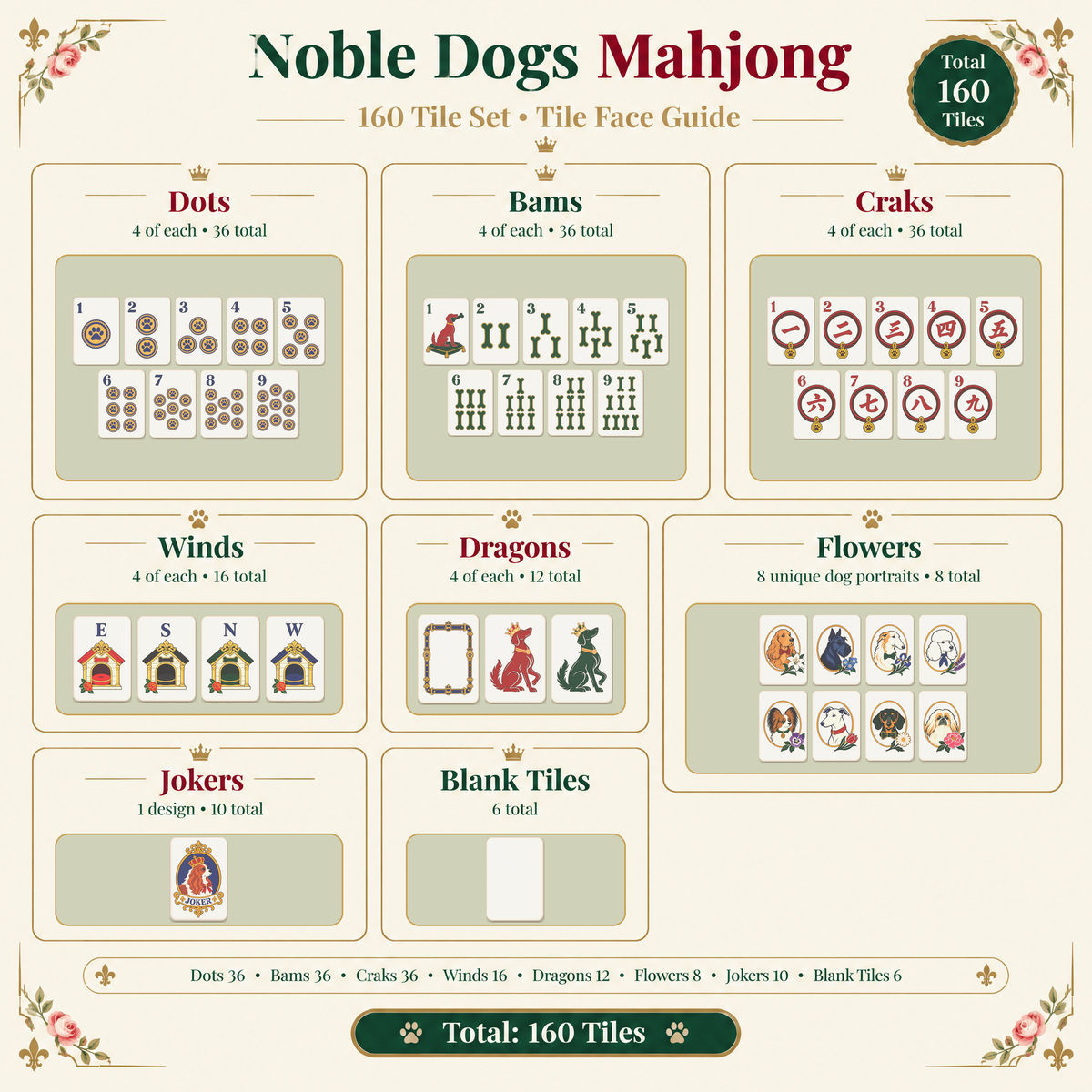
American mahjong is a four-player tile game using 152 tiles plus 8 jokers, played with hands drawn from the current year's National Mah Jongg League card. Games take 45–90 minutes. A standard set includes three suits (Bams, Craks, Dots numbered 1–9), winds, dragons, flowers, and jokers; no chows or sequences are allowed. Before play begins, players exchange tiles in a ritual called the Charleston. Hands are made only from the official card—melding exposed pungs, kongs, and quints while keeping a hidden pair. Scoring depends on your hand's position on the card. Mahstead offers best-selling mahjong sets with engraved tiles, mats, and racks, all designed by players for weekly game hosting.
How many tiles are in an American mahjong set?
A standard American mahjong set contains exactly 152 playing tiles plus 8 jokers. The 152 break down as: three suits (Bams, Craks, Dots) numbered 1–9, with four copies of each tile (108 total); 16 winds (four each of North, East, West, South); 12 dragons (four Red, four Green, four White); and 8 flowers. Jokers are never part of the base count—they're wildcards used during play. When you buy a 160-tile set from Mahstead, you're getting the full 152 playing tiles plus spare tiles, so you always have everything needed for a legal game.
🀄 Shop best-selling mahjong sets →

What exactly is the Charleston, and why do we do it?
The Charleston is the mandatory tile-passing ritual that happens before every hand begins. You and the other three players exchange tiles in three passes: first, each player passes three tiles to their right; second, three tiles to the player across the table; third, three tiles to the left. In the second Charleston (optional, but common), you may pass fewer tiles or pass to yourself. The purpose is to randomize your opening hand fairly and prevent anyone from holding a strategic advantage from the draw. It's part of American mahjong tradition and skill—not just luck, but also reading your opponents' tile choices to guess which hands they're building.
Can I use a sequence like 1-2-3 in American mahjong?
No. American mahjong does not allow chows (sequences). You can only meld pungs (three identical tiles), kongs (four identical tiles), quints (five identical tiles), and sextets (six identical tiles). This is a fundamental difference from Chinese, Hong Kong, and Riichi mahjong, where sequences are a core part of play. Every tile in your meld must match exactly—three 5 Dots, not three consecutive numbers. Your hand on the National Mah Jongg League card will show only these allowed groupings. This constraint means strategy focuses on which pungs are reachable and how jokers can substitute for missing tiles, not on building long runs.
How do jokers actually work in American mahjong?
Jokers are wildcards that substitute for one missing tile in any meld you expose, but they come with three strict rules. First, a joker cannot be used in a single tile (you cannot show just one joker as a tile). Second, a joker cannot be in a pair—your final pair must always be two identical tiles, never a tile plus a joker. Third, once a joker is exposed in your meld, any player can replace it by playing the tile it represents; if you're holding that tile, you must surrender your joker immediately. Many new players mistakenly try to hide jokers in their concealed hand or use them in pairs—both illegal. Strategic use of jokers in exposed pungs and kongs is where much of American mahjong's depth lies.
What's the difference between American mahjong and other versions?
American mahjong is distinct in four ways. It uses the current year's official hand card only—no hands are valid outside that card. It forbids chows entirely; all melds are identical-tile groups. Jokers cannot appear in single tiles or pairs, and they can be claimed back. Finally, it uses 152 tiles, whereas Chinese mahjong traditionally uses 144, and both Hong Kong and Riichi have their own tile counts and grouping rules. If you've played Chinese or Riichi mahjong and are switching to American, expect to unlearn sequences and hand validation, then relearn from the card. The strategic depth is similar, but the ruleset is completely different.
How do I read the National Mah Jongg League card?
The card lists all legal hands organized by sections: suited hands, honor hands, like hands, consecutive-like hands, and many more. Each hand shows a visual pattern of tiles you must collect. Learning to scan the card quickly takes practice—most players keep the card at the table and reference it constantly. You read across rows to find your tiles. If your hand matches a row exactly, you've won or are working toward it. New players often freeze when holding tiles, afraid they're misreading the card; the solution is to study a few common hand types before your first game, then ask teammates to confirm matches you're unsure of. Speed comes with repetition over five to ten games.
How is scoring calculated in American mahjong?
Scoring is determined by which section of the National Mah Jongg League card your winning hand appears in, and whether you've won on your own draw, the tile you discarded, or a tile someone else threw. Different sections carry different point values. For example, a hand in one section might be worth double the points of a hand in another. The payout is split among the three losers. Rather than memorize every value, most players keep the card at the table or reference a scoresheet. Winning "on the wall" (drawing your own tile) often earns bonus points. Scoring is standardized across all American mahjong tables, so once you learn your local group's variation (if any), you know the system.
What should I check before buying my first set?
Decision | What It Affects | Our Recommendation |
Tile size & weight | Comfort during 2+ hours of play | Standard-sized acrylic tiles (most sets offer this) |
Material | Durability & feel | Acrylic for longevity; bamboo for authentic weight |
Joker visibility | Speed of play & avoiding errors | Clearly marked or colored jokers |
Mat quality | Table protection & tile movement | Slip-resistant backing, reinforced stitching |
Storage & portability | Setup & teardown time | Bag or case if you host rotating games |
Racks & pushers | One-handed tile management | Racks with pushers if playing weekly |
Choose a best-selling set from a maker who designs for players, not collectors. Look for sets that come with a mat and racks, not just tiles. Ask your game host if they have a preference; many groups have a "house set" that players are used to handling. If you're hosting, buy once and buy well—a quality set will last for years of weekly games.
🎁 See our most-loved mahjong sets & accessories →
Can you play American mahjong with two or three players?
Yes, but the rules change significantly. With three players, one wind is removed from the wall, and hand-reading becomes much faster because fewer tiles are in play. With two players, only East and West participate, and the wall is dealt differently. The pacing, strategy, and tile frequency all shift—for instance, specific tiles become much rarer, and certain hands become impossible to achieve. Most American mahjong groups play four-player because the original rules are balanced for that count. If you're learning or hosting, start with four players on the standard American mahjong ruleset, then explore two- and three-player variants once everyone knows the base game. The card remains the same; only tile distribution and seating change.
What to check before you buy
Tile count: Ensure the set contains exactly 152 playing tiles plus 8 jokers (a 160-tile set from Mahstead includes spares for insurance).
Marker quality: Engraved or printed tiles should be readable after hundreds of plays, not faded or worn.
Joker clarity: Jokers must look visibly different from numbered tiles—no confusion during fast play.
Mat backing: A non-slip mat prevents tiles from shifting mid-game, which frustrates players and slows hand-reading.
Bag durability: If you're traveling between homes or venues, a padded case keeps tiles from rattling loose.
Rack fit: Racks should hold your tiles securely without requiring constant adjustment.
✨ Find your Mahstead set — free US shipping →
FAQ
What tiles are in an American mahjong set?
152 tiles plus 8 jokers. Three suits (Bams, Craks, Dots) numbered 1–9 with four copies each; 16 winds (North, East, West, South); 12 dragons (Red, Green, White); and 8 flowers. Jokers are wildcards, not base tiles.
Do I need to know all the hands before I start playing?
No. Every player keeps the official card at the table and references it constantly. Study a few common hand types beforehand to build confidence, then ask teammates to confirm matches you're unsure of during play.
Can a joker be used in a pair?
No. A pair must always be two identical tiles. Jokers can substitute only in exposed pungs, kongs, quints, and sextets, and any player can reclaim a joker by playing the tile it represents.
How long does a typical game last?
Most games take 45–90 minutes, depending on how quickly players read the card and decide which hand to build. New groups may run longer; experienced players often finish in under an hour.
Is American mahjong the same as Chinese mahjong?
No. American uses only the official yearly card, forbids sequences, uses 152 tiles, and has strict joker rules. Chinese mahjong allows sequences, has different tile counts, and different hand validation. They are separate games.
Can I buy a mahjong set designed for beginners?
Yes. Look for sets with clearly marked tiles, easy-to-read engraving, and matching mats and racks included. Mahstead's collections include starter-friendly options with player-tested designs.


View More
View More
View More
