
1 Dot Tile in Chinese Mahjong: What It Means & How It Differs From American
Last updated: Nov 23, 2026
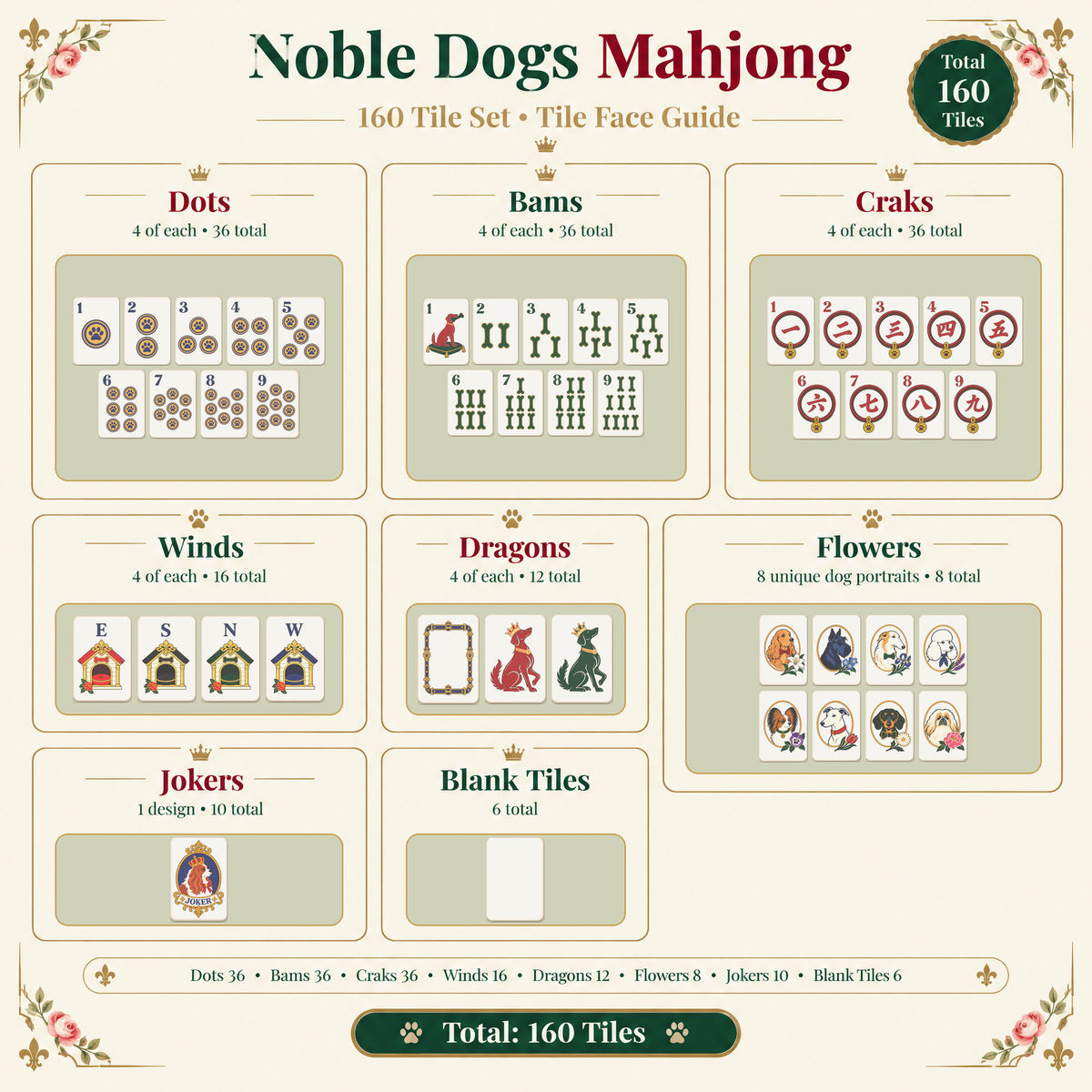
In Chinese mahjong, the 1 Dot (also called 1 Circle or Wan) is a terminal tile with a single circular pip and a low point value, typically 1 point. It forms the lowest number in the Dot suit (1–9) and can be used in sequences (chows) with 2–3 Dots, or in pairs and triplets. In American mahjong, the 1 Dot exists but functions as a non-terminal number; it cannot be grouped in sequences and appears only in specific hand patterns on the current year's National Mah Jongg League card. American rules disallow chows entirely—only sets of identical tiles (pungs, kongs, quints, sextets) and jokers. Both games use a Dot suit, but Chinese mahjong awards more flexibility with sequences, while American play demands exact pattern matching. Jokers cannot replace a 1 Dot in American play; in Chinese variants, this depends on house rules. The core difference: Chinese treats 1 Dot as a building block for runs; American treats all tile numbers as fixed elements in predetermined combinations.
🀄 Shop best-selling mahjong sets →
How does the 1 Dot tile work in Chinese mahjong play?
In Chinese mahjong, the 1 Dot is a terminal tile—meaning it sits at the boundary of sequences. It can form a chow (sequence) only with 2 and 3 Dots; you cannot make 9–1–2 Dots or wrap around. The 1 Dot scores 1 point in most Chinese rule sets and is prized in terminal-honor hands. Players actively seek it as a building block rather than avoiding it, unlike in some scoring systems where terminals carry higher point penalties. It pairs freely and can anchor complex melds.

Why doesn't American mahjong use the 1 Dot in sequences?
American mahjong has no sequences (chows) at all—that is the fundamental design. Every group you expose—pung, kong, quint, sextet—must contain identical tiles only. The 1 Dot appears on American hands solely as a fixed element within predetermined patterns on the current National Mah Jongg League card. This means the 1 Dot's role shifts from a flexible connector (in Chinese play) to a static placeholder in American hands. You cannot call a 1 Dot from the discard pile because you saw it as part of a potential sequence; you call it only if the exact hand pattern on your card requires it. Learn how to read the mahjong card for a deeper dive into American hand structure.
What tiles are in the Dot suit across all variants?
Every mahjong variant uses the Dot suit (also called Circles or Wan). It always contains numbered tiles 1–9, and most full sets include four copies of each, plus honors (Winds, Dragons, Flowers) and jokers. What's in an American mahjong set describes the complete 152-tile roster. Chinese sets may differ slightly in spare tile counts but follow the same 1–9 numbering. The 1 Dot in all variants wears a single pip or circle symbol; some custom designs show artistic renderings. When you hold a 1 Dot in your hand, you're holding one of the oldest tiles in mahjong history—the symbol has remained consistent across hundreds of years and dozens of regional rules.
Variant | 1 Dot Role | Sequence Use? | Point Value | Preferred Pairing |
Chinese (Standard) | Terminal, building block | Yes (1–2–3 Dots) | 1 point | Pairs freely; honors higher value |
Hong Kong | Terminal, building block | Yes (1–2–3 Dots) | 1 point | Often in terminal-honor combos |
Riichi (Japanese) | Terminal, building block | Yes (1–2–3 Dots) | Variable | Part of standard sequences |
American | Fixed hand element | No sequences exist | Part of specific patterns only | Per National Mah Jongg League card |
Taiwanese | Terminal, building block | Yes (1–2–3 Dots) | 1 point | Flexible; pattern-dependent |
Key insight: American mahjong's total elimination of sequences fundamentally changes how the 1 Dot functions—from a versatile connector to a fixed slot filler.

How do jokers interact with the 1 Dot in different games?
In American mahjong, jokers cannot substitute for a 1 Dot in any position—not in a pung, not as a single tile, not in a pair. A joker can only replace a tile within an exposed group (pung, kong, quint, sextet), and even then, only if the group is already exposed. A 1 Dot that sits in your hand waiting to be paired or played stands completely alone. Chinese mahjong house rules vary: some allow jokers to replace any tile freely; others forbid jokers entirely or restrict them to specific melds. Before you begin a game, always clarify the joker rule with your table, especially if players have learned multiple variants. How jokers work in American play explains the American restrictions in detail.
Can you swap the 1 Dot during the Charleston?
Yes—the 1 Dot is a regular tile and moves like any other during the Charleston (the tile-passing ritual before American play begins). You can pass it left, right, across, or in any move the Charleston rules allow. The 1 Dot holds no special status during the exchange; it trades hands the same way a 5 Bam or a Wind would. If your opening hand contains a 1 Dot you don't need, pass it freely. If you need it, hold it. The Charleston explained covers every pass and return in detail.
🎁 See our most-loved mahjong sets & accessories →
What to check before you buy a set for multi-variant play
If you play both American and Chinese mahjong, your tile set must include a Dot suit numbered 1–9 on every tile (and four copies of each). Verify the product description lists "Dot" or "Circle" tiles and shows a clear image of the 1 Dot. Look for:
Tile count: 152 tiles minimum for American; Chinese variant sets may differ.
Suit clarity: Dots must be clearly marked with pips or circles, not symbols.
Joker count: American play requires exactly 8 jokers; Chinese games may use fewer or none.
Readability: The "1" number and single pip should be instantly recognizable from your hand rack.
Our best-selling mahjong sets are designed for American play with crisp Dot rendering; they work perfectly for casual Chinese play too.
✨ Find your Mahstead set — free US shipping →

FAQ
Is the 1 Dot the same across all mahjong variants?
The 1 Dot tile itself—a single pip or circle—is identical across all variants. Its function differs: Chinese games use it as a terminal in sequences; American play uses it only in fixed hand patterns. Both are the same physical tile.
Can I use a Chinese mahjong set to play American mahjong?
If the Chinese set contains exactly 152 tiles (108 in three numbered suits, 16 Winds, 12 Dragons, 8 Flowers, 8 jokers), and is clearly marked, yes. Verify the Dot suit has all nine numbers with four copies each before you buy.
Why do some mahjong sets show a bird on the 1 Bam instead of a dot?
The 1 Bam traditionally depicts a bird (the "Crested Myna" in some designs). The 1 Dot always shows a single pip or circle—never a bird. Custom engravings may vary the artistic style but keep the pip symbol recognizable.
Do I need to know Chinese mahjong rules to play American mahjong?
No. American mahjong is a distinct game with its own rules, card patterns, and scoring. Learning American play does not require Chinese mahjong knowledge, though understanding how sequences work in Chinese can help you appreciate why American eliminated them.
What's the point value of a 1 Dot in American mahjong scoring?
Point values in American mahjong depend entirely on the hand pattern—there is no flat "1 Dot = X points" rule. The National Mah Jongg League card dictates which hands score what. American mahjong scoring explains how to calculate totals from the card.
Can the 1 Dot be used as a pair in American mahjong?
Only if the current year's National Mah Jongg League card shows a hand that includes a pair of 1 Dots. If no such hand exists on that year's card, you cannot form and declare a pair of 1 Dots—it would not be a legal American mahjong hand.
How many 1 Dot tiles are in a standard American mahjong set?
Four—one for each copy of the tile. American mahjong uses 152 tiles in play, which includes four copies of every numbered tile in the three suits (Bams, Craks, Dots).


View More
View More
View More
