
Wright-Patterson Mahjong Scoring: American Rules Explained
Last updated: Nov 23, 2026
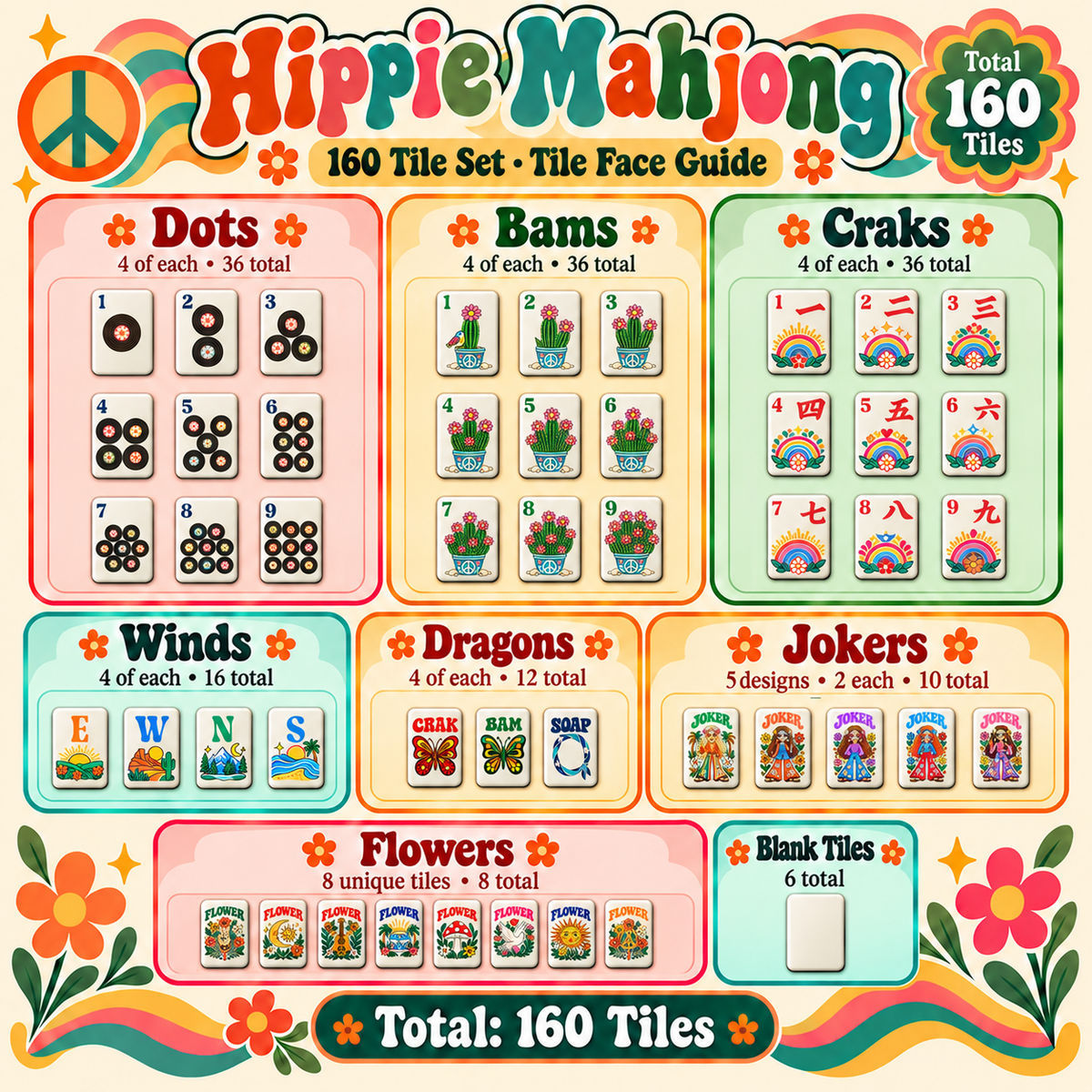
Wright-Patterson scoring does not exist as an official mahjong system. American mahjong scoring, governed by the National Mah Jongg League, awards points based on hand patterns listed on the annual card: basic hands earn fixed values (typically 20–80 points depending on pattern complexity), with bonuses for limit hands, all-singles, all-pairs, and quint/sextet combinations. A standard game uses 152 tiles plus 8 jokers, plays to 1,000 or 2,000 cumulative points, and tallies after each hand. The hand value depends only on matching the current year's card pattern—tile count, suit composition, and exposure rules all matter. No variant called "Wright-Patterson" governs these calculations; if you've heard the term locally, clarify with your group whether they mean a house rule or a regional nickname for a standard system.
American mahjong scoring sounds complicated at first, but it follows one core principle: your hand's value is printed on the current year's National Mah Jongg League card. You don't calculate points based on individual tiles or strategic choices—only pattern matching and a few bonus multipliers matter. We'll walk you through how scoring actually works, where confusion creeps in, and how to avoid mistakes at the table.
What does the mahjong card tell you about hand values?
The annual League card organizes hands by point value in labeled sections. Hands worth 20 points sit in one section; 30-point hands in another; 40, 50, 60, 70, 80, and limit hands fill the rest. When you complete a hand, you find its exact pattern on the card, read its point value, and apply multipliers (doubles or triples for certain conditions). You do not add up tile values or count tile "points"—the card gives you the complete number. This system ensures fairness: every player sees the same patterns and knows the payoff before the game starts.
🀄 Shop best-selling mahjong sets →

How do limit hands and bonuses change the final score?
Limit hands (the top section of the card) are worth the maximum payout, sometimes labeled "limit," "ceiling," or shown as a fixed number like 1,000 or 2,000 points depending on house rules. A hand qualifies as a limit hand only if it matches a pattern explicitly labeled as such on the card—you cannot declare a hand limit; the card decides. Bonuses multiply the base score: if you go mah jongg on your first turn (drawing from the wall on your first move), you earn a double. If the wall runs short (no tiles left to draw), the value may triple. Some groups award a double for an all-singles hand, or an all-pair hand, if the card labels these separately. Read your year's card carefully—bonus rules vary by group and region, so agree on them before the first hand.
What scoring mistakes do new players make most often?
Common errors at the table:
Assuming tile rank matters: Beginners think a hand of all high numbers (7, 8, 9) is "worth more" than low numbers. It is not. Only the card pattern matters.
Miscounting jokers in a hand: Jokers are wildcards and can substitute for any tile in an exposure (pung, kong, quint, sextet). Do not count jokers as separate "points."
Adding tile values together: Some games (like classical Chinese mahjong) score by tile math. American mahjong does not. Stop, check the card, and use the printed value.
Forgetting to announce bonuses: If you earn a double or triple, state it clearly before settling payment so everyone agrees.
Confusing exposure with value: Exposing a pung (three identical tiles) does not increase a hand's value on its own; only the card pattern and bonuses do.
The safest habit: before declaring mah jongg, show your hand to one other player and have them verify the pattern on the card alongside you.
How do payments work across four players?
In a four-player game, the player who goes mah jongg collects points from all three other players. If a hand is worth 40 points, each other player pays 40 points to the winner (total win: 120 points). If a bonus applies—say, a double—the winner collects 80 from each player (total: 240 points). Players track cumulative scores throughout a session (usually 8–16 hands). The player with the highest total at the end wins. Some groups play "settle per hand" (no cumulative score), but tracking over a full session is standard and prevents ties at the end.
If nobody goes mah jongg (the wall empties), there is no winner; each player keeps their current score, and the next hand begins. A few groups award a small payment (1 point) to the player closest to a hand, but this is rare and a house rule—check before you play.

How does the Charleston affect scoring?
The Charleston (the ritual three-pass exchange of tiles before the game starts) does not directly change scoring. It is a setup ritual that helps each player build a stronger starting hand. After the Charleston, players draw wall tiles to bring their hand to 13 tiles (or 14 for East player), and scoring begins as normal. The Charleston is part of American mahjong's social tradition; learn the Charleston exchange in detail so you run it smoothly and get to the actual game.
🎁 See our most-loved mahjong sets & accessories →
Can you compare scoring between American mahjong and other variants?
Variant | Who decides hand value? | Bonuses for luck? | Pattern source | Game length |
American | National League card (annual) | Yes (doubles, triples) | Card only | 8–16 hands, 1,000–2,000 points |
Chinese | Tile math (melds, terminals, honors) | Yes (multiples of base) | Memorized or reference book | 4 hands, 4 players, no cumulative score |
Hong Kong | Tile math + lucky melds | Yes (heavy multipliers) | Memorized rules | 4 hands, 4 players |
Riichi (Japanese) | Tile math + "ready" declaration | Yes (speed bonus, yakus) | Memorized rules | 1–4 rounds of 4 hands each |
Taiwanese | Tile math + bonus pairs | Yes (multipliers) | Memorized or card | Variable by group |
The biggest difference: American mahjong uses a card (new every year), so patterns never change and new players can learn visually. Chinese and other Asian variants rely on memorized hand math, making them steeper for beginners but more flexible for house creativity. If you're hosting a mixed group, clarify which variant you're playing and provide the card or rulebook before the first hand.
What should you check before you score a hand?
Pre-scoring checklist:
✓ Hand matches a pattern on the current year's card (not last year's; card changes spring each year).
✓ All exposed tiles (pung, kong, quint, sextet) are identical.
✓ Jokers are used only in exposures, never as a pair or single tile.
✓ Pair is a non-joker double (two identical tiles).
✓ No more than eight jokers in the hand (the game contains eight jokers total).
✓ All four players agree the hand is valid before settlement.
✓ Bonus conditions are stated (first turn draw? wall run short? all-singles?).
When in doubt, place the hand face-up on the table and read the card aloud together. It takes 30 seconds and prevents disputes.
Hosting a weekly game? Quality mahjong mats keep tile layout clear and protect your table, while racks with pushers help players read their hands and announce without errors. Many scoring mishaps happen when tiles are hard to see or a player misreads their hand in poor light—good equipment reduces pressure and keeps the game flowing.
✨ Find your Mahstead set — free US shipping →
If you've heard "Wright-Patterson scoring" as a local or club name, it likely refers to a house variant of standard American scoring. Ask your group leader for a written rule sheet or the specific bonus rules they use. Once you master the card-based system and bonuses above, you'll adapt to any house rules in minutes—they're almost always tweaks to the timing of doubles or special hands, not fundamentals. Stick to the National League card as your reference, verify your hand before declaring, and you'll score confidently at any table.

FAQ
Is "Wright-Patterson mahjong" a real variant?
No. Wright-Patterson does not appear in any standard mahjong rulebook (American, Chinese, Hong Kong, Riichi, or Taiwanese). It may be a local club nickname or a misremembered term. Always ask your group for their written rules or card.
What's the highest score in a single hand?
Limit hands (top section of the card) are worth the maximum payout, typically 1,000 points in house play, though some groups cap at 500 or set house limits. A bonus (double or triple) can raise the payout further.
Do I have to announce my hand before I score it?
Yes. Call "mah jongg" when you complete a winning hand. Do not score silently. All players must verify the pattern on the card before payment.
Can a hand have two bonuses at once?
Yes. If you go mah jongg on your first draw and the wall runs short, you might earn a double and a triple in the same hand. House rules decide the interaction; clarify before the game starts.
What if someone disputes my hand after I score?
Stop and reverify together on the card. If the pattern matches, you win; if it does not, the hand is void and play passes to the next player. Document your group's dispute process before you need it.
How often does the scoring card change?
The National Mah Jongg League issues a new card every spring. Always use the current year's card—patterns and values may shift, and old cards are not valid.


View More
View More
View More
