
Why Homeschoolers Love Mahjong: Skills, Screen-Free Fun, and Family Time
Last updated: Nov 23, 2026
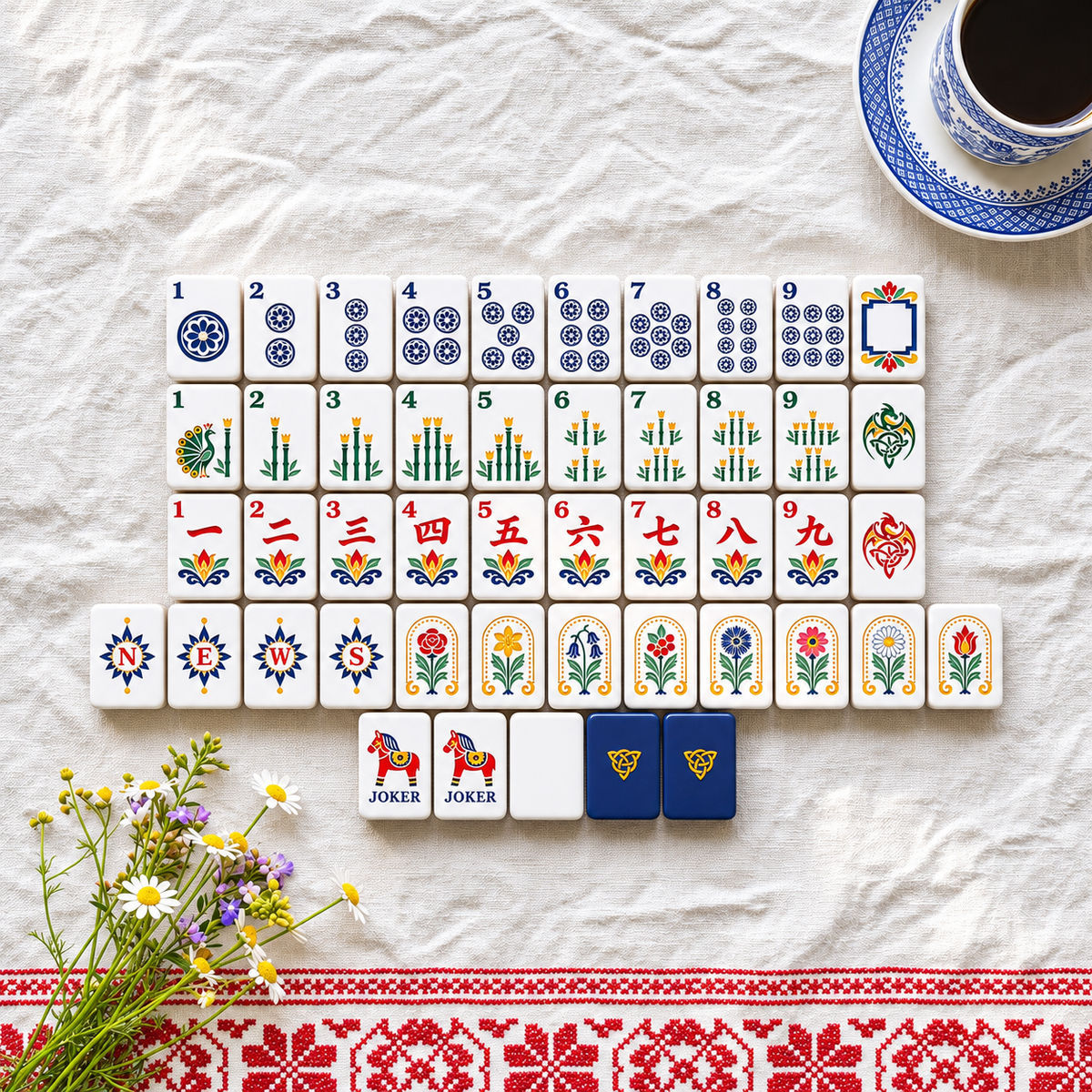
Homeschoolers embrace mahjong because it delivers academic rigor and family connection in a single evening. The game builds probability reasoning (calculating tile draws and hand odds), visual-spatial memory (tracking 13–14 tiles and hand sequences), and strategic planning—all skills tested in standardized math and logic curricula. Unlike worksheets, mahjong feels like play; unlike screens, it demands face-to-face attention and conversation. A 90-minute game teaches negotiation (the Charleston tile-passing phase), risk assessment (calling vs. waiting), and social resilience through friendly competition. From a practical standpoint, you need one 160-tile American mahjong set (which includes racks, dice, and a wind indicator), basic knowledge of the current year's National Mah Jongg League card, and a flat surface. Mahstead sells complete sets with free US shipping, designed for durability through repeated family play. No age minimum exists, though players typically excel from 10 onward; older siblings teaching younger ones reinforces both groups' learning.
Homeschoolers are turning to mahjong as a living-room classroom that teaches probability, pattern recognition, and social skills without a screen. The game builds probability reasoning (calculating tile draws and hand odds), visual-spatial memory (tracking 13–14 tiles and hand sequences), and strategic planning—all skills tested in standardized math and logic curricula. Unlike worksheets, mahjong feels like play; unlike screens, it demands face-to-face attention and conversation. A 90-minute game teaches negotiation, risk assessment, and social resilience through friendly competition. You need one 160-tile American mahjong set (which includes racks, dice, and a wind indicator), basic knowledge of the current year's National Mah Jongg League card, and a flat surface.
How Does Mahjong Fit Into a Homeschool Curriculum?
Mahjong is not a subject; it's a teaching tool disguised as recreation. The game embeds pattern recognition (matching tiles by suit, number, and rank), combinatorial thinking (how many ways can 13 tiles form a valid hand), and probability assessment (what tiles remain in the wall, what your opponents likely hold). Teachers and parents report that students who struggle with abstract math—fractions, probability, set theory—suddenly "get it" when the lesson involves a tile they can hold. A single game session covers mental arithmetic (counting joker substitutions, scoring multipliers), resource management (deciding which tile to discard), and adaptive strategy (adjusting your hand plan when the player across calls a pung before you do). Many homeschool co-ops now schedule a weekly mahjong hour, treating it as an elective in logic and social-emotional learning.
🀄 Shop best-selling mahjong sets →

What Age Do Homeschoolers Start Their Kids on Mahjong?
Most families introduce mahjong between ages 9 and 12, though younger siblings can observe and learn. The barrier is not age but comfort with number sequences and tile memory. A nine-year-old who reads fluently and enjoys strategy games (Uno, Sequence, even simple card games) is ready. We've hosted families where a 10-year-old beat her parents in her first game because she memorized the card pattern faster than they expected. The real advantage for homeschoolers is continuity: siblings can play together across a five-year age gap because the rules scale to skill. A 14-year-old might calculate hand odds; a 10-year-old might rely on pattern matching and learn to count remaining tiles. No one is bored, and everyone improves over time. Start with the mahjong basics pillar to learn the exact sequence before your first game.
Why Do Families Choose Mahjong Over Other Board Games?
Mahjong offers what most board games don't: simultaneous play, hidden information, and variable outcomes that reward learning over luck. In chess, one wrong move ends the game; in mahjong, a mistake on turn three is recoverable, so younger players stay engaged. A 90-minute session teaches more social turns than a two-hour board-game night—each player calls plays, passes tiles, and makes discard decisions multiple times per game. The variable hand pools (the card changes every spring, offering 80+ unique hand patterns) mean families don't memorize a single optimal strategy; they adapt. Homeschoolers value this because it mirrors real-world problem-solving: given a constraint set (your tiles, the card, the discards), find the best next move. Unlike games that end in 20 minutes (leaving younger players frustrated), mahjong scales to family pace. You can pause between games, debrief strategy, and replay turns in practice rounds.
Here's how mahjong compares to other homeschool-friendly activities:
Activity | Best For | Time | Replayability | Social Learning |
Chess | Logical depth | 45–90 min | Very high; same rules always | Turn-taking, delayed gratification |
Mahjong | Pattern + social strategy | 90–120 min | Very high; card changes yearly | Risk assessment, negotiation, adaptation |
Board games (Catan, Ticket to Ride) | Casual fun | 60–120 min | Medium; strategy similar each game | Trade-offs, friendly loss |
Video strategy games | Visual reflexes | 20–60 min | High; updates change meta | Quick thinking, but solo or team chat |
Mahjong's edge: real human faces, no pause button, and rules complex enough for teens but learnable for preteens in one sitting. The physical tiles also create a tangible artifact—players remember their winning hand, replay it aloud, and discuss why it worked.

What Materials Do Homeschoolers Need to Start?
You need three things: a 160-tile American mahjong set, a copy of the current year's National Mah Jongg League card, and a mat or flat table. The 160-tile set includes 152 playing tiles (three suits: Bams, Craks, Dots; four winds; three dragon types; and eight flowers, with jokers woven throughout), four racks with pushers, one dice, and one wind indicator. A mat keeps tiles from sliding and defines the table boundary for play. The card—printed each spring—shows all legal hand combinations; you consult it like a menu before declaring your hand. Many homeschoolers laminate or page-protect their cards because they get worn fast. Mahstead's best-selling mahjong sets come complete with everything except the card (which you print or order from the National Mah Jongg League). If your table is small or you play weekly, a mahjong mat is worth the investment—it's portable, folds easily, and eliminates disputes about tile placement. For families that travel or play at co-ops, a travel-friendly bag or case keeps tiles intact and organized.
🎁 See our most-loved mahjong sets & accessories →
How Does Regular Play Build Homeschool Skills Over Time?
Consistent weekly or biweekly play compounds learning in three dimensions. First, pattern recognition becomes automatic: after five games, players stop consciously reading the card and start seeing hand combinations intuitively (the same way fluent readers don't sound out every letter). Second, numerical reasoning accelerates—players begin to estimate probabilities without verbalizing it ("I haven't seen a Green dragon in two rounds; one is still in the wall, and she called a pung, so two are left"). Third, social resilience strengthens through repeated low-stakes competition. A child who loses a game on turn 13 learns that setback is temporary, skill improves, and victory is often one session away. Over a year of play, homeschoolers consistently report that their kids approach academic challenges with less anxiety and more strategic patience. Teachers also notice that mahjong players ask better questions in math class because they've internalized the idea that multiple solutions can coexist (like multiple valid hands from the same 13 tiles), and they're comfortable sitting in uncertainty while they calculate. This is exactly the mindset homeschools aim to nurture.
✨ Find your Mahstead set — free US shipping →
What Should You Check Before You Buy Your First Set?
Tile clarity: Homeschoolers play in natural light and under lamps; cheap tiles often have faint or misaligned symbols that slow down reading. Run your finger across the symbols—they should feel raised or deeply stamped, not printed flat.
Rack stability: Kids tend to lean or nudge racks; wobbly plastic racks frustrate young players and cause tiles to spill. Test the rack's grip and hinge before purchasing.
Joker count: The game uses exactly eight jokers in play (never more, never fewer). A 160-tile set includes eight jokers embedded among the tiles; verify that your set includes spares, so you're not caught short if a joker cracks.
Pushers: Each player needs one pusher. Sets sold as complete should include four. Test that pushers slide smoothly—stiff ones cause tiles to stick.
Storage: Ask whether the set comes in a box or bag and whether you'll want a separate travel case for co-op play. Mahstead's travel-bag collection fits standard sets and stands up to weekly transport.
Card format: Confirm you can print or laminate the National Mah Jongg League card (it's updated every spring). Some homeschool families order a laminated card from the league directly or use photo-quality printing at home.

FAQ
Can four kids of different ages play the same game?
Yes. American mahjong rules are identical regardless of age; skill varies by memory and pattern recognition, not by separate rulesets. A 10-year-old and a 16-year-old play the same game and often win in turns, teaching each other strategy.
How long does it take to learn mahjong well enough to play a full game?
Most homeschoolers learn the basics (tile types, how to read the card, when to call a hand) in one 30-minute tutorial, then play their first game with light coaching. Comfort and speed grow over five to eight games, roughly 5–10 hours of play spread across weeks.
Is there a mahjong skill level that homeschoolers should reach before joining a co-op or club?
No formal levels exist in American mahjong. Co-ops accept beginners; play happens alongside experienced players, and everyone benefits. The National Mah Jongg League card ensures everyone uses the same rules and hand combinations, so newcomers are never at a disadvantage.
What happens if we lose or break a tile?
A single lost or broken tile is catastrophic—the game cannot be played with an incomplete set. Store tiles carefully and keep spare blanks (included in 160-tile sets) as replacements. If a tile cracks, contact the seller about a replacement; Mahstead designs sets for durability, and users report very few tile failures.
Can we play mahjong with the free apps instead of buying a physical set?
Apps teach the rules but miss the core homeschool benefit: face-to-face interaction, memory work (remembering discards and other players' plays), and the social ritual. Physical sets also eliminate screen time. We recommend starting with the real game; apps are a backup for travel, not a replacement.
How often should we refresh or buy a new set?
A well-maintained set lasts years. Homeschoolers rarely need to buy a second set unless they want engraved tiles (for gifts or family games with names) or prefer a different design. Mahstead's engraved collections let families personalize their sets without buying duplicates.


View More
View More
View More
