
What Size Table for Mahjong: A Complete Guide
Last updated: Nov 23, 2026
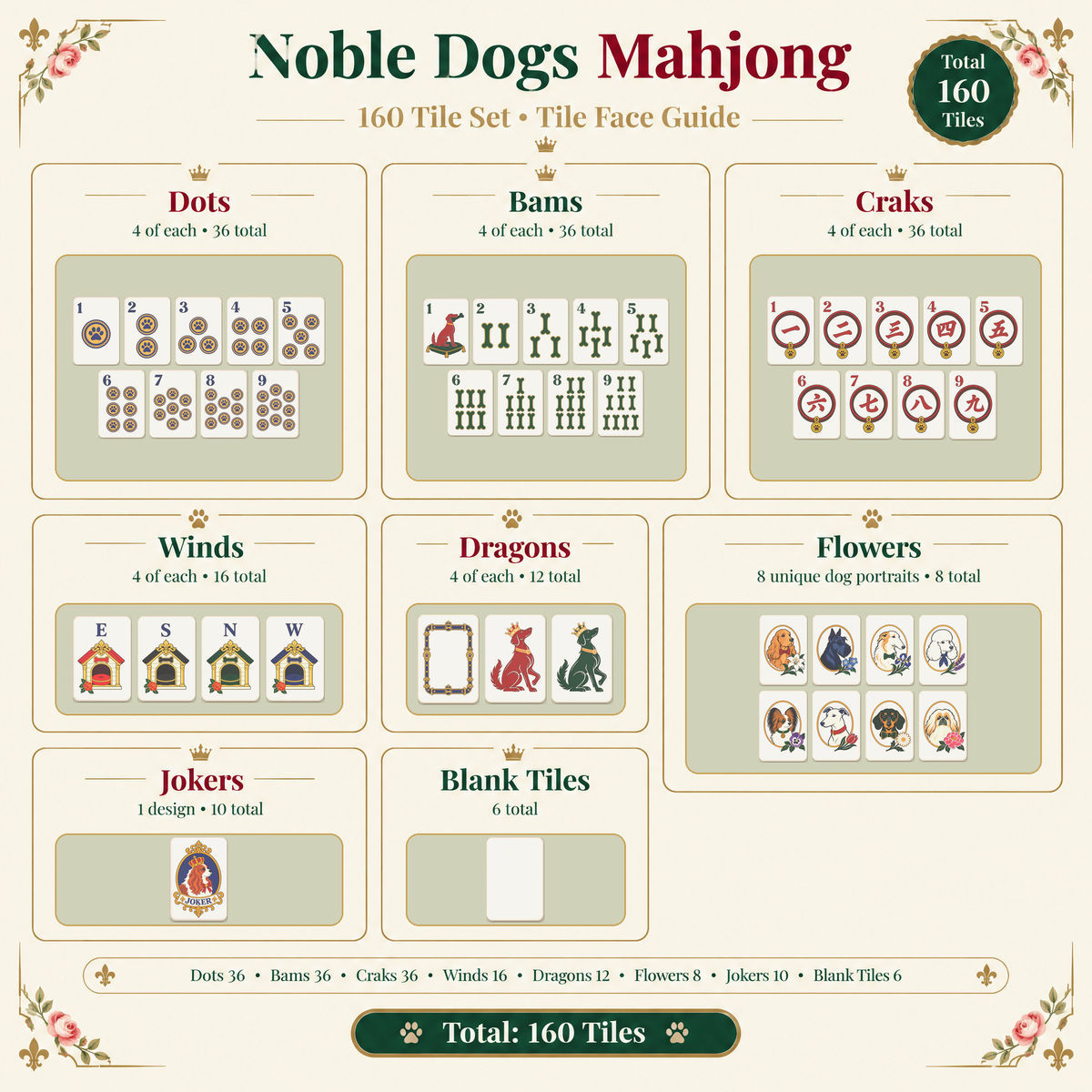
American mahjong requires a table at minimum 40 inches square (roughly 3.3 feet per side), though 48 inches square is standard for comfortable four-player games. This space accommodates the wall of 152 tiles, four player walls plus the Kong box, and room for each player to see and reach tiles without crowding. Round tables 48–54 inches in diameter work equally well. The height should be 28–32 inches—standard dining table height. Smaller tables (under 40 inches) force cramped walls and make calling tiles difficult; larger tables (60+ inches) mean players can't reach the center easily. A dedicated mahjong mat (with marked player positions and a clear Kong box layout) transforms any hard surface into a legal play area. Most home games use either a folding dining table or a permanent mahjong table with cup holders and a center well. Mahstead mats and racks help you get setup right, regardless of your table size.
We've hosted thousands of games in living rooms, basements, and patios, and the first question is always: "Will this table work?" The answer depends less on your furniture's brand than on its actual dimensions and how you arrange the tiles. Let's cut through the confusion.
Why Exactly 40 Inches Minimum?
The 152-tile American mahjong wall is built in stacks four tiles high and 38 tiles long—roughly 37 inches across when tiles sit side by side. Add one inch of breathing room on each side, and you need 39 inches; round up to 40 for safety. Each player's wall takes that full 37-inch width. Four walls around a square table means you need at least that span on every side, plus 4–6 inches in the center for the Kong box (where discarded tiles go) and hand exposure. A 36-inch table forces players to sit too close; tiles start overlapping into the center before the wall is even complete. A 48-inch table is the real comfort zone—it's what a standard American dining table offers, and it's what the National Mah Jongg League assumes in tournament setups.

Round vs. Square: Which Wins?
Round tables 48–54 inches in diameter work beautifully and often feel more social. Measured across the middle (the diameter), they give each player roughly 12–15 inches of depth—similar to a square table—but the curved edges reduce dead space at the corners. Some players find the shorter distance to the center easier; others hate not having a clear corner to sit in. Square 48×48 tables are the safest bet because walls sit flush against the edges, and you know exactly where the center is. Rectangles (e.g., 48×60) create confusion: one pair of opposite players has less space than the other. If you love your rectangle, use a mahjong mat to define player zones—it prevents chaos.
Table Shape | Diameter / Width | Best For | Notes |
Square | 48×48 in. | Serious home games, beginners | Clearest layout, walls fit flush |
Round | 48–54 in. | Social play, mixed skill | Shorter reach to center, fewer corners |
Rectangle | 48×60+ in. | Large groups, occasional play | Risk of unequal player space; use a mat |
Folding dining | 36–42 in. (varies) | Casual play, travel | Smaller; works for patient players; consider a mat overlay |
Height Matters More Than You'd Think
A 28–32 inch table is ideal; anything lower feels cramped after an hour, and anything higher strains your shoulders. This is standard dining height—good news if you're repurposing a dining table. Mahjong-specific tables (where they exist) usually nail this. If your table is 24 inches (coffee-table height), you'll regret it by game three. If it's 36 inches (kitchen counter height), your arms will ache. Before you buy or borrow a table, measure from the floor to the surface with a tape. Non-negotiable.
🀄 Shop best-selling mahjong sets →
How to Upgrade Any Table With a Mat
Here's the secret: a proper mahjong mat doesn't just look nice—it solves size problems. Our mats are marked with player positions, a centered Kong box, and a discard area. If your table is 42–48 inches square, a mat lets you play by showing exactly where walls go, even if the space is tight. The mat also protects the table surface and gives you a consistent, professional feel every time. Choose a mat with secure stitching and a nonstick bottom so it doesn't slide during play. If you're playing on a folding table, a mat is essential—it hides the wobble and keeps everyone's focus on the game.
Setting Up Small Spaces: The Compromise
Under 40 inches? Not ideal, but not impossible. Compact American mahjong is played by some groups with a shortened wall (fewer tiles visible at once) or in smaller formats. More practically: shrink the Kong box to 2–3 inches, keep walls tight, and use mahjong racks with pushers to keep your personal hand organized without taking table real estate. Racks store your 13–14 tiles vertically, freeing up the space that would otherwise hold an exposed hand. This is common in tournaments and high-level play anyway—it keeps the game cleaner and faster. If racks feel fussy for your group, accept that a 36-inch table will feel cozy. Some players prefer cozy.
The Portable Option: Fold-and-Go
A 42–48 inch folding table plus a Mahstead mat is the gold standard for groups that rotate hosting duty. Folding tables pack into most car trunks, and the mat rolls or folds separately. Set up takes 3–4 minutes once you've done it twice. Weight is usually under 30 pounds. The trade-off: surfaces can wobble if legs aren't locked, and you lose the permanence of a dedicated table. If your group plays weekly at different homes, this is the move. If you have one regular venue, invest in a proper table.
🎁 See our most-loved mahjong sets & accessories →
What to Check Before You Buy
Tape-measure the surface: width, depth, and height in inches. Round tables: measure the diameter.
Test leg stability: wobbly legs make shuffling tiles annoying and scare new players.
Check the edge height: a beveled or low edge lets tiles slide off too easily; a slight lip is better.
Sit and reach: with a friend sitting opposite, can you reach the center Kong box without leaning? If not, go bigger.
Count the surface: a 48-inch table can feel cramped if the center 6 inches is taken by a cup holder or sunken well. Account for that space in your math.
What If Your Space Is Truly Tiny?
Two or three player mahjong exists and has formal rules. 2 and 3 player American mahjong uses a reduced wall and modified hand sizes, and works on tables as small as 36 inches square. This is not a compromise—it's a legal variant, though most home games are four-player. If you're committed to four-player but truly squeezed, a 40-inch square table with racks for each player's hand is your answer.
Our Pick for Your Setup
If you're buying a table and mats together, start with a mahjong mat from our collection and measure your table first. A 48×48 inch dining table + a Mahstead mat + matching racks creates a pro-level experience. If you're new to the game, read our mahjong for beginners guide to understand tile counts and wall size—that knowledge will guide your setup decisions.
✨ Find your Mahstead set — free US shipping →

FAQ
Can I play mahjong on a 36-inch table?
Technically yes, but it's tight. Walls will be cramped, and players sit very close. If this is your only option, use racks to store hands and keep the center clear. Not recommended for beginners or long sessions.
Is a round table worse than a square table?
No—a 48–54 inch round table works just as well. Players sometimes prefer the shorter reach to the center, but square tables make wall alignment clearer. Choose based on your room and comfort.
Do I need a dedicated mahjong table, or can I use a dining table?
A dining table works perfectly if it's 48+ inches square, 28–32 inches high, and has a stable base. A mahjong mat (with marked zones) transforms any hard surface into a legal setup. A dedicated table is a luxury, not a requirement.
What if my table wobbles during play?
Check that all four legs are locked (if folding) or level (measure with a level tool). Wobble breaks concentration and risks tile spills. If a folding table wobbles even when locked, return it or reinforce the legs. Stability is non-negotiable.
How much space do racks take up, and do I need them?
Racks are typically 1–2 inches deep and hold one player's 13–14 tiles vertically. They free up 8–12 inches of table space compared to a fanned-out hand. They're not required for casual games, but serious players and tournaments always use them. They also keep tiles hidden from other players during draws.


View More
View More
View More
