
What Is a Consecutive Run in American Mahjong?
Last updated: Nov 23, 2026
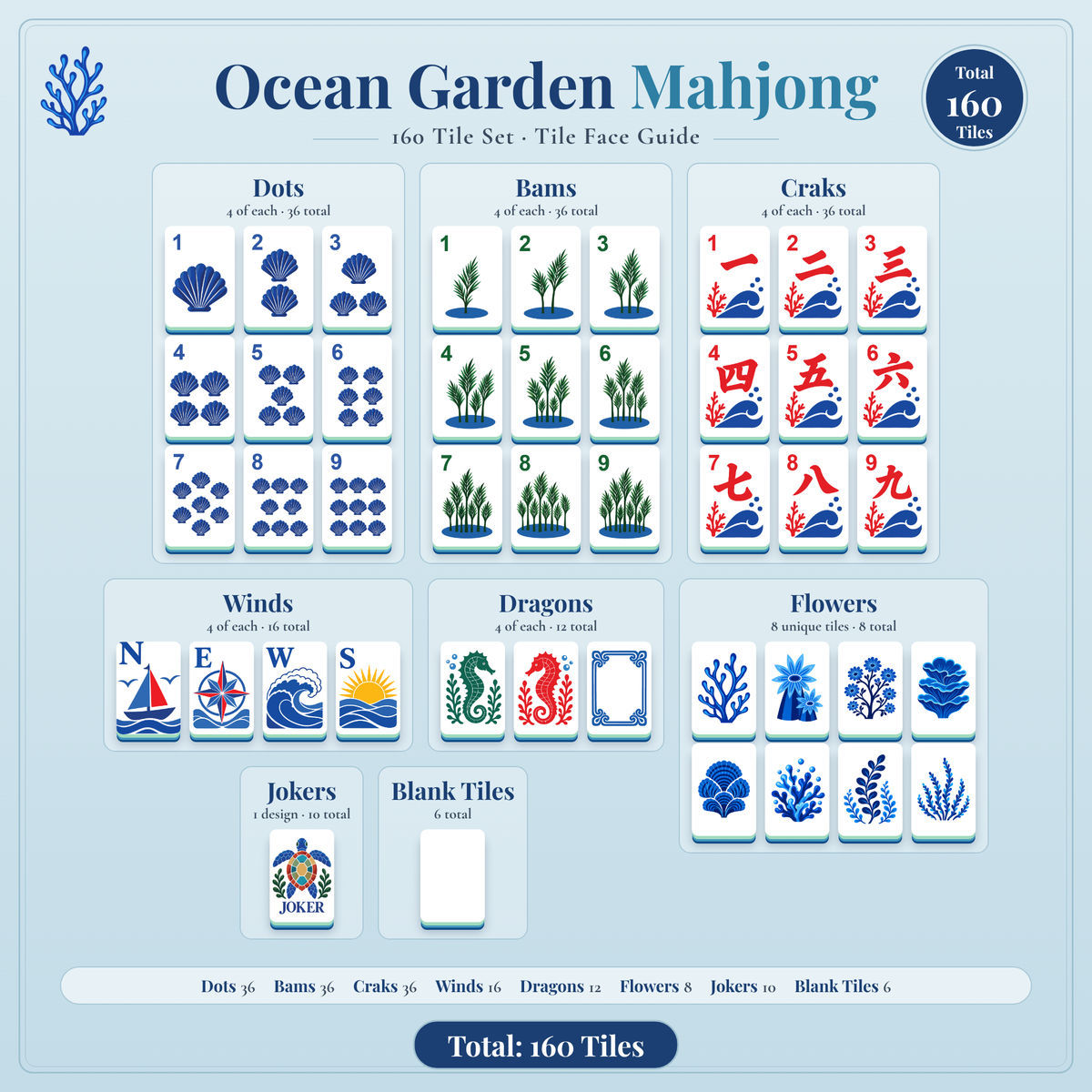
A consecutive run in American mahjong is a sequence of three or more numbered tiles in the same suit (Bams, Craks, or Dots), arranged in unbroken numerical order. Examples: 1–2–3 Craks, 5–6–7–8 Dots, or 7–8–9 Bams. Unlike Chinese or Hong Kong mahjong, American mahjong has no chow melds (exposed sequences called mid-hand); all runs must be kept hidden in your hand or exposed only as part of a complete, winning hand declared on the card. Consecutive runs appear on the National Mah Jongg League card each year in specific patterns—mostly in "like number" sections where you're holding runs alongside matching pairs or special tiles. The card tells you which run lengths (3, 4, 5, or 6 tiles) count as valid for each hand. A typical American set contains 152 tiles—three suits numbered 1–9, four of each—so you have the numbers you need to build runs. Consecutive runs are never jokers; jokers can fill gaps only in exposed pungs, kongs, and melds in winning hands, never in single tiles or pairs. When you win, you lay out your whole hand on the card to prove it matches.
🀄 Shop best-selling mahjong sets →
Where do consecutive runs appear on the card?
The National Mah Jongg League card, updated each spring, organizes hands into sections. "Like number" sections—the most common—feature consecutive runs as the backbone. A hand might read: "1–2–3–4–5 Craks, 2–3–4 Dots, 1–1–1 Bams (pung), 2–2 Dragons." This means your winning hand holds a 5-tile run in Craks, a 3-tile run in Dots, a pung (three identical tiles) of Bam 1s, and a pair of Dragons. The card itself doesn't list every possible run—it describes the pattern using shorthand notation. Run length and suit are fixed; your job is to have the exact tiles the card specifies. Runs always appear in ascending order: 1–2–3 is valid; 3–2–1 is not.

How do jokers fit into runs during play?
In American mahjong, jokers have strict limits. During active play—before you declare a win—you cannot use jokers to fill gaps in runs you're building. You can use jokers only in exposed melds on the table (pungs, kongs, quints, sextets) once you've called them. When you're holding a hidden hand, every tile in every run must be real. On the winning declaration, jokers can replace a tile in an exposed group (a pung or kong you show), but a run left on the table or in your concealed hand cannot contain a joker. This is a common mistake: newer players assume a joker can stand in for a missing 4 Dot while they're hunting for the real tile. It cannot. Jokers are wildcards for pungs and kongs only, and only after they're exposed.
What's the difference between 3-tile, 4-tile, and 5-tile runs?
Consecutive runs come in three main lengths on the card, each counting toward different hands. A 3-tile run is the minimum: 1–2–3, 4–5–6, or 7–8–9. A 4-tile run adds one more: 1–2–3–4, 5–6–7–8, or 6–7–8–9. A 5-tile or 6-tile run spans more of the suit: 1–2–3–4–5, 3–4–5–6–7, or 5–6–7–8–9. Longer runs are rarer on the card because they use more tiles from a single suit. Since each suit has only one of each number (four copies total across four players), building a 5-tile run yourself means holding five distinct numbers from the same suit—a tight constraint. The card specifies which length is valid for each hand pattern. You cannot shorten or extend a run beyond what the card permits. How to read the mahjong card explains notation in detail, so you can decode which runs your hand requires.
Run Length | Example | Tiles Used | Common Pattern |
3-tile | 2–3–4 Craks | 3 from one suit | Basic "like number" hand |
4-tile | 5–6–7–8 Dots | 4 from one suit | Mixed hand with pung |
5-tile | 1–2–3–4–5 Bams | 5 from one suit | Advanced "all runs" hand |
6-tile | 4–5–6–7–8–9 Craks | 6 from one suit | Rare; all runs or extended pattern |

How do you avoid mixing up runs with pungs?
A run is different numbers in sequence (1–2–3 Craks). A pung is three identical tiles (3–3–3 Craks). The two look nothing alike, but beginners sometimes confuse them when reading the card. Here's the key: a run always has distinct ascending numbers; a pung always has the same number repeated. If the card says "1–2–3 Craks, 1–1–1 Dots," you're holding a 3-tile run of Craks and a pung of Dot 1s—completely different tile sets. When you're discarding during play, tracking runs in your hand helps you know what to avoid throwing. If you're one tile short of a run—say you hold 2–3–4 Craks but are hunting for 5 Craks to complete a 4-tile run—never throw a 5 Crak if another player hasn't called yet; they might win on it. Conversely, if someone is hunting, throwing the completing tile is called "feeding," and losing teams often regret it.
How does the American rule against chows change run strategy?
Unlike Chinese, Hong Kong, or Riichi mahjong, American mahjong forbids exposing runs (chows) during active play. You cannot call a tile mid-game and lay down a run on the table; you can only expose pungs, kongs, quints, and sextets. This means all your runs stay hidden until you win. Strategy shifts: you're safer holding runs because no one can see you're hunting for specific numbers. But it also means you cannot build runs gradually through calls; you either complete them in your hand or you don't. Other variants allow exposed chows, which changes discard safety entirely. In American play, a tile is much safer to throw if it fits no pung or kong anyone's calling—but you still watch for runs because a win declaration reveals them instantly. How to play American mahjong covers exposure rules in full.
🎁 See our most-loved mahjong sets & accessories →
What's the best way to practice spotting runs on the card?
Spend 10 minutes every few days scanning the card's "like number" section and circling runs. Pick a hand at random and ask yourself: "What are my three runs?" "What pair do I need?" This trains your eye faster than playing. Keep the card at your table during games; using it mid-hand is legal and expected. Many players slip the card into a sleeve or stand it in a clear holder so it's always visible without blocking other players. When someone wins, lay their tiles out next to the card and verify the match yourself—this is how you internalize the patterns. After a few weeks of weekly play, you'll recognize run patterns almost instantly. Physical practice matters: holding real tiles and moving them into run sequences—using mahjong racks with pushers—makes the patterns stick better than studying alone. The pushers help you keep runs separate from pungs and the pair, so you train your muscle memory for hand organization too.
What to check before you buy a set for run practice
Tile clarity: Make sure your set's numbering is crisp and easy to read at a glance. Engraved tiles are easier to read under table lighting than printed ones. Suit distinction: Bam, Crak, and Dot symbols must look different enough that you're not squinting during play. Tile size: Standard American tiles are roughly 1 inch, large enough to hold comfortably and move into runs without fumbling. Case organization: A good travel bag or case lets you sort tiles by suit before play, so you can spot runs faster during the hand. Our best-selling mahjong sets include clear tile marking and are sized for weeknight play and tournaments alike. If you're hosting weekly games, an organized set is the fastest way to keep learning smooth.
✨ Find your Mahstead set — free US shipping →

FAQ
Can a run wrap around—like 9–1–2?
No. In American mahjong, runs are always ascending within a single pass: 1–2–3, 5–6–7–8–9, etc. The sequence never wraps from 9 back to 1. The card specifies each run's exact numbers in order.
Do I need all four copies of each number to build a run?
No. A 3-tile run like 4–5–6 Craks uses just three tiles. Since there are four players and four copies of each tile, you'll only see one copy per player in any given hand. Runs are built with what you draw.
What if the card says "any run" in a section—does that mean I choose?
Yes. If a hand pattern says "any run + any pung + any pair," you can build any valid consecutive run in any suit, any pung, and any pair that completes the hand. The card's flexibility is in which specific tiles you pick, not the shape of the run (which is always consecutive numbers).
If I have four of the same run—like two 3–4–5 Craks—can I use both in one hand?
No. A hand is always 13 or 14 tiles total (depending on whether you've drawn or won). If you have duplicates of a run, you use only one run in your winning hand; the other tiles either go unused or form separate melds.
Can jokers ever fill the middle of a run, like 3–joker–5 Craks?
No. Jokers cannot appear in runs at all, hidden or exposed. They can replace a tile only in pungs, kongs, quints, or sextets. Runs must be all real tiles.
How many runs are in a typical winning hand?
Most "like number" hands have two or three runs, plus a pung and a pair. Some advanced hands have three or four runs and no pungs. The card shows each pattern; you match it exactly.
What happens if I declare a win but my runs don't match the card?
You're penalized—your hand is void, and play restarts. Always double-check your layout against the card before announcing a win. Teammates or other players will verify before payment is settled.
Do runs have to be the same length in one hand?
No. A hand might have one 3-tile run, one 5-tile run, plus a pung and pair. The card specifies each meld's length; they don't have to match.


View More
View More
View More
