
What Does the 7 Bam Tile Look Like in Mahjong?
Last updated: Nov 23, 2026
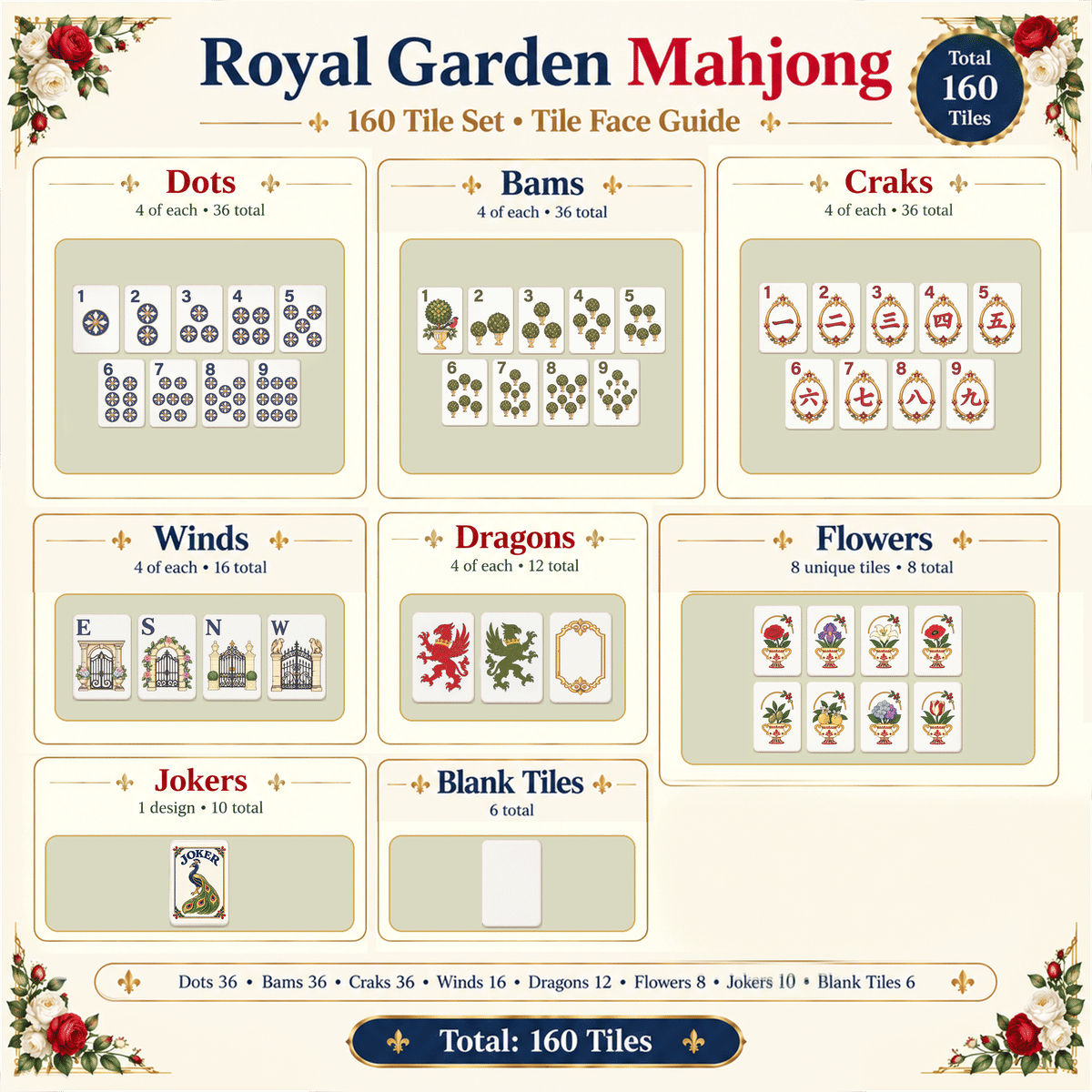
The 7 Bam tile shows seven upright bamboo stalks arranged vertically or in a grid pattern on the tile face. In American mahjong, it belongs to the Bam suit and is one of four identical copies in a 152-tile set (you get four 7 Bams per set, plus 8 jokers to make 160 tiles total). The design comes directly from the Chinese origin of mahjong and appears on every modern American set, whether bamboo, bone, acrylic, or engraved. You'll use the 7 Bam to form pungs (three identical tiles), kongs (four identical tiles), or longer combinations when building hands from the current year's NMJL card. The bamboo stalk design is instantly recognizable and rarely confused with other suits — Craks show numerical symbols or characters, and Dots show circles. If you're buying your first set with clear American mahjong tiles, check that the Bam suit has sharply printed or engraved bamboo stalks so you can spot the 7 quickly during fast play.
The 7 Bam shows seven upright bamboo stalks, a design inherited directly from Chinese playing-card art. In American mahjong, it's one of four identical copies per set. Here's what you need to know to recognize it instantly and use it in your games.
Why does the Bam suit show bamboo stalks instead of numbers?
Mahjong tile designs come from Chinese origin traditions, where the Bam suit (also called Bamboo) was drawn as vertical stalks to distinguish it visually from the other two number suits. The 1 Bam shows a bird perched on a stalk—a cultural artistic choice that persists in every modern deck. Numbers 2–9 Bam show their corresponding count of stalks, making the 7 Bam instantly identifiable by counting upward. This visual coding means you can spot any Bam tile across a crowded table without reading printed numerals, which speeds up play and reduces errors during the Charleston or tile exchanges.

How do you tell the 7 Bam apart from the 7 Crak and 7 Dot?
The 7 Crak displays a numerical character or stylized symbol (rooted in Chinese currency notations), while the 7 Dot shows seven small filled circles arranged in rows. Only the 7 Bam uses bamboo stalks. On a well-printed set, the contrast is stark: bamboo stalks are linear and vertical, circles are round, and Craks are symbolic or block-shaped. During play, speed matters—your eye learns to filter by suit outline before reading exact rank. If you buy a set with poor print quality or low contrast, the 7 Bam and 7 Crak can blur together, which causes misreads during discards. Engraved American mahjong sets eliminate this risk because the stalk design is carved into the tile surface, making it tactile and impossible to misidentify even under dim light or when tiles are held at an angle.
What combinations include the 7 Bam in hands you can actually win?
The 7 Bam appears in hundreds of hands on the current year's NMJL card, always as part of a pung (three 7 Bams), kong (four 7 Bams), quint (five 7 Bams), or longer consecutive group. American mahjong never uses chows or sequences—you cannot win with 5-6-7 Bam. Instead, the 7 Bam is valuable in "like" hands (three separate pungs of similar structure, e.g., three Craks, three Dots, three Bams each in the same shape) or "consecutive" patterns where each pung rank climbs by one. The card changes yearly, so the hands available rotate. If you've just learned to play, read the NMJL card guide to see exactly which hands use the 7 Bam in your current season. New players often over-rotate tiles looking for rare hands when the 7 Bam is actually part of a common pattern they missed on their first scan.

Does tile design or color affect how the 7 Bam looks?
Yes. Bone tiles carve deeper and show more shadow, making bamboo stalks appear more three-dimensional. Acrylic tiles print designs on the surface in black or gold, so stalks stay flat but can be extremely sharp if the print resolution is high. Engraved tiles use deep cuts, so the stalk pattern is both visible from above and tactile to the touch—useful if you play with players who have low vision or prefer sensory feedback. Color background (cream, white, jade green) doesn't change the 7 Bam's rank or suit; it's purely aesthetic. However, on a dark background (rare in American sets), bamboo stalks must be light-colored or gilded to remain visible. If you host weekly games and want zero confusion during fast play, acrylic or engraved sets with bright contrast between tile color and stalk design are the safest choice. Our best-selling collection includes designs with high-contrast printing, so the 7 Bam stands out instantly.
🀄 Shop best-selling mahjong sets →
What should you check before buying a set to ensure the 7 Bam is clear?
Before purchase, ask the seller (or check product images) for close-ups of the Bam suit tiles 1–9. The stalks should be crisp, evenly spaced, and easy to count at arm's length. If the image is blurry or the stalks blend into the background, that set will slow down your games. Count the printed stalks yourself in the photo—if you cannot reliably count to seven, neither will your table under game pressure. Ask whether the set includes 152 playing tiles plus 8 jokers (160 total); any fewer and you'll be short during play. Check what's included in an American mahjong set to confirm you're buying a complete, legal deck. Finally, verify the set includes four copies of every number tile (four 7 Bams)—some budget sets cut corners here, leaving you unable to form certain hands. Mahstead sets are shipped complete, so there's no guesswork; every set includes exactly 152 playing tiles and 8 jokers with clear, consistent design across all tiles.
Comparison: Tile clarity across common set types
Set Type | Stalk visibility | Speed of play impact | Best for | Print durability |
Acrylic, high-contrast | Excellent (black or gold on white/cream) | Fastest; no squinting | Casual and competitive tables | Excellent; lasts years of weekly play |
Engraved acrylic | Excellent (tactile + visual) | Fastest; tactile feedback too | All players; accessible; high-engagement games | Excellent; cannot fade or wear off |
Bone (traditional) | Good (shadowed stalks) | Moderate; requires close look | Collectors; players who value tradition | Good; susceptible to yellowing over time |
Printed acrylic, low contrast | Poor (faint or blurred) | Slowest; frequent misreads | Not recommended for serious play | Fair; fades if exposed to UV light |
🎁 See our most-loved mahjong sets & accessories →
What to check before you buy
Stalk clarity: Count the seven bamboo stalks in a product photo or in hand. If you hesitate, it's not clear enough.
Tile quantity: Confirm 152 playing tiles + 8 jokers (160 total). No blanks are added during play.
Four copies per rank: Verify you receive four 7 Bams (and four of every other numbered tile).
Contrast ratio: Light background + dark stalks (or dark background + gold/light stalks) minimizes errors.
Material: Acrylic or engraved designs resist fading; avoid sets with low-resolution printing or pale ink.
✨ Find your Mahstead set — free US shipping →

FAQ
Can I confuse the 7 Bam with the 7 Crak or 7 Dot if I'm new to mahjong?
Yes, if the set has poor printing or low contrast. Bam = bamboo stalks (vertical lines), Crak = character/symbol, Dot = small circles. On a high-quality set, the difference is instant. Engraved sets eliminate confusion entirely because the design is tactile.
Does the 7 Bam have the same rank in Hong Kong or Chinese mahjong as in American mahjong?
Yes—the 7 Bam represents seven in all variants. However, Chinese and Hong Kong mahjong allow chows (sequences like 5-6-7 Bam), which American mahjong does not. In American play, the 7 Bam only appears in pungs, kongs, or longer identical-rank groups.
How many 7 Bams do I get in one mahjong set?
Exactly four. An American mahjong set contains 152 playing tiles: 36 Bams (four each of ranks 1–9), 36 Craks, 36 Dots, 16 winds, 12 dragons, 8 flowers, and 8 jokers (making 160 total). You always have four copies of every numbered tile.
Why does the 1 Bam show a bird instead of one stalk?
That's a cultural design choice from Chinese playing-card tradition. The bird is the visual anchor for the Bam suit and makes the 1 Bam instantly recognizable—you never confuse it with a 1 Crak or 1 Dot. This tradition is preserved in every modern American mahjong set.
If I lose a 7 Bam tile, can I replace it with a blank or joker?
No. American mahjong requires exactly 152 specific tiles plus 8 jokers during play. A missing 7 Bam means you cannot form any hand that includes it. Jokers are wildcards in exposed combinations only, not replacements for lost tiles. Buy a complete set with spares so you always have backup tiles.
Does tile color or engraving style change what rank the 7 Bam represents?
No. Whether the 7 Bam is printed, carved, or engraved, it's always rank 7 of the Bam suit. The design style affects visibility and durability but never the tile's identity or use in hands.


View More
View More
View More
