
What Does the 3 Dot Mahjong Tile Symbol Mean?
Last updated: Nov 23, 2026
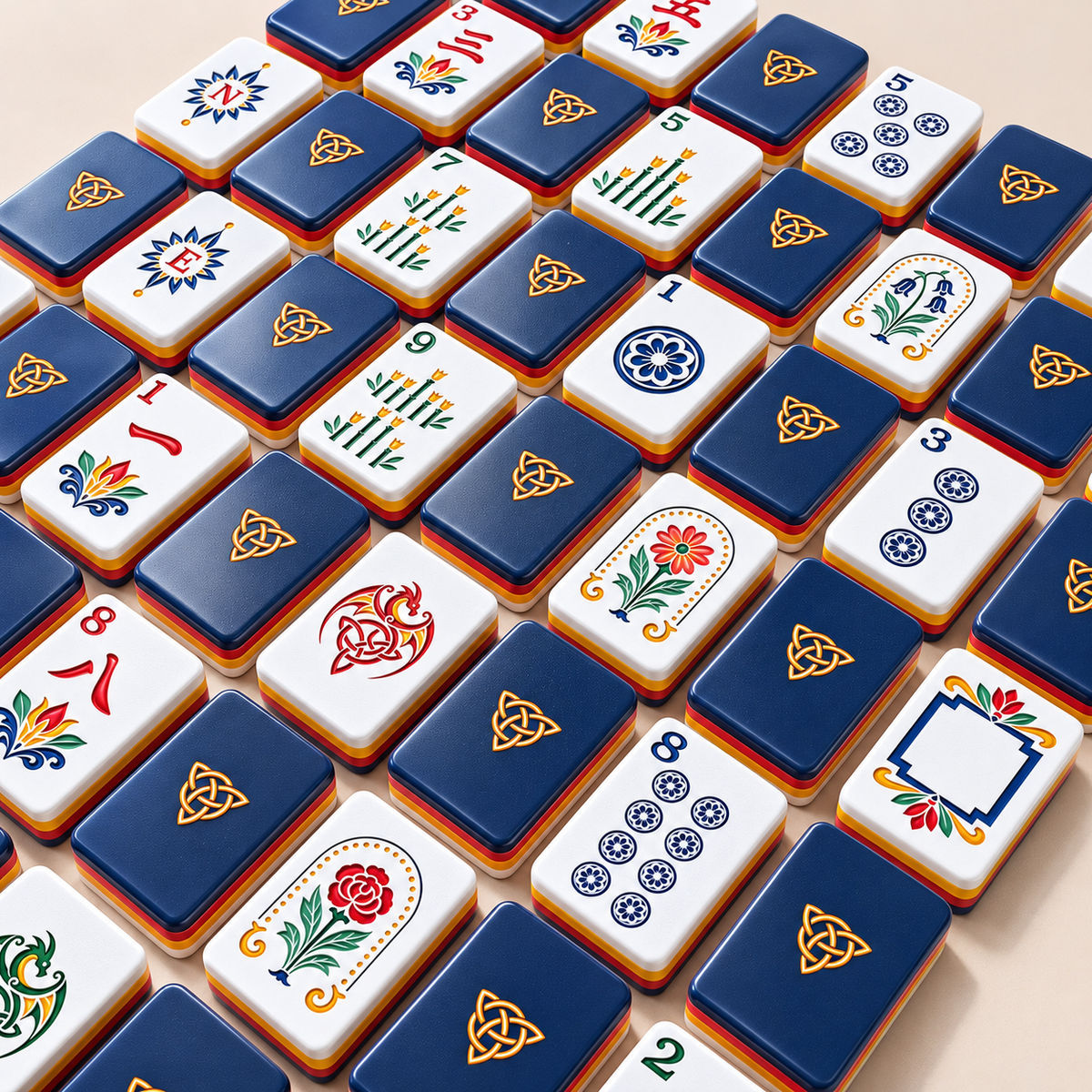
The 3 Dot tile belongs to the Dot suit and displays three small circles arranged on its face. In American mahjong, the Dot suit runs 1–9, and you receive four identical copies of each number in a standard set. The 3 Dot appears frequently in hand combinations because it falls in the middle range of the sequence; many patterns on the annual League card call for sequences containing 3 Dots (such as 1-2-3 or 3-4-5 Dots in a called pung or exposed kong). The tile's symbol—three dots, never a character—makes it instantly recognizable at the table. Like all numbered tiles, it carries no special power (unlike winds, dragons, or flowers) and must be matched exactly with two other identical 3 Dots to form a pair, or with other 3 Dots to build a pung (3 tiles), kong (4 tiles), or larger meld. Understanding each suit's role helps you read hands faster and spot winning combinations on your what's in an American mahjong set card.
What's the difference between Dots, Bams, and Craks?
American mahjong uses three numbered suits: Dots, Bams, and Craks, each running 1–9. Dots display circular symbols; Bams show bamboo stalks (and the 1 Bam traditionally depicts a bird); Craks feature Chinese characters or stylized designs. All three are ranked equally—no suit outranks another. The 3 Dot, 3 Bam, and 3 Crak are three different tiles; you cannot mix suits in a single pung, kong, or sequence. Recognizing suit symbols at a glance speeds up tile selection during the Charleston pass and keeps your hand organized.

Why is the 3 Dot so common in winning hands?
The middle-ranked tiles (2, 3, 4, 5, 6, 7, 8) appear more often in hand patterns than edge tiles (1, 9) because sequences and sets are more flexible when you're not pinned to the boundaries of the suit. The 3 Dot pairs well with 1-2-3, 2-3-4, or 3-4-5 combinations; these shorter sequences show up frequently on the current year's card. If you find yourself holding many 3 Dots during a game, check the card for patterns that use 3 Dot runs; odds are higher you're building toward a call than if you held several 1 Dots or 9 Dots.
How do you spot a 3 Dot tile in a crowded rack?
Look for exactly three small circles (pips) arranged on the tile face, typically in a vertical or triangular pattern depending on the set's design. The circles are always solid and never hollow, distinguishing them from other suits. If you're new to the game, mahjong for beginners resources teach suit recognition through repeated play; most players develop instant visual memory within a few games. Sets with clearer, larger faces or higher-contrast colors make tile spotting easier under poor lighting—a real consideration for weekly home games.
🀄 Shop best-selling mahjong sets →
Can jokers substitute for a 3 Dot?
Yes, but with strict limits. In American mahjong, a joker can replace any tile within an exposed meld—a pung, kong, quint, or sextet that you've already called and revealed on the table. A joker can never be used to fill a pair or single tile, and it cannot appear in a concealed hand. If you're holding two 3 Dots and need a third to complete a pung, you may use a joker as the third tile only after calling the pung aloud and exposing it face-up. Read our full guide on how jokers work for edge cases and scoring impact.

What role does the 3 Dot play in hand scoring?
The 3 Dot has no inherent point value; your hand's score depends entirely on the pattern you form and the position you hold (East, South, West, North) when you win. A pung of 3 Dots scores differently depending on whether the pattern appears as an "exposed pung" (called and revealed) or hidden, and whether it's part of a hand listed on the current year's card. Scoring complexity is one reason American mahjong scoring takes practice; learn the card's notation first, then master multipliers and bonuses.
Comparing numbered tiles at a glance
Tile | Suit | Symbol | Role in play | Frequency in patterns |
1 Dot | Dots | One circle | Edge of sequences, pairs | Medium |
3 Dot | Dots | Three circles | Sequence runs (1-2-3, 2-3-4, 3-4-5) | High |
5 Dot | Dots | Five circles | Center of sequences, pairs | High |
9 Dot | Dots | Nine circles | Edge of sequences, pairs | Medium |
The middle-ranked tiles (3, 4, 5, 6, 7) form sequences more flexibly than edge tiles (1, 2, 8, 9), so they appear in more hand patterns on the League card.
Common mistakes when handling 3 Dot tiles
Confusing 3 Dot with 3 Bam or 3 Crak. Always verify the suit symbol (dots = circles) before committing a tile to a meld. Mixing suits is a dead hand and may force a restart depending on your house rules.
Using a joker in place of a 3 Dot for your pair or single tile. Jokers cannot fill pairs or single-tile requirements under any circumstance in American mahjong. Only exposed melded groups (pugs, kongs, quints, sextets) can contain a joker.
Forgetting you have four copies of 3 Dot in the set. A complete set includes four of every numbered tile. If you've called three 3 Dots and the fourth is still in play, that tile remains live and your opponents can still draw or discard it. Never assume a tile is "gone" just because you've used three.
Holding 3 Dots for too long while waiting for an unlikely sequence. The 3 Dot is useful, but if your hand has three 3 Dots and the card patterns you need don't use them, discard one early rather than clogging your rack. Dead tiles waste space and slow your progress toward a call.
🎁 See our most-loved mahjong sets & accessories →
What to check before you buy a mahjong set
Tile face size and clarity. If you wear reading glasses or have difficulty spotting small symbols, choose a set with larger-faced tiles (usually 1.5 inches or more) and high-contrast colors. Acrylic sets offer bright, clear pip printing that stays legible after years of play.
Suit symbol consistency. Verify that all three suits are clearly distinct: Dots are circles, Bams are bamboo stalks, Craks are character designs. Poor print quality can blur these distinctions and slow down tile recognition.
Joker count and spare tiles.What's in an American mahjong set explains the tile inventory; a standard game uses 152 tiles and 8 jokers. When shopping for new sets, confirm the total count matches your needs. Extra spares (blank tiles or extra jokers) are useful for backups but don't change the active game.
Set completeness. Lay out all four copies of the 3 Dot and verify no tiles are chipped, cracked, or missing. A single missing tile breaks the entire set.
If you host a regular game, our best-selling mahjong sets include custom engraving options that let you personalize your collection—a practical way to keep track of sets if you own more than one or gift a set to another player.
✨ Find your Mahstead set — free US shipping →

FAQ
Is a 3 Dot tile the same in Chinese mahjong as it is in American mahjong?
No. Chinese mahjong uses a different tile inventory and hand structure; the 3 Dot symbol is the same (three circles), but the rules governing how you use it differ completely. American mahjong requires hands from the current year's National Mah Jongg League card; Chinese mahjong does not. Always clarify your game variant before play.
Can a 3 Dot tile substitute for a wind or dragon tile?
No. Jokers can only substitute for tiles within an exposed meld, and each meld must be homogeneous (all the same tile type or a valid sequence). A 3 Dot and a wind tile are unrelated, so no joker can bridge them.
How many 3 Dot tiles should be in a complete American mahjong set?
Exactly four. A standard 152-tile set includes four copies each of every numbered tile (1–9 in three suits = 36 tiles per suit, 108 total). If your set is missing a 3 Dot, it is incomplete and should not be played.
What happens if I discard a 3 Dot and another player is waiting on it?
That player can declare a "pung", "kong", "quint", or "sextet" (depending on their hand's needs), and you must surrender the tile to complete their meld. If they declare "mahjong" (a winning hand) using your discard, you pay the penalty; if they meld it as a group, the game continues and your turn passes to the next player.
Are there any hands on the League card that require *all four* 3 Dot tiles?
Yes. Some patterns call for a "sextet" (six identical tiles), which would require all four 3 Dots plus two jokers. Other patterns may require three 3 Dots (using two jokers if needed within an exposed pung, kong, quint, or sextet). Reference the current year's card for specific patterns in your area.
Do numbered tiles like 3 Dot have rank or point value before a hand wins?
No. All numbered tiles are equal until you form them into a completed hand on the card. Only the finished pattern and the player's position (East, South, West, North) determine the score. A 3 Dot pung scores differently as a concealed hand versus an exposed pung, based on the card's notation.


View More
View More
View More
