
Two-Player Mahjong: How to Count Points Fairly
Last updated: Nov 23, 2026
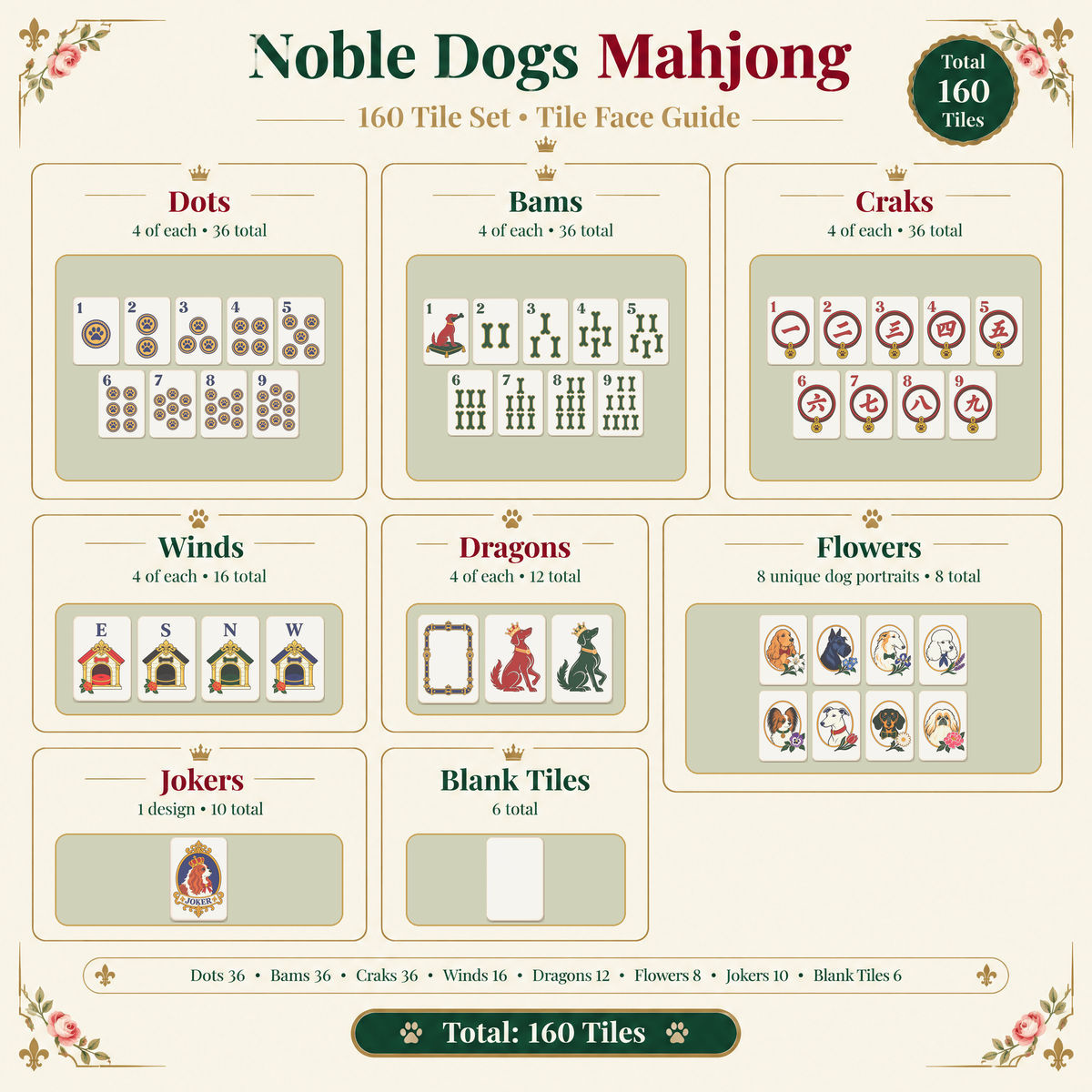
Two-player American mahjong follows standard hand validation from the National Mah Jongg League card but reverses the payment structure: the winner collects from one opponent, and the loser pays one. Start by validating your hand on the current year's card—it must match a listed pattern exactly (pung, kong, quint, or sextet shapes) and use only the tiles you hold. Next, identify your point value: base points depend on whether the hand contains concealed or exposed melds, flowers, and special combos like "Like Numbers" or "All Terminals." Most hands score between 30 and 70 points in American mahjong. Then apply any doubling: many hands double for conditions like "all pung" (no sequences, only 3s and 4s) or "all honor" tiles (winds and dragons only). Multiply your base by the number of doublings, then the winner collects that total from the single opponent. Mistakes happen when players misread the card, forget to count flowers (worth 2 points each, whether concealed or exposed), or apply doublings to hands that don't qualify. We recommend a best-selling set with a quality mat so both players can see tiles clearly and verify the card together.
Two-player mahjong is faster than four-player and cuts negotiation, but scoring logic trips up newcomers. The core rule is simple: winner collects from one opponent, not three. However, counting the base points and tracking doublings requires care.
🀄 Shop best-selling mahjong sets →
How do I validate a two-player hand?
Your hand must appear exactly on the current year's National Mah Jongg League card. Match your tiles to a listed pattern: look for the suit (Bam, Crak, Dot), the numbers, and the meld structure (pung, kong, quint, sextet, or pair). Your hand always contains four melds and one pair—no chows or sequences are allowed in American mahjong. Check that every tile in your hand is either concealed (in your rack) or an exposed meld called in your turn. If you drew or picked a single tile on your winning turn, it must complete the pair or final meld. If any tile doesn't match the card, your hand is invalid and you forfeit; no exceptions, even in casual play.

What's the base point value for a two-player hand?
Base points range from 30 to 80 depending on whether your melds are concealed or exposed and whether you hold flowers. A "concealed hand"—all four melds hidden in your rack until you win—starts higher. An exposed hand—where you've called some melds during play—starts lower. Flowers (the four Flower tiles and sometimes the four Season tiles, depending on variant) add 2 points each to your base. Honor tiles (winds and dragons) in your melds may increase your score. The NMJL card lists the base for each hand pattern; read the notes column carefully, as some hands have special conditions. Always refer to the card itself or a published American mahjong scoring guide; guessing costs you points at settlement.
How do doublings work in two-player mahjong?
Doublings multiply your base points. Common doublings include "all concealed" (all four melds hidden), "all terminals and honors" (only 1s, 9s, winds, and dragons), "all pung" (only 3s and 4s, no mixed numbers), and "like numbers" (all melds contain the same number across all suits). Each doubling that applies to your hand multiplies the base by 2. If your hand doubles twice, you multiply your base by 4; three doublings by 8. Not every hand qualifies for every doubling—the card specifies which hands carry which doublings. Misapplying a doubling is the most common error: re-read the card and confirm with your opponent before settlement.
What's the settlement formula for two-player play?
After you validate and count your base, apply all doublings. Multiply base × 2^(number of doublings). In two-player, the opponent you played against pays you that total. If you went out by self-draw (picking your own winning tile), the opponent pays the full amount. If you won on a discard, the player who discarded pays the full amount—there's no "limit" payment (a cap that exists in some four-player variants). Write down the total, confirm aloud, and settle before the next game. Keep a running tally if you're playing a series; it helps both players track wins and losses fairly.
Scenario | Base Points | Doublings | Total Paid to Winner | Key Rule |
Concealed pung hand, no flowers | 40 | All concealed (×2) | 80 | One player pays all; no split |
Exposed hand with 2 flowers | 50 | Like Numbers (×2) | 200 | Flowers add 2 pts each; doublings stack |
All honors (winds/dragons), concealed | 60 | All honor (×2) + All concealed (×4) | 240 | Check card for which doublings stack |
Mixed terminals and honors | 35 | None apply | 35 | Opponent pays base only |

What mistakes do most two-player players make?
Forgetting flowers: Each Flower tile (1–4) in your hand, whether exposed or hidden, adds 2 points. Many players skip flowers or count them wrong. Before calculating, separate flowers from your melds and add their value.
Misreading the card: Hands on the NMJL card are listed by year and often by section (like "Consecutive Pungs" or "Mixed Like Numbers"). Read the fine print; some hands require specific number ranges or tile sequences. If your hand doesn't match exactly, it's invalid.
Double-counting doublings: Some hands qualify for multiple doublings (e.g., all concealed and all honor). Apply each qualifying doubling once. Don't apply the same doubling twice.
Assuming all Bam/Crak/Dot hands are the same: Each suit's tiles are distinct. A hand of three 5 Bams is not the same as three 5 Craks. Check suit carefully on the card.
Not calling or exposing melds in time: In American mahjong, if you call a meld and lay it in front of you, your hand becomes "exposed." You can't later claim it's "concealed" for a doubling. Make meld calls deliberate and final.
🎁 See our most-loved mahjong sets & accessories →
How does two-player differ from four-player scoring?
In four-player American mahjong, the winner collects from all three opponents and also receives bonus payments (flower payments, kong payments, etc.). In two-player, there is only one opponent, so the winner collects the calculated point total once. There's no "east" bonus or winner/loser cycle that repeats; play a series of hands and track cumulative points. Two-player is also more intimate: both players see the same tiles discarded and the same melds called, so disputes are rare. Because there's no third or fourth player to consult, both players should agree on the hand's validity and the card reference before settling—discuss it aloud and have the card visible.
Step-by-step: your first two-player settlement
Verify your hand on the card: Locate the pattern matching your tiles (meld types, numbers, suits).
Count flowers: Separate them; add 2 per flower to your base.
Read the base points: The card lists base for each hand.
Check for doublings: Read the card's notes; confirm each doubling applies to your hand.
Multiply: Base × 2^(number of doublings) = final score.
Confirm aloud: "I have [hand name], base [X], doublings [Y and Z], total [Z×4 or Z×8]."
Opponent pays: The opponent settles the total immediately.
Record: Write down the score for your series tally.
What should I check before settling in two-player?
Card year: You're using the current year's official NMJL card, not an old one.
Hand match: Every tile in your hand appears on the card pattern you're claiming.
Flowers counted: You've added 2 points per flower to the base.
Doublings are real: Each doubling you applied is listed on the card for your hand.
No disputed tiles: Both players agree on which tiles are in your hand and which are on the table.
Opponent agrees: The opponent has seen the card and confirmed the total before you settle.
✨ Find your Mahstead set — free US shipping →
If you're hosting regular two-player games, a quality engraved set with a dedicated mat keeps tiles visible and organized so both players can verify hands quickly. Clear sight lines and a smooth surface prevent argument.
For a deeper dive into American mahjong mechanics, consult our American mahjong scoring guide or how to read the mahjong card. Two-player games are a perfect way to learn the tile values and doubling rules before moving to four-player.

FAQ
Can I use old NMJL cards to play two-player mahjong?
No. American mahjong hands change yearly; the NMJL publishes a new card every spring. Using an old card means your hands won't match current rules, and disputes will follow. Always use the current year's official card. If you don't have one, ask at a local community center or mahjong group where you can purchase or reference a copy.
Do jokers work the same way in two-player as in four-player?
Yes. Jokers can substitute for any tile in an exposed meld (pung, kong, quint, or sextet), but never in a concealed meld, a pair, or a single tile. If your hand is entirely concealed, you cannot use any jokers. Count jokers as the tiles they replace when tallying points.
What if my opponent and I disagree on whether a doubling applies?
Stop and check the card together. Read the notes column for your hand. If the card lists the doubling, it applies; if not, it doesn't. Resolve disagreement before settling. If you still can't agree, consult a third-party source (a published scoring guide or another player) or agree to play that hand neutral (no doubling) and move on.
How many points should I expect to win or lose per hand?
Typical two-player hands range from 40 to 240 points after doublings. A simple hand with no doublings might be 40–50 points. A concealed hand with two doublings could be 160–240 points. Over a series (six to eight hands), swings are normal; luck and card reading both matter. Track your series total to spot trends.
Is there a "limit hand" or cap on two-player scoring?
No. American mahjong two-player has no limit. You calculate and pay the full amount owed. Some variants (like Chinese mahjong) use limits, but American does not. If the hand is very large, confirm the calculation with your opponent before settlement to avoid shock.
Can I play two-player mahjong without flowers?
Yes. If you and your opponent agree to remove all eight flower tiles before the game starts, you can play with 144 tiles (152 minus 8). Hands will still match the card as long as no hand on the card requires flowers. However, most two-player players keep flowers to use all available tiles and add scoring variety. The choice is yours; just agree before play begins.


View More
View More
View More
