
Taiwanese vs. American Mahjong: Key Rules & Gameplay Differences
Last updated: Nov 23, 2026
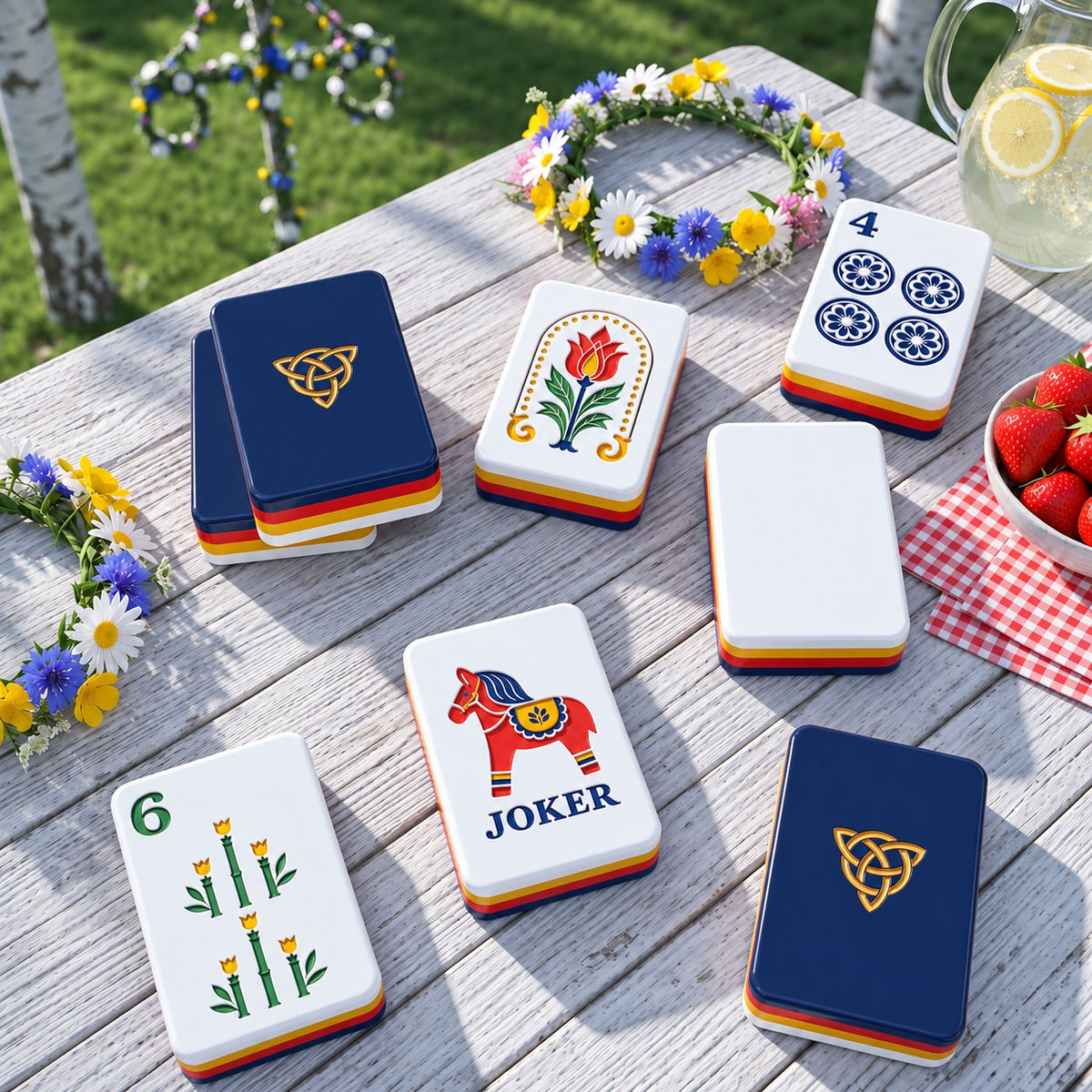
Taiwanese mahjong uses 144 tiles (no flowers, no jokers) and emphasizes chows (1-2-3 sequences in a suit) alongside pungs (3 identical tiles). Players draw from a live wall and draw an extra tile after discarding; winning hands require four melds plus a pair, scored by point multipliers rather than by hand name. American mahjong uses 152 tiles including flowers and eight jokers, bans chows entirely (only pungs, kongs, quints, sextets allowed), and players select hands from the current year's National Mah Jongg League card. Taiwanese games are quicker and more tactical; American games favor long-term planning. If you host both, a best-selling 160-tile acrylic set works for American play, while a separate 144-tile set is needed for Taiwanese rules. Neither variant uses the other's tile composition—buying the wrong set forces you to borrow or restart mid-season.
Taiwanese mahjong and American mahjong look similar from across a table—four players, tiles, a wall—but they are fundamentally different games. We've hosted players who've switched between variants mid-week and spent the first hour unlearning one rule set to learn another. The confusion costs time and frustration. This guide maps the precise differences so you can host either game with confidence, know which equipment you actually need, and help newcomers land on the right ruleset for your group.
What's the tile composition difference?
Taiwanese mahjong runs on 144 tiles: three suits (Bam, Crak, Dot) numbered 1–9 in four copies each (108 tiles), plus four winds (North, East, West, South, four copies each = 16 tiles), plus four dragons (Red, Green, White, one extra neutral = 16 tiles). There are no flowers, no jokers, no blanks. American mahjong uses 152 tiles: the same 108 suit tiles and 16 winds, but adds twelve dragons (four Red, four Green, four White), eight flowers (typically numbered 1–4 twice), and eight jokers. A 160-tile best-selling acrylic set includes 152 playing tiles plus eight spare tiles (extra jokers or blanks); no 144-tile option exists at Mahstead because we focus on American-format equipment. If you play Taiwanese regularly, you'll need a separate 144-tile set sourced elsewhere.

How do hand patterns differ between the two variants?
In Taiwanese mahjong, all legal hands follow one structure: four melds (each 3 tiles) plus one pair (2 tiles) = 14 tiles total. A meld can be a pung (three identical tiles like three 5 Dots), a kong (four identical), or a chow (a sequence like 4–5–6 Bams all in the same suit). Jokers do not exist, so no wild tiles. You can form and declare chows openly at the table, and opponents can call your discard to complete any meld type.
American mahjong allows no chows whatsoever. All melds must be identical tiles: pungs, kongs, quints (five identical), or sextets (six identical). A legal hand comes only from the current year's National Mah Jongg League card—a published reference sheet that lists hundreds of valid patterns. Jokers may appear in melds (e.g., three 3 Dots plus one Joker as a substitute) but jokers can never form a single tile, a pair, or stand alone. This means American players must memorize or carry the card; Taiwanese players memorize the meld structure and improvise within it.
What's the tile-drawing process in each game?
Taiwanese mahjong: players draw from a live wall (the remaining tiles in the center). After the initial deal, the player whose turn it is draws one tile, then discards one tile. The next player draws from the wall. When you form a meld by calling another player's discard (pung, kong, or chow), you draw again after declaring. The game accelerates because the wall shrinks and the hand fills quickly.
American mahjong: similarly, players draw from the wall one at a time; after the Charleston (the pre-game tile pass), the player in position draws 14 tiles and discards 1, leaving 13 in hand. Players then draw and discard one at a time. However, in American play, a player can only declare a pung, kong, quint, or sextet if they have the matching tiles already in hand—you cannot "call" an exposed meld from an opponent's discard the way you do in Taiwanese. This makes American games slower and more about holding tiles strategically.
How does scoring work in each game?
Taiwanese mahjong scoring is multiplier-based. A winning hand earns a base score (usually 1 point), then that score is multiplied by the number of "fán" (winning conditions met: all simples, all terminals, all honors, etc.). Multiply by 2 or 4 or 8 depending on how many conditions you hit. A hand with many fán multiplies to a much higher payment. Scoring is fast, cumulative across rounds, and rounds end when someone goes out.
American mahjong scoring is fixed per hand name. The National Mah Jongg League card assigns each hand pattern a point value: a "Concealed Hand" might be worth 60 points, an "All Simples" 30 points, etc. You do not multiply; you add up the points of any bonus conditions (like "concealed" or "robbed the kong"). The card is the arbiter. Scoring is slower because you must reference the card every time someone wins, but it is deterministic and removes debate.

What's the strategic difference in how games play out?
Taiwanese mahjong favors speed and opportunism. Because chows are allowed and melds can be declared from any player's discard, the table is fluid. A discard can complete another player's meld instantly, making you more vulnerable. Players often form melds mid-game; the hand evolves constantly. The winning player is often the one who reads the flow fastest and adapts. Rounds last 15–30 minutes.
American mahjong rewards patience and planning. You choose your hand from the card at the start and work toward that exact pattern all game. You cannot adapt mid-stream (no impromptu melds), so you need to plan for tile draws. Failing to get one critical tile means you lose. The game is quieter, more contemplative, and rounds often run 40–60 minutes. Newer players sometimes quit early because they feel "locked in" to a hand; Taiwanese is more forgiving for beginners.
🀄 Shop best-selling mahjong sets →
Which variant is easier to learn?
Taiwanese mahjong has a simpler core rule: get four melds and a pair, any way you can. Beginners grasp it in one session. American mahjong requires learning the National Mah Jongg League card format, the Charleston, and the constraint that jokers cannot be pairs—this typically takes 2–3 weeks of weekly play to internalize. However, American rules are more stable (the card is the law; disputes are rare), whereas Taiwanese rules vary by region and table culture (Hong Kong rules differ from Taiwan rules differ from Singapore rules), which can confuse people switching groups.
Comparison table: Quick reference
Aspect | Taiwanese | American |
Tile count | 144 (no jokers, no flowers) | 152 (with jokers, flowers) |
Meld types allowed | Pung, kong, chow | Pung, kong, quint, sextet only |
Jokers | None | 8 (can substitute in melds, never alone or as pair) |
Hand structure | 4 melds + 1 pair | Any valid pattern from current year's card |
Calling melds | Yes, from any player's discard | No, only draw from wall or wait for your turn |
Scoring method | Multipliers (fán-based) | Fixed by hand name on card |
Typical round length | 15–30 min | 40–60 min |
Rules variation | High (region-dependent) | Low (card is standard) |
Best for | Fast play, improvisation | Long sessions, strategic depth |
🎁 See our most-loved mahjong sets & accessories →
What to check before you buy equipment for either variant
If you're an American player, a 160-tile acrylic set with clear engraving is all you need. Each tile is marked with suit, number, or wind; jokers are labeled. Ensure the set includes exactly 152 playing tiles plus spare tiles.
If you play Taiwanese regularly, you'll need a separate 144-tile set (not sold at Mahstead). Do not try to adapt a 152-tile American set by removing tiles—the flower and joker positions break the balance of the wall, and opponents will rightfully call foul.
If you host both groups in your home, buy two complete sets and label them clearly ("American—152" and "Taiwanese—144") to avoid mid-game confusion. Store them in separate bags; our mahjong bags and cases keep sets protected and organized.
If you travel between clubs, ask in advance which variant they play. Do not assume. Showing up with an American set to a Taiwanese table, or vice versa, wastes 20 minutes and tests the host's patience.
✨ Find your Mahstead set — free US shipping →

FAQ
Can I use the same mahjong set for both Taiwanese and American play?
No. Taiwanese uses 144 tiles with no flowers or jokers; American uses 152. Mixing them breaks the game's math. You need separate sets.
Is American mahjong easier than Taiwanese?
Not necessarily. American has simpler rules to learn but requires memorizing the National Mah Jongg League card. Taiwanese melds are intuitive but regional rule variations can confuse players between tables.
Do jokers work the same way in both games?
Taiwanese mahjong has no jokers. American mahjong includes eight jokers that can substitute for any other tile within a meld, but never as a single tile, pair, or solo element.
Why does Taiwanese mahjong allow chows but American doesn't?
The two games evolved on separate paths. American mahjong deliberately removed chows to increase complexity and force players to rely on the card for hand selection. It is a deliberate design choice, not an error.
Which variant do most U.S. mahjong clubs play?
In the continental U.S., American mahjong (National Mah Jongg League rules) dominates among social players. Taiwanese and Hong Kong variants are common in communities with recent Asian immigration and among players with family ties to those regions. Ask your local club directly.
If I learn American mahjong, can I easily switch to Taiwanese?
Yes, but you'll unlearn the "no chows" rule and the card dependency. Most players report switching takes 2–3 weeks of practice. The tile positions and wind/dragon meanings transfer, which helps.


View More
View More
View More
