
Siamese Card in Mahjong: Examples and How to Play Them
Last updated: Nov 23, 2026
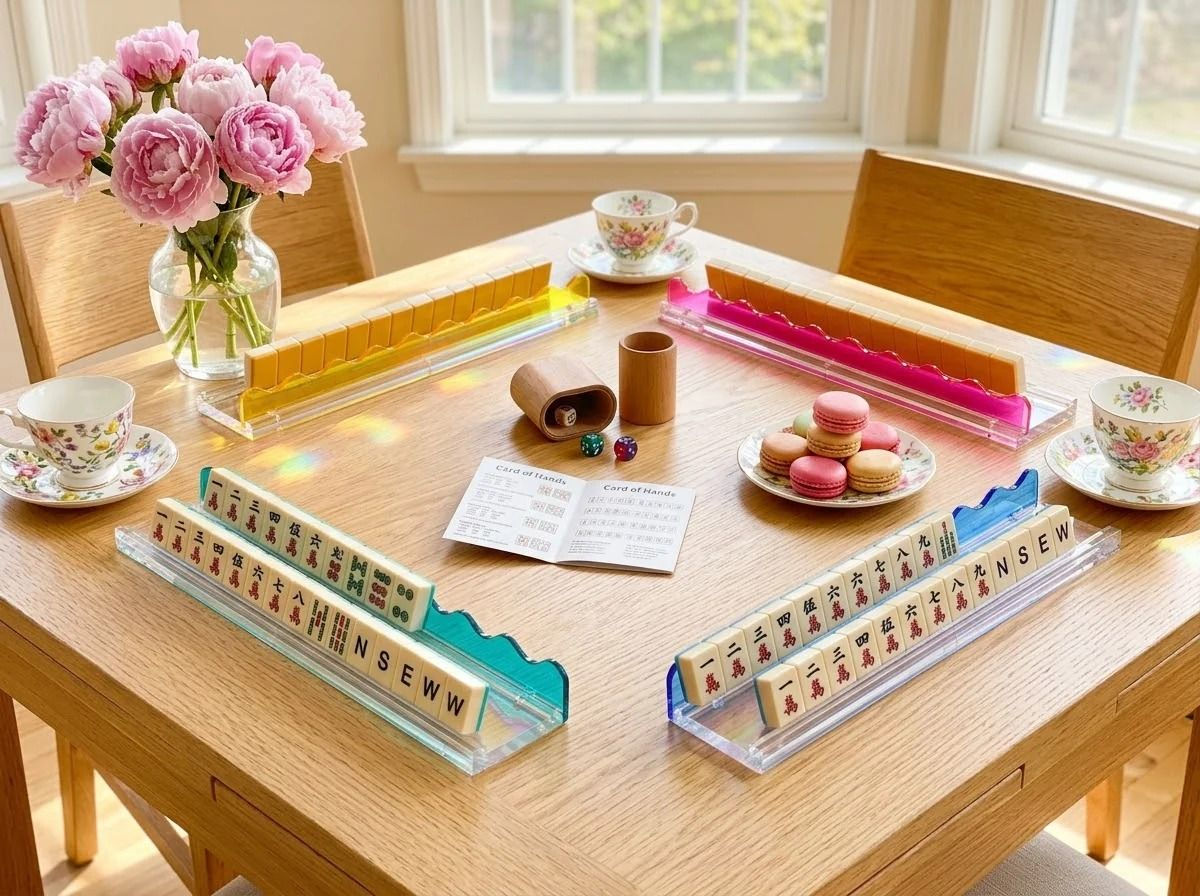
A Siamese card in American mahjong is a hand listed on the current year's National Mah Jongg League card where two identical pairs appear consecutively in the same section. For example, you might see "2 Bam pair + 3 Bam pair + additional pattern" printed as a single hand. These hands require you to hold four tiles in one suit (two matching pairs) and complete the rest of the pattern from the board or your draws. They're called "Siamese" because the two pairs are joined together—inseparable twins on the card. To win with a Siamese hand, you must draw or call tiles to finish all four required groups (typically two pung/kong pairs, one pung/kong, and one pair). Check the current League card, not memory, since hands change every spring. Our best-selling mahjong sets come with a tile rack designed to organize your hand clearly, so you can spot Siamese pairs before confusion costs you the game.
🀄 Shop best-selling mahjong sets →
What does "Siamese" mean on the mahjong card?
"Siamese" is the American mahjong term for a hand where two identical pairs are printed side-by-side on the League card, signaling they belong together in a single winning hand. Unlike a regular hand that might call for a 2 Bam pair in one section and a 5 Dot pair somewhere else, a Siamese hand requires both pairs to come from the same suit or honor class. The word evokes the image of conjoined twins—you cannot separate them. If the card shows "2 Bam pair | 3 Bam pair," that is Siamese; if it shows "2 Bam pair" and much later "5 Dot pair," those are two separate elements of a larger hand, not Siamese. Always read the card section layout carefully—spacing and typography matter.

How do you spot a Siamese hand at the table?
The fastest way is to look at your tile rack and ask: do I have four identical-number tiles in one suit? If yes, check the card. If the card shows two consecutive same-number pairs (e.g., "2 Crak pair, 3 Crak pair"), you are working toward a Siamese hand. Hold those four tiles visibly in your rack so other players see you're tracking a pattern. If you have 2 Crak, 2 Crak, 3 Crak, 3 Crak, you now need to complete the remaining pattern—usually a pung, a kong, or a pair of honor tiles. Count your pung/kong groups: if you've called or drawn three of the four required groups, you are one discard from winning. Write down or mentally note the card section number so you don't confuse it with other hands; Siamese patterns can look similar to non-Siamese hands if you rush.
Can you call a Siamese hand from the board?
Yes, but only if another player discards a tile you need to complete your fourth group. In American mahjong, you may expose pung (3 identical), kong (4 identical), quint (5 identical), or sextet (6 identical) when you call a tile from the board—but never a pair. If you hold 2 Crak, 2 Crak, 3 Crak, 3 Crak and need a 4 Crak pung to finish your hand, you can call 4 Crak when it is discarded and immediately expose your 2 Crak, 2 Crak, 3 Crak, 3 Crak as your two Siamese pairs plus the 4 Crak pung. Then declare your hand complete and score. However, if you need to draw to fill that fourth group, you cannot call—you must wait for your turn and draw from the wall. Never try to call a pair; it will be rejected and may disqualify your hand.
🎁 See our most-loved mahjong sets & accessories →
Why do players confuse Siamese with regular pairs?
Siamese hands live on the card alongside non-consecutive pair patterns, so it's easy to miss the connection. A newer player might see "2 Crak pair" on the card and think they can use any pair from elsewhere in the game. But if the card specifically shows "2 Crak | 3 Crak" as Siamese (printed together in one section), you cannot split them across two different hands. Another common mistake: holding two pairs by accident while chasing a different hand, then realizing mid-game you've blocked your own Siamese win. The best defense is to consult how to read the mahjong card before the game starts, so everyone agrees on which hands are Siamese and which are standalone. Scan the card section together during the first few minutes; experienced players do this routinely.

How do you organize your tiles to manage a Siamese hand?
Use a mahjong rack with pushers to separate your suits visually. Arrange your Bams left to right in numerical order (1, 2, 2, 3, 3, 4, etc.), then your Craks, then your Dots, then your honor tiles (winds and dragons). This layout makes it instant to spot two pairs in the same suit. If you are chasing a Siamese 2 Bam | 3 Bam pattern, you will see all four tiles grouped together at a glance. When you draw or call a new tile, slide it into its numerical position so your rack stays sorted. This reduces the mental load and prevents you from accidentally discarding a tile you need for your Siamese hand. Many players who keep messy racks lose track of their pairs; a good rack is an investment in clarity and speed.
Scenario | Your Hand | Board Play | Outcome | |
Siamese 2 Crak \ | 3 Crak ready | Hold 2C, 2C, 3C, 3C + three other groups | Opponent discards 4C and you have 4C, 4C, 4C | Call and win: expose both pairs + pung |
Siamese 2 Crak \ | 3 Crak half-built | Hold 2C, 2C, 3C + missing one 3C | Opponent discards 3C | Call and wait for your fourth group to be drawn |
Siamese vs. non-consecutive pair | Hold 2C, 2C but card shows "2C pair" under one hand and "4D pair" under another | Drawing 4D does not satisfy 2C \ | 3C Siamese | You have a regular pair, not Siamese—keep drawing for the full hand |
Confusion: wrong suit | Hold 2B, 2B, 3B, 3B but card calls for 2C \ | 3C Siamese | No match to card | Discard carefully and chase a different pattern |
What's the common mistake when calling a Siamese hand?
The biggest error is calling prematurely because you spot two pairs but haven't checked if they're actually Siamese on the current card. A second error: calling a Siamese pair exposed (e.g., exposing just 2 Bam and 2 Bam together)—that's not legal. You may only call and expose a pung, kong, or larger group; a pair must stay hidden in your rack. A third mistake: misreading the card and thinking "2 Bam pair" and "3 Bam pair" are separate hands rather than one Siamese hand, so you build both and block yourself. Before calling, ask the player to your left or read the card section aloud. Hesitation saves you from penalty tiles and embarrassment.
✨ Find your Mahstead set — free US shipping →
How does a Siamese hand differ across mahjong variants?
American mahjong is the only variant that uses the National Mah Jongg League card and the term "Siamese." Chinese (including Hong Kong and Taiwanese) mahjong uses a fixed set of hands with sequences (chows), so a "Siamese" equivalent would be two numbered sequences side-by-side—but the rule structure and tile exposure differ entirely. Riichi mahjong (Japanese) does not use a printed card and has its own hand naming system; players call hands by pattern type (tanyao, honitsu, etc.), not by printed sequences. If you play multiple variants, clarify which rules apply before you sit down. How to play American mahjong explains American-specific rules in depth; if you're learning another variant, consult a separate resource to avoid mixing up exposure rules, joker usage, and scoring.
What to check before you buy a mahjong set for Siamese hands
Tile size and clarity: Can you read the suit number and symbol clearly on each tile from arm's length? Siamese hands require fast visual recognition of four matching tiles in a row. Acrylic tiles with engraved numbers and symbols (versus printed) survive repeated shuffles and stay legible longer.
Rack design: Does the rack have a long enough ledge or partition to hold all your tiles in numerical order? A cramped rack forces you to crowd tiles and lose sight of pairs. Check that the pushers are smooth and don't jam.
Card and tile match: Confirm your set includes the current year's National Mah Jongg League card (updated every spring). An old card lists hands that may no longer exist; Siamese patterns change year to year.
Joker count: American mahjong always uses 8 jokers in play. If your set is missing or has cracked jokers, you cannot complete Siamese hands that require joker substitutes. Look for a set with spare jokers included.
Storage and transport: If you host weekly games, will you move your set between venues? A durable bag protects tiles from chips and cracks that can make Siamese tiles indistinguishable. Test the bag's weight capacity and zipper strength before relying on it.
Our engraved American mahjong sets are designed for clarity and durability, so Siamese pairs stay easy to spot even after months of play. If you travel to different game locations, explore mahjong bags and cases that fit a full set with racks and cards.

FAQ
Is "Siamese" an official National Mah Jongg League term?
Yes. The National Mah Jongg League publishes the official card every spring, and hands with two consecutive identical pairs are widely called "Siamese" in American mahjong communities. Some players say "consecutive pairs" or "double pair," but "Siamese" is the most common label.
Can you use a joker in a Siamese pair?
No. In American mahjong, jokers can never substitute for a single tile or a pair. Jokers may only be used in exposed pungs, kongs, quints, or sextets. If you need a Siamese pair (e.g., 2 Bam and 2 Bam, plus 3 Bam and 3 Bam), all four tiles must be real—no jokers allowed.
What happens if I call the wrong tile for a Siamese hand?
If you call a tile that does not complete your hand pattern, you have committed an error. The discarded tile is returned to the player who threw it, and you pay a penalty (typically one chip to the pot or a scoring penalty per your house rules). Always verify the card before calling.
Can two players work toward the same Siamese hand?
Yes. Both players may be chasing identical hands from the card. However, only one player can win with that hand in that round. If both players appear to be close, the player whose turn comes first (based on hand sequence and calling order) wins. The other player's hand becomes irrelevant.
How do I teach a beginner to spot a Siamese hand?
Show them the card section and point out the two pairs printed together. Have them hold tiles matching that pattern in their rack and ask: "Do you see all four tiles in a row?" Repeat during practice rounds. After a few games, they will recognize the layout on the card without prompting. Use a clear mahjong rack with pushers to make the visual pattern obvious.
Do Siamese hands score differently than other hands?
Not automatically. Scoring depends on the hand's point value as printed on the card and any bonuses your group awards (e.g., bonus points for calling the winning tile versus drawing it). Consult American mahjong scoring to learn how to calculate your score once you win.


View More
View More
View More
