
Shanghai Mahjong Scoring: Complete Point System & Rules
Last updated: Nov 23, 2026
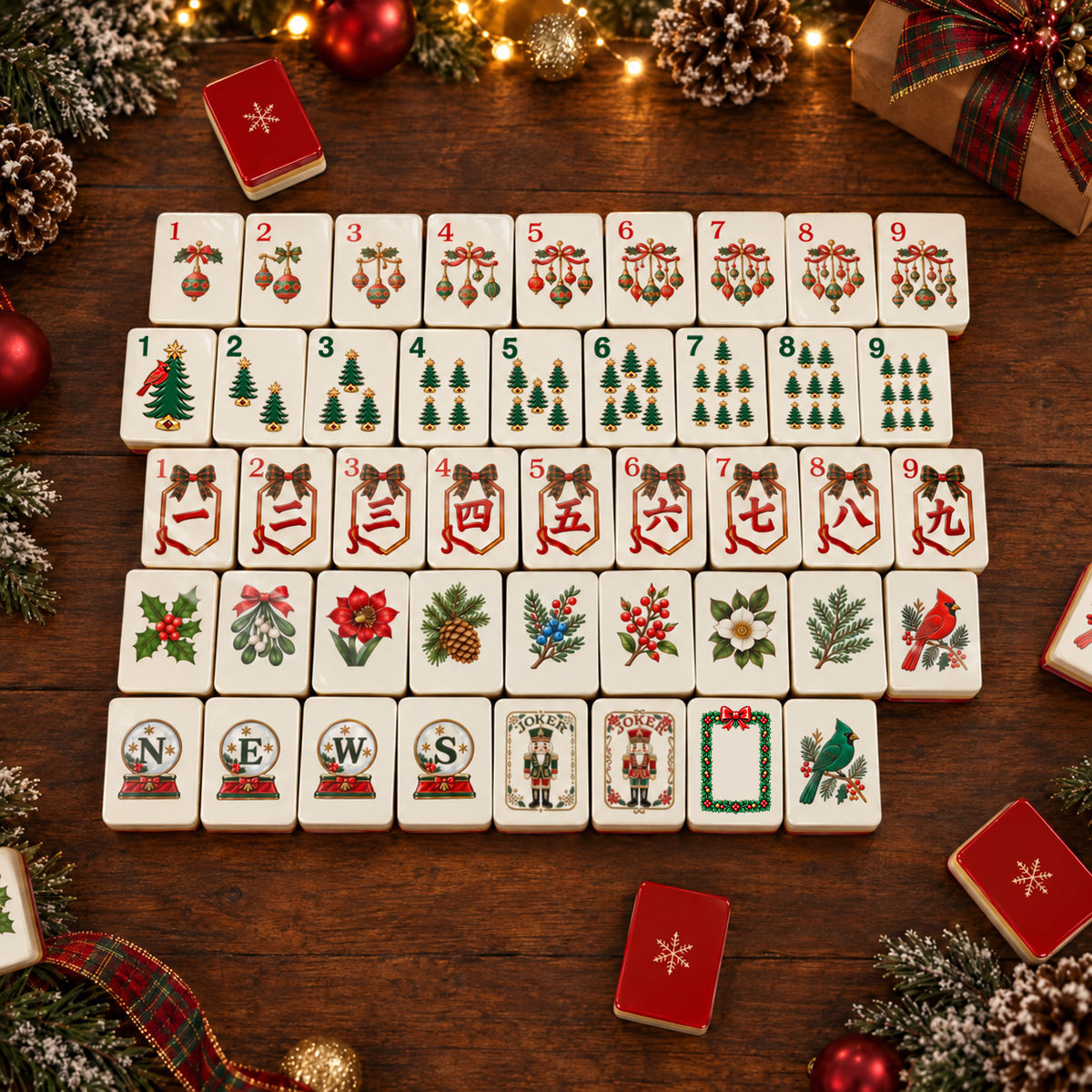
Shanghai mahjong scoring assigns "fan" (翻, multiplier levels) to completed hands based on tile patterns, bonuses, and rarity. A hand must contain a pair plus four melds (sequences called chows, sets called pungs or kongs). Each winning hand earns a minimum of 1 fan; common hands score 2–6 fans, premium hands reach 8+ fans or "limit" (a capped payout). The base point value (usually 20 or 30 per fan) multiplies by the number of fans, then doubles for each round wind the winner holds. Final scores depend on whether the winner drew from the wall or claimed a discard. Unlike American mahjong scoring, which reads from an annual card, Shanghai scoring is rules-based and consistent year to year, making it ideal for casual or tournament play where a standard set of 136 tiles (not 152) is used.
🀄 Shop best-selling mahjong sets →
How does Shanghai mahjong differ from American mahjong in scoring?
Shanghai mahjong uses a fan-based point system where bonuses and patterns multiply a base score, while American mahjong assigns fixed point values from the current year's National Mah Jongg League card. Shanghai requires only a pair and four melds (any mix of chows and pungs); American requires hands to match specific patterns on the card and forbids chows entirely. Shanghai allows jokers in limited roles; American uses jokers throughout. Shanghai typically plays 136 tiles; American always uses 152 tiles. Because Shanghai scoring is rules-based and fixed, not card-dependent, it suits international play and beginners who want predictable scores without memorizing a card.

What are the main fan categories and their point values?
The fan system in Shanghai mahjong organizes winning hands into tiers. A 1-fan hand (basic win, such as a simple pung-based combination) scores the base value—usually 20 points per fan at the start. A 2-fan hand (e.g., two pungs and a chow with a pair) doubles the base to 40 points per fan. 3-fan hands (mixed bonus patterns, like all honours tiles or a run of three consecutive numbers in one suit) triple the base. 6-fan hands ("all simples"—only number tiles 2–8, no terminals or honours) and 8-fan hands ("all terminals"—only 1 and 9 plus honours) reach limit payouts, which cap the score regardless of additional multipliers. Premium patterns—"all honours," "seven pairs," "thirteen unique terminal and honour tiles"—often count as limit hands automatically. Tables may apply a base of 20, 30, or even 40 points per fan; higher bases inflate final payouts. A 2-fan hand at 30 points per fan earns 120 base points before edge multipliers (payments from each opponent).
How do edge multipliers and round wind bonuses apply?
In Shanghai mahjong, the winner's payment depends on who paid and what bonuses applied. If you draw from the wall (a "self-draw" win), all three opponents each pay you the full calculated score. If you claim an opponent's discard, only that opponent pays you triple the calculated score; the other two pay nothing. Round wind bonuses add layers: if the winner or any opponent holds the current round's wind tile (East, South, West, or North in the rotation), that player pays an extra fan value. For example, if East wind is the current round and you (the winner) hold the East tile, you earn an extra 1 fan on top of your hand's base fans. If the discarder holds East, they pay an extra fan to you. This stacking creates steep penalties for keeping dangerous tiles.
Self-draw vs. discard table:
Scenario | Payout | Who Pays | Formula |
Self-draw, no bonuses | Base score | Each opponent | (Fans × Base value) × 2 (East) or ×1 (other winds) |
Discard claim, no bonuses | Base score × 3 | Discarder only | (Fans × Base value × 3) + wind bonus if held |
Self-draw + you hold round wind | Base + 1 fan | Each opponent | ((Fans + 1) × Base value) × 2 |
Discard + discarder holds round wind | Base × 3 + extra | Discarder | (Fans × Base value × 3) + (1 × Base value) |
Bonuses stack multiplicatively, not additively, which means a 2-fan hand with all the right bonuses can spiral into a 6+ fan equivalent payout quickly.
What are common scoring mistakes to avoid?
Mistake 1: Forgetting the East wind (banker) double. If the current East wind player wins, they multiply their final score by two before collecting from opponents. Many players miscalculate by adding 1 to fans instead of doubling the total—use multiplication. Mistake 2: Miscounting fans in mixed patterns. A hand with "one pung, one kong, two chows, one pair" might qualify for a 2-fan bonus if the pair is a dragon and a terminal—but only if the rules allow "bonus pairs." Verify your table's house rules before the round starts. Mistake 3: Paying the discarder and other opponents equally. The discarder pays triple; the other two pay the base. Writing the payment down before distributing tiles prevents disputes. Mistake 4: Applying bonuses retroactively. If you hold a wind and claim a discard, the wind bonus applies before the self-draw or discard multiplier. Calculate fans first, apply wind bonus, then apply the ×2 or ×3 multiplier. Mistake 5: Confusing limit hands with fan counts. If a hand qualifies as limit (e.g., "all terminals," "seven pairs"), the score is capped at the table's agreed limit value (often 500 or 1000 points), even if fan calculations would exceed it.

How do you calculate a winning payout step-by-step?
Here's a worked example. Assume base value = 30 points per fan, current round is East.
Scenario: You (East wind) self-draw a hand of 3 fans.
Base calculation: 3 fans × 30 points = 90 points.
East wind bonus: You hold East, so add 1 fan = 4 fans total.
New total: 4 fans × 30 points = 120 points.
Self-draw multiplier: You drew, so each opponent pays double = 120 × 2 = 240 points each.
Total received: 240 × 3 opponents = 720 points.
Scenario: You (West wind) claim a South opponent's discard, hand is 2 fans.
Base calculation: 2 fans × 30 points = 60 points.
You hold no bonus wind; South (discarder) holds no bonus wind = no change.
Discard multiplier: Only South pays, and pays triple = 60 × 3 = 180 points.
Other opponents pay nothing.
Scenario: You (South wind) self-draw 2 fans, and you hold the East wind bonus tile.
Base calculation: 2 fans × 30 points = 60 points.
Bonus: You hold East (even though South is current) = add 1 fan = 3 fans.
New total: 3 fans × 30 = 90 points.
Self-draw multiplier: 90 × 2 = 180 points each opponent (North, East, West pay separately).
Total received: 180 × 3 = 540 points.
Write these steps on paper before each game so all players agree on the calculation method.
🎁 See our most-loved mahjong sets & accessories →
What equipment do you need to play Shanghai mahjong smoothly?
Shanghai mahjong is played with 136 tiles (one copy of each compass wind, each dragon, 27 flower/season tiles, and a full suit of 1–9 in each of three suits, times four copies). Because Shanghai uses fewer tiles than American (152), a standard 160-tile set won't harm your game—you'll simply set aside extra jokers and blank tiles before dealing. However, dedicated Shanghai players often prefer a mahjong mat designed for clarity, since tracking fans and wind bonuses requires quick reference zones for melds and the score tracker. Racks with pushers help organize your hand as you build fan-eligible patterns, especially when a one-fan difference in counting costs you 30–60 points per opponent. Travel bags protect your set if you rotate games between players' homes; our best-selling collections include sets designed for both casual and serious play, all durable enough for weekly tables.
What's the best way to learn Shanghai scoring if you're switching from American mahjong?
Start by learning the seven core fan patterns: all simples, all terminals, all honours, all one suit, seven pairs, and limit hands. Write a one-page fan reference card listing each pattern, its fan value, and a one-tile example. Play practice hands (deal four complete 13-tile hands, lay one tile down as discard, then play out three winning scenarios—self-draw, discard, and bonus wind). Set a timer for 2 minutes per hand so you build speed. Play low-stakes games (1 or 2 points per fan) until you're confident in fan-counting; many players make their first mistakes under pressure when scores climb. Join a beginner-friendly community—libraries, community centers, and online meetup boards often host Shanghai sessions for learners. After 3–5 games, most players automate fan-counting and can calculate payouts in under 30 seconds.
✨ Find your Mahstead set — free US shipping →
What to check before you buy a Shanghai mahjong set
Tile count: Shanghai uses 136 tiles. A 160-tile set includes spares—set them aside before dealing; they don't affect play.
Tile size & engraving clarity: Ensure numbers and suits are dark and large enough to read at arm's length without squinting, especially if you track fans on paper.
Suit symbols: Confirm Bams (circles), Craks (characters), and Dots (dots) are consistent with your region's conventions—Shanghai typically uses traditional Chinese numbering, but international sets may differ.
Durability: Acrylic or resin tiles are more durable than bamboo for heavy weekly play; check that they won't crack or discolor after months of shuffling.
Packing: Make sure your set arrives in a padded case or bag so tiles don't shift during shipping. We ship free across the US and pack all sets securely.

FAQ
Is Shanghai mahjong faster to score than American mahjong?
Yes. Shanghai scoring is rules-based and fixed; American requires checking an annual card each hand. After 3–5 games, Shanghai players calculate payouts in 20–30 seconds. American players often spend 1–2 minutes per hand reading the card and verifying tile patterns, especially early in the season.
Can I play Shanghai mahjong with a 152-tile American set?
Yes. A 152-tile American set includes all 136 Shanghai tiles plus extra jokers and blanks. Before dealing, set aside the extra tiles and play with only the 136 Shanghai tiles. The game plays identically; you'll just have spares in the box.
What's the difference between a 1-fan and a 2-fan hand in real money?
Assume base value of 30 points per fan, self-draw, no bonuses. A 1-fan hand pays 30 × 2 = 60 points per opponent (180 total). A 2-fan hand pays 60 × 2 = 120 points per opponent (360 total). Doubling fans doubles the payout, so fan-counting accuracy directly affects your winnings.
Do all Shanghai tables use the same base point value?
No. Casual tables often use 20 or 30 points per fan; tournament tables may use 50 or higher. Agree on your base value before the first hand. A higher base amplifies payouts but doesn't change the relative scoring or fan-counting method.
How do you handle a tie (two players winning on the same discard)?
House rules vary. Most tables award the win to the player closest to the discarder in turn order (usually the player to the left). Some use a re-deal. Decide and announce this rule before starting; it prevents disputes.
Can you "go back" and change your fan count after paying?
No. Once money changes hands, the round ends. If you miscalculate, settle the difference in the next hand or replay the hand with correct scoring if all players agree. Many groups use a written score sheet to avoid mid-game disputes.


View More
View More
View More
