
Redeeming a Joker in Mahjong: Examples and Rules
Last updated: Nov 23, 2026
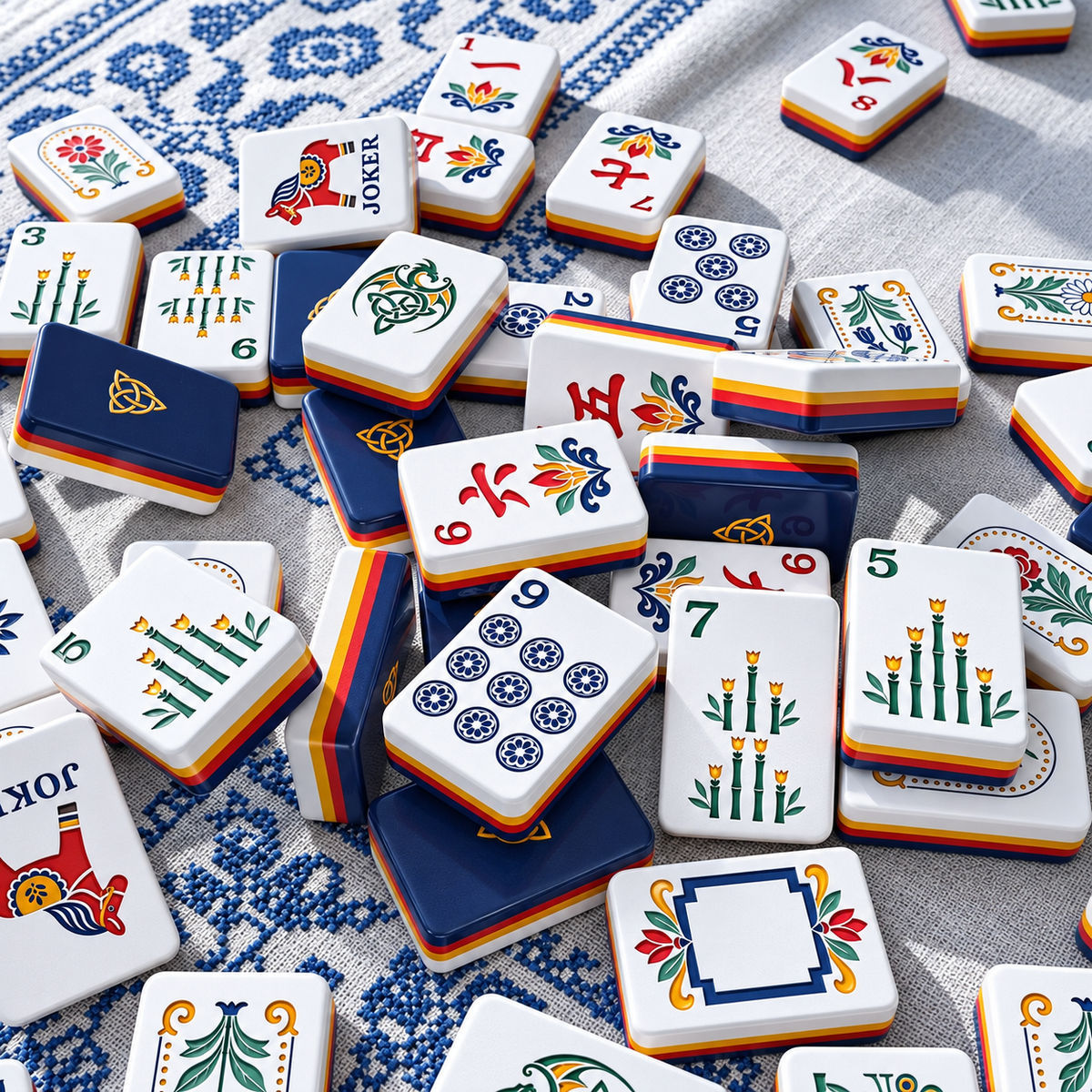
In American mahjong, a joker substitutes for exactly one tile during active play—either in your hand (hidden) or to complete an exposed pung (3), kong (4), quint (5), or sextet (6). You cannot use a joker in the pair, as a single loose tile, or with other jokers. When you redeem (replace) a joker from an exposed set on the table, you take the joker into your hand and it becomes available to substitute elsewhere. Each standard American mahjong set includes eight jokers among 152 playing tiles; extra jokers in our 160-tile sets give you spares if any become lost or worn. Understanding joker rules prevents disputes during play and keeps hands moving smoothly through the game.
In American mahjong, jokers are the game's most flexible tool—and the source of the most confusion around the table. Whether you're just learning or refreshing your memory after a season away, joker rules deserve clarity because one slip can stall an entire hand or spark a rules argument. We'll show you exactly how jokers work, walk through real-play scenarios, and explain the one rule that trips up most new players.
Can you use a joker in the pair?
No. American mahjong does not allow jokers in the pair—ever. The pair (or eye) is the foundation of every hand on the National Mah Jongg League card, and it must always be two identical tiles with no substitution. This is the single most important joker rule and the most commonly misunderstood. If you're holding a pair of 3 Craks and a joker, and you're one tile away from a complete hand, the joker cannot become the second 3 Crak for your pair. You must find the actual tile elsewhere or discard a different tile and keep hunting.

What exactly does it mean to redeem a joker?
Redeeming (or replacing) a joker means taking a joker that is sitting on the table in an exposed set (pung, kong, quint, or sextet) and swapping it for the tile it represents. For example, if three 7 Dots are on the table with a joker standing in for the fourth tile (a kong), you can call that kong and redeem the joker by removing the joker and placing the fourth 7 Dot in its place. You then take the joker into your hand, and it becomes available for any other substitution you need. This exchange happens only during active play—never in the Charleston or when drawing from the wall.
When can you redeem a joker from another player's set?
You can redeem a joker from an exposed set only after you have called or melded that set yourself. If another player has exposed a pung, kong, quint, or sextet with a joker, you cannot simply reach over and take their joker unless the rules of the hand or variant permit it. In standard American mahjong, once a set is exposed on another player's rack, the joker stays until that player redeems it (or the hand ends). However, in some regional variants or house rules, redemption may be allowed under specific conditions—always clarify this with your group before the first hand. In our weekly games, we play that you may only redeem jokers from your own sets or during the active draw-and-discard phase if a joker becomes exposed through standard play.
What happens if you run out of jokers mid-hand?
If all eight jokers are in use on the table or in players' hands and you need a joker to complete a set, you cannot proceed—unless you redeem a joker from one of your own exposed sets. This is one reason our best-selling mahjong sets come with spare jokers: a standard 152-tile set holds exactly eight jokers, but a 160-tile set includes extras so you're never caught short if a joker gets damaged or lost. Practically speaking, running out of jokers is rare in a four-player hand because players are redeeming them constantly. However, in shorter games or with aggressive melding, it can happen. The key is to track how many jokers are in play—in hand, on racks, and drawn but not yet played.
How does the joker rule differ across mahjong variants?
American mahjong strictly forbids jokers in pairs and limits their use to single substitutions in exposed melds. Chinese mahjong uses jokers differently—sometimes allowing them in pairs, in sequences (chows), and with looser substitution rules. Hong Kong mahjong traditionally uses no jokers at all, relying instead on the win conditions written in the standard card. Riichi (Japanese) mahjong has no formal jokers, though some casual games add them as house rules. Taiwanese mahjong and Western recreational variants each have their own joker logic. If you're learning a new variant, always ask your teacher or group to demonstrate a joker redemption before the first hand begins. Confusion about rules can derail a friendly game, so confirming "How do jokers work in your version?" is never wasted time.
Variant | Joker in Pair? | Joker in Sequence? | Use Case |
American | No | No | Substitute one tile in exposed pung/kong/quint/sextet only |
Chinese (Casual) | Sometimes | Sometimes | Depends on house rules—clarify before play |
Hong Kong | No jokers | — | Played without jokers; winning combos only per card |
Riichi | No | No | Not part of standard rules; house-rule add-on only |
Taiwanese | Varies | Varies | Regional rules differ; always confirm locally |

Why does your mahjong set quality matter for joker play?
When jokers are worn, chipped, or hard to distinguish visually from other tiles, joker rules become harder to enforce. If a joker looks faded or damaged, other players may misread it as a real tile, triggering disputes over whether a set is legal. High-quality engraved mahjong sets use clear, durable markings so jokers stand out unmistakably from numbered and honor tiles. Our acrylic sets are made to withstand hundreds of games without fading or cracking. Spare jokers in our 160-tile collections mean if one joker becomes worn or lost mid-season, you swap it out and keep playing. Poor tile quality doesn't just annoy players—it slows down hands, creates confusion, and turns a friendly game into a referee job. Invest in tiles you can trust.
🀄 Shop best-selling mahjong sets →
Step-by-step: Redeeming a joker in real play
Verify you have the actual tile. Before you redeem a joker from an exposed set on your rack, confirm you're holding (or are about to draw) the real tile it represents. Never redeem a joker unless you can immediately place the actual tile in its spot.
Announce your intention clearly. Say aloud: "Redeeming the joker for [tile name]." This prevents confusion and gives other players a moment to verify you're playing legally.
Remove the joker and place the real tile. On your rack, replace the joker standing in the set with the actual tile. The set now shows three or four (or more) of the same real tile with no substitution.
Take the joker into your hand. The joker becomes a resource you can use to complete another set, either an exposed meld or tiles in your concealed hand.
Continue play. You've now freed up one joker and strengthened one set. Track which jokers remain in play and which are back in circulation.
Never redeem into the pair. Even if you've just drawn the second tile of a pair, you cannot use a redeemed joker to replace one half. The pair must always be two real, identical tiles.
Common mistakes and how to avoid them
Mistake 1: Using a joker in the pair. We see this at least once a season. The pair is off-limits. Period. If you're in doubt, ask before you play—one question now beats a hand replay later.
Mistake 2: Forgetting jokers count toward your hand total. If you have three jokers in your hand and four tiles showing on your rack, you have seven tiles accounted for, not four. Keep a running mental tally so you know when you're one tile away from 14 (ready to win).
Mistake 3: Redeeming a joker then immediately discarding it. Redeem a joker only if you have a clear use for it—either another set you're building or a substitute you know you'll need. Pulling a joker into your hand just to discard it wastes that resource.
Mistake 4: Not announcing redemptions aloud. Silent tile swaps lead to "Wait, did you redeem that?" moments. Speak up. Clear communication is the foundation of every smooth game.
Mistake 5: Assuming house rules are the same everywhere. Joker rules can vary slightly depending on your city, club, or group. Before you join a new game, always ask, "How do jokers work at your table?" It's not insulting—it's professional.
What to check before you buy
Joker count and visibility. Confirm your set has at least eight jokers and that they're visually distinct from real tiles (often marked with a symbol or different color). Check the product images online so you know what to expect.
Spare jokers for the season. A 160-tile set includes extra jokers beyond the standard eight, reducing risk if one gets damaged mid-season.
Tile durability. Acrylic tiles resist fading and chipping far better than bamboo or plastic. Jokers that stay crisp and clear prevent rule disputes and speed up play.
Racks and pushers that fit. If your jokers look different in size or feel slippery on your rack, it signals a lower-quality set. Quality sets from our best-selling collection are engineered so every tile—including jokers—sits securely and plays smoothly.
🎁 See our most-loved mahjong sets & accessories →
How to explain joker rules to new players
Before the first hand, set aside two minutes to walk a newcomer through jokers:
"Jokers replace one tile in a set you've exposed on your rack. You can't use them in the pair or as a single loose tile."
"When you draw a real tile and you have a joker standing in for it, you can swap them. The joker comes into your hand; the real tile stays in the set."
"You have eight jokers per hand. When they run low, you start redeeming them more often."
Demonstrate with tiles. Show three 5 Bams and a joker standing in as the fourth. Then show how you'd redeem: swap in the fourth 5 Bam real tile, take the joker into your hand.
This takes 90 seconds and saves confusion for the whole game. Most new players grasp joker rules instantly once they see them in action.
To deepen your understanding of how jokers fit into the broader game, read our complete guide to how jokers work and revisit our full primer on how to play American mahjong. Both cover the rules, the strategy, and the common pitfalls that trip up even experienced players returning after a break.
If you're hosting games regularly or want to upgrade to a set that makes joker play crystal clear, explore our full range of sets and accessories. Quality tiles and reliable racks with pushers transform the experience and eliminate the small frustrations that slow down joker exchanges and meld verification.
✨ Find your Mahstead set — free US shipping →

FAQ
Can a joker ever represent a flower or a blank tile?
No. Jokers substitute only for numbered tiles (1–9 in each suit) and honor tiles (winds, dragons). Flowers are their own tiles and cannot be replaced. Blank tiles in spare sets are not in play.
What if I accidentally expose a joker before I'm ready to use it?
If a joker falls on the table or becomes visible during a non-play moment (Charleston, waiting for your turn), inform the group immediately. Most house rules treat an exposed joker like any other exposed tile—you may use it immediately or it becomes subject to the group's rule for exposed tiles. Always clarify your group's policy before the first hand.
Can I redeem a joker from my own exposed set and immediately discard a different tile?
Yes. Redeem the joker into your hand, then on your turn, discard any tile you wish (joker or otherwise). Redeeming a joker does not lock you into any discard; it simply moves the joker into your hand where you control it.
If two players want the same tile to redeem a joker, who gets it?
In American mahjong, redemptions happen on each player's turn in sequence (East, South, West, North). If the tile is discarded on your turn, you decide whether to redeem a joker with it or discard it. If another player has already called it before your turn ends, you cannot redeem it. Turn order and the discard sequence determine priority.
Are there any hands on the annual card that forbid joker use?
The National Mah Jongg League card lists hands by category and pattern. The card itself does not explicitly forbid jokers; however, some hands are designed so that joker use makes them illegal (for example, a hand requiring all four 5 Craks as a pung cannot use a joker in place of one of them—you must have all four real tiles). Always verify a hand's legality before calling it, especially if jokers are involved. When in doubt, hold the card, point to the hand, and ask: "Is this legal with a joker here?"


View More
View More
View More
