
Quint Mahjong Rule Explained: How 5-Tile Melds Work
Last updated: Nov 23, 2026
A quint is exactly five identical tiles (e.g., five 7 Dots, five West Winds, or five Jokers substituting for five identical tiles) exposed together as one meld during play. In American mahjong, you may expose only four types of melds: pungs (3 identical), kongs (4 identical), quints (5 identical), and sextets (6 identical)—no sequences or chows allowed. Quints appear on the current-year National Mah Jongg League card as named patterns; you build them by drawing tiles or picking up a discard that completes the set. Unlike a pung or kong, a quint ties up five tile slots in your hand, so they're less common in winning hands but crucial on certain card patterns. Learn the complete rules at our how-to-play guide, and see our best-selling mahjong sets for the tiles you'll need to practice. 🀄 Shop best-selling mahjong sets →
What exactly is a quint?
A quint is five of the same tile—same number, same suit, same wind, or same dragon. For example: five 3 Bams, five North Winds, or five Red Dragons. You expose it as a single meld on the table, taking up five spaces on your rack and five spaces in the discard history. Unlike a pung (3) or kong (4), a quint eats more tiles but delivers more points if it's on your winning hand on the card.

How does a quint differ from a pung, kong, or sextet?
Pattern | Tile count | How common | Tile cost | Used on many card patterns? |
Pung | 3 identical | Very common | Low | Yes; easiest to build |
Kong | 4 identical | Common | Medium | Yes; standard in many hands |
Quint | 5 identical | Uncommon | High | Seldom; specific patterns only |
Sextet | 6 identical | Rare | Very high | Very rarely; luxury patterns |
A pung is the quickest meld to complete and appears in most hands. A kong is stronger and ties up four tiles but is still manageable because fewer card patterns require six or more of the same tile in one hand. A quint demands that you commit five tiles to one pattern—risky if the hand doesn't come together. A sextet is even more extreme: six identical tiles almost never fit a practical hand.
When can you call or expose a quint?
You expose a quint exactly the same way as a pung or kong: when you draw a tile that completes the set, or when another player discards a tile you need. You place all five tiles face-up on the table in front of your rack. Once exposed, your hand is locked into that pattern; you cannot hide it or break it up. If the quint is part of your winning hand on the current-year card, it scores as named. If it's not on the card for your hand, it's still counted as a legal meld but earns no special bonus—you only score for the completed hand itself.
🎁 See our most-loved mahjong sets & accessories →
Where do you find quints on the National Mah Jongg League card?
The annual card groups hands by section: pairs, eyes, chows, pungs, kongs, quints, and combinations. Hands featuring quints are usually isolated on dedicated lines or clearly marked as "quint patterns." Because quints require five identical tiles—and the American set has exactly four copies of most tiles—a quint often includes one or more Jokers standing in for a tile. For instance, a hand might call for five 5 Dots: you'd hold the four actual 5 Dots in the set plus one Joker as a substitute fifth 5 Dot. Study how to read the mahjong card to spot quint patterns quickly; they're usually easier to spot than you'd think once you know what to look for.
What common mistakes do new players make with quints?
Mistake 1: Confusing quints with Joker-only patterns. A quint must contain at least one real tile. You cannot make a quint of five Jokers alone; Jokers fill in for missing real tiles. If your hand calls for five 3 Craks and you own only three real 3 Craks, you add two Jokers to complete it—now you have a legal quint.
Mistake 2: Trying to build a quint without checking the card. Many players expose a four-tile kong and then hope to draw a fifth matching tile—only to discover the current card has no quint that includes that pattern. Save Jokers and tile draws for hands named on the card. Never build toward a quint unless it's part of your planned winning hand.
Mistake 3: Forgetting that quints block your flexibility. Once you expose a quint, you're committed to a specific hand. If that hand fails to come together, you've wasted five tiles and can't pivot to a faster backup. Pungs and kongs are safer bets early in the game because more hands use them.
Mistake 4: Using a Joker wrongly in a quint. Jokers in a quint must stand in for a specific real tile. You cannot use a Joker as a "wild any tile" inside a quint. If your hand calls for five 2 Bams and you only have two real 2 Bams, you add three Jokers, each one locked into that role as a 2 Bam. If you later need a Joker to be a 7 Dot instead, you're out of luck—Jokers don't move once exposed.
Why are quints rarer than other melds in American mahjong?
The core reason: tile math. American mahjong uses 152 playing tiles, and nearly every tile type exists in exactly four copies. A pung uses three copies, leaving one in reserve. A kong uses all four. A quint needs five—which forces you to use a Joker. Since the set contains only eight Jokers total and most winning hands require several Jokers in other places (completing shorter melds, standing in for pairs, filling gaps), committing two to four Jokers to a single quint is expensive. Compare this to Chinese or Hong Kong mahjong, where some variants run 144 or 152 tiles with different ratios of dragons and winds—and where quints or longer sequences might not be legal at all. American mahjong is unique in allowing exposed quints and sextets, which makes them possible but costly.
How do you score a quint on the card?
When your quint is part of your completed winning hand, the card line assigns it a point value, usually ranging from 20 to 60 points (or more in special cases). The point value depends on the hand pattern the quint is embedded in, not the quint alone. For example, one line might say "Quint of Winds + Pair of Dragons + Pung of Bams" and assign it 40 points; another might offer a different quint pattern for 25 points. You read the hand off the card, verify every tile matches, and claim the score. If your five-tile meld is not listed as a quint on any card pattern, it's still a legal exposed meld but contributes no bonus—you score only the full hand itself. See our scoring guide for step-by-step examples.
What should you check before you buy a set to practice quints?
Joker count and condition. Since quints eat Jokers, you want a set with clearly marked, easy-to-spot Jokers that won't smudge or fade. Our best-selling acrylic sets use durable, laser-engraved markings so Jokers stay legible through months of play.
Tile grip and visibility. If tiles are slippery or small, you'll struggle to hold and organize a five-tile meld neatly on your rack. Acrylic tiles with beveled edges grip the rack better than smooth bone or bamboo.
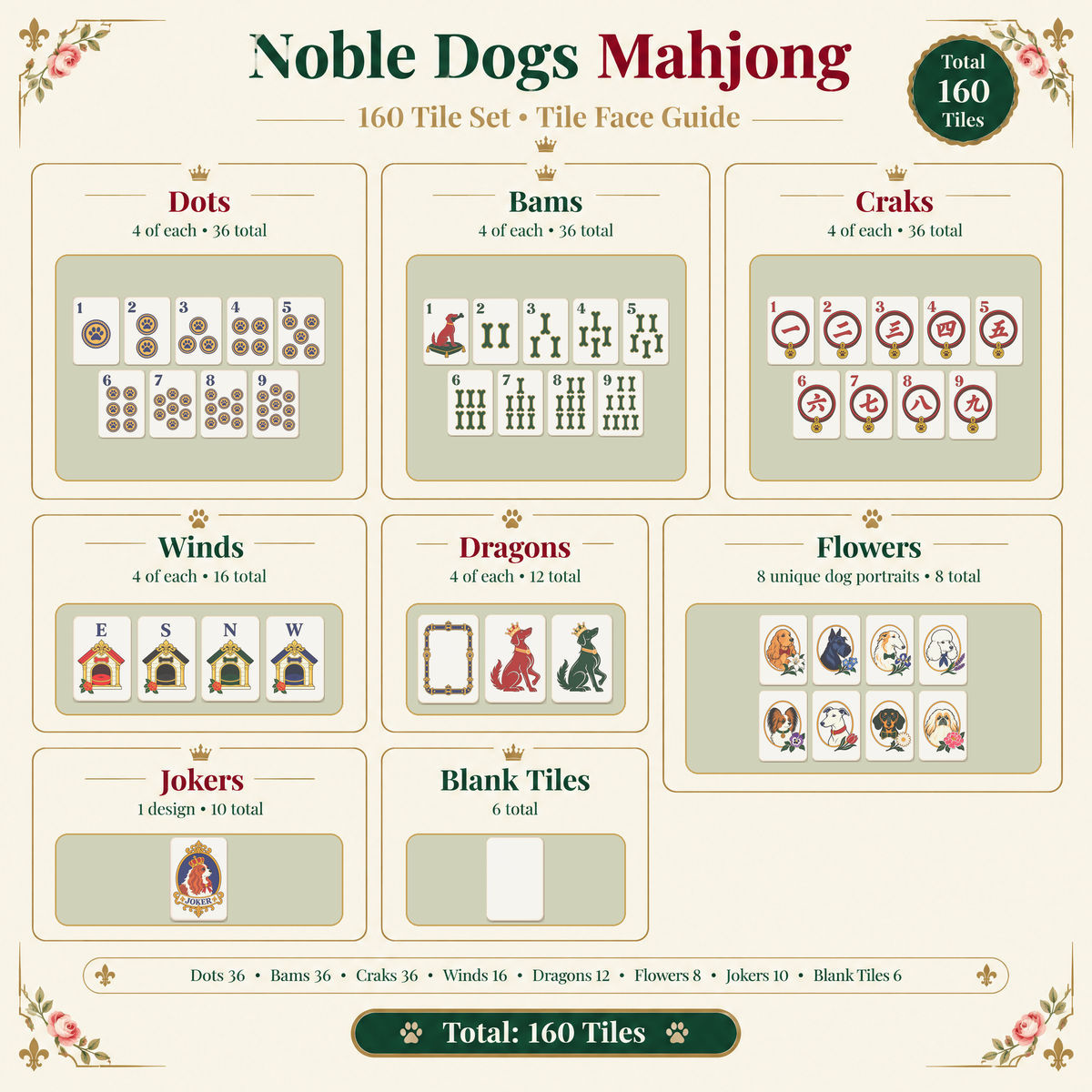
Spare Jokers. A standard 160-tile set includes spare tiles beyond the 152 used in play. Check that replacements are on hand if a Joker cracks or fades.
A clear card. Make sure your set comes with the current year's National Mah Jongg League card (issued every spring), printed large enough to read quickly. Quint patterns are easier to spot when the card is legible.
✨ Find your Mahstead set — free US shipping →
Quint-spotting checklist for your next game
Read the card before the game starts. Highlight or circle all lines featuring quints so you recognize them instantly.
Count your Jokers at the start. Note how many you have; if you commit three to a quint, only five remain for the rest of your hand.
Verify the pattern on the card before you expose the meld. Don't expose a five-tile set unless the card shows that exact pattern.
Check that all five tiles are identical. A "5 Dot + Joker + 5 Dot + Joker + 5 Dot" is a legal quint (three real tiles, two Jokers as stand-ins). A "5 Dot + 5 Dot + 6 Dot + Joker + Joker" is not a quint.
Once exposed, don't rearrange the quint unless the rules of your group allow it (most groups do not).
FAQ
Can a quint ever be a pair of Jokers plus three real tiles?
No. A quint must be five identical tile values. Two Jokers standing in for two of those five tiles, plus three real tiles, equals five of the same thing—a legal quint. But you cannot use a Joker as itself in a quint; Jokers only fill in for real tiles.
Is a quint ever better than a kong in American mahjong?
Only if the card names it. A kong is easier to build and more flexible because more hands use kongs. A quint is worth it only when the card shows a specific winning hand that includes a quint and you can actually build it.
What happens if I expose five tiles but the card says the hand needs a sextet (six)?
You've made a mistake. Once exposed, the meld is locked. Your hand would fail because it doesn't match the card line. Never expose a meld unless you're certain it matches the pattern on the card.
Can I use five Jokers as a quint?
No. Jokers cannot form a meld on their own. They only stand in for real tiles. Five Jokers with no real tiles underneath them is not a legal meld.
If I expose a quint on the wrong hand, can I expose a different hand to win?
No. Once you expose a meld, your hand is frozen into that pattern. You must complete the hand you've declared (usually by calling "mahjong" when you draw or pick a winning tile), or you're out for that round.
How many quints might appear on a single year's card?
It varies. Some years feature 10–20 lines with quints; other years fewer. The card is designed to balance pung-heavy hands with kong and quint patterns so players see variety across the season.


View More
View More
View More
