
News Hand Mahjong Rule Explained: American Play Step by Step
Last updated: Nov 23, 2026
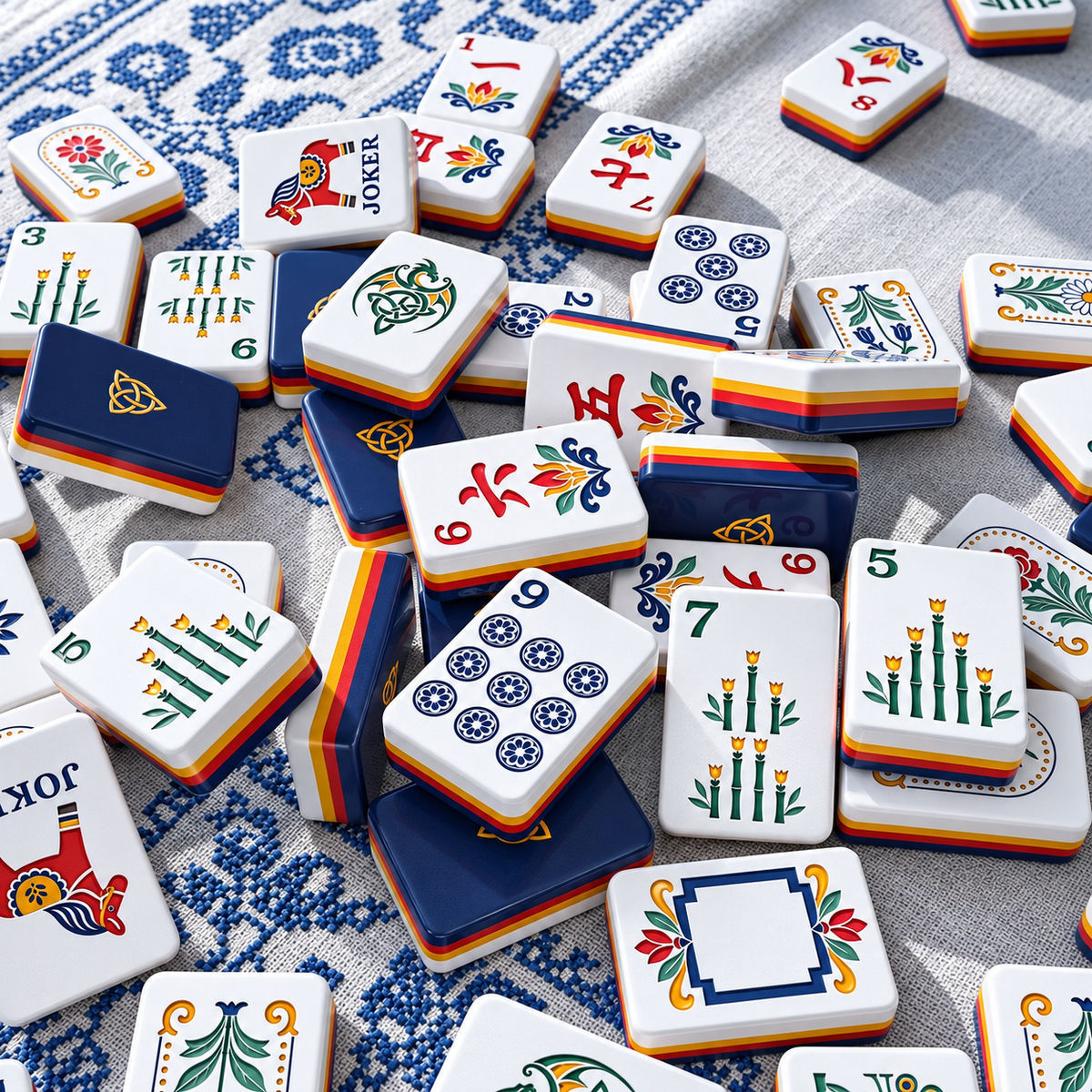
A news hand is any winning tile combination that appears on the current year's National Mah Jongg League card in American mahjong. The card, issued every spring, contains all legal hands for that season; if your tiles match one hand exactly—suit, number, exposure type, and position—you have won. News hands come in patterns: pairs with pungs, sequences of different melds, or specific numbered combinations. You may not invent hands; American mahjong allows only card-listed combinations. The hand must use exactly 14 tiles (13 in hand plus 1 drawn or called), with jokers standing in for missing tiles only where the card permits. When you have a news hand, you declare "Mahjong," stop play, and score based on the hand's difficulty level listed on the card. Mahstead's 160-tile sets are built to the standard American count needed for any news hand.
A news hand in American mahjong is any winning tile combination printed on the current year's National Mah Jongg League card. The card, issued each spring, is the rulebook of legal hands; without it, you cannot win. Every hand shown follows strict patterns: a pair (2 identical tiles) plus four melds (sets of 3, 4, 5, or 6 matching tiles), jokers filling gaps where allowed. You may never create a hand on the fly or play tiles that form a sequence the card does not list. If your 14 tiles (13 kept, 1 drawn or called) match a card hand exactly in suit, number, and meld structure, you declare "Mahjong" and win. The hand's point value appears next to its pattern; higher-numbered melds score more. Understanding news hands means learning to read the card, spot patterns in your tiles, and avoid common declaration mistakes.
How do you read a news hand off the card?
The National Mah Jongg League card divides hands into sections (often by complexity or meld type). Each row shows one hand: a pair symbol, then four melds separated by spaces. Numbers represent tile counts (1–9), letters stand for suit abbreviations (B = Bam, C = Crak, D = Dot), and Wind or Dragon symbols fill specific positions. Jokers are marked with an asterisk or symbol showing they may replace a tile in that meld. Your job is to scan the card until your 14 tiles match one hand exactly. For example, a hand might read "pair of 5D, pung 3B, pung 4B, quint 7C*, kong 2D"—meaning two 5 Dots, three 3 Bams, three 4 Bams, five 7 Craks (one as a joker), and four 2 Dots. If your hand does not match any card pattern in suit and number, you have not won; you must discard and wait. Learning to read the card fast takes practice; many players keep a finger on their section and scan left to right as they draw tiles.
🀄 Shop best-selling mahjong sets →

What is the difference between a pung, kong, quint, and sextet in a news hand?
In American mahjong, only four meld types appear on the card: pungs (3 identical tiles), kongs (4 identical), quints (5 identical), and sextets (6 identical). A pair is always 2 identical tiles and must appear exactly once per hand. No sequence of different numbers (like 1-2-3) may be exposed; only identical tiles form legal melds. If a card hand calls for a pung, you must have three of the exact same tile—for instance, three 7 Dots, not 7 Dot plus two jokers posing as 7 Dots. Jokers substitute only where the card explicitly marks them with an asterisk or symbol. A kong counts as four identical; a quint as five; a sextet as six. These melds grow in point value: a quint scores higher than a pung because it uses more tiles and is harder to complete. When you draw a tile, count how many copies you hold; if you have all four copies of a tile, you have a kong.
Can you use jokers in a news hand?
Yes—jokers (marked on the card with an asterisk or special symbol) replace missing tiles, but only where the card permits and never in a pair. If a news hand shows a pung with a joker mark, one of your three tiles may be a joker standing in for the true tile. Jokers are wild only in that specific meld; you cannot move them or use them in multiple melds. For example, if you need a pung of 3 Bams and a joker is marked in that meld, you might hold two 3 Bams and one joker. If the card does not mark a joker in a meld, you must have all true tiles; a joker in an unmarked meld is illegal. Never use a joker in a pair; pairs must be two identical true tiles. Understanding how jokers work prevents costly errors—and many players accidentally declare hands with illegal jokers.
What happens if you declare a hand that is not on the card?
If you declare "Mahjong" with a hand that does not appear on the current year's card, you lose play immediately and must sit out one round (called going "dead"). In some groups, you also pay a penalty to each player. This is one of American mahjong's strictest rules: the card is the absolute law. Before you declare, double-check three things: the pair is correct (two identical tiles), each meld matches the card in suit and number, and you use exactly 14 tiles (13 in hand, 1 drawn or called). A common mistake is confusing hands that look similar; two hands may both have a 5 Dot pair and three Bam pungs, but arranged differently on the card, making them distinct hands. Ask another player to verify your hand if you are unsure; there is no penalty for asking. Once you declare, the round ends; if your hand is wrong, the loss is permanent for that round.

What is the difference between American, Chinese, and Riichi news hands?
American mahjong is the only variant that uses a card-based system for news hands. The National Mah Jongg League card lists all legal hands for the year; players must match tiles to the card exactly. In Chinese mahjong (often called Cantonese or Hong Kong mahjong), there is no card; instead, players learn hand patterns by memory and tradition. A news hand in Chinese mahjong is still a winning combination, but the rules for melds differ: Chinese mahjong allows chows (sequences like 1-2-3 of the same suit), which American mahjong forbids. Riichi mahjong (Japanese) also has no card; it uses a point system called fu and han, scoring hands by their complexity and tile count. Taiwanese mahjong blends elements of Chinese and American styles. If you play American mahjong, you must use the card and know only identical-tile melds (no sequences). If you switch to Chinese or Riichi, the hand structures, scoring, and strategy change entirely. Most players specialize in one variant; mixing them at the table causes confusion.
Variant | Pair + Meld System | Melds Allowed | Uses a Card? | Scoring Basis |
American | Pair + four identical-tile melds | Pung, kong, quint, sextet only | Yes (annual) | Card-listed points |
Chinese/Cantonese | Pair + three melds | Pungs, kongs, chows | No | Hand complexity, fu/han |
Riichi/Japanese | Pair + four melds | Pungs, kongs, chows | No | Fu, han, yakuza |
Taiwanese | Pair + melds (varies) | Mixed (depends on house rules) | Partial/optional | Varies by region |
🎁 See our most-loved mahjong sets & accessories →
How do you prepare for learning news hands?
Start by getting a current year's National Mah Jongg League card and a set of American mahjong tiles. Familiarize yourself with suit abbreviations, Wind and Dragon symbols, and how joker marks appear on your card. Play several practice rounds with experienced players who can walk you through hand recognition in real time. Sit near the player who declares so you see what a valid hand looks like. Many players begin by learning the most common hands (pairs with simple pungs and kongs) before attempting complex ones with quints, sextets, or mixed melds. Spend 10–15 minutes each week scanning the card without tiles in hand, pointing to patterns and saying them aloud: this builds muscle memory. When you draw tiles, use a rack or holder to organize them by suit and number; this makes spotting matches faster. Take notes on hands you almost formed; over time, you will recognize patterns more quickly. Joining a beginner-friendly game or club is invaluable—real play teaches faster than studying alone.
What do you need to play American mahjong news hands?
To play and declare news hands, you need a best-selling mahjong set with the full 152 playing tiles (plus spares), the current year's National Mah Jongg League card (available from the League or most mahjong retailers), a rack or tile holder for organizing your tiles, and ideally a mat to define the play space clearly. A 160-tile set gives you spare tiles; if one is damaged, you replace it without stopping play. A rack with pushers helps you sort tiles fast and prevents accidental exposure. A mat marks the wall, discard area, and meld spaces, making hand-reading easier for all players. Our mahjong racks with pushers are designed to hold tiles upright and allow quick sliding as you form and check melds. For traveling or storing your set, a mahjong bag or case protects tiles from damage and keeps the card, dice, and racks organized.
✨ Find your Mahstead set — free US shipping →
What to check before you declare a news hand
Before you call "Mahjong," verify these five points in order:
Pair check: Are your two tiles identical (same suit and number)? No joker may be in a pair.
Meld count: Do you have exactly four melds (each a pung, kong, quint, or sextet)?
Card match: Do your pair and four melds appear together on the card as a single hand?
Joker legality: Is every joker in your hand positioned where the card marks one with an asterisk or symbol?
Tile count: Do you hold exactly 13 tiles in hand plus the 1 tile you just drew or called? (Total = 14.)
If all five check, declare. If any fails, discard and continue. Many players skip the card-match step and declare early, leading to a dead hand. Take two seconds to scan the card; it prevents costly penalties.

FAQ
Can I win with a hand I made up if it looks logical?
No. American mahjong allows only hands listed on the current year's card. Any invented hand, no matter how sensible, results in a dead hand and a penalty round.
What happens if the National Mah Jongg League updates the card mid-year?
The card is fixed each spring; groups play the entire season with the same card. A new card is not issued until the following spring.
If I have four Winds, is that automatically a news hand?
Not necessarily. Four Winds must match a specific hand on the card in combination with a pair and three other melds. Four Winds alone do not make a hand; check the card.
Can I use more than one joker in a single meld?
Only if the card marks more than one joker asterisk in that meld. Most melds allow zero or one joker. Check the card symbol closely.
Is the news hand rule the same in all American mahjong groups?
Yes. The National Mah Jongg League card is the standard for American mahjong; all groups use the same card and rules for news hands.


View More
View More
View More
