
Mahjong vs Mahjong Solitaire: Key Differences Explained
Last updated: Nov 23, 2026
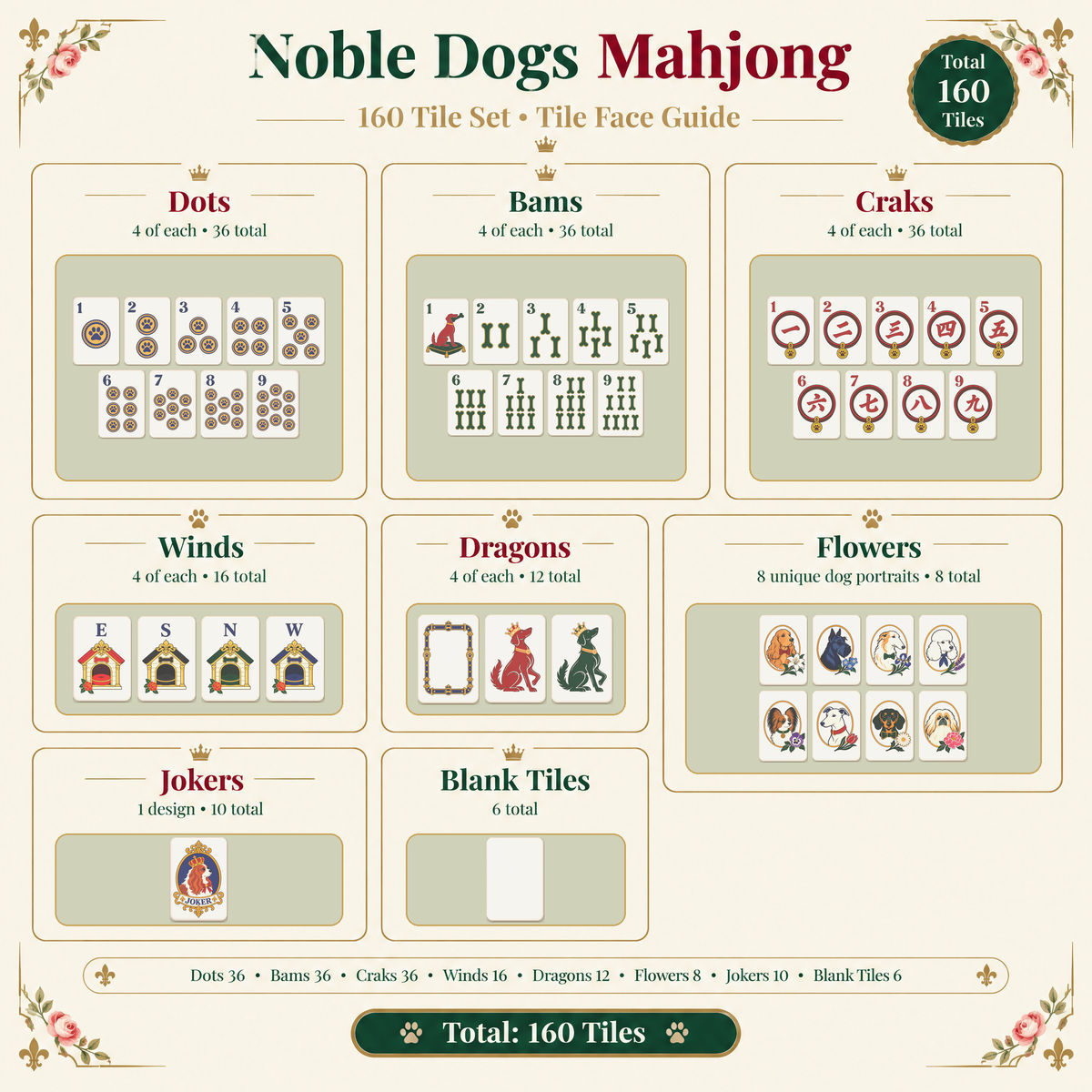
Mahjong is a four-player competitive tile game requiring strategy, memory, and luck—played with 152 tiles, based on a seasonal hand card, and won by completing a specific pattern first. Mahjong solitaire is a single-player pattern-matching puzzle (digital or physical) where you match and remove pairs of identical tiles until none remain; no hand card, no opponents, no turn structure. American mahjong uses Bams, Craks, Dots, Winds, Dragons, Flowers, and Jokers; solitaire typically uses only a simpler tile set. The traditional game takes 30–90 minutes per round and demands knowledge of rules and scoring. Solitaire is casual, meditative, and ends when you succeed or exhaust possible moves. If you're learning group play, start with the mahjong-for-beginners pillar and a best-selling acrylic set designed for weekly games.
American mahjong is a four-player competitive tile game requiring strategy, memory, and luck—played with 152 tiles, based on a seasonal hand card, and won by completing a specific pattern first. Mahjong solitaire is a single-player pattern-matching puzzle (digital or physical) where you match and remove pairs of identical tiles until none remain; no hand card, no opponents, no turn structure. American mahjong uses Bams, Craks, Dots, Winds, Dragons, Flowers, and Jokers; solitaire typically uses only a simpler tile set. The traditional game takes 30–90 minutes per round and demands knowledge of rules and scoring. Solitaire is casual, meditative, and ends when you succeed or exhaust possible moves.
How many players and what's the goal?
American mahjong requires exactly four players; each sits at a table, draws and discards tiles in turn, and races to complete a hand pattern listed on the current year's National Mah Jongg League card. The winner is the first to "go mah jongg"—exposing a complete, legal hand. Mahjong solitaire is one player removing matching tile pairs from a preset board until the board is empty (a win) or no legal moves remain (a loss). In traditional mahjong, success requires reading opponents, tracking discards, and managing luck. In solitaire, the only opponent is probability—you're working out a puzzle, not competing.

What tiles and equipment do you need?
A traditional American mahjong set contains 152 tiles: three suits (Bams, Craks, Dots numbered 1–9, four of each = 108 tiles), 16 Winds (four each of North, East, West, South), 12 Dragons (four Red, four Green, four White), 8 Flowers, and 8 Jokers. A best-selling Mahstead set includes engraved acrylic or bamboo tiles, a mat with rack spaces, and often racks with pushers to hold your hand upright. Mahjong solitaire boards vary widely: some use the same 152 tiles arranged in a specific pyramid or tower layout; others use a simplified deck of 72 or 144 tiles in a two-dimensional pattern. Digital solitaire needs only a screen. For traditional play, you'll also need a durable mat to protect tiles and define dealer/player positions, and a travel bag or case if you host games weekly. Solitaire requires nothing beyond the tiles or app.
How long does each game take?
A single round of American mahjong typically lasts 20–45 minutes; a full session (four rounds) is 2–3 hours. Players sit for the entire round whether they win or lose. Most weekly games run 2–4 hours with breaks. Mahjong solitaire is flexible: a single puzzle ranges from 5–20 minutes, and you can play as many rounds as you wish without delay. There is no waiting for other players or turn sequence; you move at your own pace. If you're hosting a group, traditional mahjong demands commitment and scheduling; solitaire is a pick-up-and-play activity for downtime.
What rules and strategy matter?
American mahjong is governed by strict rules. You draw one tile per turn, discard one, and may only expose (lay down face-up) pungs (three identical tiles), kongs (four identical), or longer melds—never a pair, and never sequences like 1-2-3 (called "chows" in other variants). Your winning hand must match exactly one pattern from the current year's hand card. Jokers can substitute in melds but never in a pair. Scoring depends on hand type, and disputes are settled by the card. Mahjong solitaire has no complex rules: you simply remove identical adjacent tiles—often from the surface of the layout—until you clear the board or get stuck. Strategy involves looking ahead to avoid trapping tiles, but there is no hand card, no scoring system, and no penalties. Traditional mahjong demands study; solitaire is intuitive.
Why choose one over the other?
Scenario | Best choice | Why ---|---|--- Learning a new social skill | American mahjong | Builds memory, reading, and group play; weekly games deepen friendships. Quick, solo relaxation | Mahjong solitaire | No learning curve; meditative; play anytime, any length. Hosting regular game nights | American mahjong | Structured, competitive, replayable; invest in a durable set and mat. Casual travel entertainment | Mahjong solitaire | Light, portable digital app or mini tile set; no opponents needed. Family gathering | American mahjong | Intergenerational bonding; same rules for everyone; engraved sets add keepsake value.
The choice hinges on whether you want social play and structure (traditional mahjong) or solitary puzzle-solving and flexibility (solitaire). Many players enjoy both.
🀄 Shop best-selling mahjong sets →
How do you learn each game?
Traditional American mahjong requires reading the National Mah Jongg League card (released each spring) to understand which hand patterns are legal that year. You'll need to learn tile names, the Charleston (the opening tile-passing ritual), draw-and-discard order, and how to read a card's hand notation. Most new players join a beginner class or weekly group where an experienced player coaches them through a few rounds. Our how-to-play American mahjong guide covers rules and the Charleston step-by-step. Mahjong solitaire is intuitive: you match two identical tiles, they disappear, and you continue until the board is clear or stuck. Most apps teach the mechanic in seconds. For traditional play, expect 4–8 weeks of regular games before you're truly comfortable; solitaire mastery takes minutes but success on hard layouts takes trial and error.
🎁 See our most-loved mahjong sets & accessories →
What mistakes should you avoid?
In traditional mahjong, new players often forget that jokers can't replace a pair, misread the hand card's notation, or discard tiles that block their own win. Keep a printed hand card handy and ask experienced players to review patterns you're unsure of. Avoid playing too fast; speed comes after dozens of games. In mahjong solitaire, common errors include trapping tiles by removing pairs that block future moves—always scan the board first before matching. With digital versions, the app usually prevents illegal moves, so you mainly manage strategy. For traditional play, using a quality set on a stable mat prevents accidental tile shifts that can derail a hand. For solitaire, there's no equipment risk; just take your time.
What to check before you buy:
For traditional mahjong: Do you have a regular group or plan to host one? Buy a 152-tile acrylic or bamboo set plus a mat and racks with pushers. Budget for a travel case if you move sets between homes or friends' houses.
For mahjong solitaire: If physical tiles, ensure the layout matches your skill level (pyramids are harder than flat spreads). If digital, download from a trusted app store and check ratings. No hardware investment needed.
Hybrid approach: Many players own a traditional set for group nights and play solitaire on their phone during commutes—best of both worlds.
✨ Find your Mahstead set — free US shipping →

FAQ
Can you play traditional mahjong with two or three people?
Yes, but rules must adapt—one player takes a dummy hand, or you reduce tiles and modify the hand card. Most groups prefer four; see our 2 and 3 player rules guide for specifics.
Is mahjong solitaire the same as "Shanghai" or "Taipei" mahjong?
No. Shanghai and Taipei are traditional variants played by four humans with strategy and opponents. Solitaire is a solo puzzle that happens to use mahjong tiles but shares no gameplay mechanics.
Do I need to know Chinese to play traditional mahjong?
No. American mahjong tiles are numbered 1–9; winds and dragons are labeled in English. The hand card uses English notation. You don't need any Chinese knowledge to learn.
What's the smallest mahjong set I can buy?
A standard American set contains 152 tiles. Sets sold with 160 tiles include spares (extra jokers and blanks) but play with the same 152-tile core. Smaller portable sets exist but aren't standard for American mahjong rules.
Can I practice traditional mahjong alone before joining a group?
You can study the hand card and learn tile names solo, but you can't simulate real play—traditional mahjong requires opponent behavior and discard tracking. Join a beginner class or casual group first; most welcome new players gladly.
Why is the current year's hand card so important?
The National Mah Jongg League releases a new card every spring with updated hand patterns. Only hands on that year's card are legal in play. This keeps the game fresh and ensures fairness across groups.


View More
View More
View More
