
Mahjong Solitaire Tips: Win More Hands Every Game
Last updated: Nov 23, 2026
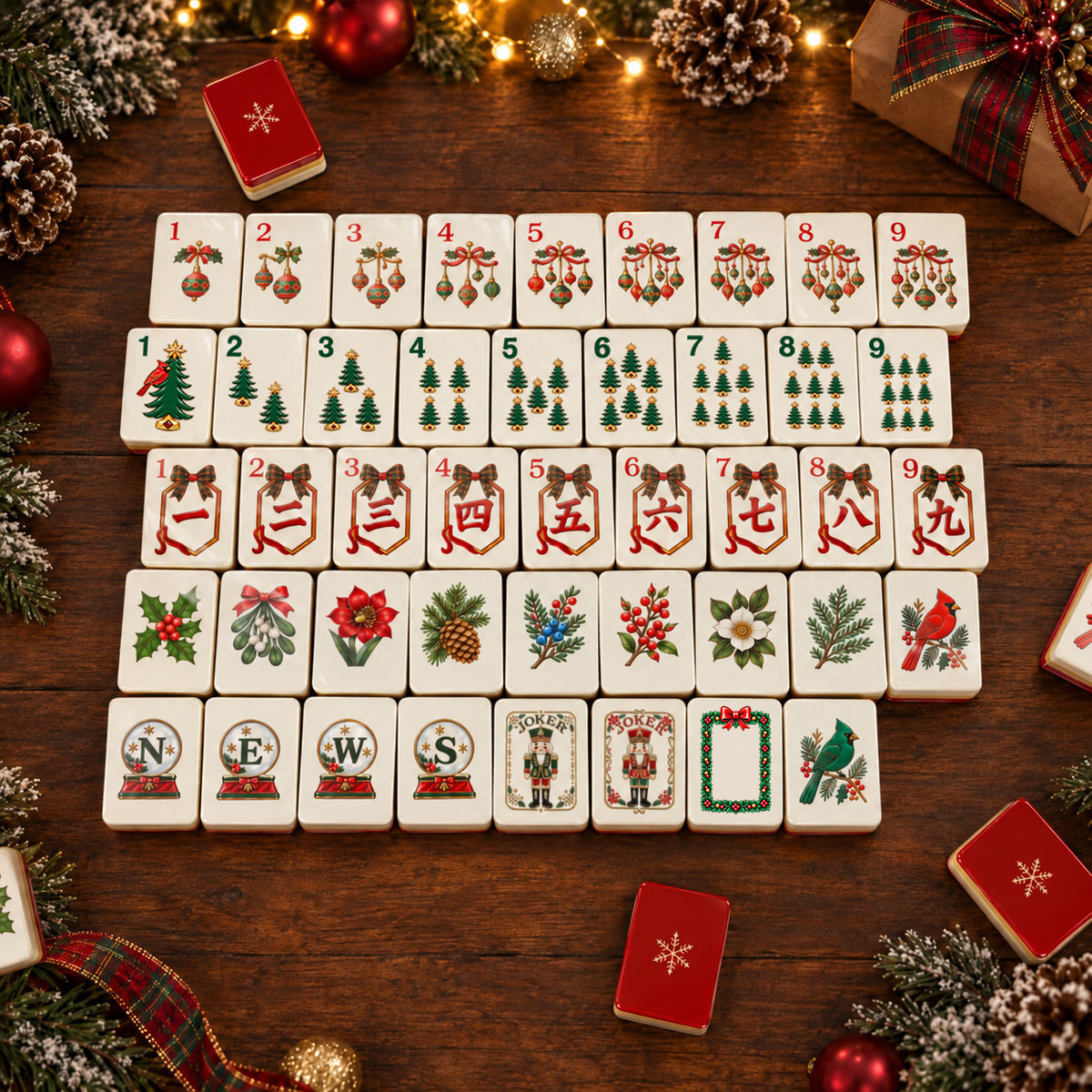
Mahjong solitaire is a tile-matching puzzle game where you remove pairs of identical, unblocked tiles from a stacked pyramid or pattern until the board clears or you get stuck. Unblocked means a tile has at least one open side and nothing resting on top—click/tap two matching tiles meeting both rules to remove them. The goal is to clear all tiles, typically in 1–5 minutes per round. Unlike table mahjong (a multiplayer rummy-like game played with a shuffled hand and a play card), solitaire uses a fixed, preset board layout and pure matching logic. Many digital platforms offer versions free or for a small one-time fee; difficulty ranges from beginner layouts with obvious pairs to expert boards where only optimal sequencing wins. Success depends on foresight—recognizing which pair removals unlock buried tiles—and pattern memory. Winning solitaire sharpens tile recognition skills that carry over to learning table mahjong rules. 🀄 Shop best-selling mahjong sets →
How do I know which tiles are blocked or unblocked?
A tile is playable only if it has at least one open side (left or right edge touching air—not another tile) and nothing stacked on top. Tiles buried under others or sandwiched between two neighbors cannot be matched yet. Before each move, scan the board for any tile with both conditions met, then check if an identical tile elsewhere is also free. If you move a pair that leaves a tile fully trapped underneath, you've made an unrecoverable mistake—always trace the consequences visually before clicking.

What's the best strategy for choosing which pair to match first?
Read the board top-down and outside-in. Remove exposed pairs from the pyramid edges first, especially the top—clearing upper tiles unpacks the layer below, freeing tiles that were buried. Avoid matching interior tiles unless they block access to multiple tiles above them. On a typical pyramid, the peak, front corners, and outer rows are your first targets. Save pairs in the deepest center until you must; they usually unlock fewer neighbors. Ask yourself: If I remove this pair, does it free at least two new tiles? If yes, take it. If no, look for a better move.
How can I remember where matching tiles are on a complex board?
Use tile-type zones: all Bamboos cluster in the left third, Dragons in the center-right, Seasons and Winds scattered. Many layouts group like tiles loosely rather than randomly. On your first play-through, spend 10 seconds scanning the entire board once, mentally noting where you spot each suit and number. If your platform shows the full pattern, take a screenshot or sketch it. During play, after removing a pair, look immediately at the newly exposed tile underneath—that's where your next match often hides. Avoid moving on autopilot; pause every 3–4 moves to re-scan for newly freed pairs you missed.
Strategy | Best For | Time Saved | Real Cost |
Remove top-to-bottom pyramid layers | Structured pyramids, beginner boards | 1–2 minutes | Low; obvious pairs |
Match all exposed suits first, then numbers | Mixed layouts | Moderate | Medium; requires scanning twice |
Prioritize pairs that free 2+ new tiles | Expert boards, tight stacks | 2–3 minutes | High; needs forward planning |
Work corners outward, save center last | Symmetrical designs | 1–3 minutes | Medium; directional discipline |
What's the most common mistake new solitaire players make?
Panic-matching the first pair you see without checking if it blocks progress elsewhere. You spot two 5 Dots on the surface, click them instantly, and then realize you've sealed off three Craks underneath—now unwinnable. Take a breath. Before every match, trace the consequences: does removing this pair expose a playable neighbor? Does it open access to a buried tile or dead zone? Most losing games stem from one hasty move early on. Experienced players "think backward"—they imagine the final empty board, then work out which pair removals had to happen last, second-to-last, and so on. That mental rehearsal prevents traps.
How do I plan ahead when there are dozens of possible pairs?
Adopt the Consequence Map method: after each move, mark (mentally or on paper) which tile each removal exposed. Build a chain: Removing pair A frees tile B; B's match is C; removing C exposes D. Look for chains three or more moves long. If a chain leads to a dead zone (isolated tiles that can't match anything), stop. Chains that lead to unlocked pairs in the center or layers below are gold—prioritize them. On platforms that allow undos, test risky sequences: play a questionable move, see what it unpacks, then undo if it's a trap. Never underestimate a "dumb" move; sometimes clearing edge tiles that seem unimportant opens the entire middle.
Does knowing the tile names from table mahjong help?
Yes—absolutely. If you already know that Winds, Dragons, and Dots differ visually, you'll match them faster in solitaire than a player unfamiliar with the symbols. The 1 Bam usually shows a bird, Craks have complex designs, Dots are simple circles. Dragons are labeled (Red, Green, White). Seasons are depicted as flowers or plants. Even 10 minutes learning how to read American mahjong tile faces accelerates your solitaire gameplay. Many solitaire apps show simplified or stylized artwork—learn the canonical tile icons, and you'll spot matches instantly. This skill also builds a foundation if you ever want to move to learning how to play American mahjong at the table.

What to check before you start a new solitaire game
Board difficulty: Choose a level matching your current skill (beginner, intermediate, hard, expert).
Tile size: Can you see the symbols clearly, or are they too small? Adjust zoom or font if the app allows.
Undo limit: Does the game allow infinite undos, or a limited number? Plan accordingly.
Time pressure: Some boards offer a timer. Decide if speed or perfection matters to you.
Pattern memory: If the board layout repeats, use prior losses to inform your current strategy.
If you enjoy mahjong solitaire and are curious about the multiplayer table game, start with our beginner's guide to American mahjong. Table mahjong uses real tiles—many players find holding engraved acrylic sets makes the ritual and social play far more engaging than screen versions. When you're ready to host, our best-selling mahjong sets are designed for weekly games and ship free across the US.
🎁 See our most-loved mahjong sets & accessories →
Can I improve my solitaire skills by playing the same layout twice?
Yes. Replaying teaches pattern recognition. The second time, you'll recall which tiles were buried and sequence your moves accordingly. However, true mastery comes from different boards—each layout teaches a new puzzle type. Play five unique boards at hard difficulty rather than one easy board ten times.
Do professional solitaire players use apps with hints?
Many do for learning. A hint function reveals the next legal pair without spoiling future moves. Use hints to break loops or confirm you've missed an open tile, but avoid relying on them for every move—you won't build foresight.
How long should an expert player take to clear an average board?
Varies by layout. Beginner: 3–7 minutes. Intermediate: 5–12 minutes. Expert: 10–25 minutes or longer if the board is deliberately tight.
Does solitaire performance predict table mahjong skill?
Partial correlation only. Solitaire teaches tile recognition and logical sequencing; table mahjong adds hand-building strategy, game theory, and reading opponents. A strong solitaire player learns table rules faster, but they're distinct games.
Which apps or platforms offer the best mahjong solitaire experience?
Most mobile app stores offer dozens of free and paid versions. Look for user ratings (4+ stars), no forced ads mid-game, and clear tile artwork. Many are solid; pick one and play consistently rather than switching constantly.

FAQ
What does "unblocked" mean in mahjong solitaire exactly?
A tile is unblocked when it has at least one open side (left or right edge exposed) and nothing stacked on top of it. Both conditions must be true to match it.
Why can't I match two 5 Dots I see clearly on the board?
One or both likely have tiles resting on top, or they're both sandwiched between neighbors. Check the left and right edges—if either tile is fully enclosed, it's blocked.
Is there a "best" order to clear tiles, or is it random?
Not random. Top-to-bottom pyramid clearing, prioritizing pairs that free multiple buried tiles, and avoiding dead-zone traps significantly raise your win rate.
Can I apply solitaire strategies to table mahjong?
Some do—tile tracking and foresight help—but table mahjong emphasizes hand-building, discards, and opponent play. Solitaire is purely matching logic; table mahjong is strategy.
How can I play solitaire on a real mahjong set if it's a single-player game?
You can't use a real set for digital solitaire, but you can practice tile recognition and hand-building exercises with a real set offline. Real tile sets are designed for four-player table mahjong, not solitaire.
Should I learn solitaire before playing table mahjong?
Not necessary, but it helps. Solitaire teaches tile names and faces; table mahjong is a separate social game with its own hand patterns and rules. ✨ Find your Mahstead set — free US shipping →


View More
View More
View More
