
Riichi Mahjong Placement Strategy: Position & Wind Dynamics
Last updated: Nov 23, 2026
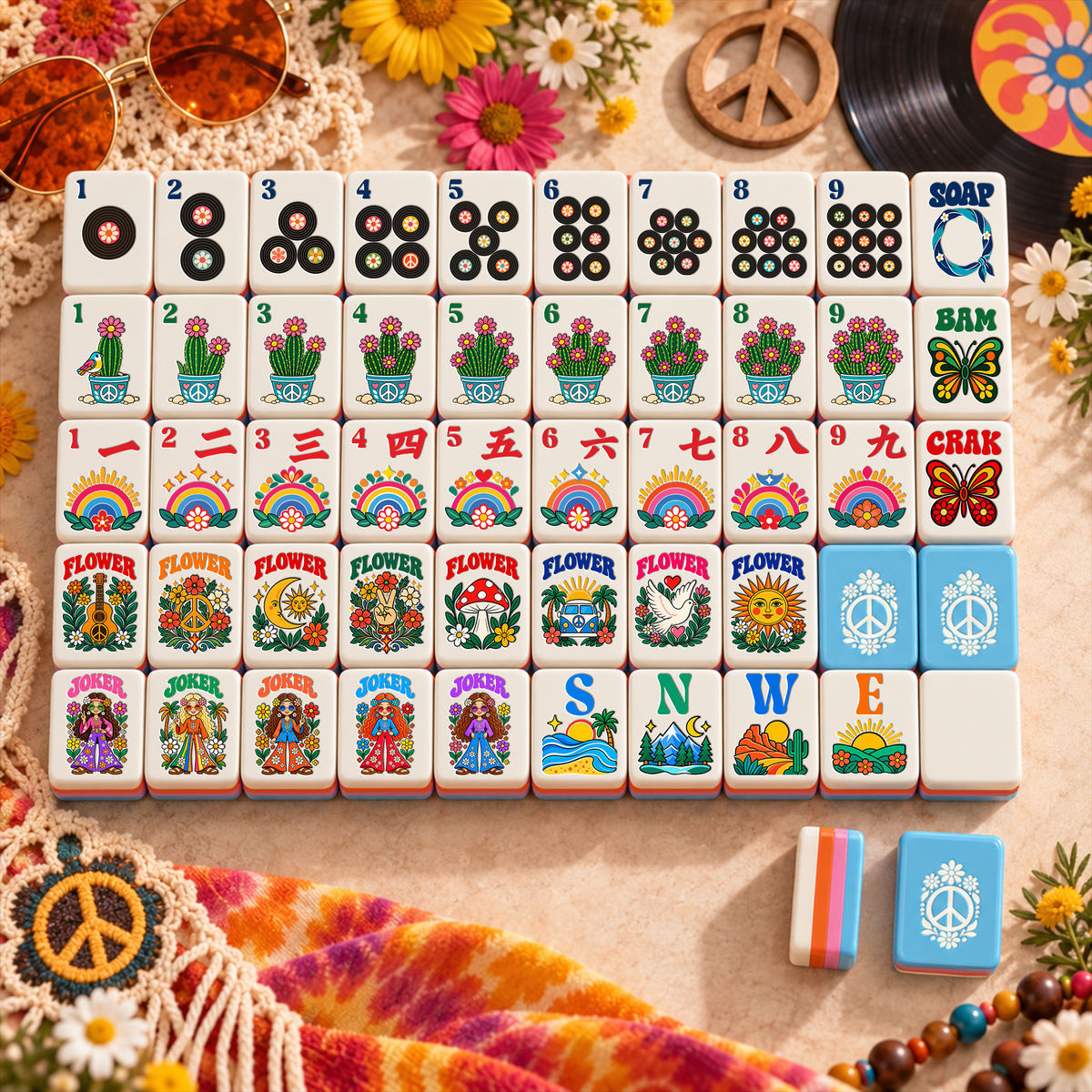
Riichi mahjong placement (座位戦略) refers to the seat assignment system and how your wind rank (East, South, West, North) affects dealer status, turn order, turn limits, and scoring multipliers across a session. East wind opens as dealer; winds rotate counterclockwise per hand, and each player's position relative to the dealer influences which tiles are revealed and when. Placement strategy means knowing which seats favor defensive play versus aggression, how to read the dealer's likely tiles from discard patterns specific to your wind, and when your wind rank grants a scoring advantage. Unlike American mahjong (which uses no dealer rotation), Riichi has standing dealer rules and wind-based scoring multipliers that reward seat awareness. Learning placement strategy takes most players 10–15 hours of live play to internalize; the framework here compresses that into actionable positioning rules you can apply today from our best-selling collection sets onward.
Riichi placement strategy rests on one core principle: your wind rank and distance from the dealer govern both your hand's statistical strength and your risk exposure. The dealer (East wind) draws 14 tiles initially while others draw 13, giving East a subtle statistical edge that compounds if they win consecutive hands and retain dealer status. Your physical seat at the table relative to the dealer determines which player's discards you see first, which tiles rotate to you latest in the draw sequence, and (crucially) which players are most likely to call your discards.
Discard safety, hand speed, and aggression levels shift by placement. Understanding these shifts lets you adjust your strategy mid-hand instead of playing the same way from every seat.
What is your wind rank and why does it change every hand?
Wind rank (東 East, 南 South, 西 West, 北 North) is assigned at the start of a session and rotates counterclockwise after each hand. East begins as dealer and draws first; after a hand, winds rotate so South becomes East, West becomes South, and so on. Only the East player (current dealer) draws 14 tiles on the opening draw; all other players draw 13. This one-tile advantage plus East's first-meld priority gives dealer seat roughly 3–5% higher win rate across thousands of hands. Your wind rank determines your score multiplier: East player's hand scores 1.5× payment; South, West, North pay/receive base value. Tracking your wind rank helps you anticipate seat rotations and plan session strategy over multiple hands, not just one hand in isolation.

How does your seat position affect tile visibility and discard reading?
In Riichi, players sit at cardinal points around the table: East (dealer) at the origin, South to East's right, West opposite, North to East's left. Discard piles (捨て牌) radiate outward from each player in front of them; you always see the most recent discard from all players, but the older discards of players seated far from you are harder to read without leaning. The player directly to the dealer's right (South) sees East's discards most clearly and first, giving South a slight defensive edge: you can track which tiles East is afraid to discard and adjust your own hands. West (opposite the dealer) and North (left of dealer) see fewer tiles at optimal viewing angles and must rely more on memory and rapid-fire tile recall. Practical tip: when you're North or West, keep a mental note of which suit East is hoarding; when you're South, you can exploit that information immediately by avoiding tiles East might call.
Which placement positions favor offense versus defense?
East (dealer): First move, 14 tiles, 1.5× score multiplier. Offense pays off here because you draw first, can see which tiles are safe early, and profit more if you win. Risk: if you chase aggressively and lose, the next hand rotates the dealer to South, resetting your advantage. Play faster hands (calls allowed 7–10 turns in).
South: Second draw, clear view of East's discards, base 1× scoring. South is the "information seat"—you have time to read East's strategy before committing. This favors measured offense: call safe Pung or Kong tiles early, then tighten as the hand speeds up. Risk: you're not dealer, so your score multiplier is lower; overcommitting costs more.
West: Opposite dealer, half the player pool to your left unseen directly. West suits patient, closed-hand play (no calls until your hand is nearly complete). Offense here means speed: hold your hand closed until you're one tile away, then call aggressively to finish before East or South steals the hand. Risk: discards circulate slowly past you, so you may miss safe tile windows.
North: Left of dealer, last to act on early rotations. North is the "reaction seat"—wait for other players to call and discard their tiles, then pivot your hand based on what's left. Conservative offense works: hold Pung/Kong calls in reserve, then explode with calls in the final 5 turns if you're close.
Position payoff order (offense to defense): East > South > North > West. But this inverts under pressure: if East is winning consecutive hands, West's tightness becomes a survival play, not a weakness.
How do wind-based scoring multipliers influence your placement strategy?
East player's hand pays (or receives) 1.5× base value; all other winds pay/receive 1×. Over a 12-hand session (three full rotations), each player spends four hands at each wind. But if East wins three consecutive hands, East's score snowballs. Placement strategy accounts for this: if you're West or North and the dealer is on a winning streak, shift to ultra-defensive play (no calls, close hand, wait for safe discards) until the dealer loses. Conversely, if you're South and the dealer just lost, be aggressive in the next hand because the dealer's hand will be looser after a loss. Scoring multipliers reward patience when out of dealer seat and speed when in dealer seat.
Wind | Draw tiles | Score multiplier | Win rate vs others | Placement strategy |
East (dealer) | 14 | 1.5× | +3–5% | Offense; fast hands |
South | 13 | 1.0× | +1–2% | Measured offense; read East |
North | 13 | 1.0× | −1–2% | Reaction play; call late |
West | 13 | 1.0× | −2–3% | Defense; closed hands |
What are the most common placement strategy mistakes?
Mistake 1: Playing the same hand type from every seat. New players often treat placement as cosmetic, applying the same "call aggressive" or "play tight" rule everywhere. Reality: East's offense wins; West's defense survives. Adjust your opening hand threshold, call frequency, and discard timing to your wind rank and relative position.
Mistake 2: Ignoring the dealer's hand speed. If East is playing fast hands (calling Pungs by turn 8), your North position should tighten, not match. You're slower to act, so you're more likely to be stuck holding tiles the dealer just called. Wait two more turns before calling the same tile from a different player.
Mistake 3: Reading discards without tracking the discard time. A player discards a 4 Crak at turn 2 (early) versus turn 11 (late). Early discard = the tile was not useful early, so it's likely safe. Late discard = the player was holding it, waiting for a call or a pair; late discard often means the player's hand changed, not that the tile is safe. Many players reverse this, leading to calling tiles right when the discarder is ready to trap them.
Mistake 4: Chasing hands from North when you should pass. North's "reaction" advantage disappears if you're one away from winning at turn 10 and the dealer is also one away at turn 9. You will lose. A common mistake is staying in and hoping for a one-in-four tile instead of folding your 2-away hand and waiting for the next hand when your wind rank improves.
Mistake 5: Over-valuing East when you haven't won yet. Yes, East has a 1.5× multiplier. But if you're at turn 12 and need a specific terminal tile (1 or 9), your odds are the same from any seat. Don't call tiles out of order just to stay in the hand as East; a losing hand costs all your points regardless of wind rank.
🀄 Shop best-selling mahjong sets →
If you're learning Riichi placement strategy with a group, a quality set with clear suit markings and a smooth-sliding mahjong mat helps everyone read discards and positions faster. Our acrylic sets and mats let you focus on seat dynamics, not deciphering faded tiles or squinting at worn-down pips.

How do you practice placement strategy in live play?
The only way to internalize placement strategy is live play with four consistent opponents over at least 20 hands. Here's a structured practice plan:
Play one full session (12 hands) focusing only on one wind. Choose East in the first session. Play only one decision: call vs. pass on your first opportunity. Track your win rate.
Next session, sit West. Play the same hand 12 times. Notice how your decision-making speed changes.
After three sessions, compare your win rates by seat. You should see East ≥ South ≥ North > West (roughly). If West is winning as much as East, either your East play was too cautious or your West play is too risky.
In your fourth session, rotate seats every hand as normal but keep a written log of your hand outcome and the reason: "East, turn 7 call, won" or "North, turn 10, too slow, lost to South." After 12 hands, review which reasons recur.
Adjust one variable per session: in session 5, tighten your opening hand threshold when North. In session 6, speed up your call timing when South. Each adjustment should reduce one specific type of loss.
Live play is non-negotiable because Riichi is probabilistic over time, not per-hand deterministic. A single session of 12 hands shows noise; 60 hands across five sessions shows signal. Most players who claim placement strategy doesn't matter are comparing fewer than 24 hands total.
Why does discard-tile ordering matter in placement strategy?
Discards accumulate in a linear sequence in front of each player, oldest to newest (left to right or right to left depending on house rules). A player who discards a tile early (turn 3–5) and the same tile again later (turn 10) is signaling: "I had one, didn't need it yet, and now I have another and still don't need it." That tile is usually safe. Conversely, a player who discards a tile at turn 8 (mid-hand) and then later discards an adjacent number (e.g., 3 Bam at turn 8, then 4 Bam at turn 12) is likely building a sequence or pair in a different suit; the original tile becomes risky if you call it now because the player's hand has shifted.
Placement amplifies discard reading: from South, you see this sequence unfold live because East is directly across; from West, you're seeing the same discards but from a 45° angle, so you may miss the timing. From North, East's discards are furthest away. Your seat position determines how much information you can extract from discard order, so your confidence in calling should adjust accordingly. Don't call a "safe" tile from West with the same confidence you'd call it from South.
🎁 See our most-loved mahjong sets & accessories →
How does a strong mat or rack improve your placement awareness?
Good mats and racks matter because a cluttered or narrow tile space forces you to focus on your own hand instead of your seat placement and opponents' discards. Our mahjong racks with pushers let you organize tiles vertically so you can see all 13 tiles at once without twisting; that means you can glance up at the table (and opponents' discard piles) more often, catching the early-vs-late discard patterns that feed placement strategy.
A mahjong mat with clear zone markers (dealer position, discard area, draw sequence) helps new Riichi players anchor their mental model of where each player sits and why seat order matters. Acrylic sets with thick, flat tiles slide without jamming, so tile draws stay fast and visible to all players—no one gets stuck squinting at a tile that's jammed in the rack, which breaks discard-reading rhythm.
What to check before you buy a Riichi set or mat
If you're hosting Riichi games and want to improve placement awareness for your group:
Tile size and weight: Heavier tiles (acrylic) move smoothly and feel professional, helping players focus on strategy instead of fumbling tiles. Check that each tile is uniform; warped or lightweight tiles create "habits" (players favoring certain tiles because they draw easier), which corrupts placement strategy.
Rack height and angle: Riichi players hold 13 tiles (or 14 in East seat). If your rack is too shallow, players lean forward to see their tiles, which angles their view of the table. A taller, angled rack lets players keep their head up and eyes on the game.
Mat size and clarity: A mat at least 24" square ensures four players can sit comfortably with 12–14" per side. If the mat is too small, discards pile up and overlap, making discard-order reading impossible. Ensure the mat's dealer-seat and discard-zone markings are visible but not distracting.
Set completeness: Riichi uses a standard 136-tile set (34 tiles per suit × 4 copies, no Flowers or Jokers like American mahjong). Verify the set includes all four copies of each number and wind. A missing tile mid-hand corrupts strategy.
✨ Find your Mahstead set — free US shipping →

FAQ
Does my starting hand matter more than my seat position in Riichi?
Both matter, but seat position sets your baseline odds. A starting hand of three concealed Pungs is strong from any seat, but East wins at 1.5× value; West wins at 1.0× value. If you're East with a weak hand versus West with a strong hand, East's advantage narrows or reverses. In the long run (100+ hands), seat position affects 5–10% of outcomes; hand strength affects 40–60%. Don't ignore seat strategy even if your hand looks good.
What's the fastest way to learn which positions to call from?
Play 20 hands in a row logging every call: turn number, your wind, whether you won or lost. After 20 hands, count your win rate at each wind. If your East win rate is 50% and West is 30%, you're playing East too loose or West too tight. Adjust one thing per session: tighten East calls, or speed up West calls. Track for 60 hands and you'll see a clear pattern.
How do I read an opponent's hand from their first five discards?
The suit of a player's first three discards often matches the suit they're NOT building. If a player discards two 1 Craks and one 2 Dot early, they're likely avoiding Craks and Dots, so they're building Bams and/or Honors. Watch the first five turns; the suit a player discards most is their "junk" suit. Avoid calling tiles from their junk suit; call from the suit they're not discarding (carefully).
Is North position always worse than South position?
Over 12 hands, yes; over 100 hands, the difference is noise. But in a single 12-hand session, North is statistically disadvantaged because North acts last on most turns and sees fewer early discard cues. If you must choose a seat, choose South or East. But if your group rotates seats every hand (fair play), all positions equalize by the end of the session.
What's the biggest tell that an opponent is close to winning?
Slowing down their discard timing. A player who discards at turn 3 normally but waits 8 seconds at turn 10 is one or two tiles away. The converse is also true: rapid discards mid-hand mean the player is far away and discarding junk. Use discard speed as a tempo read, not an exact tell.


View More
View More
View More
