
Mahjong Joker Tracking Mistakes to Avoid
Last updated: Nov 23, 2026
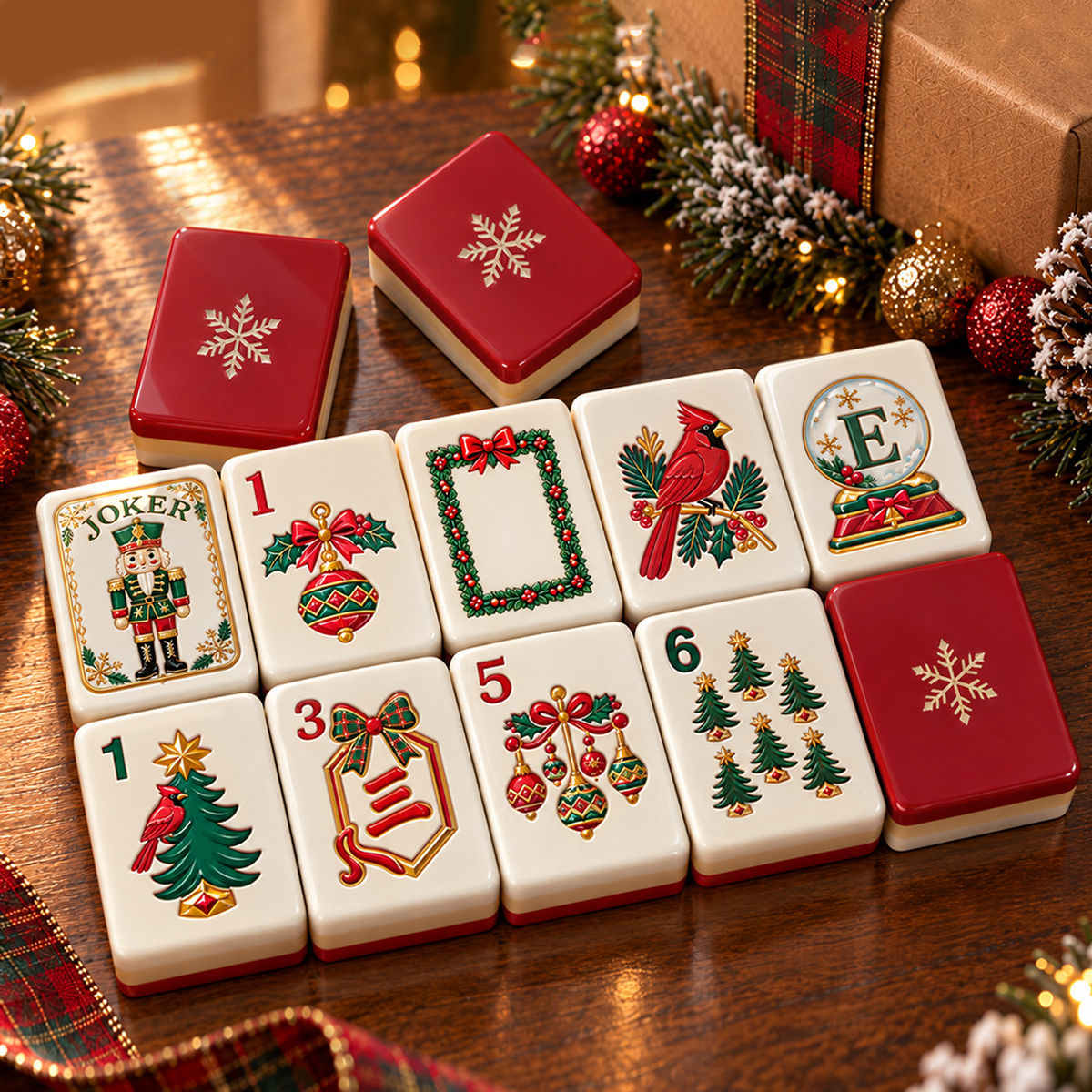
American mahjong uses exactly eight jokers across a 152-tile game, and they can only replace tiles in exposed sets (pungs, kongs, quints, sextets) — never in a single tile, a pair, or any concealed hand. The biggest mistakes: losing count of how many jokers are in play, accidentally pulling a joker that's already been used, and forgetting that jokers in your hand can't fill a pair. When you draw or claim a tile, check the discard pile first to count which jokers have already been played; keep your hand organized by suit so you can spot a joker's position at a glance. We recommend using a mahjong mat with clear zones so jokers stay visible separate from number tiles, and racks with pushers that let you slide tiles forward without fumbling—both make joker tracking automatic and faster.
Jokers are the wildcard in American mahjong, but tracking them wrong mid-game costs you the hand or ruins a win. We'll show you the exact mistakes we see at the table and how to fix them.
What exactly are jokers allowed to do in American mahjong?
Jokers replace any single number tile inside an exposed pung, kong, quint, or sextet—never a wind, dragon, or flower. You cannot use a joker as a single tile (e.g., standing alone to complete a suit), nor can two jokers and a number ever form a pair. Once a joker is played in an exposed set on the table, it stays there until that set is dismantled; it does not swap positions or swap to a different player's hand. The rule is simple: jokers are substitutes only, never originals.

Why do we lose count of jokers so fast?
Most players stop watching the discard pile once the game gets past the first few rounds. Jokers move quickly—one player exposes a set, another claims a discard, someone else draws from the wall—and the eye naturally drifts to the hand you're building. We track winning hands, suit combinations, and the card, but forget to glance sideways and count: two jokers on the table now, was that three before? By mid-game, uncertainty sets in, and when you draw the eighth tile thinking it's a joker but it's actually been on the table for three turns, you've broken the hand or wasted time recounting. The fix is brutally simple: after each play, mentally tick off how many jokers are visible (table, hands, wall, discard pile) and confirm the total is eight.
🀄 Shop best-selling mahjong sets →
How do you safely track jokers during a hand?
Keep a one-second tally as the game unfolds. When someone exposes a set with a joker, count it. When a joker hits the discard pile, count it gone from play (or mark it in memory as "discarded"). When you hold jokers in your hand, place them at the far right or left edge—never buried in the middle—so you and your neighbors can see them without asking. If you're the East player (dealer), you set the pace: announce how many jokers are out before someone draws from the wall. This sounds ceremonial, but it stops mid-hand disputes. At the table, we use a simple rule: eyes on the discard pile first, then the table, then our hand. Three sweeps, eight jokers accounted for—it takes three seconds and prevents an entire round of confusion.
Situation | What to do | Why it matters |
You draw a tile you think is a joker | Pause. Count the visible jokers on the table. If total ≤7, yours is valid. If 8, it's not a joker. | Prevents a false win and a hand recount. |
Someone exposes a set with 2 jokers | Nod and move on. Don't announce it—let the table see it. | Keeps the game flowing; visible jokers don't need verbal confirmation. |
A joker hits the discard pile | Note it, but leave it. It's now "used." The next player cannot pick it up. | A joker in the discard pile is live only if someone hasn't claimed it yet; once discarded, it's locked. |
You hold 3 jokers in your hand mid-game | Separate them visually. Count your concealed tiles + jokers once before you expose. | Prevents pairing errors (you can't use jokers to fill a pair). |
End of hand: one joker left in the wall | Discard it or draw it as normal. Eight jokers total will be accounted for at the close of the hand. | Confirms the math and locks the score. |
What's the most common joker mistake we see?
Pairing a joker with a number tile as if the joker completes a pair. American mahjong is strict: a pair must be two identical tiles—1 Dot and 1 Dot, East and East, Red Dragon and Red Dragon. A joker and a 1 Dot is not a pair, and standing on that as your pair disqualifies the hand immediately. The second most common error: accidentally using a joker that's already in someone else's exposed set. You can't reclaim a joker once it's locked in a pung on the table; it stays there, and if you miscounted and thought it was still available, you've just built an illegal hand. The third: forgetting that jokers in your concealed hand don't count toward a number tile total. If you hold East, East, Joker, the joker cannot be the third East—it's a blank space. You need the actual third East tile to complete the pung. We catch these during the hand check: if someone melds and their exposed sets don't match the card, and the error involves a joker, it's a dead hand.
How do you organize your hand so jokers stay visible?
Racks are the fastest solution. A rack with pushers lets you slide number tiles forward as you play them, leaving jokers stationary at the back or edge so they're impossible to miss. Without a rack, place jokers at one end—far left or far right—and never shuffle them into the middle. This takes discipline, but after one or two hands, it becomes automatic. Some players use a small notepad and tally mark each joker as it appears; this works for serious league play or teaching, but it's overkill for casual weekly games. The mat method: use a mahjong mat with dedicated player zones; place your jokers in the top row of your zone, number tiles below. The zones create a visual boundary so jokers never drift into someone else's view, and you know exactly where yours are.
🎁 See our most-loved mahjong sets & accessories →

Can you lose a joker in the wall or on the table?
No. All eight jokers must be accounted for at the end of every hand. If you count only seven at the close of a hand, the game stops—someone has misplaced one, or a tile was set aside by mistake. We've had to recount the wall, the discard pile, and all four hands to find a joker lodged under a mat or accidentally set face-down. To avoid this: before the next hand starts, have one player (usually East) visually confirm all eight jokers are returned to the tile bag or holder. This takes 10 seconds and prevents a cascade of disputes. A 160-tile set from Mahstead includes exactly eight jokers plus spare tiles, so if you ever find an extra joker in the bag after a hand, it's a spare—don't add it to play. Keep spares separate in the box.
What's the fastest way to spot a joker error at the end of a hand?
The card reader checks the hand first, then the scorekeeper confirms the jokers used. If someone claims a win—say, a pung of East, East, Joker—the card reader glances at the exposed set and asks: "Is that the actual East?" If it's a joker standing in for East, the reader says so aloud and confirms it's allowed in that hand type (some hands on the card allow jokers, others don't). The scorekeeper then crosses off the jokers used against the total: "Two jokers in that hand, total now is six remaining." At the end of a full round (four hands), all eight jokers should be back in the bag. If the count is off, no new hand starts until you find the discrepancy. We use a simple checklist: after hand settlement, one player counts the bag aloud (eight jokers), and the next hand begins. This ritual sounds formal, but it cuts disputes to nearly zero.
✨ Find your Mahstead set — free US shipping →
What to check before you buy a mahjong set to track jokers better
Tile size and contrast. Jokers should be visually distinct from number tiles—a different color, symbol, or finish. If your set's jokers are the same size and hue as Bams, you'll squint and lose them fast. Check the product photos before buying; a best-selling set typically uses bright or neutral joker faces that stand out.
Included accessories. Does the set come with a mat or rack? A good mat has player zones and a discard pile area, which naturally separates jokers. If not, buy them separately—the cost is small compared to the headache of a miscount.
Joker design consistency. All eight jokers should look identical so you never accidentally mistake one for a number tile. Open the box and count them before a game.
Storage organization. Use the bag or case that comes with your set or buy one designed for mahjong. Jokers loose in a box shift and crack during transport or storage.
How jokers work in American mahjong fits the bigger picture
Joker tracking is one piece of the rule set. If you're new to American mahjong, start by learning how to play American mahjong end-to-end. Once you understand the full game structure—melds, the card, scoring—joker mistakes become obvious and rare. Understanding what's inside a standard set also helps: knowing exactly how many of each tile exists makes joker substitution intuitive.

FAQ
Can a joker be part of a concealed hand (not exposed on the table)?
Yes. Jokers can sit in your concealed hand to be exposed later as part of a pung, kong, or higher set. However, a joker cannot be counted as part of a pair when you stand—a pair must be two identical tiles.
If I discard a joker by mistake, can I take it back?
No. Once a tile leaves your hand and lands in the discard pile, it's live for the next player to claim or it stays discarded. You cannot retrieve it. Check your hand carefully before discarding.
What happens if we run out of jokers mid-hand (all eight are on the table)?
The game continues normally. Any exposed set you form after that must use actual tiles, not jokers. This is rare but legal.
Can two jokers be in the same pung (e.g., Red Dragon, Red Dragon, Joker, Joker)?
No. A pung is three tiles; if you have Red Dragon, Red Dragon, Joker, Joker, that's four tiles—a kong. A joker replaces one position, not two.
If someone plays out of turn and exposes a set with a joker, is the hand void?
No. The out-of-turn play is the error, not the joker. The hand proceeds, but house rules may require a penalty or replay. The joker itself is legal.
How do jokers work in 2- or 3-player mahjong?
The same: eight jokers, same substitution rules. Fewer players means fewer concealed tiles and faster melds, so jokers appear more often on the table.
Should I count jokers before I draw from the wall?
Not required, but it's smart. A quick count prevents mid-hand confusion and keeps the game flowing.
If a spare joker ends up in the play pile by mistake, should we stop the game?
Yes. Remove it immediately and confirm the count is back to eight. Spare tiles should never enter play.


View More
View More
View More
