
Mahjong for Rummikub Players: What Transfers and What Changes
Last updated: Nov 23, 2026
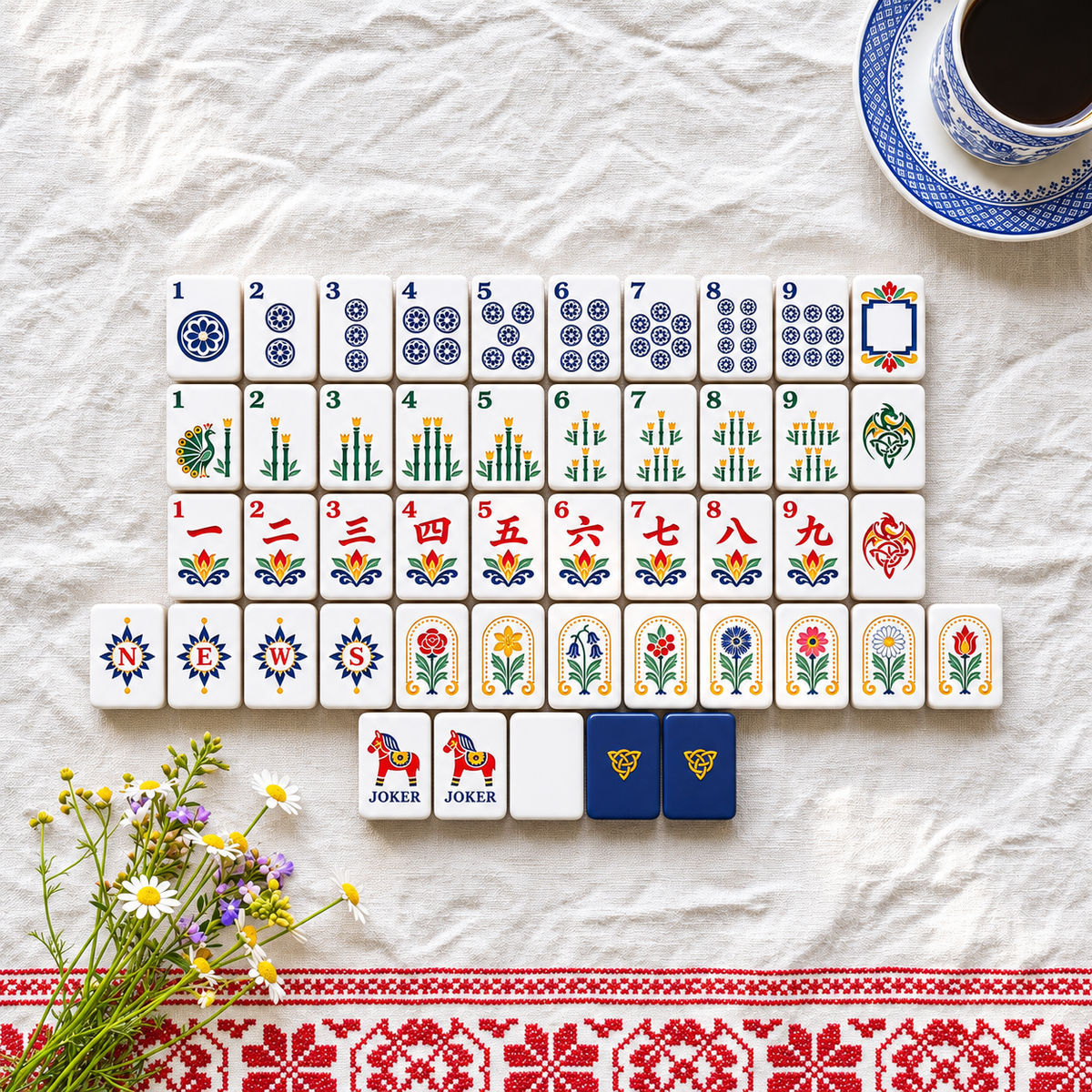
If you play Rummikub, you already understand two core ideas: numbered tile sequences and the satisfaction of placing tiles in a layout. Mahjong—specifically American mahjong—uses similar logic but plays by entirely different rules. You'll recognize numbered suits (Bams, Craks, Dots 1–9) and the concept of collecting identical or sequential pieces. But in American mahjong, sequences (called "chows") cannot be called or exposed; only identical groups (pungs of 3, kongs of 4, or larger sets) score points. The hand comes from a card issued each spring by the National Mah Jongg League, not from any combination you invent. A full game uses 152 tiles plus 8 jokers, with a ritual tile-passing round called the Charleston before play begins. Jokers are wild but cannot fill a single tile or a pair. You'll need to learn one new card per season, but the transferable skill—reading tile groups and spotting patterns—is exactly what drew you to Rummikub in the first place.
What carries over: tile logic and pattern recognition
Both games reward the ability to spot sets and sequences at a glance. In Rummikub, you see 1-2-3 Reds and immediately know it's valid; in American mahjong, you scan the card and recognize that same 1-2-3 pattern as a specific hand section. The hand-building instinct translates directly: you're still collecting tiles, tracking what's been played, and managing your rack. Jokers work similarly—they're wildcards that plug gaps. If you already keep score on Rummikub or play gin rummy, the competitive math translates too. The biggest carryover is table awareness: noticing which tiles your opponents keep, remembering discards, and inferring their strategy. These habits, honed over years of Rummikub nights, are pure gold in mahjong and hard to teach from scratch.
🀄 Shop best-selling mahjong sets →

What changes: sequences, the card, and winning rules
Here's the hard stop: Rummikub lets you lay down any valid run or group you build. American mahjong does not. You cannot call or expose a sequence (chow) of 1-2-3; you may only expose identical tiles (three or four of the same number and suit, called a pung or kong). This is the single biggest mental shift. In Rummikub, a hand emerges from your own creativity and the tiles you draw; in American mahjong, every winning hand must appear on the official card for that year. The card narrows the possibilities from infinite to roughly 88 documented patterns per player position (East, South, West, North). You don't invent; you hunt. The winning call is also different: in Rummikub you declare "Out!" when your hand empties; in mahjong, you claim mahjong (or mah-jongg), and your hand must match the card exactly—no more, no fewer tiles, and jokers only where the card permits. Learning how to read a mahjong card takes practice, but once it clicks, it's faster than scanning Rummikub sets.
The Charleston: a ritual unique to American mahjong
Before the first tile is drawn, players pass tiles in a choreographed exchange called the Charleston. You pass three tiles to your right, then three to your left, then two to the player across from you, then one back to the right. This sounds complex but is mechanical: count, pass, done. It levels the luck factor and gives every player agency in seeding their starting hand. Rummikub has no equivalent, so this is your first genuinely new rule. Ignore it and your whole game falls apart—everyone expects it, and skipping it breaks the social contract. The Charleston explained covers the full ritual step-by-step.
Comparing the two games: a practical table
Aspect | Rummikub | American Mahjong |
Tile suits | Red, Black, Yellow numbered 1–13 | Bams, Craks, Dots 1–9 + Winds + Dragons |
Valid exposed groups | Any set or run you build | Only identical tiles (pung, kong) or 5–6 tile quints |
Sequences playable? | Yes, on the table | No, never called or exposed |
Winning hands | Any valid layout you complete | Must match the official card for that year |
Wildcard rules | Joker can fill any position | Joker wild except in pairs or single tiles |
Pre-game ritual | None | The Charleston (3-tile passes) |
Typical game length | 30–60 minutes | 45–90 minutes |
Skill floor for basics | Low (rules fit in 5 min) | Medium (card reading takes practice) |

Starting your first game: a checklist for Rummikub players
Before you play:
Get a full 160-tile American mahjong set—it includes the card, tiles, racks, and mat. Don't mix it with cards from previous years; the card changes every spring.
Read the card section for your starting position (the dealers are assigned positions East, South, West, North). Focus on one position first.
Learn the Charleston in isolation—practice passing once with your group before declaring it's time to play for real.
Place your tiles on a mahjong mat or organized surface; Rummikub racks work, but racks with pushers show tiles more clearly.
During play:
Track which tiles have been discarded—more actively than in Rummikub, because the card is finite.
Call out your discards (or place them in the center—never silently remove them).
Never assume a hand is impossible; the card lists all winning combos.
Common mistakes to avoid:
Forgetting that a sequence cannot be called. You will make this error once and feel it.
Using a joker in a pair—it's forbidden.
Consulting the card mid-hand after another player declares mahjong. Too late; the moment has passed.
🎁 See our most-loved mahjong sets & accessories →
Why the shift feels fast despite the learning curve
Your Rummikub muscle memory carries 70% of the way. You already scan a rack for patterns, track discards, and read opponents. The new layer—memorizing 88 patterns from a card instead of inventing your own—feels daunting for the first 2–3 games. Then it clicks: the card becomes a vocabulary you recognize as fast as you spot a Rummikub run. Many Rummikub veterans report that mahjong feels easier after 4–5 sessions because the card removes the paralysis of infinite choice. You hunt, you find, you play. The rhythm becomes meditative in a way Rummikub's open creativity cannot match.
✨ Find your Mahstead set — free US shipping →
What to check before you buy
Set contents: Confirm your set includes the current-year card, 152 playing tiles, 8 jokers, a mat, and racks. A best-selling set from Mahstead includes all of these.
Tile readability: Acrylic tiles with clear engravings matter more than in Rummikub—the 1 Bam (bird), dragons, and winds are new symbols you'll read hundreds of times per game.
Storage:Mahjong bags and cases keep tiles organized between games. A Rummikub box won't fit 152 tiles and the card.
Card year: Every spring, the National Mah Jongg League issues a new card. Ensure you're playing with the 2026 card (or current year). Playing last year's card with this year's group will confuse everyone.

FAQ
Can I play the hands I know from Rummikub in mahjong?
No. Rummikub hands are invented by you; mahjong hands are predefined by the card. The card for 2026 contains roughly 88 patterns you'll learn as the season progresses. However, the pattern recognition skill—spotting runs and sets—transfers directly.
Do I need to memorize the card before my first game?
Not all of it. Start with your assigned position (East, South, West, or North). That's roughly 20–25 hands. Learn them cold, then expand. After 5–10 games, you'll recognize patterns across all positions without effort.
Is a joker in mahjong the same as in Rummikub?
Similar but stricter. Both are wildcards, but in mahjong, a joker cannot be used to fill a pair or to stand alone as a single tile. If the card shows "2-4 Joker 6 Dots," that joker belongs in the 5-Dot slot of a pung—nowhere else.
How long does the Charleston take?
90 seconds if everyone knows the pattern. On your first night, 3–4 minutes as players double-check their passes. It's a pause, not a burden, and it happens once per game.
Can I use Rummikub tiles in American mahjong?
No. Rummikub tiles are numbered 1–13 across three colors; American mahjong uses nine numbers, three suits (Bams, Craks, Dots), plus Winds and Dragons. You need a proper set. Mahstead's best-selling sets include all required tiles, engraved clearly for fast reading.
What if I've played other mahjong variants (Chinese, Hong Kong)?
American mahjong is its own beast. Chinese mahjong allows chows, uses a different tile set, and has no card. Hong Kong mahjong is similar to Chinese but faster. If you've played those, American mahjong will feel restrictive at first—but that restriction is what makes it elegant and easier to learn than you'd expect. Start fresh and don't assume your old rules apply.


View More
View More
View More
