
Mahjong Dots Explained: Suit, Rank, and Table Tactics
Last updated: Nov 23, 2026
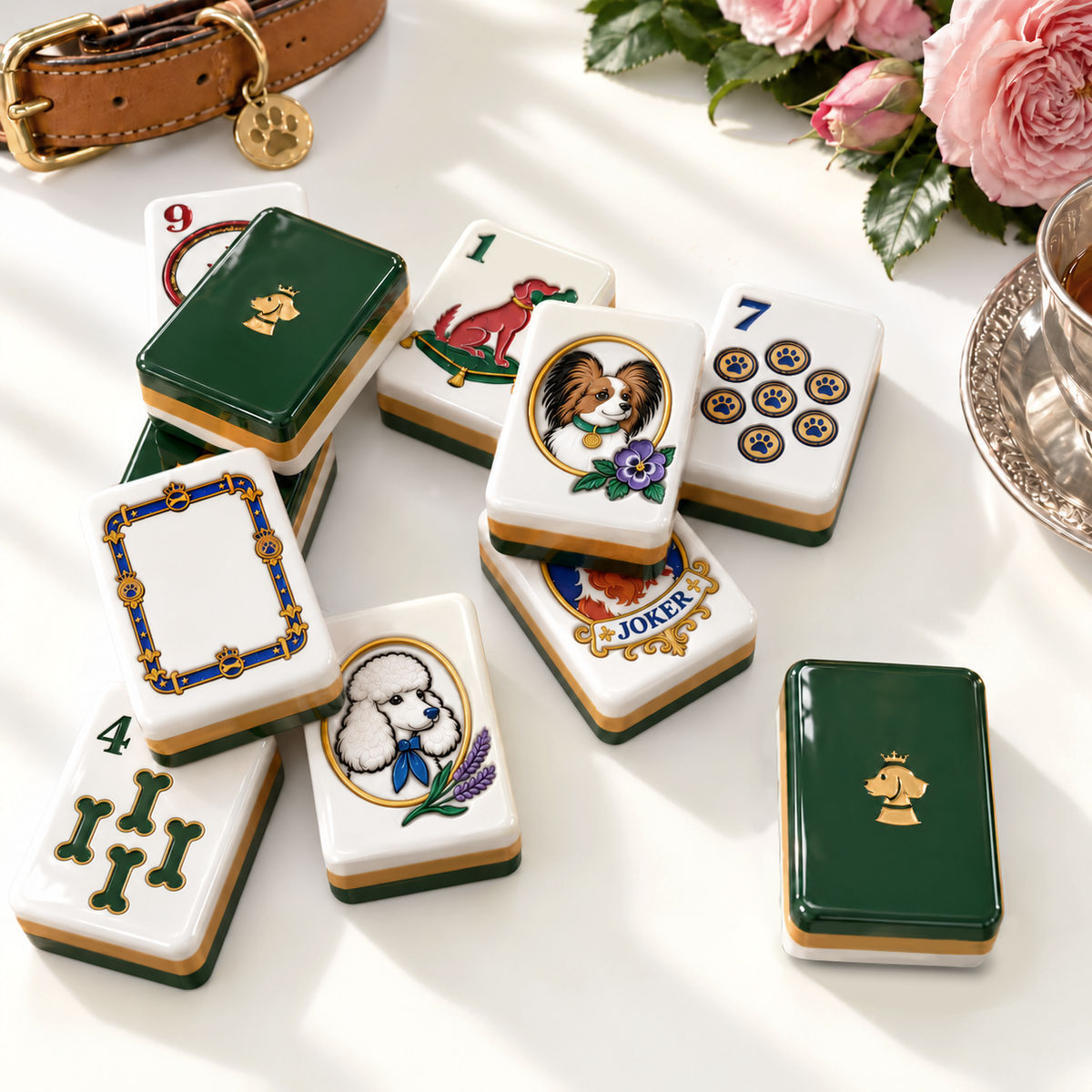
Dots (also called Circles) are one of three numbered suits in American mahjong, alongside Bams and Craks. A standard set contains 36 Dots: four copies each of 1 through 9. In the traditional symbolism, Dots represent coins, and the White dragon (often called "Soap") is paired with the Dot suit—though White also acts as zero in certain hand patterns. You'll identify Dots on the tile face by the circular pip symbols. Dots appear in nearly every winning hand on the current year's National Mah Jongg League card, forming pungs, kongs, quints, and sextets. A 160-tile American mahjong set from Mahstead includes all 36 Dots plus Bams, Craks, winds, dragons, flowers, jokers, and spares.
Dots are one of three numbered suits in American mahjong, ranked 1–9 and paired with the White dragon. Understanding their role and combinations is essential for reading hands and winning at your weekly game.
What makes Dots different from Bams and Craks?
Each of the three numbered suits—Dots, Bams, and Craks—contains ranks 1 through 9, with four identical copies of each rank (36 tiles per suit). Dots are visually distinct: they display circular pips on the tile face, whereas Bams show bamboo stalks and Craks show Chinese character symbols. All three suits rank from 1 (lowest) to 9 (highest) and follow identical rules for exposure and melding. The key difference is visual recognition: you must instantly spot which suit a tile belongs to during the fast-paced discard phase. In practice, beginners often confuse Bams and Craks at first, but Dots are universally easy to read because the circular pips are unmistakable.

How are the 1 through 9 Dots used in hand patterns?
The nine Dot ranks fill specific roles in winning hand patterns on the current year's card. You might need a pung (three identical Dots), a kong (four identical Dots), a quint (five identical Dots), or a sextet (six identical Dots)—never a sequence like 1–2–3 or 4–5–6 Dots, because American mahjong has no sequences. Common hand types include patterns like "three like pungs" (three separate groups of identical Dots) or hands that mix Dots with other suits and honor tiles. The 1 Dot rank, the lowest numerically, still appears in hands requiring "1 in a pair" or "1 in a pung." Jokers can substitute for any missing Dot tile within a pung, kong, quint, or sextet—but never as a single tile or part of a pair.
🀄 Shop best-selling mahjong sets →
Why is the White dragon paired with Dots?
In American mahjong, each of the three suits has a dragon honor tile associated with it: Red with Craks, Green with Bams, and White with Dots. This pairing is traditional and appears throughout hand patterns on the card. The White dragon (nicknamed "Soap") serves double duty—it's a dragon tile in its own right, and it functions as zero in certain algebraic or numerical hand patterns. For example, a hand pattern might call for "Dot pairs" and list "White, 1, 2, 3, 4," meaning White counts as zero in that sequence for pattern-matching purposes. This dual nature makes the White dragon uniquely versatile and why many advanced players watch closely when Whites are discarded early.

How do Dots interact with other tiles during play?
Dots form independent groups (pungs, kongs, etc.) that don't mix suit ranks—a 3 Dot pung is three 3 Dots, never a 1–2–3 combination. However, a single hand often combines Dots with Bams, Craks, winds, dragons, and flowers. For example, you might hold a hand requiring "two pungs of Dots, one pung of Bams, one pung of Winds, and a pair of Dragons." Jokers can fill missing Dots once you expose the group, but you cannot swap or hide them later. During the Charleston (the tile-passing phase before play), you don't yet know which hands are possible, so strategic players sometimes pass common Dot ranks to avoid blocking their own flexibility. After play begins, players watch which Dots others discard to infer what patterns they're building and which Dots remain in the wall.
What mistakes do new players make with Dots?
Beginners often misread the Dot suit visually—confusing a tile under poor lighting or mistaking a 1 Dot for a blank. Another common error: assuming Dots can form sequences like 1–2–3 Dots (they cannot; American mahjong has no chows). New players also sometimes waste Dots by holding too many unrelated ranks early in the game, hoping to form multiple pungs—when in fact the current year's card might require only one or two specific Dot patterns. A critical mistake is calling a pung or kong before fully checking the card: you must have the exact tiles or valid joker substitutions, and once exposed, that group cannot be altered. Finally, players overlook that Dots with high numbers (7, 8, 9) are often rarer than mid-range Dots (3, 4, 5) in the tile distribution, so hoarding them without a clear hand target is risky. See the pillar guide on what's in an American mahjong set for a full picture of how all tiles work together.
Mistake | Why It Costs You | How to Avoid It |
Confusing Dots with Bams under poor light | Calling the wrong tile; breaking your hand | Use a mat with good color contrast; check tiles before discarding |
Thinking Dots form sequences (1–2–3) | Illegal exposure; turn passes to next player | Memorize: only pungs, kongs, quints, sextets—no sequences in American |
Holding too many unrelated Dot ranks early | Dead tiles; no hand emerges by mid-game | Study the card before play; identify which Dot patterns appear this year |
Calling a Dot pung with an invalid joker | Illegal hand; penalty | Recount: jokers cannot be part of a pair or single tile, only fill exposed groups |
Discarding key Dots without reading the card | Other players complete their hands faster | Scan the card for Dot patterns; pass them strategically during Charleston |
🎁 See our most-loved mahjong sets & accessories →
What to check before you buy a mahjong set with clear Dots
Dots must be instantly readable during rapid play—if they blur or look too small, you'll slow down the table. Check that the tile face is engraved or printed in high contrast: Dots should pop visually against the background. If you're buying an engraved set with titles or custom designs, confirm that the Dot suit itself remains unmodified (the standard four-circle pips, ranks 1–9). Look for tiles that sit flush on a rack with pushers—poorly sized Dots can tilt or jam. For travel, verify that your bag or case offers padding; unprotected acrylic Dots can chip, making them unreadable at a glance. Finally, confirm your set contains exactly 36 Dots (four each of ranks 1–9) and is a standard 160-tile set, never a non-standard variant.
✨ Find your Mahstead set — free US shipping →

FAQ
Can Dots form a sequence like 1–2–3 in American mahjong?
No. American mahjong has no sequences (called chows). You can only expose pungs (three identical), kongs (four identical), quints (five identical), or sextets (six identical). A 1–2–3 combination is illegal in American mahjong, though it exists in other variants like Chinese or Riichi mahjong.
What does the White dragon have to do with Dots?
The White dragon is traditionally paired with the Dot suit and also functions as zero in certain hand patterns. While it is an honor tile in its own right, it can represent the numeral zero when a pattern requires it, making it uniquely versatile.
How many copies of each Dot rank are in a standard set?
There are four copies of each Dot rank (1–9), totaling 36 Dots. A standard 160-tile American mahjong set includes these 36 Dots plus 36 Bams, 36 Craks, 16 winds, 12 dragons, 8 flowers, and 8 jokers, with spares included.
If I have three 5 Dots and one joker, can I call a pung?
Yes. A joker can substitute for any missing tile within an exposed pung, kong, quint, or sextet. However, a joker cannot be part of a pair or a single tile, and once exposed, the joker's identity in that group is locked.
Why do advanced players watch which Dots are discarded early?
Discarded tiles reveal which patterns other players are not building. If high Dots (7, 8, 9) are discarded early, you can infer that few players are pursuing hands requiring them, freeing you to target those tiles safely. Dot discards also signal suit distribution.
Is there a difference between American, Chinese, and Hong Kong mahjong Dots?
Yes. American mahjong Dots range 1–9 and appear only in pungs, kongs, quints, and sextets. Chinese and Hong Kong mahjong also use 1–9 Dots but allow sequences (chows: 1–2–3, 4–5–6, etc.). Taiwanese and Riichi variants have their own Dot systems, tile counts, and exposure rules entirely.


View More
View More
View More
