
Mahjong Competition Rules: How to Count Points
Last updated: Nov 23, 2026
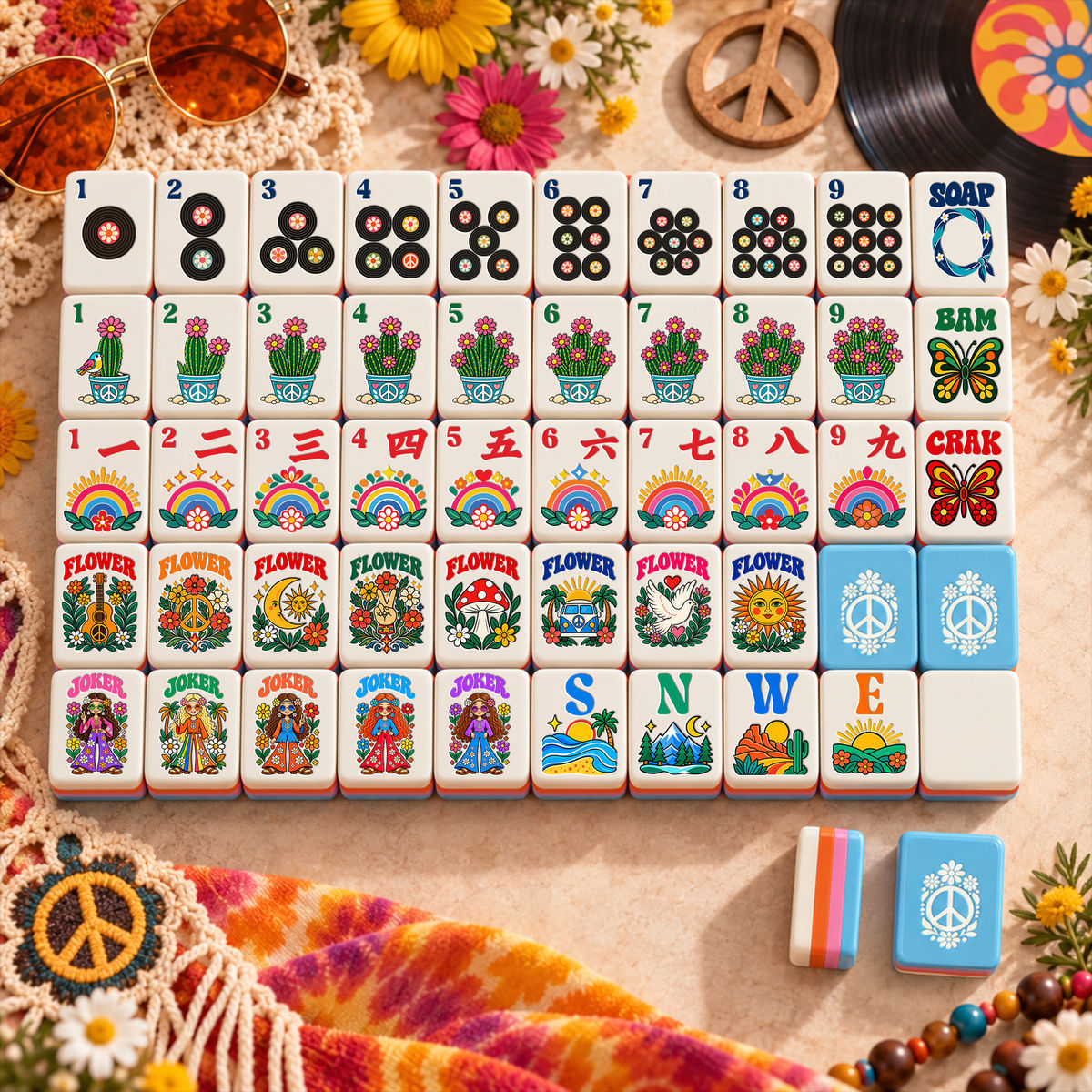
In American mahjong competition play, you don't count tile-by-tile; instead, every hand on the current year's League card has a fixed point value printed next to it. When you declare mahjong, you read your hand type (e.g., "Pung, Pung, Pung, Pair"), match it to the card, and collect the points shown—typically 30, 40, 50, 60, or 70 points per hand. Payment flows from the three other players directly to the winner: if your hand is worth 40, each player pays you 40. In tournament play, points accumulate across rounds; the player with the highest total after all hands wins. Jokers raise a hand's value and are critical to earning higher-point hands. Mahstead's best-selling mahjong sets include full tile counts and bonus jokers so you can practice scoring with regulation equipment.
How is the point value determined for each hand?
Every legal winning hand appears on the official National Mah Jongg League card released each spring. The card is organized by hand type (Pungs, Quints, mixed suits, etc.) and displays the exact point value next to each pattern. You do not calculate points; you simply find your hand and read the number. Different patterns of the same three suits might be worth 30, 40, or 50 points depending on their complexity and joker count. Higher point values almost always require more jokers or rarer tile combinations. Once you learn to read the card quickly, scoring takes seconds.

What's the difference between paying and collecting in American mahjong?
When you win a hand, the other three players each pay you the full point value of that hand. If your winning hand is worth 50 points, you collect 50 from the East player, 50 from the South player, and 50 from the West player—for a total of 150 points into your tally. If you don't win the hand, you pay the winner their points. Over a full game (usually 16 hands in a four-player round), these individual payments accumulate into a running total. The settlement is always direct: no communal pot, no house banker keeping a cut. This one-to-one payment system is what makes American mahjong scoring both simple and fair for casual play and competition alike.
How do jokers affect the point count?
Jokers are wild tiles that substitute for any other tile in your hand. The more jokers you use in a winning hand, the higher its point value on the card. A hand built with zero jokers might be worth 30 points; the same pattern of tiles but with one or two jokers substituted becomes 40 or 50 points. This rewards skill and luck: you need both the right tiles and the right jokers to land a high-value hand. Importantly, jokers can never be used alone (you can't win with "just" a joker as your pair or single tile), and they cannot appear in a pair. Understanding how jokers work is essential to predicting which hands are scorable and which jokers to hold or discard.
What happens in tournament or competition scoring rounds?
Tournament play divides players into rounds, typically four people per table, with each player sitting as a different wind (East, South, West, North) for a set number of hands. After each hand, points are recorded on a score sheet. East typically scores double (collecting or paying double the hand value) as compensation for the responsibility of rolling dice and breaking the wall first. After all players have been East the same number of times, the final tallies determine the winner. Some leagues use bonus chips or multipliers in the later rounds, but the core principle remains: accumulate the highest point total across all hands. Casual home games often skip round rotation and simply play until someone reaches an agreed target score (like 500 points) or for a fixed number of hands. Recording scores in real time prevents disputes and keeps play moving.
Why do different sources show different point values for the same hand?
The National Mah Jongg League issues one official card per year, and that card alone determines legal play and scoring for American mahjong competition. If you consult an old card, a regional variant rule sheet, or a different mahjong tradition (Chinese, Hong Kong, Riichi), you will see completely different scoring systems. Chinese mahjong, for instance, uses a doubling system and counts tile combinations rather than named hand types. Riichi mahjong uses fan (multiplier levels) and base point calculations. American mahjong is unique: one card per year, one point value per hand, no negotiation. Always confirm you're playing from the current year's League card before starting a game with new players, and ask what variant you're playing if you join an unfamiliar group.
Quick Scoring Reference Table
Hand Type | Typical Point Range | Joker Count | Payment Flow |
Pung/Pung/Pung + Pair | 30–40 | 0–1 | Each player pays winner |
Mixed suits, Pungs + Quint | 40–50 | 1–2 | Each player pays winner |
Like Numbers or Like Numbers + Pung | 50–60 | 2–3 | Each player pays winner |
Rare patterns, all Kongs or Quints | 60–70 | 3+ | Each player pays winner |
🀄 Shop best-selling mahjong sets →

How do you record scores during play?
Keep a paper score sheet with four columns—one for each player's wind position—and a row for each hand played. After every winning hand, write the point value in the winner's column and subtract it from the three payers' columns (or simply record +50 for the winner and –50 for each payer). At the end of the game, add each column. Highest total wins. Many players photograph the card or keep it visible so everyone can verify the point value before settlement. If a dispute arises about whether a hand is legal, players usually reference the card together and make a decision before moving on; there is no "replay" or "undo." Digital scoresheets work too, but paper prevents the risk of accidental edits and keeps the table focused on play rather than phones.
What is East wind scoring and why does it matter?
In American mahjong, the player sitting as East wind (determined by dice roll at the start) holds special status: they go first, they roll the dice to determine where to break the wall, and—critically—they collect and pay double points. If a hand is worth 40 points and East wins it, they collect 40 × 2 = 80 from each of the other three players. If East loses the hand to another player, East pays the winner 40 × 2 = 80. This magnifies East's risk and reward and keeps the advantage from concentrating in one player's hands. Wind positions rotate after each hand (East becomes South, South becomes West, etc.) so every player experiences East a roughly equal number of times. In a casual four-handed game of 16 hands, each player sits East four times. Tournament play strictly enforces this rotation to ensure fairness.
🎁 See our most-loved mahjong sets & accessories →
What common scoring mistakes should you avoid?
The most frequent error is looking up a hand on an old or wrong card. Always play from the current year's League card. A second mistake is paying or collecting the wrong amount from the wrong players; double-check the point value and confirm you're taking payment from all three players (or paying all three if you lost). A third is forgetting that East pays or collects double. If you are East and unsure whether a hand is worth 30 or 40 points, that difference doubles: 60 vs. 80 in payments. Finally, never assume scoring is the same across variants; if you're playing American, don't apply Chinese or Hong Kong rules. Take five seconds before each hand to confirm the rules with your group, especially if anyone is new.
What equipment should you have for scoring accuracy?
A printed or laminated copy of the current year's National Mah Jongg League card is non-negotiable—keep one at the table. A paper score sheet or scorepad, a pen, and a calculator (or pen and paper for quick addition) complete the setup. Some players use mahjong racks with pushers to organize their tiles neatly, making it faster and clearer to verify a hand before calling mahjong. A mahjong mat with clear zones for the wall, the discard pond, and each player's hand space keeps tiles from sliding and reduces mistakes. Good lighting also helps avoid mis-reading tiles, especially older sets with worn imagery. Investing in quality display and organization equipment reduces confusion and speeds up scoring.
✨ Find your Mahstead set — free US shipping →
What to Check Before You Buy a Mahjong Set for Scoring Practice
Tile count: All American mahjong play uses exactly 152 tiles plus 8 jokers; make sure your set includes the full complement.
Card visibility: Ensure you have or can access the current year's League card—no substitutes.
Tile clarity: Read every tile clearly in your lighting; worn or poorly printed tiles cause scoring disputes.
Joker abundance: Extra jokers (beyond the standard 8) in a set mean you can practice higher-point hands without constantly recycling the same ones.
Space and organization: A mat and rack system keep hands stable during scoring verification.

FAQ
Can I use an old mahjong card to score games?
No. American mahjong competition scoring is tied exclusively to the current year's National Mah Jongg League card. Old cards have different hand types and point values. Always play from the current card or agree explicitly with your group on which year's card you're using.
What if two players reach mahjong on the same hand?
In American mahjong, only one player can declare mahjong per hand. The first player to declare and have their hand verified wins; the other player's tiles are returned to the wall. If there is a dispute about who declared first, the player sitting East (or the closest to East if East is involved) has priority.
Do ties in total points happen, and how do you break them?
Ties are rare but possible, especially in casual play. Most groups play a tiebreaker hand immediately, or they declare a shared win and split any prize pool. In formal tournaments, tiebreaker rules are set in advance (e.g., most hands won, East position in the final tie round, or playoff hands).
Can you change the point value of a hand once it's been called?
No. Once you declare mahjong and show your hand, the point value is set by the card and cannot be disputed or altered. If players believe the hand is not legal on the card, they may ask the group to verify, but the card's listing is final. After settlement, play moves to the next hand.
How do payments work if multiple people are competing in a tournament for a final prize?
Hand-to-hand payments still flow directly from each losing player to the winner (or doubled if the winner is East). At the end of all rounds, the player with the highest cumulative point total wins the tournament. The tournament organizer then settles the prize pool based on final standings, not on individual hand payments.
Is there a maximum hand value, or can scores go higher than 70 points?
The National Mah Jongg League card lists the legal hands and their point values for each year. Point values typically range from 30 to 70, but the card always defines the upper limit. If a hand is not on the card, it is not a legal winning hand, and you cannot score it no matter how high you think it should be.


View More
View More
View More
