
Is Mahjong a Board Game or a Card Game?
Last updated: Nov 23, 2026
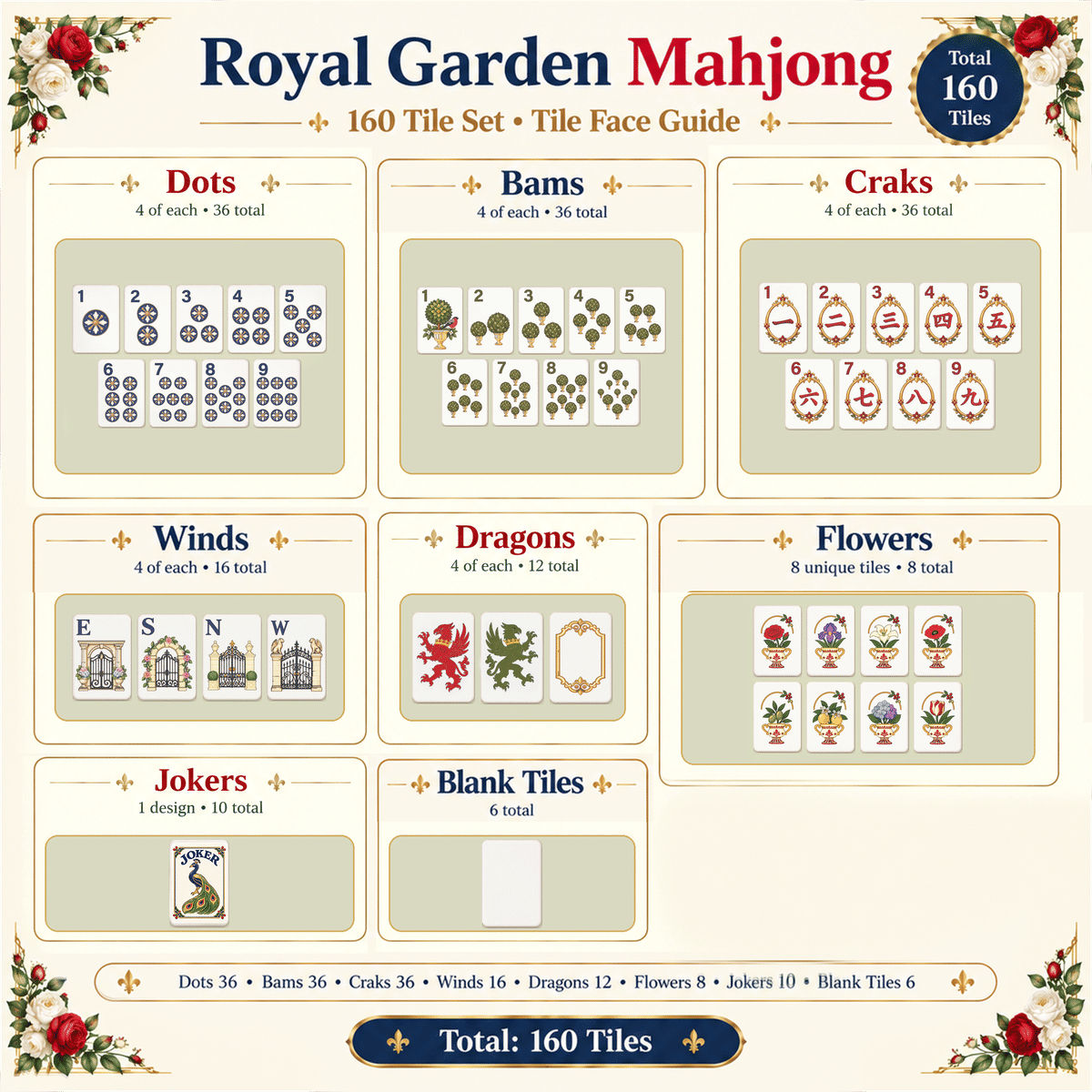
Mahjong is neither a traditional board game nor a card game; it's a tile-based game played with 152 tiles (including 8 jokers) drawn from a wall and arranged in the player's hand. American mahjong, the most common variant in the US, requires four players, a hand from the current year's National Mah Jongg League card, and a dedicated mat. A game lasts roughly 90 minutes. Players expose matched sets—pungs (three identical tiles), kongs (four), quints, or sextets—and score based on the card hand they achieve. Unlike card games, mahjong demands specific tiles in specific combinations; unlike board games, play flows entirely from hand management and tile calculation. A best-selling 160-tile acrylic set is your starting point: it contains all tiles, spares, and is built to last through years of weekly games.
Mahjong is neither a board game nor a card game; it's a tile-based game played with 152 tiles (including 8 jokers) drawn from a wall and arranged in the player's hand. American mahjong, the most common variant in the US, requires four players, a hand from the current year's National Mah Jongg League card, and a dedicated mat. A game lasts roughly 90 minutes. Players expose matched sets—pungs (three identical tiles), kongs (four), quints, or sextets—and score based on the card hand they achieve. Unlike card games, mahjong demands specific tiles in specific combinations; unlike board games, play flows entirely from hand management and tile calculation. A best-selling 160-tile acrylic set is your starting point: it contains all tiles, spares, and is built to last through years of weekly games.
What makes mahjong different from a board game?
Board games use a board, pieces, and fixed positions. Mahjong has no board. You hold tiles in your hand, draw from a wall, and arrange them openly on a mat or table cover as you form winning combinations. Movement and positioning don't matter; tile matching is everything. Your goal isn't to reach a destination or conquer territory—it's to form a legal hand from the National Mah Jongg League card before anyone else. The tile wall itself replaces the "luck mechanic" of a board; drawing the right tile is your progress, not landing on a square.
🀄 Shop best-selling mahjong sets →

Why isn't mahjong a card game?
Card games use cards; mahjong uses tiles. The critical difference: card decks are shuffled once and dealt in fixed quantities; mahjong tiles are drawn continuously from a wall throughout play. In poker or bridge, your hand is dealt and then you trade or play cards away. In mahjong, you draw one tile per turn and discard one, cycling through the entire wall (152 tiles total, drawn over ~90 minutes). Card games have no "mat" or "wall." Mahjong has both. Also, in American mahjong, you cannot create a winning hand from random tiles—you must match one of roughly 70 specific hand patterns printed on the current year's card. Card games reward strategy with your dealt hand; mahjong rewards your ability to read the card, track discards, and adapt your hand shape as tiles appear.
What exactly is an American mahjong set?
An American mahjong set contains 152 active tiles used in every game, plus 8 spare jokers and tiles (in a 160-tile set). The breakdown: three suits (Bams, Craks, Dots) with numbers 1–9, four of each tile (108 tiles), 16 winds (four each: North, East, West, South), 12 dragons (four Red, four Green, four White), and 8 flowers. You play with all 152; the extras are spares for damage or loss. Each tile is typically 1×1 inch in acrylic or bamboo and weighs roughly 3–4 grams. A complete best-selling set ships with racks (or a mat), a card holder, and often a bag. No board. No spinner. Just tiles, hands, and the card.
Feature | American Mahjong | Board Game | Card Game |
Equipment | 152 tiles, mat, card | Board, pieces, rules | Deck, cards, rules |
Draw mechanic | Continuous from wall | Single position-based | Single deal, then play |
Winning condition | Specific hand on card | Position or resource | Card combination |
Hand holds items? | Yes (racks) | No | Yes (hidden) |
Exposed sets? | Yes (mat) | Varies | No (usually hidden) |
Luck factor | High (tile draw) | Medium | Medium–high (shuffle) |
🎁 See our most-loved mahjong sets & accessories →

How do you actually win at mahjong?
You win by completing one of roughly 70 legal hands shown on the current-year National Mah Jongg League card. A legal hand always consists of exposing sets (pung, kong, quint, sextet) on the mat and holding a pair. For example: three 5 Dots + three 5 Bams + three East winds + three Red dragons + one pair of 1 Craks = a win (if that exact pattern appears on the card). You cannot invent combinations. You cannot use a chow (sequence like 1-2-3). You cannot create a pair from different tiles (e.g., 5 Dot + 5 Bam is not a pair; they must be identical). If you complete a legal hand, you announce "Mahjong" and stop. Scoring is calculated per the card and the National Mah Jongg League rules. Speed and hand-reading matter; so does tracking what others discard and anticipating the wall.
How is American mahjong different from Chinese, Hong Kong, or Riichi?
American mahjong uses the current year's card (hand patterns change annually), forbids chows, requires four players, and plays with 152 tiles + 8 jokers. Jokers can substitute for any tile except in a single tile or a pair.
Chinese mahjong uses fixed hand types (no annual card), allows chows (1-2-3 sequences), often has suits like Honors and Flowers, and plays with 144 tiles. You can meld chows openly or call a discard tile.
Hong Kong mahjong is faster, uses fewer tiles (144), and allows chows and melds. Scoring is complex and regional.
Riichi mahjong (Japanese) is solitaire-focused: you don't show sets until you go out; it uses chows, complex scoring, and a 136-tile set. Only one winner per hand.
If you're starting out, American mahjong's card-based structure makes learning predictable. Learn the basics before exploring variants.
What equipment do you actually need to play?
Essential:
One 160-tile American mahjong set (152 play tiles + spares)
Current year's National Mah Jongg League card (or printed copy)
Four players
A table
Highly recommended:
Mahjong mat (protects tiles, organizes play, holds card)
Racks with pushers (holds your 13 tiles securely, prevents accidental melds)
Two dice (included in most sets)
Nice to have:
Mahjong bag or case (protects set during storage/travel)
Wind indicator/marker
Scorer's notepad
A mat + racks + set = the full experience. Without racks, tiles spill; without a mat, tiles slide. You don't need a board, spinner, or special table.
✨ Find your Mahstead set — free US shipping →
What to check before you buy
Tile material: Acrylic (lightweight, loud, affordable) vs. bamboo (traditional, heavier, warmer feel). Both last decades.
Set size: All playable sets are 160 tiles (152 play + 8 spares). Never buy a 144-tile set for American mahjong.
Racks included? Check the product listing. Most quality sets include racks with pushers; some sell them separately.
Engraving or design?Engraved sets with titles or themes make great gifts and are easier to read. Plain sets cost less.
Bag? If you host rotating games or travel, a protective bag or case prevents tile loss and damage.
Free shipping? Mahstead offers free shipping across the US on all orders.

FAQ
Can you play mahjong with just a card and dice, no tiles?
No. You need all 152 tiles. Some online versions simulate tiles, but in-person mahjong requires physical tiles to draw, hold, and expose. The physical act of drawing and discarding is core to the game's strategy and pace.
Is mahjong easier to learn than chess or checkers?
Mahjong has more rules to memorize (tile names, suits, the hand card), but it's turn-based and forgiving. Chess requires deep strategy. Mahjong rewards pattern recognition and luck equally. Most people learn American mahjong in 2–3 games if taught step-by-step.
Do board games and card games cost more or less than a mahjong set?
Cost varies widely by game. A mahjong set from Mahstead (160-tile acrylic) is mid-range: more than a standard card deck, less than a high-end chess set. Bamboo or engraved sets cost more. Quality and durability are comparable to premium board games.
Why do you need the National Mah Jongg League card to play American mahjong?
The card defines legal hands that change yearly. Without it, you'd invent arbitrary winning combinations. The card ensures all players follow the same rules. It's printed by the National Mah Jongg League (a non-profit since 1937) and is the official standard for American mahjong.
Can you play American mahjong with 2 or 3 players?
Yes, but rules and tile counts change. With 2 or 3 players, you hold fewer tiles and draw fewer times. Specialized rules apply. Standard American mahjong is designed for exactly four players; most groups start there.
What's the difference between a mahjong mat and a mahjong table cover or tablecloth?
A dedicated mahjong mat has a wall outline, score pad pocket, and felt backing. A table cover is cloth protection only. A mat serves as a playing guide; a cover protects the table underneath. For organized play, a mat is essential.


View More
View More
View More
