
How to Use the 9 Dot Tile in American Mahjong
Last updated: Nov 23, 2026
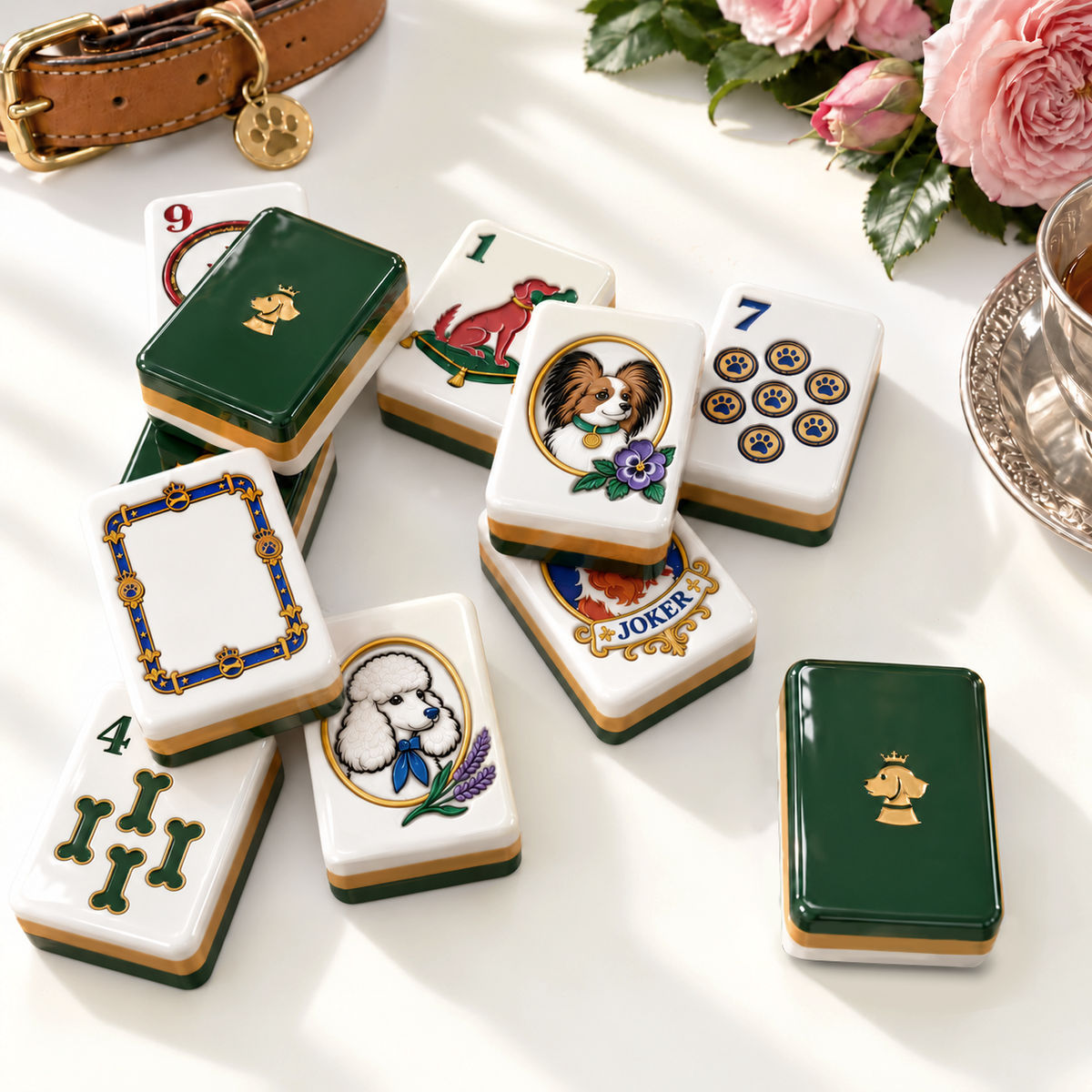
The 9 Dot tile—the highest Dot in American mahjong—appears four times in a standard set and is used identically to any number tile: in pungs (three 9 Dots), kongs (four 9 Dots), quints, or sextets, all matched on the current year's National Mah Jongg League card. The 9 Dot can never form a sequence (chow) with 1–2 or any other number, because American mahjong has no sequences—only identical-tile melds. It cannot serve as a joker substitute or be used alone as a single tile or pair. Position it in any exposed pung, kong, or longer meld by matching the tile pattern exactly to the hand on the card you are playing. Mahstead's best-selling mahjong sets include four crisp, clearly marked 9 Dot tiles so confusion never happens mid-game.
The 9 Dot is the highest number tile in its suit and plays a unique role in American mahjong hands. Understanding where it fits on the card and how to expose it will sharpen your strategy and avoid misplays.
What rank does the 9 Dot hold in the Dot suit?
The 9 Dot is the highest-numbered tile in the Dots suit (1–9 Dots). All number tiles rank equally in terms of meld-building: a pung of 9 Dots is no more or less valuable than a pung of 1 Dots when it appears on the card you're playing. The only rank distinction in American mahjong is whether a meld is exposed (pung, kong, quint, sextet) or concealed (in your hand). The 9 Dot's role depends entirely on which hand pattern from the current year's card you are pursuing.

Can the 9 Dot form a sequence with other numbers?
No. American mahjong contains no sequences (chows). Unlike Chinese or Riichi variants, where 7–8–9 is a valid chow, American mahjong only permits melds of identical tiles: three, four, five, or six of the same tile. The 9 Dot can only combine with other 9 Dots—never with 8 Dots, 1 Dots, or any other number. This rule applies to all number tiles and is one of the biggest rule shifts beginners encounter when learning how to play American mahjong.
How do you expose a 9 Dot pung or kong?
When a 9 Dot pung (three tiles) or kong (four tiles) appears on your hand card, and you own all three or four, you call the meld when the tile you need is discarded by another player (or when you draw it from the wall, in the case of a kong). Lay all three or four 9 Dots face-up on the table in front of you, grouped neatly so the others can see the suit and number clearly. If you are using mahjong racks with pushers, push the three or four 9 Dots to the outer edge of your rack to signal they are exposed. Jokers can never substitute for a 9 Dot in a pung, kong, quint, or sextet—every tile must be identical and real.
What about 9 Dots in quints or sextets?
A quint is five identical tiles; a sextet is six. The 9 Dot can appear in either if your card pattern calls for it. For example, if you are playing a hand that requires a sextet of 9 Dots and a pair of Winds, you must hold or collect all six 9 Dots and expose them together as one meld. Quints and sextets are always exposed—you cannot hold them concealed in your hand. These longer melds are less common than pungs and kongs, but they appear regularly on the card and score well when completed correctly.

When can the 9 Dot NOT be used?
The 9 Dot cannot be used as a joker, a single tile, or part of a pair except where the card explicitly shows a pair of 9 Dots. It cannot form a sequence, appear in a chow, or be mixed with other numbers in any meld. If your card calls for "a pair and three pungs," but you only have one 9 Dot and no way to complete a pung of 9 Dots, you cannot use that tile to fill the pair slot—you must use a different tile pair (like two Winds, two Dragons, two Flowers, or a legitimate pair from another suit). This is where careful hand reading prevents dead-end situations late in the game.
How does the 9 Dot fit into common hand patterns?
Most hand patterns on the League card mix number tiles with Winds, Dragons, and Flowers. A hand might read: "3 like number / 2 like number / 1 like number / pair like number"—meaning you need three pungs of one number (such as three 9 Dots, three 9 Bams, three 9 Craks), two pungs of a different number, one pung of a third number, and a pair of any identical tiles. The 9 Dot slot into this structure exactly like any other number tile. What matters is that you match the position on the card and hold four identical 9 Dot tiles if you need all four for your hand. Here's a decision framework for spotting 9 Dot hands quickly:
Pattern Element | 9 Dot Use | How to Check | Best Strategy |
3 like | Three 9 Dots in a pung | Card shows "3 like number" + holds three 9 Dots | Call or expose when you have all three |
2 like + pair | Two pungs of 9 Dots, or 9 Dots as pair | Rare; requires two separate 9 melds or 9 Dots as pair slot | Collect both melds separately if card permits |
Quint or sextet | Five or six 9 Dots | Card explicitly shows "quint of 9" or "sextet of 9" | Exposing longer meld wins faster than three separate pungs |
Dead tile | None | Your hand never includes 9 Dots; card uses other suits only | Discard all 9 Dots early to free up space |
🀄 Shop best-selling mahjong sets →
Common mistakes with the 9 Dot—and how to avoid them
Confusing the 9 Dot with a joker: Many newer players think the 9 Dot can stand in for missing tiles. It cannot. Every exposed meld must be pure—all identical tiles, no substitutes. If you expose "9 Dot, 9 Dot, Joker" thinking it counts as a pung of 9 Dots, your hand is misdeclared and you lose the round. Check before you play: is every exposed meld exactly the same tile repeated?
Missing 9 Dot hands on the card: The 9 Dot appears on many hand patterns because it is the highest number tile and often anchors "3 like" or "2 like" sections. Scan the full card for every instance of "9 Dot" or "9 any" before each game. Use how to read the mahjong card as your reference guide to decode card notation quickly.
Holding onto 9 Dots when they are not in your hand: If your hand pattern does not include a 9 Dot pung, holding three 9 Dots eats up valuable rack space and slows you down. Discard them early. Every tile slot counts in a 14-tile hand (13 in hand, one drawn or called).
Forgetting the four-tile rule: There are only four 9 Dots in the set. If you need a pung and someone else is also collecting 9 Dots, your odds of winning that race shrink fast. Watch the discard pile: if three 9 Dots are already gone, your chances of completing a 9 Dot pung are almost zero.
What to check before you buy:
When you order a best-selling mahjong set or any 160-tile acrylic set, verify the Dot suit tiles are clearly printed and easy to distinguish at arm's length. Acrylic tiles with sharp edges and bold numbering prevent table fumbles and disputes. Check that the bag or case can hold your set safely if you host games weekly—loose tiles shift during transport and can scratch. If you play frequently, consider mahjong mats to protect your tiles and table surface.
🎁 See our most-loved mahjong sets & accessories →
Why mastering the 9 Dot matters
The 9 Dot is not special or rare—but playing it correctly is the difference between a smooth game and a halted round. When you understand that the 9 Dot is simply the highest number tile, cannot partner with any other number, and must appear in an exposed meld exactly as it sits on your hand card, you avoid the three most common rule disputes at the table: "Is that a real pung?" "Can I use a joker here?" "Is this hand even possible?" By the time you finish a few games, spotting 9 Dot hands becomes automatic. The bigger win is confidence: you know the rules, you move faster, and you enjoy the game instead of second-guessing yourself. Explore what's in an American mahjong set to deepen your tile knowledge further.
✨ Find your Mahstead set — free US shipping →

FAQ
Can I use a 9 Dot as a joker in a pung of 9 Dots?
No. Jokers cannot substitute for any tile in an exposed pung, kong, quint, or sextet. All exposed melds must be pure—every tile identical. A pung of 9 Dots must contain three real 9 Dots, no jokers.
What happens if I expose three 9 Dots and one of them is wrong?
Your hand is misdeclared. You lose the round, pay penalties, and sit out until the next hand begins. Always double-check your card notation before laying tiles on the table.
Can 9 Dots ever form a pair?
Yes, only if the hand card explicitly shows a pair of 9 Dots. Otherwise, pairs are Winds, Dragons, Flowers, or other number tiles. You cannot use 9 Dots as a pair just because you hold two.
If I hold three 9 Dots but my hand does not include them, should I keep or discard them?
Discard all three early. Dead tiles waste rack space and slow your hand progress. Release them so you can draw and collect tiles that actually match your current hand card.
How many 9 Dots are in a standard American mahjong set?
Four. There are exactly four of each number tile (1–9) in each suit, plus four Winds of each direction and four of each Dragon. A standard set always contains 152 playing tiles.


View More
View More
View More
