
How to Use the 8 Bam Tile in American Mahjong
Last updated: Nov 23, 2026
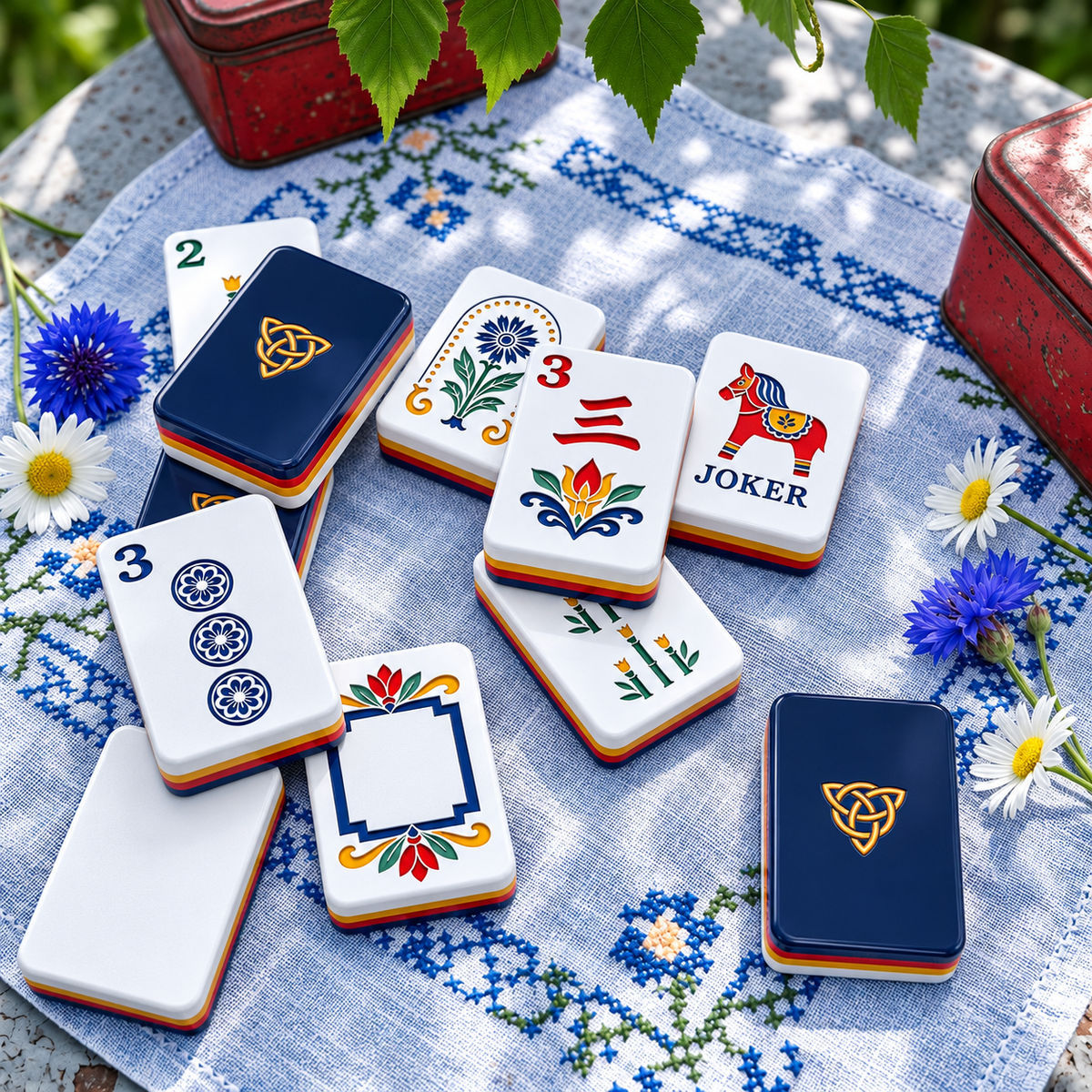
The 8 Bam is one of nine numbered Bamboo tiles (1–9) in American mahjong, appearing four times in a standard deck. You draw and hold it like any other number tile until you match it to a hand on the current year's National Mah Jongg League card. The 8 Bam can form pungs (three identical 8 Bams), kongs (four identical 8 Bams), quints (five 8 Bams plus a joker), or sextets (six 8 Bams using jokers), or appear as part of a hand pattern with other Bam numbers. Because American mahjong allows only identical-number groups—never sequences like 7-8-9—the 8 Bam works only in hands where three or more 8s are called for. Once you've drawn all tiles, if your hand matches a pattern on the card, you expose qualifying groups (called melds) and declare Mahjong. Most casual games use one of our best-selling mahjong sets so all four 8 Bams are identical and easy to spot.
Which hand patterns include the 8 Bam?
The 8 Bam appears in hands that call explicitly for three or more identical 8 Bams. Consult your current year's National Mah Jongg League card: look for any pattern listing "8 Bam × 3," "8 Bam × 4," "8 Bam × 5" (with joker), or higher. The card never asks for mixed sequences (like 6-7-8 Bam)—American mahjong forbids chows entirely. The 8 Bam cannot be used alone or as a pair; it must be part of a three-or-more group to be exposed during play. If your hand requires 8 Bams but you've drawn fewer than three, a joker can substitute for any missing 8. Check the hand section of the card carefully; some years feature dozens of 8 Bam patterns, others fewer. To learn how to read the card efficiently, see how to read the mahjong card.

How do jokers substitute for the 8 Bam?
Jokers in American mahjong are wild tiles: each joker can stand in for any other tile you need. If a hand calls for four 8 Bams and you have only three, one joker fills the gap to complete a kong. If you need five 8 Bams (a quint), you can use three real 8 Bams plus two jokers—or three 8 Bams and one joker, depending on the hand. Critically, jokers cannot form a pair by themselves, and a single tile cannot be a joker alone; jokers only work in groups of three or more. Once you expose a group containing a joker (say, three 8 Bams + one joker as a quint), that joker is locked in place for the rest of the hand—you cannot exchange it for another tile later. This rule prevents mid-game changes that would break the integrity of your hand. For the full rules governing joker use, read how jokers work in American mahjong.
🀄 Shop best-selling mahjong sets →
Can you discard the 8 Bam safely?
Discarding the 8 Bam is always legal before you declare Mahjong, but timing matters strategically. Early in the hand, discarding an 8 Bam is often safe because other players are unlikely to have the three or four 8s needed for an immediate exposure. Watch the discard rack: if an opponent has already discarded three 8 Bams, others probably don't have many. If you hold two 8 Bams and need three for a group, discard it to reduce your hand count and free mental space. However, if an opponent has just picked a tile and you suspect they're building an 8 Bam pung, holding yours a turn or two longer may protect you. The moment someone exposes a pung or kong of 8 Bams, avoid discarding any Bam tile (any number) if possible, because exposed Bams make it easier for the active player to complete their hand. Strategic discarding is learned through play; beginners should focus on accuracy over tactics.
What's the difference between pungs, kongs, and quints with 8 Bams?
A pung is exactly three identical tiles—three 8 Bams, no jokers, no substitutions. A kong is exactly four identical tiles—four real 8 Bams, or three 8 Bams plus one joker. A quint is five identical tiles—all real (five 8 Bams) or with jokers (e.g., three real 8 Bams plus two jokers). A sextet is six identical tiles, using jokers as needed. Each counts as a separate meld when exposed on the table. The hand card specifies which size you need: some hands call for "pung of 8 Bam," others for "kong of 8 Bam" or higher. All four copies of the 8 Bam look visually identical in a quality set, making it easy to count at a glance. The key rule: you cannot mix pung and kong or pung and quint—you must expose the exact group size the hand requires, no smaller, no larger.
Group Size | Composition | Number of Jokers Allowed | When to Use |
Pung | 3 identical 8 Bams | 0 (all must be real) | Hand calls for "pung of 8 Bam" |
Kong | 4 identical 8 Bams | 0–1 (e.g., 3 real + 1 joker) | Hand calls for "kong of 8 Bam" |
Quint | 5 identical 8 Bams | 0–2 (e.g., 3 real + 2 jokers) | Hand calls for "quint of 8 Bam" |
Sextet | 6 identical 8 Bams | 0–3 (e.g., 3 real + 3 jokers) | Hand calls for "sextet of 8 Bam" |

What tiles work alongside the 8 Bam in a hand?
The 8 Bam appears in hands alongside other tiles from any suit (Craks, Dots) or honor tiles (Winds, Dragons, Flowers). American mahjong hands are custom combinations, not standard sequences, so an 8 Bam hand might include, for example, three 8 Bams, a pung of East Winds, a pair of Red Dragons, and a pair of Flowers. The hand card shows exactly which tiles belong together; your job is to draw and match. Never assume the 8 Bams connect to other Bam numbers—the card is absolute law. When you've drawn exactly 14 tiles and all 14 match a single pattern on the card (with all exposures, known as melds, matching their required meld type), you declare Mahjong and win the hand. Before declaring, count aloud to verify: confirm your pair, count each meld, check the total equals 14, and read the hand name from the card. For detailed rules on how hands are structured and won, see what's in an American mahjong set.
🎁 See our most-loved mahjong sets & accessories →
How does the 8 Bam differ from other number tiles?
The 8 Bam is functionally identical to the 1, 2, 3, 4, 5, 6, 7, or 9 Bam; each number appears four times and can form the same meld types (pung, kong, quint, sextet). There is no rank or hierarchy among number tiles in American mahjong—an 8 Bam is no "higher" or "lower" than a 3 Bam. The sole visual distinction is the number on the tile; gameplay rules are the same. In contrast, Wind and Dragon honor tiles have special roles in certain hand patterns (e.g., some hands call for "pair of Winds"), but Bam numbers are interchangeable in structure. The 8 Bam is simply the tile marked with the numeral 8 in the Bamboo suit. Because all number tiles behave identically, beginners often find Bam, Crak, and Dot tiles easier to grasp than honor tiles, which have symbolic meaning and suit-specific pairings.
What common mistakes happen with the 8 Bam?
Mistake 1: Exposing too few or too many. If the hand calls for a pung of 8 Bam and you expose four 8 Bams (a kong), your hand is illegal; you've over-exposed. Similarly, exposing two 8 Bams when you need three makes the hand impossible to match. Always count the hand card requirement before laying down tiles.
Mistake 2: Using a joker as a single tile or pair. Jokers cannot stand alone or form a pair; they work only in groups of three or more. If you need a pair of 8 Bams, both must be real tiles—no joker substitutions allowed.
Mistake 3: Mixing real tiles and jokers incorrectly. If a hand requires three 8 Bams with no jokers stated, all three must be real 8 Bams. Substituting a joker when the card does not permit it invalidates your hand.
Mistake 4: Confusing 8 Bams with 8 Craks or 8 Dots. Each suit (Bam, Crak, Dot) has its own set of 1–9 tiles. An 8 Bam is not the same as an 8 Crak. If your hand calls for "8 Bam," only the 8 Bam tile works; Craks and Dots do not substitute.
Mistake 5: Discarding before verifying your hand. Beginners sometimes discard a tile, then realize they've broken their hand. Before each discard, scan the remaining 13 tiles to ensure they still match a live hand on the card.
What to check before you buy:
Tile clarity: Ensure your set's number tiles are printed or engraved clearly so you can spot all four 8 Bams instantly.
Consistency: All four 8 Bams should look identical (same size, weight, color, marker style). Mismatched tiles cause counting errors mid-game.
Durability: Tiles are handled repeatedly over hours—choose a set with reinforced numbers that won't fade or chip.
Complete set: A legal American mahjong set must contain exactly 152 tiles (three suits × 1–9 × 4 = 108 Bam/Crak/Dot tiles, plus 16 Winds, 12 Dragons, 8 Flowers, 8 Jokers). Count before play begins.
Our best-selling mahjong sets are designed and engraved so every tile, including all four 8 Bams, is legible and uniform.
✨ Find your Mahstead set — free US shipping →

FAQ
Can the 8 Bam appear as part of a sequence like 6-7-8 in American mahjong?
No. American mahjong forbids all sequences (called chows). The 8 Bam can only appear in identical-tile groups—pungs, kongs, quints, or sextets—where all tiles are the same number.
If I have two 8 Bams and one joker, can I expose that as a pung?
Yes. Two real 8 Bams plus one joker form a legal pung of 8 Bams, provided your hand card permits jokers in that meld (most do). All three tiles are exposed as one meld.
What happens if I draw all four 8 Bams but my hand only needs three?
Hold all four in your rack but expose only three as your meld when you declare Mahjong. The fourth 8 Bam (and any other "extra" tiles) becomes part of your unused hand inventory—it must match the card's overall pattern, or your hand is dead.
Is the 8 Bam harder to spot in a set than higher or lower numbers?
Not if your set has clear, large numerals. Poor-quality sets with faded or tiny numbers make all tiles harder to spot quickly, including the 8 Bam. Invest in a set with bold engraving or clear printing.
Can I discard the 8 Bam to force another player to draw it?
No player can force another to draw a specific tile; players draw in turn from the wall. You can discard the 8 Bam anytime before you declare, but only the active player draws next—it's not a punishment or strategy tool.
Does the 8 Bam score differently than other number tiles if I win?
No. American mahjong scoring depends only on which hand pattern you completed, not on individual tile numbers. Two different 8 Bam hands on the card may score differently, but that's because the patterns differ, not because of the 8 itself.


View More
View More
View More
