
Mahjong Solitaire for Beginners: Rules, Games & First Steps
Last updated: Nov 23, 2026
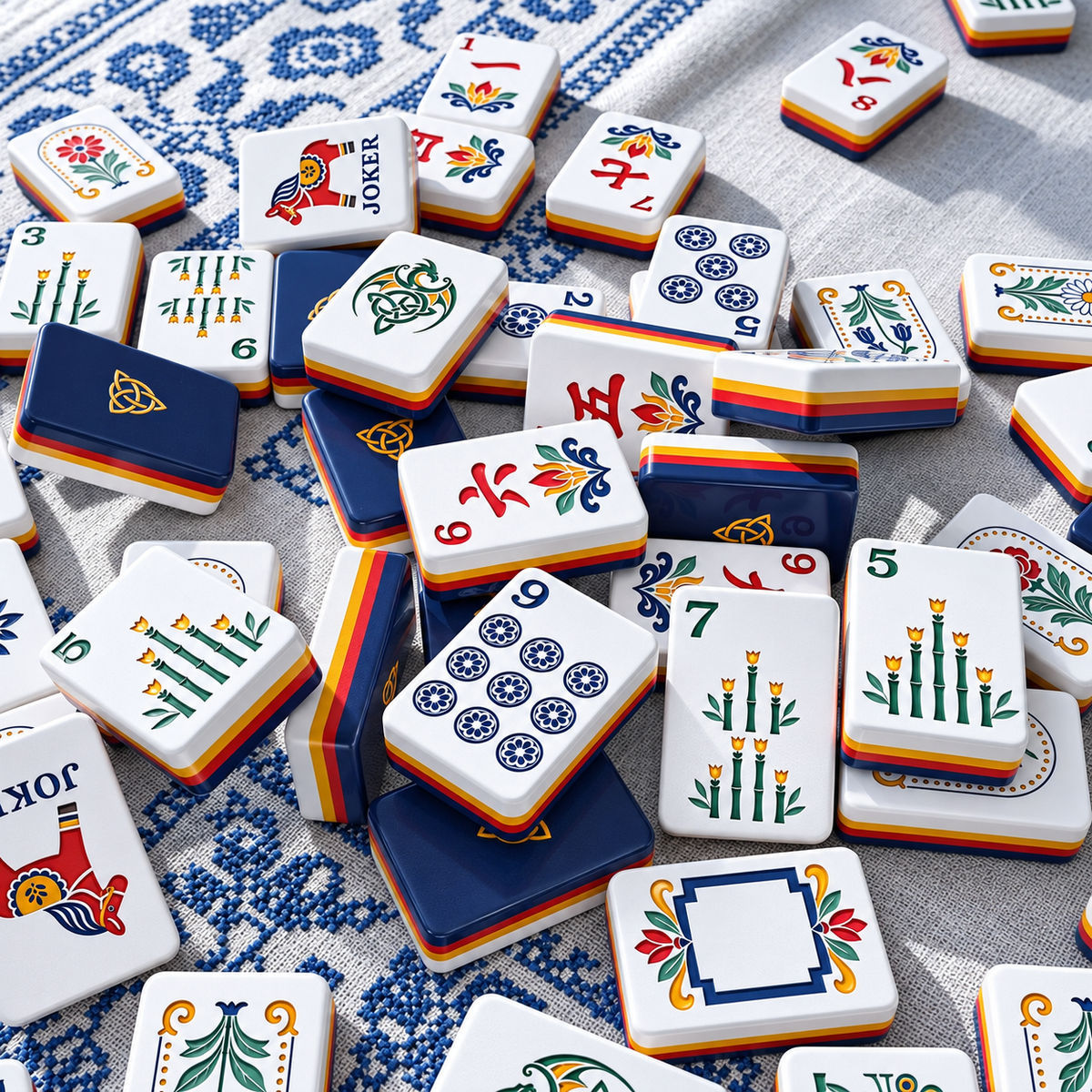
Mahjong solitaire is a single-player puzzle where you match and remove pairs of identical tiles from a layout until the board clears—unrelated to the four-player game Americans know. Unlike traditional mahjong (which requires strategy, hand reading, and group play), solitaire uses a standard 152-tile mahjong set but only as puzzle pieces; the card-based hand-matching rules don't apply. Each game takes 10–30 minutes depending on difficulty and your familiarity with tile symbols. You need one mahjong set, a flat surface, and no partners. Beginners should start with digital versions or simpler tile-matching layouts before attempting trickier board shapes. Our best-selling acrylic sets work well for learning tile names, though any set suffices. Common mistake: confusing solitaire rules with four-player American mahjong—they're entirely separate games sharing only tile names and appearance.
What is mahjong solitaire vs. traditional mahjong?
Mahjong solitaire is a solitary tile-matching puzzle; traditional American mahjong is a competitive four-player game with hands dealt from a shuffled tile pool, governed by an official card, and scored by melds. In solitaire, you see all tiles at once (usually stacked or arranged on a grid), match identical pairs, and remove them until none remain. No luck, no dealing, no card—just pattern recognition and planning. You can play solitaire on paper, a tablet, or a physical set; traditional mahjong requires exactly four players, a wind position, a current-year NMJL card, and knowledge of hand patterns. If you want group play with stakes and strategy, learn traditional mahjong; if you want a solo brain workout over coffee, solitaire is your game.

How do you set up and play a solitaire game?
Shuffle all tiles from a standard 152-tile set (including winds, dragons, flowers, and jokers). Arrange tiles in your chosen layout—many beginners start with simple rows, stacked pyramids, or a "pair removal" grid where each tile lies flat and visible. The goal is to match two identical tiles and remove both. In most layouts, you can only match tiles that are "free" (not blocked on left or right, or not covered by other tiles in stacked versions). Remove the pair, then re-examine the board; new matches may open up. Keep going until no free matches remain. If the board clears completely, you've won; if you get stuck, you've learned something about tile grouping and planning ahead—both skills that help in traditional play. Start with a simple 4×10 grid (40 tiles), then graduate to stacked pyramids or shapes.
🀄 Shop best-selling mahjong sets →
Which solitaire layouts are easiest for beginners?
Layout | Tiles used | Difficulty | Best for |
Simple grid (4×10) | 40 | Easy | First-time players |
Pyramid stack | 60–80 | Medium | Learning tile recognition |
Classic diamond | 80–100 | Medium | Practicing foresight |
Full board (all 152) | 152 | Hard | Mastering tile memory |
Start with a grid where all 40 tiles lie flat in four rows of ten; this trains your eye to spot matching pairs quickly without the memory challenge of stacked layouts. Once you clear grids consistently, try a three-tier pyramid (each tile covered by two above it), which adds the rule that only uncovered tiles are playable—this mimics the "blocked" mechanic of many digital solitaire games. The full-board puzzle uses all 152 tiles in a complex shape and requires planning several moves ahead; it's a real test, but attempting it teaches the tile names and symbols faster than any flashcard. Most players find the pyramid layout most satisfying because it rewards both speed and strategy.
Should you use a physical set or a digital app?
Physical sets teach tile symbols, hand coordination, and the weight of real play—useful before you sit down for traditional mahjong with others. Apps (free on most devices) offer unlimited layouts, undo buttons, and instant shuffles, making them ideal for travel and quick practice. We recommend starting with an app to learn rules and build confidence, then using a physical set to reinforce tile names and feel the ritual of shuffling and placing. If you have a set of acrylic tiles, use it weekly; the haptic feedback and visible symbols stick in your memory better than screen time. Apps are free; a beginner-quality physical set is affordable. Honest truth: most casual players stick with apps because they're frictionless, but friends who kept a set at hand reported stronger retention of tile names and faster play-joining success later.

Can you play mahjong solitaire on your phone or computer?
Yes—hundreds of free apps exist for iOS, Android, and web browsers. Most offer multiple layouts, adjustable difficulty, timer modes, and undo features that physical play doesn't. Digital solitaire is ideal if you travel, have limited table space, or want to practice during lunch breaks. The downside: scrolling and tapping don't build the tile-handling skills you'll need if you later join a traditional game. Many beginners play digital for weeks, then feel clumsy when they touch a real set for the first time; others find that digital practice doesn't transfer well because they relied on undo buttons instead of planning. Our suggestion: use an app to learn the tile system (which suit is which, where the dragon is, what flowers look like), then move to a physical set for reinforcement. A portable acrylic set is compact enough to keep in a closet and use on any flat surface at home.
🎁 See our most-loved mahjong sets & accessories →
How is mahjong solitaire different across countries?
The term "mahjong solitaire" typically refers to the Western tile-matching puzzle described above and is most common in English-speaking countries. Chinese mahjong players call similar games "solitaire" but play with their own tile set (144 tiles, simpler symbols, no flowers or jokers) and slightly different matching rules. Hong Kong and Riichi mahjong players have variant puzzle versions, though fewer resources exist in English. If you find a solitaire game or set labeled "Chinese" or "Hong Kong," the tiles will look different, and some symbols won't match an American 152-tile set. For learning traditional American mahjong later, stick with American solitaire layouts and American tile sets—the symbol consistency matters. Digital apps usually specify their variant in the description; if you buy a physical set, check the tile count (152 for American) and ensure it includes the full 8 flowers, 16 winds, 12 dragons, and 8 jokers unique to the American version.
What to check before you buy a set for solitaire practice
Tile count: American mahjong solitaire uses 152 playing tiles (plus spares). Sets labeled "Chinese" have 144 tiles and won't match American guides.
Symbol clarity: Can you see winds (N/E/W/S), dragons (Red, Green, White), flowers, and suit symbols without squinting? Acrylic tiles with printed details stay clear longer than bamboo.
Size for your hands: Beginner sets sometimes come in youth sizes (smaller tiles, harder to handle). A standard American set feels better in adult hands and trains you for table play.
Surface stability: A mat or soft table surface prevents tiles from sliding around. If you don't have one, a folded towel works in a pinch.
Tile durability: You'll shuffle these dozens of times. Acrylic withstands repeated shuffling better than bone or bamboo sets on a budget.
✨ Find your Mahstead set — free US shipping →

FAQ
Can I learn traditional American mahjong by playing solitaire first?
Partially. Solitaire teaches tile names, symbols, and how to spot matches—valuable for speed and recognition. But it teaches no hand patterns, no scoring, no call mechanics, and no strategy against opponents. Most players pair solitaire practice with a beginner's guide or a teacher to jump to traditional play.
How long does a solitaire game usually take?
Simple layouts (40–60 tiles) take 5–15 minutes; medium layouts (80–100 tiles) take 15–30 minutes; a full 152-tile board can take 30–60 minutes, especially on your first attempts. Faster play comes with familiarity.
Do jokers work the same way in solitaire as in traditional mahjong?
No. In traditional mahjong, jokers are wild and substitute for any tile in a meld. In solitaire, most layouts treat jokers as unique tiles themselves; you match two jokers to each other, not jokers to other tiles. Check your app or layout rules first.
What's the best physical set to buy if I'm just starting?
A standard American 160-tile acrylic set from a reputable maker offers clear symbols, durability, and tile counts that match digital games and guides. Look for sets described as beginner-friendly with large, printed faces on tiles.
Can I play mahjong solitaire with a partner, or is it strictly solo?
It's designed for one player, but you can race a friend (each shuffles their own set, plays their layout, first to clear wins). Some people call this "competitive solitaire," though it's not a traditional variant.
How do I know if I'm ready to join a real mahjong game after practicing solitaire?
You're ready when you can name all tile types, recognize suits and symbols instantly, shuffle smoothly, and understand the four wind positions. Solitaire gets you 60% there; a few hours with a traditional beginner's guide or video completes the picture.


View More
View More
View More
