
How to Use the 2 Dot Tile in American Mahjong
Last updated: Nov 23, 2026
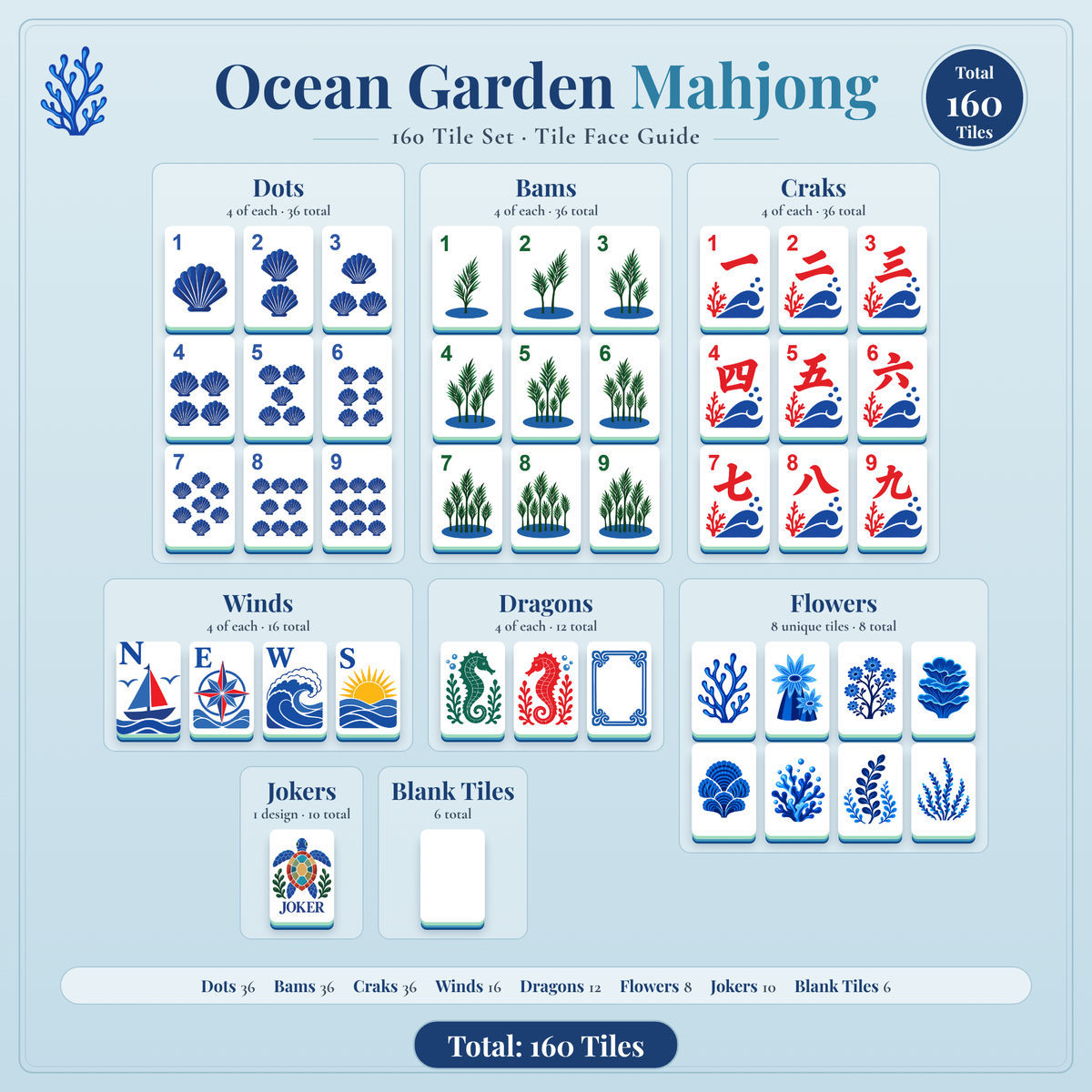
In American mahjong, you have four identical 2 Dot tiles in your 160-tile set. The 2 Dot appears on the current year's National Mah Jongg League card in many hand patterns as part of pungs (three identical tiles), kongs (four identical), quints, or sextets; it also shows up in sequences with other Dots (like 1–2–3 or 2–3–4 of Dots). You play the 2 Dot by drawing it, holding it in your rack, and matching it to a hand listed on the card. Unlike jokers, you can play the 2 Dot as a "real" tile—it fills its own number slot. The card changes every spring, so patterns using the 2 Dot vary year to year. Jokers can substitute for the 2 Dot if the card calls for one and you don't have it, but you cannot use a joker alone as your pair or in a single-tile exposure. Most players keep best-selling sets with clear, color-blocked Dot tiles so spotting the 2 is fast during play.
What does the 2 Dot look like in American mahjong?
The 2 Dot tile shows two small circle symbols (pips) arranged on the tile face, typically in the center or diagonal corners depending on the tile design. American mahjong tiles are larger than Chinese sets—roughly 1.5 inches wide—so the dots are easy to read at arm's length. Most Mahstead sets use vibrant reds or greens for Dot suits, making the 2 Dot distinct from Bams (characters/bamboo) and Craks (symbols). The tile is wider and thicker than playing cards, designed to stand upright in your rack.
🀄 Shop best-selling mahjong sets →

Where do you find 2 Dots on the mahjong card?
The current year's National Mah Jongg League card lists hundreds of winning hand patterns. The 2 Dot appears in many of them—sometimes as three copies in a pung, four in a kong, or mixed with other Dots in sequences like 1–2–3 or 2–3–4. Some patterns call for multiple 2 Dots across different melds. The card sections are organized by hand type (like "2 Like Numbers" or "Consecutive Run"), so you scan your tiles against each section. Jokers can fill a 2 Dot slot if needed, but the real tile is always preferable because jokers are limited (eight per set) and must be managed carefully across your entire hand. Learning how to read the mahjong card makes spotting 2 Dot patterns faster.
Can you use a joker instead of the 2 Dot?
Yes—jokers are wild tiles that substitute for any tile on the card, including the 2 Dot. However, there are strict rules: a joker cannot be your pair (the two identical tiles that complete your hand), and it cannot be played as a single exposed tile. If a hand pattern calls for a pung of 2 Dots but you only have two real 2 Dots and a joker, you can use the joker as the third tile. But if the pattern needs a pair of 2 Dots, you must have two real 2 Dots; you cannot use a joker for the pair. This constraint matters because you often draw all four copies of a tile during a 16-tile draw, so you rarely need to joker a 2 Dot. Jokers are most valuable for tiles you didn't draw—like a specific Dragon or Wind. Learn more about how jokers work in your winning hand strategy.

Why is the 2 Dot harder to spot than other Dots?
The 2 Dot uses only two pips, making it visually smaller and quicker to misread than, say, the 8 or 9 Dot (which have eight or nine pips densely packed on the tile). Under table lighting or when you're holding your rack at an angle, the two dots can blur together or be mistaken for dust on the tile. Players new to American mahjong often confuse the 2 Dot with a blank tile or the 1 Dot (which shows a bird symbol instead of a dot). The best defense is to arrange your tiles by suit and number in your rack, so you know exactly where the 2 Dots sit. Many players also keep mahjong racks with pushers that have deep grooves or angled tile stands—these keep tiles upright and visible, reducing read errors during fast play.
How do you play a 2 Dot once you draw it?
After the Charleston (the tile-passing ritual before play), you draw tiles one at a time. When you draw a 2 Dot, place it in your rack in the Dots section, sorted by number if possible. Check the current year's card to see which hands include a 2 Dot. If you have all other tiles in a pattern that needs a 2 Dot, call "Mahjong" and lay your hand on the mat to be verified. If no hand is complete, keep the 2 Dot and continue drawing. If you hold two 2 Dots and need three for a pung, you can also draw tiles hoping for a third copy or a joker to substitute. Once you declare a winning hand, the game ends, and the dealer settles points with each player based on the hand's value on the card. Hands vary wildly in difficulty and point value, so a hand heavy in 2 Dots might be worth 25 points or 50—the card determines all.
Tile Scenario | Can You Play It? | Notes |
Have 1 real 2 Dot, need a pung | No — draw or call a joker | If you draw the real tile later, you have a pung. |
Have 2 real 2 Dots, need a pung | No — draw or call a joker | Joker becomes your third. Pair cannot be a joker. |
Have 3 real 2 Dots, need a pung | Yes — expose your pung | You now have one fewer tile to reach 14. |
Have 2 real 2 Dots, need a pair | Yes — complete your hand | Pairs must be real tiles. |
Have 2 Dots in one hand section and a joker as the 2 Dot elsewhere | Allowed | Different hands can use different melds. |
Common mistakes with the 2 Dot—and how to avoid them
Confusing 2 Dot with blank or joker: If your set includes spare blank tiles (common in 160-tile sets), never mix them into play. Only 152 tiles are used; the rest stay off the table. Keep jokers in a separate pile to avoid accidentally mixing them with real tiles.
Playing the 2 Dot in a sequence where it doesn't belong: American mahjong has no "chows"—open sequences like 1–2–3—that can be exposed and called by other players. You can hold 1–2–3 of Dots in your hand, but you cannot lay it on the mat as an exposed meld unless the card explicitly lists it as a consecutive run. Always verify the card before exposing any meld.
Using a joker for the pair: This is the cardinal sin. If your winning hand needs a pair of 2 Dots, you must have two real 2 Dots. Jokers cannot fill the pair slot, and doing so will be caught during verification and cost you the hand.
Holding too many 2 Dots early in the game: If you draw two 2 Dots in your opening hand and no pattern uses them, you're holding "dead" tiles. Discard one early to open up space for tiles that complete a hand faster. The discard is crucial; it tells other players what you don't need.
Not calling Mahjong when you have it: Players sometimes forget to check the card after drawing. If you complete a hand and don't announce it, you cannot go out until your next turn—giving opponents chances to discard into your winning hand or steal your win. Always announce immediately.
What to check before you buy:
Tile size: Ensure your set's tiles are large enough to read (1.5 inches is standard for American mahjong).
Color contrast: Verify Dots are a bright, distinct color (not muddy or faded) to avoid misreading the 2.
Rack quality: Use racks with angled or grooved tile holders to keep the 2 Dot visible and not buried.
Card clarity: Your current year's card should be laminated and printed large—a small or creased card makes scanning for patterns difficult.
Storage: Keep your set in a bag or case when not in use; loose tiles in a drawer get mixed up and lost.
🎁 See our most-loved mahjong sets & accessories →
Understanding the 2 Dot is a small skill, but it's part of the larger puzzle of reading the card and managing your tiles efficiently. Most of us learned by playing weekly games and making mistakes—then catching them. The sooner you can spot a 2 Dot in your rack and cross-reference it on the card, the faster you'll complete hands and win. If you're building your first set or upgrading from worn tiles, explore sets with clear, color-coded suits—they make the 2 Dot and every other tile unmistakable.
✨ Find your Mahstead set — free US shipping →

FAQ
Can a joker replace the 2 Dot in any hand?
A joker can substitute for the 2 Dot in any meld except the pair. Pairs must always be two real identical tiles. Jokers also cannot be played as a single exposed tile.
Why does my 2 Dot look different from my friend's set?
American mahjong sets from different makers vary slightly in tile size, pip style, and color intensity. Mahstead sets use consistent dot sizing and color so the 2 Dot reads quickly under any lighting. If you're merging sets to make enough tiles, confirm tile dimensions match first.
If I draw all four 2 Dots, what do I do?
You can use up to four 2 Dots across multiple melds in a single hand (for example, a pung of three and a pair of one). More often, hands use only one or two 2 Dots mixed with other tiles. If a hand needs only one 2 Dot, you discard the extras.
Is the 2 Dot worth more points than other Dot tiles?
No. On the National Mah Jongg League card, point value depends on the hand pattern, not the individual tile. A hand listing "2 Dot pung + other melds" is worth the same points regardless of whether the 2 Dot is replaced by a joker or is a real tile—as long as the hand is verifiable.
Can beginners practice with just one set and no spares?
Yes. A standard 152-tile American mahjong set (the playing tiles in a 160-tile box) is all you need to play a complete game with four players. Spare tiles in the 160-tile set are backup jokers and blanks—useful if a tile cracks, but not required for play. If you're hosting weekly games, keep spares to handle wear and tear.


View More
View More
View More
