
How to Use the 1 Crak Tile in American Mahjong
Last updated: Nov 23, 2026
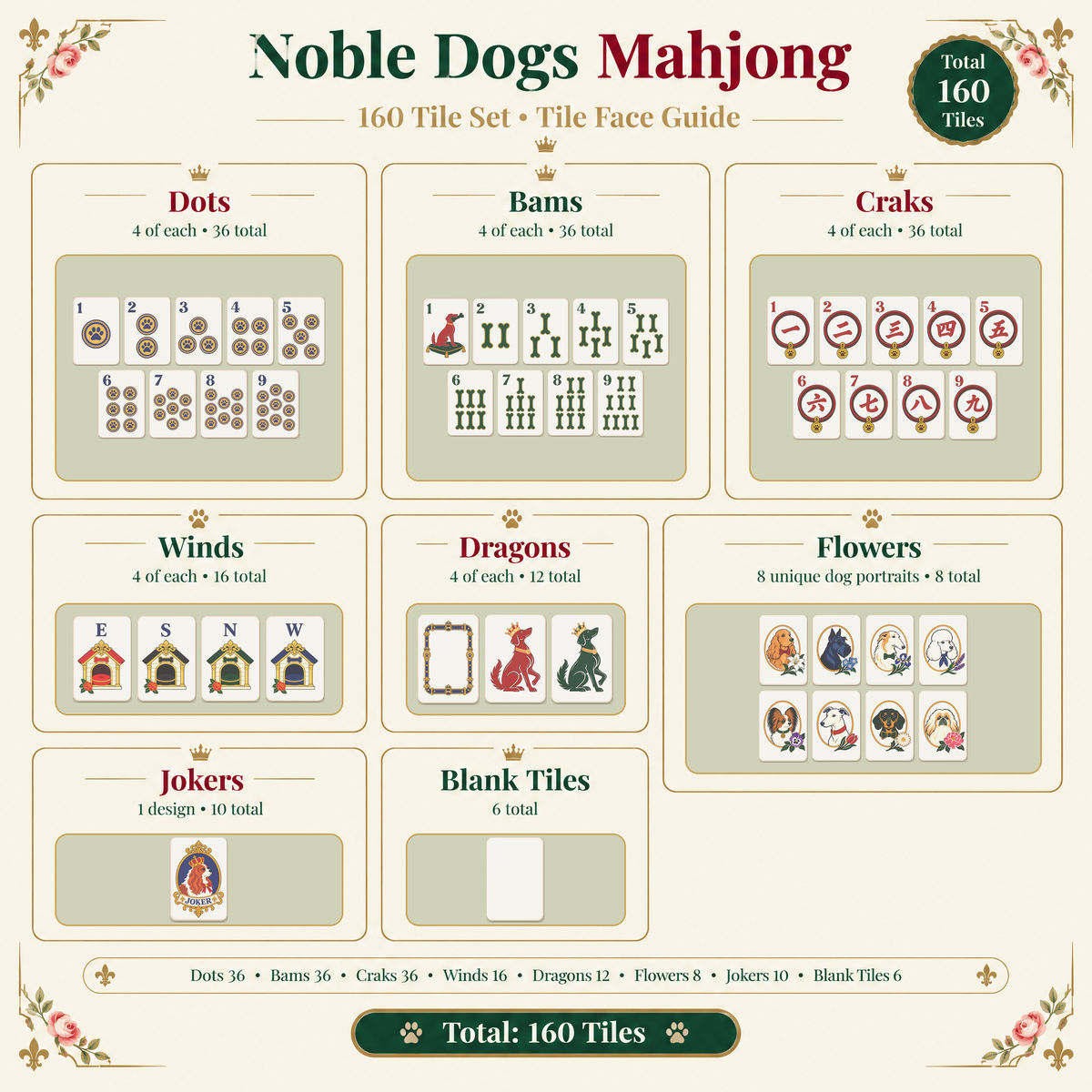
The 1 Crak serves a dual purpose in American mahjong—it counts as both the 1 of Craks (the numeric tile) and as the Red Dragon. You'll find it in four copies in any standard 152-tile set (the four copies are identical). On the tile itself, you'll typically see the Chinese character for 1 inside a red circle or frame, marking its dragon status. In hand-building, you can use it as a 1 Crak or substitute it for a Red Dragon when called for by the current year's National Mah Jongg League card, but never both in the same grouping—it's one tile with two identities, not two separate tiles. This duality makes it the most strategically loaded single tile in the game. When scanning the card to plan your hand, always check whether the section you're targeting calls for Red Dragons or 1 Craks; the 1 Crak satisfies either requirement, giving you flexibility that no other tile offers.
The 1 Crak is often the first tile that trips up newer players because it breaks the rule that each tile has one role. Unlike the other 35 Crak tiles, which are straightforward (1 through 9, each repeating four times), the 1 Crak doubles as the Red Dragon. This design choice exists because Red Dragons are the only dragons that visually link to a suit—they belong with the Crak suit, which traditionally displays in red in many sets.
Why Does the 1 Crak Act as Both a Number and a Dragon?
In American mahjong, the dragon tiles represent the three suits and carry symbolic meaning rather than numeric rank. The Red Dragon represents Craks, the Green Dragon represents Bams, and the White Dragon (called "Soap") represents Dots. Since the Red Dragon is so closely tied to the Crak suit, the tile design combines the symbol. This gives you more flexibility when building hands—instead of needing four separate Red Dragons for certain patterns, you can use the 1 Craks you've already drawn. The rule is: you hold four copies of one tile marked "1 Crak," and those tiles work as either 1 Craks or Red Dragons depending on what the current year's League card requires.

How Do You Read a 1 Crak Tile Visually?
The 1 Crak tile displays a red circle or frame (sometimes a red square or border) containing the Chinese numeral for 1. On many acrylic sets, the character fills the upper half of the tile, with the Crak suit symbol (usually a circle) below it. Some players confuse it with the White Dragon at first glance—the White Dragon is typically plain or stamped with a simple outline—so take a moment to check for that red marking. If you're hosting weekly games and your set's tiles have worn or faded, engraved designs hold their clarity far longer than painted ones; if legibility matters to your group, custom engraved sets from our best-selling collection are worth the investment.
When Should You Use the 1 Crak as a Number vs. a Dragon?
This is where strategy matters. Before drawing, study the current year's National Mah Jongg League card section you're targeting. If your target hand calls for three Red Dragons and four 1 Craks separately, you have flexibility: you can use some of your four 1 Crak tiles to fill the Dragon requirement, freeing up other tiles for the numeric section. Conversely, if you need four 1 Craks and no Red Dragons, hold all four 1 Craks as numbers. The key rule: in a single grouping (a pung, kong, quint, or sextet), the 1 Crak counts as one identity only—you cannot use three 1 Craks and one Red Dragon as a pung, because that's mixing identities. A pung must be three identical tiles.
Scenario | Use 1 Crak As | Reason |
Hand calls for Red Dragons only | Dragon | Reserves numeric 1 Craks for other patterns |
Hand calls for 1 Craks only | Number | Reserves Red Dragons for other patterns |
Hand calls for both, separate | Either, as needed | Play whichever grouping you complete first |
Mixed grouping (3 + 1 Red) | Never mix | Always choose one identity per group |

What's the Most Common Mistake Players Make With the 1 Crak?
The biggest error we see in our weekly games is forgetting that the 1 Crak cannot be mixed with other Red Dragons in the same pung or exposed group. A new player might lay three 1 Craks and one Red Dragon (thinking "that's four reds"), which is not legal. A pung must be three identical tiles, and a kong must be four identical tiles. If you're holding three Red Dragons and find the fourth, you must use a Red Dragon tile—you cannot substitute a 1 Crak mid-grouping. The reverse is also true: three 1 Craks cannot accept a Red Dragon tile to complete a kong. Once you've committed a tile to an exposed pung or kong on the table, its identity is locked.
Another frequent slip is misreading the tile under poor lighting and calling it a White Dragon by mistake. Ensure your playing space has even light and that your set's tiles are clear enough to read quickly. If you're buying a set for regular hosting, clarity matters—engraved or high-contrast acrylic designs prevent these mix-ups.
🀄 Shop best-selling mahjong sets →
How Does the 1 Crak Affect Your Hand-Building Strategy?
The dual role of the 1 Crak makes it one of the most valuable tiles to draw early. If you're unsure which hand to pursue, a pair of 1 Craks in your rack keeps both numeric and dragon options open longer than any other tile. This flexibility is why skilled players track which hands on the card use Red Dragons versus 1 Craks—drawing a 1 Crak early might nudge you toward a dragon-heavy pattern, or it might anchor a numeric strategy. Conversely, if you're deep into a hand and you need specifically four Red Dragons (not 1 Craks), drawing the 1 Crak is useful but not ideal—you'll need to exchange it via a pass or hope to draw an actual Red Dragon later.
This strategic layer is exactly why understanding the tile matters before you sit down. Read a guide on how to read the mahjong card to spot which hands prioritize 1 Craks and which prioritize Red Dragons. Armed with that knowledge, you'll play smarter and faster.
What Should You Check Before You Buy a Mahjong Set?
Clarity of the 1 Crak is one of the first things to verify when choosing a set. If you're hosting regular games, especially with newcomers, your tiles need to be instantly recognizable. Here's a practical checklist:
Red marking is visible: The 1 Crak has a clear red frame, circle, or border that distinguishes it from the White Dragon.
Tile size is standard: Each tile should fit comfortably in a rack with pushers; oversized or undersized tiles cause confusion and slow play.
Acrylic is not cloudy: Frosted or yellowed acrylic makes characters hard to read from a distance.
Engraving is deep and sharp: If the set is engraved (rather than painted), lettering and suit symbols should be crisp and legible after months of shuffling.
Joker count is clear: A standard 152-tile set includes 8 jokers; confirm yours has that count before play.
Storage fits your space: If you host weekly, a mat with built-in racks and a secure bag keep everything organized between games.
Explore engraved American mahjong sets to see designs where the 1 Crak is deliberately highlighted for clarity. Many players choose sets with custom engravings that reinforce suit colors—red for Craks, green for Bams, white dots for Dots—so the 1 Crak's red marking stands out instantly.
🎁 See our most-loved mahjong sets & accessories →
To deepen your overall game, review the full breakdown of what's in an American mahjong set, which covers the other 151 tiles and how they fit together. Understanding each tile's role will sharpen your card-reading speed and your ability to spot winning hands on the fly.
What to Check Before You Buy
When shopping for a set, prioritize tiles over aesthetics. A beautiful set that leaves you squinting at the 1 Crak is a frustration waiting to happen. Test-handle tiles if possible, or read customer feedback on legibility. If you play indoors with variable lighting, matte acrylic or engraved finishes outperform glossy tiles. Sets from our best-selling collection come with free US shipping, so you can experiment with different styles without worrying about travel cost.
Pair your set with a quality mahjong mat and racks with pushers so every player can hold tiles at the same comfortable angle—this reduces misreads and keeps the game flowing. Once you and your group settle into a routine, consistency in equipment pays dividends.
✨ Find your Mahstead set — free US shipping →

FAQ
Can I use a 1 Crak and three Red Dragons to make a pung?
No. A pung must be three identical tiles. Since the 1 Crak and Red Dragon are technically different identities, you cannot mix them in the same grouping, even though the 1 Crak can substitute for a Red Dragon in different patterns.
If I'm building a hand and I need four Red Dragons but I've only drawn 1 Craks, can I use them?
Only if your target hand on the card calls for 1 Craks as well as Red Dragons separately. If the hand specifies four Red Dragons and zero 1 Craks, you cannot substitute 1 Craks for Red Dragons. Always check the card first.
How many copies of the 1 Crak are in a standard set?
Four copies, just like every other tile. You'll have four 1 Craks in your 152-tile set, and they're all identical, so the 1 Crak serves as both a 1 Crak or a Red Dragon across multiple groupings in a single hand.
What's the difference between a 1 Crak and a White Dragon visually?
The 1 Crak displays a red circle or frame with the numeral 1 inside it. The White Dragon is typically plain white or has a simple outline symbol and no red marking. Under good lighting, they're easy to distinguish; always verify before announcing or committing a tile.
Why does American mahjong combine the 1 Crak and Red Dragon into one tile?
The Red Dragon symbolizes the Crak suit, which is traditionally displayed in red. This design gives players more strategic flexibility: instead of needing four separate Red Dragons, you can use the 1 Craks you've already drawn. It's a compact, elegant solution to the tile inventory.
Can I use jokers to replace a 1 Crak?
Yes, jokers in American mahjong act as wild tiles and can substitute for any tile—including the 1 Crak when building a hand. However, you can never use a joker as a single unpaired tile or as part of a pair; jokers only belong in pungs (3), kongs (4), quints (5), or sextets (6).


View More
View More
View More
