
How to Teach Mahjong to Bridge Players
Last updated: Nov 23, 2026
Bridge players bring two huge advantages: they read unrelated suits fluidly and plan sequences under pressure. To teach them mahjong, start with what's different: American mahjong has no sequences (only pungs/triplets, kongs/quads, and sextets), jokers substitute for any tile, and hands come from a printed card issued each season. Teach the Charleston (tile-passing ritual) before any hand, show them how to read the National Mah Jongg League card, then play tutorials slowly. The leap takes four weeks of weekly games—not months. Most bridge players pick it up faster than absolute beginners because they already think in sets, tile probabilities, and discard logic. Use a 152-tile set with 8 jokers so everyone has clear, identical equipment. Avoid pairing them with novices their first game; play with experienced players who can model calm discarding.
Why Do Bridge Players Learn Mahjong So Fast?
Bridge trains you to evaluate incomplete information, track discards, and think in sets. Mahjong requires all three—but in a different rhythm. Bridge players are comfortable with complex hand notation; the National Mah Jongg League card (a printed grid of legal hands) feels natural to them. They already know how to read a partner's bid as a signal and weigh risk. In mahjong, discards carry similar messages: a 7 Dot early means someone probably doesn't want flowers or gaps. Bridge players intuitivize this faster than most.
The main psychological shift is speed. Bridge is turn-based; everyone has time to think. Mahjong moves in real time: you have seconds to decide whether to pung, call, or discard. Bridge players often freeze the first two weeks because they're used to longer deliberation. Reassure them that mistakes are cheap here and speed comes with three games, not thirty.

What's the Fastest Way to Introduce the Rules?
Teach in this order: (1) tile names and suits, (2) the Charleston, (3) how to read the card, (4) what a legal hand is, (5) scoring. Compress it into one 90-minute session.
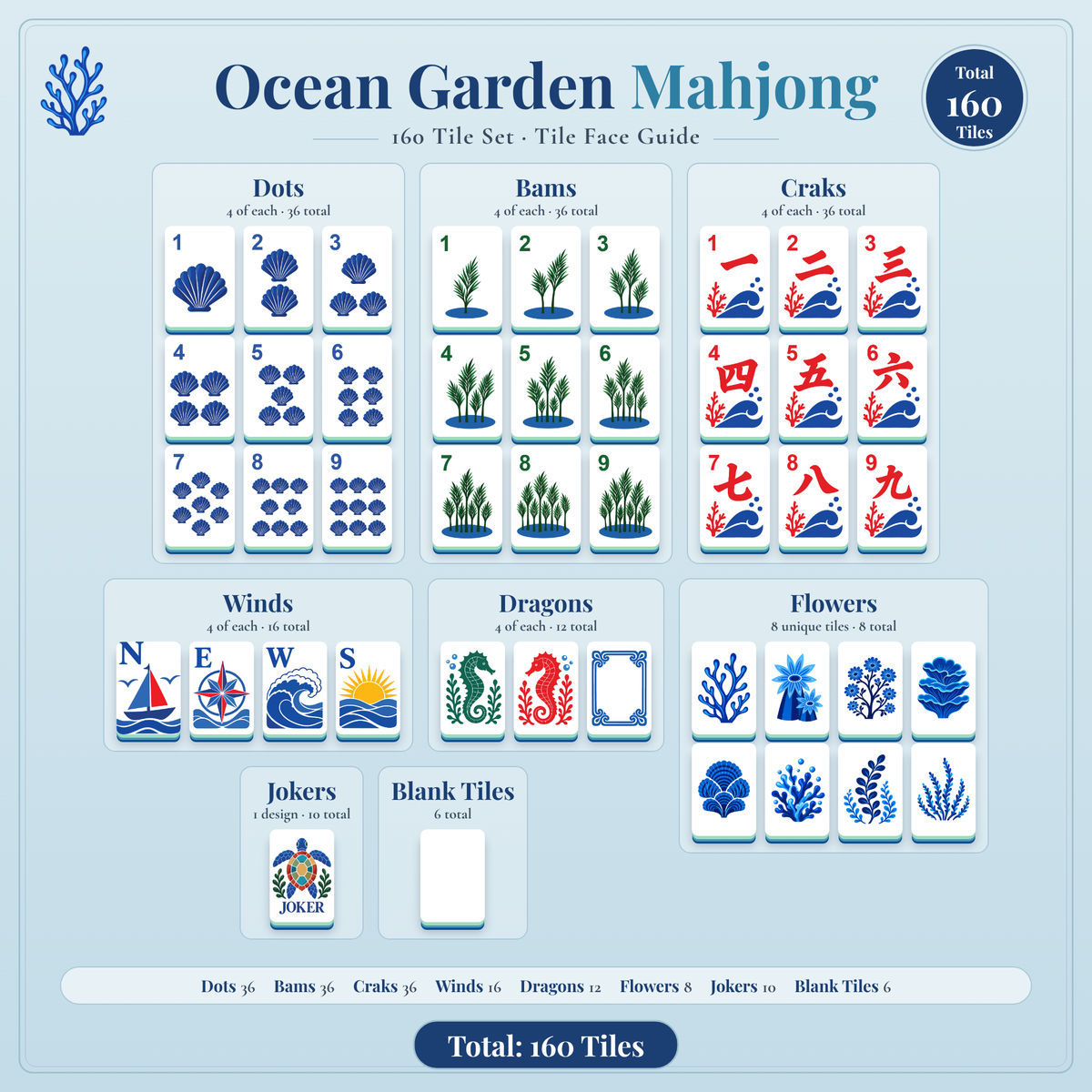
Start with the suits: Bams (1–9, bird on 1), Craks (1–9), Dots (1–9). Add winds (N/E/W/S) and dragons (Red, Green, White). Let them hold tiles while you talk—tactile learners absorb faster.
Next, run a mock Charleston without real stakes so they see the tile-passing flow. Go slow. Explain that you pass 14 tiles across, then backwards, then right. Bridge players will ask why; answer honestly: "It randomizes the hand so no one starts with an advantage."
Then show them a sample 2026 card. Point to one legal hand. Explain that every hand on the card uses the same tiles—never different numbers in a sequence. A pung must be three identical tiles. A kong is four. Jokers can fill any tile in any group except a single or a pair.
Finally, say: "Your first three games, don't worry about score. Just make a legal hand and declare it." This removes cognitive overload.
🀄 Shop best-selling mahjong sets →
How Do You Handle the No-Sequences Rule?
This is where bridge players stub their toe. In bridge, sequences (runs) are bread-and-butter. In American mahjong, they do not exist. You can only expose pungs (3), kongs (4), quints (5), and sextets (6). No Bam-1-2-3. No progressions.
Tell them: "Think of each suit as a separate inventory bin. You're collecting triples, not chains." Use a comparison to bridge: "In bridge, you honor the suit order. In mahjong, you honor the tile identity. If you want 3–4–5 of one suit, you keep those three tiles hidden and move on."
The consequence is real: it changes discard strategy. In bridge, holding a middle card (like 5) opens options. In mahjong, a lonely 5 with no matching 5s nearby is often garbage. Bridge players must learn to read the card and the table before deciding what to bury.
Practice this in the first game by narrating your own play aloud: "I need three Red Dragons and two 7 Craks for this hand, so I'm discarding all my Dots except my 1—see, no sequence value here." Hearing your reasoning twice speeds adoption.
What's the Best Format for a First Teaching Game?
Play a simplified version: four players (standard), one deck per table, no time pressure the first game. Sit next to the learner, not across.
Use a mahjong mat with clear spot markings so everyone sees where tiles go. If you don't have a mat, a dark tablecloth with four zones marked by coins works. The visual anchor matters for new players.
Deal 13 tiles. Run the Charleston with someone else narrating what happens. Let the learner watch, then ask: "What do you pass?" If they hesitate, say, "Anything you don't like. You don't know the hand yet."
After Charleston, each player draws a 14th tile. Now show the learner the card. Say, "Find a hand that uses four or five of your tiles. Raise your hand when you do." This gives them agency and a clear goal.
If they find nothing, they discard. If they find a partial hand, you encourage: "You have three 5 Dots—that's a group. Now look for one more group." This scaffolds success.
Most bridge players clear a legal hand by game two. Do not rush it.

What Common Mistakes Do Bridge Players Make?
Bridge players often try to build all possibilities before committing. They'll hold nine tiles because "they might form two hands." Mahjong doesn't reward that; you have exactly 13 tiles plus one draw and one discard per turn. Abundance is impossible. Teach them: "Commit to one hand early. Discard tiles that don't fit it. Speed beats perfection."
Second mistake: overthinking the discard. Bridge players see a discarded 7 and think, "Why would they give that up?" In mahjong, sometimes you discard because your hand has no use for it. Discard logic is simpler. Teach them: "You throw what doesn't belong in your hand. The reason is usually just: it's not on my card."
Third: misreading the card. Bridge players scan too fast. The card has multiple sections (like "One Suit," "Like Numbers," "Consecutive Sets"). Spend 10 minutes teaching how to skim it methodically. Show them the 2026 card (don't name the league to avoid copyright issues, but show the printout) and say, "Look here first—hands with all one suit. Faster to spot. Now look here—mixed suits but all the same number." Systematic reading beats intuition.
Fourth: joker anxiety. Bridge players see "wild" and expect chaos. Explain: "A joker is a blank tile you fill in. If you need a 3 Dot and have a joker, you put the joker in that spot. It's fixed once you use it." They relax when they understand jokers are commitments, not free passes.
Why Play a Second Game the Next Week?
Muscle memory and real pressure. The first game is intellectual. The second game—with the same group—lets them internalize discard timing and card-scanning speed. Most bridge players are competitive; they'll practice between games.
Invite the same four players weekly for a month. By game four, they should play near your pace. This consistency also lets you fade your coaching gradually: week one, narrate everything; week two, answer questions only; week three, watch silently; week four, play normally.
Milestone | What They Can Do | What Happens Next |
After Game 1 | Find a legal hand on the card with guidance | Game 2: they'll spot hands faster without help |
After Game 2 | Discard without panic; ask clarifying questions | Game 3: they'll develop their own discard logic |
After Game 3 | Balance offense (building their hand) and defense (blocking others) | Game 4: they're a peer; welcome to the table |
After Game 4 | Play a full evening without coaching | Invite them to your regular weekly game |
🎁 See our most-loved mahjong sets & accessories →
Should You Use a Special Teaching Set?
If you want to reduce cognitive load, yes. A clearly engraved set with big numbers helps. Bridge players often wear glasses; they appreciate precision. Avoid sets with ornate symbols only; bridge brains read numbers faster than art.
A standard 160-tile set works fine if you have good lighting. But if your table is dim or your players are over 60, an engraved set with large, clear tiles saves headaches and keeps people focused on strategy, not squinting.
You don't need a fancy bag or case for teaching, but if you host weekly, one keeps the set organized between sessions and signals that this is a serious, repeating commitment—not a one-off demo. Bridge players respect ritual; a dedicated set and mat send that signal.
What to Check Before You Buy Equipment
Tile size and readability: Can you see every tile from arm's length? Bridge players come from card tables where small text is standard; mahjong tiles are bigger, but if your eyes are tired, readability matters.
Joker and wind clarity: Winds (N/E/W/S) should be distinct. Jokers should be visually obvious. Some sets use solid-color jokers; others use joker symbols. Either works, but ask: "Will someone confuse a joker for a real tile?"
Set completeness: You need exactly 152 playing tiles plus 8 jokers. A 160-tile set includes spare tiles; you use only the 152. Spare jokers or blanks are replacements if tiles crack, not for gameplay.
Rack height and pusher design: If your bridge players are used to bridge racks (low, flat), mahjong racks with pushers may feel high. Sit them at a table with a standard rack and ask: "Comfortable?" Comfort matters for a four-week commitment.
Shipping to your location: Free US shipping removes one friction point. If you're teaching a group, order early so you have time to unbox and practice shuffling.
✨ Find your Mahstead set — free US shipping →

FAQ
Do bridge players really learn mahjong faster than non-players?
Yes. Bridge trains set recognition, discard logic, and incomplete-information decision-making—all central to mahjong. The learning curve is typically three to four weeks instead of eight to twelve weeks. The main adjustment is speed, not concept.
Should I teach bridge players the scoring system before their first game?
No. Teach hand recognition first. Scoring obscures the main goal: finding a legal hand and understanding the card. Add scoring in week two or three when they're confident about hand validity.
What if a bridge player keeps trying to make sequences?
Repeat: "American mahjong has no runs. Only groups of three, four, five, or six identical tiles." Show the card and say, "Look—every legal hand uses only identical tiles or full suit runs with no gaps." Point to examples. They'll internalize it by game two.
Can I teach mahjong to a bridge player one-on-one before the group?
Yes, and it helps. Spend 30 minutes on tiles, the Charleston, and the card. Then invite them to a group game. Solo teaching is slower because you can't model competition or table dynamics. Group learning accelerates adoption.
How do I know if a bridge player is ready to join my regular mahjong group?
They find a legal hand without asking; they discard without panic; they don't ask why the card has certain hands. By game four, they should be ready to sit with experienced players. Invite them to your regular weekly game and let them observe one hand before joining.


View More
View More
View More
