
Easiest Mahjong Rules for Visually Impaired Players
Last updated: Nov 23, 2026
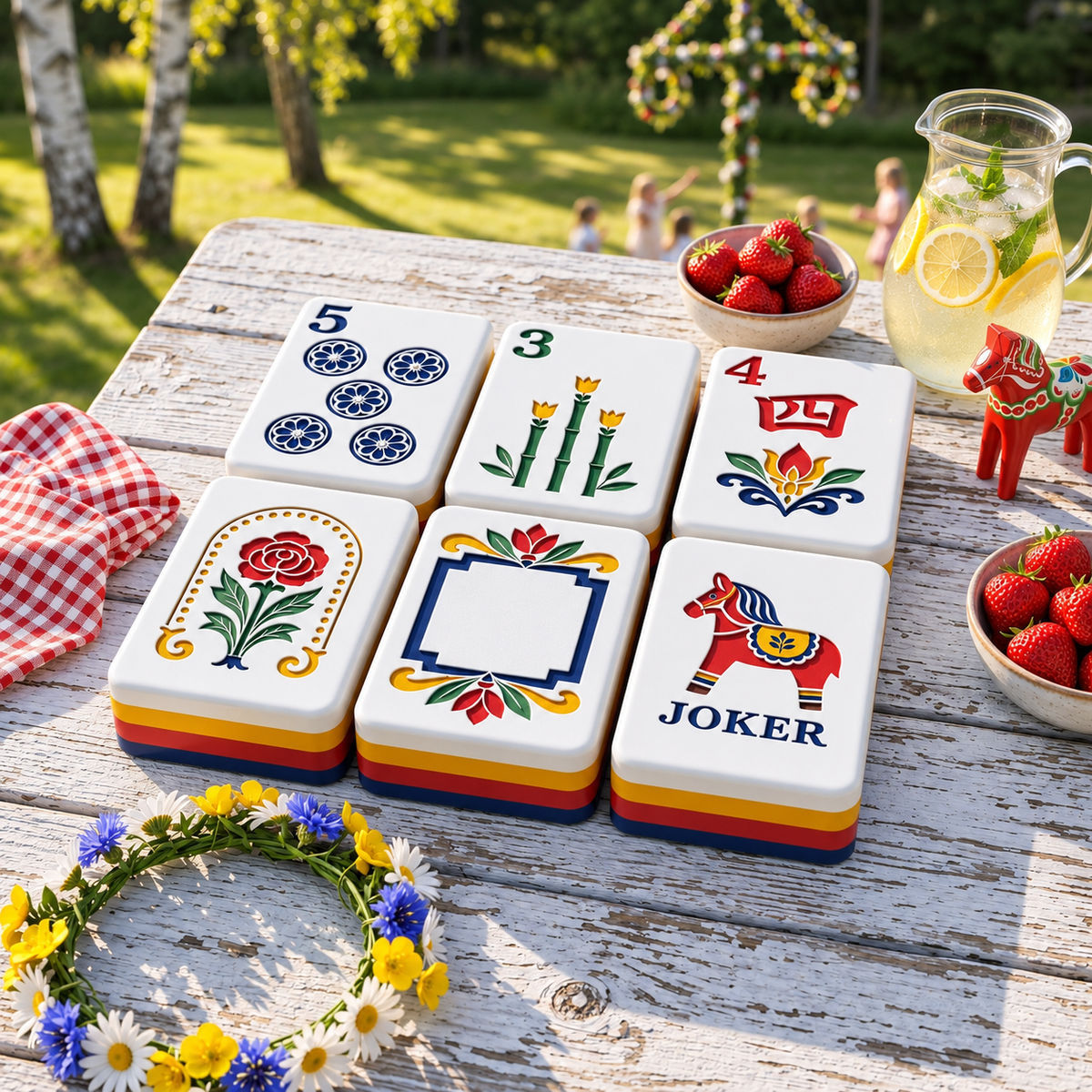
Yes, visually impaired players can master American mahjong using accessible equipment. Start with a 160-tile acrylic set featuring bold, high-contrast engraved suits (Bams, Craks, Dots) and wind/dragon symbols in large fonts. Use braille-labeled index tabs applied to the edge of your rack or case for quick tile identification; pair this with a mahjong mat that has a raised border to keep tiles from rolling. Keep your rack upright and organized: Mahstead's racks with pushers allow you to feel tile orientation and count easily by touch. Learn hand patterns from the National Mah Jongg League card (available in large print or audio format) and practice the Charleston (the pre-game tile pass) with sighted partners who call out tile names clearly. Total setup cost is modest, and once you know the 152-tile structure, the game becomes intuitive—many blind players report enjoying it as much as sighted ones.
American mahjong is fully playable for visually impaired players using accessible equipment. Start with a 160-tile acrylic set featuring bold, high-contrast engraved suits (Bams, Craks, Dots) and wind/dragon symbols in large fonts. Use braille-labeled index tabs applied to the edge of your rack or case for quick tile identification; pair this with a mahjong mat that has a raised border to keep tiles from rolling. Keep your rack upright and organized: racks with pushers allow you to feel tile orientation and count easily by touch. Learn hand patterns from the National Mah Jongg League card (available in large print or audio format) and practice the Charleston (the pre-game tile pass) with sighted partners who call out tile names clearly. Total setup cost is modest, and once you know the 152-tile structure, the game becomes intuitive—many blind players report enjoying it as much as sighted ones.
What makes American mahjong accessible for visually impaired players?
American mahjong has structural advantages for low-vision play: the game uses exactly 152 identical tiles (not a constantly changing deck), so you memorize one fixed set of 152 instead of learning infinite variations. Each tile appears in multiples of four (Bams 1–9, Craks 1–9, Dots 1–9, winds, dragons, flowers, jokers), meaning once you feel a 5 Dot's shape and size, every other 5 Dot is identical. The 1 Bam traditionally shows a bird, adding a tactile cue. Your hand stays in front of you on an upright rack all game, not reshuffled between turns. The best-selling mahjong sets feature deeply engraved characters you can read by running your finger over raised symbols—high contrast print supports low-vision players, while identical tile weight and size serve blind players equally well. This consistency transforms mahjong into a learnable, repeatable skill rather than a memory challenge.
🀄 Shop best-selling mahjong sets →

How do you organize tiles so you can feel them quickly?
Organize your rack in a fixed, predictable order: left to right, suits first (all Bams, then Craks, then Dots), then winds, then dragons. Use a mahjong rack with pushers that holds tiles upright at a 45-degree angle—this lets your fingers run across the top edge of each tile to read its number and suit without lifting it. Apply removable braille stickers or adhesive braille labels to the corner of your rack's wood or plastic frame (one label per section: "B" for Bams, "C" for Craks, "D" for Dots, "W" for winds, "Dr" for dragons). When you draw a new tile, place it in the correct section immediately—never lay tiles flat or in a loose pile. Ask your sighted partners to call out every tile they draw and discard aloud before placing it on the mat; this confirms what's in play and prevents you from accidentally playing a tile already discarded. Keep a small notepad with a tactile grid (a printable template with raised bumps, or a braille label maker) to track what's been thrown and what hand patterns remain possible this round.
What equipment do visually impaired players need to set up a game?
You need five items: a high-contrast 160-tile acrylic set, a mahjong rack with pushers, a mat with a raised border, braille or large-print labels, and a large-print or audio-format copy of the current National Mah Jongg League card. Acrylic tiles are ideal because they're heavier and less likely to scatter than bamboo or plastic; the weight gives you tactile feedback when drawing from the wall. A mahjong mat with a lip or border prevents tiles from rolling onto the floor during play. Request large-print or braille versions of the League card from your local library, a blind services organization, or the League directly (updated annually each spring). Bring a travel bag or case to keep your set organized and protected—one compartment for tiles by suit, another for your rack, braille labels, and notepad. For hosting weekly games, one set per player is ideal; sighted partners can share a set if necessary.
Setup Item | Purpose | Why It Matters for VIP |
160-tile acrylic set | Core gameplay tiles | Heavy, uniform, high-contrast engraving |
Upright mahjong rack | Tile organization & holding | Fingers read tile order without lifting |
Mahjong mat with border | Tile placement surface | Raised edge prevents rolling, defines play area |
Braille or large-print labels | Rack section markers | Quick mental navigation of tile sections |
League card (large print/audio) | Hand patterns & rules | Reference for valid melds each round |

How does the Charleston work for visually impaired players?
The Charleston is the pre-game tile-passing ritual where each player passes 14 tiles to the right, then 14 to the left, then 6 to the player across (or a variant). For visually impaired players, the sighted dealer should call out each step clearly: "We're passing right. Pass your 14 tiles now. After each pass, a sighted partner picks up your passed tiles and places them in your rack in the agreed-on order (e.g., suits left to right). Never let tiles mix during the exchange. Agree beforehand on a passing tempo (e.g., "Ready?" followed by everyone passing simultaneously) so you don't lose track. Some groups simplify the Charleston for mixed tables: two passes instead of three, or pre-sorting the passed tiles before hand. The goal is speed and fairness, not perfection; if the group pauses to reorganize after the Charleston, that's completely normal and acceptable.
🎁 See our most-loved mahjong sets & accessories →
What are the most common mistakes visually impaired players make—and how to avoid them?
Mistake 1: Mixing tiles on the mat. Tiles scatter easily on a flat surface. Use a mahjong mat with a raised perimeter; keep your discard area (the mat center) small and compact, and ask sighted players to announce every tile they place. Mistake 2: Forgetting the 152-tile count. American mahjong has exactly 152 playable tiles plus 8 jokers. If tiles go missing, the game breaks. Use a travel bag or case with compartments to count before and after play. Mistake 3: Disorganizing the rack mid-game. When you draw a new tile, insert it in the correct section immediately—don't leave it loose or "to be sorted later." This habit prevents confusion and keeps your hand legible. Mistake 4: Assuming the League card is too complex. The card is a grid of hand patterns; a large-print or audio version (contact your local blind services org) makes it accessible. Spend 10 minutes before game 1 learning how to navigate it. Mistake 5: Not asking for clarification. If you don't hear a tile name or discarded tile clearly, ask immediately. Sighted players expect this and want accuracy.
What to check before you buy
Tile engraving depth: Run your finger over sample tiles; raised characters must be at least 1 mm deep for tactile reading.
Rack angle: Test the 45-degree angle; tiles should rest securely without sliding.
Braille label adhesive: Confirm removable labels won't damage your mat or case finish.
Mat border height: A 1–2 inch raised edge is standard; ensure it doesn't interfere with your rack positioning.
Tile uniformity: All 152 tiles must feel identical in size and weight.
Case compartments: Confirm your preferred travel bag or case has enough sections for organized tile storage.
✨ Find your Mahstead set — free US shipping →
Learn more about how to play American mahjong and the full beginner's guide to mahjong.

FAQ
Can completely blind players play American mahjong?
Yes. Use a rack with pushers to feel tile positions, learn the 152-tile set by touch, apply braille labels to your rack, and have sighted partners call out discards. Thousands of blind players enjoy it weekly.
Do I need a special tile set for visually impaired play?
Not necessarily special—but buy high-contrast acrylic tiles with deeply engraved characters. Avoid thin plastic or bamboo sets; they're harder to read and more prone to scatter.
Where can I find a large-print mahjong card?
Contact your state's library for the blind, a local blindness services organization, or request one directly from the National Mah Jongg League (issued each spring). Braille versions also exist.
Can I play online if I'm visually impaired?
Some platforms offer accessible mahjong apps with screen-reader support or audio cues, but they're limited. In-person play with accessible equipment is the gold standard.
How long does it take to learn mahjong if I'm visually impaired?
Most players need 3–5 games to master tile recognition and hand patterns. If you're blind, allow 6–8 games to internalize the rack layout and tile positions.
Do I need different rules for mixed sighted/visually impaired tables?
No. American mahjong rules are identical. The only adaptation is calling out tiles aloud and organizing your rack for touch. Sighted players follow the same hand patterns and scoring.


View More
View More
View More
