
How to Host a Mahjong Night: Setup, Rules & What You'll Need
Last updated: Nov 23, 2026
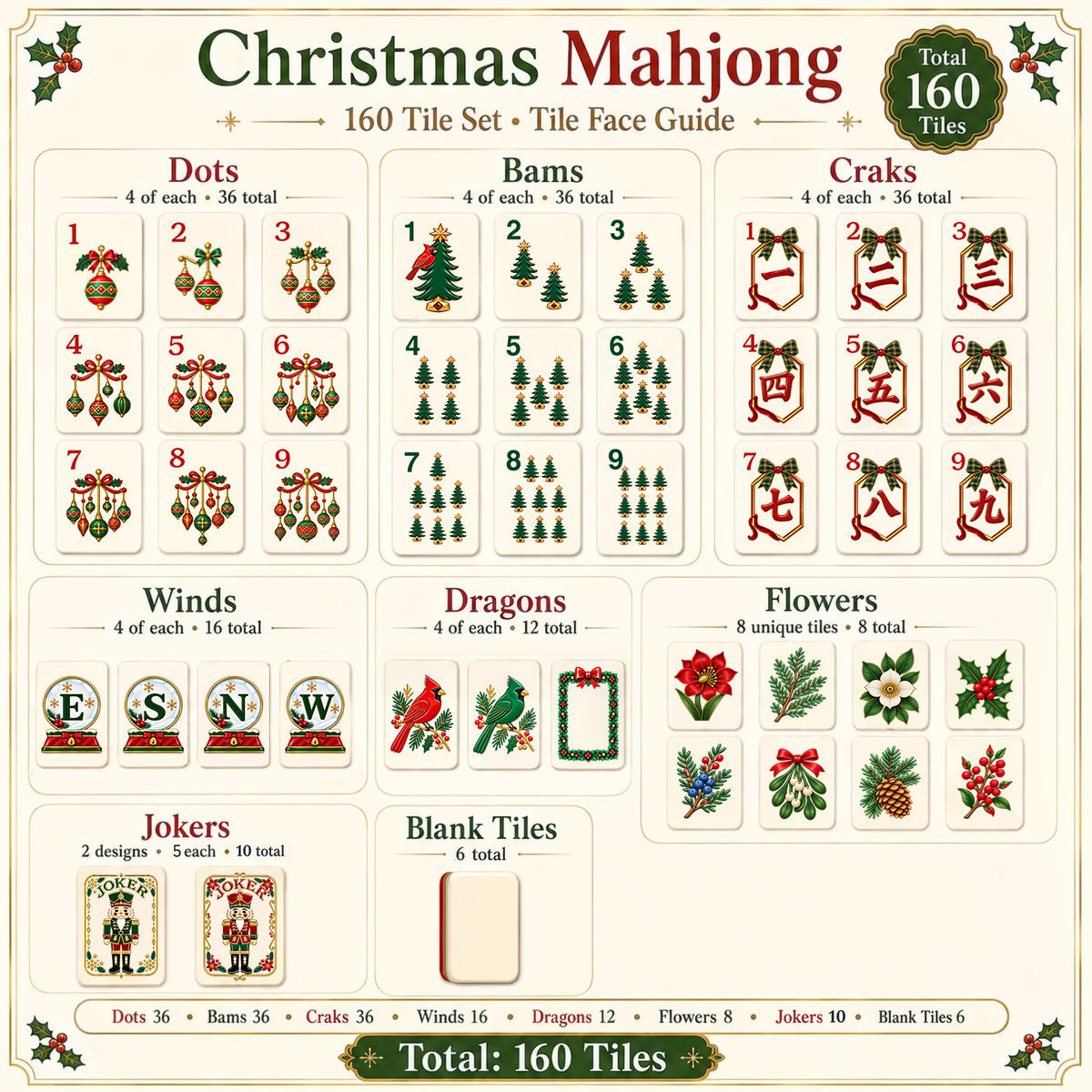
A mahjong night needs four players, one American 160-tile set (containing the 152 playing tiles), a hand card from the current year's National Mah Jongg League, a mat to play on, and tile racks with pushers for each player. Set aside 2–3 hours; plan snacks and drinks. Seat players around the mat, establish wind positions (East, South, West, North), pass the tiles in the Charleston ritual, draw 13 tiles each, and play from the current year's card—hands change each season, so verify you have 2026's edition. Mahstead's engraved sets arrive with clear tile markings and spare jokers, making it easier for new hosts to track what's in play. Avoid mixing old card years, playing without jokers, or skipping the Charleston; these are the most common trip-ups we see.
Hosting a mahjong night means gathering four players, one American 160-tile set (containing the 152 playing tiles), a hand card from the current year's National Mah Jongg League, a mat to play on, and tile racks with pushers for each player. Set aside 2–3 hours; plan snacks and drinks. Seat players around the mat, establish wind positions (East, South, West, North), pass the tiles in the Charleston ritual, draw 13 tiles each, and play from the current year's card—hands change each season, so verify you have 2026's edition. Mahstead's sets arrive with clear tile markings and spare jokers, making it easier for new hosts to track what's in play. Avoid mixing old card years, playing without jokers, or skipping the Charleston; these are the most common trip-ups we see.
What tiles and equipment do I actually need on the table?
You need exactly 152 tiles, 8 jokers, one mat, four racks with pushers, one 2026 hand card, and a way to keep score. A 160-tile set from our best-selling collection includes all playing tiles plus spares; never add extra tiles to the game itself. Each player needs a rack (usually two pieces that hold 13–14 tiles upright) and a pusher stick to move tiles without fumbling. A felt or vinyl mat protects your table and gives you space to organize your hand and discard pile. The hand card shows legal combinations for this year's play—order it from the National Mah Jongg League or check if your local community center has a copy. A pencil and scoreboard complete the setup.

How do I arrange players and deal the wall?
Decide who sits East, South, West, and North—East goes first and holds some advantage in scoring. All four players roll dice to determine the initial dealer; highest roll is East. Shuffle all 152 tiles face-down on the table. Each player then builds a wall 19 tiles long and two tiles high in front of them, stacking left to right. East breaks the wall at a random point by drawing two tiles, going counterclockwise until each player has drawn 13 tiles. East draws one more (14 total) and is the first to play. Beginners often over-shuffle or under-organize the wall; take time to stack neatly so players can draw without hesitation.
🀄 Shop best-selling mahjong sets →
What is the Charleston and why can't I skip it?
The Charleston is the tile-passing ritual that happens before anyone plays a hand. After the initial deal, each player passes three tiles face-down to the player on their right, then left, then across. There's a second pass if everyone agrees. This randomizes the tiles and ensures no player has a hidden advantage. Many new hosts think they can deal and play immediately; the Charleston is not optional—it's core to fair play and house rules across the U.S. Our guide to the Charleston explains every step with examples so you can lead it with confidence.
How do I know which hands are legal and when someone wins?
Players use the current year's (2026) National Mah Jongg League hand card to look up legal winning combinations. A hand must include a pair, then fill the remaining 12 tiles with pungs (3 identical tiles), kongs (4 identical), quints (5), sextets (6), or jokers as wildcards. The card is organized by suit and number, and you read it left to right. East calls "mah-jongg" when they form a legal hand from the card. Sound judgment and honesty matter here: all four players verify the winning hand against the card before scoring. If the hand isn't on this year's card, it's not a win. Learn how to read the card in detail before your first game so you can answer disputes quickly.
What equipment setup stops arguments and confusion mid-game?
A well-organized table stops most disputes. Use a felt or vinyl mat that shows four discard zones (one per player) so tiles don't scatter. Each player's rack holds their 13 tiles upright and private; pushers keep tiles from sliding off. Place the hand card in the center where all four can see it without reaching. Keep a running score sheet visible—most hosts use a whiteboard or printed scoreboard. Engraved tiles with clear markings (especially if you choose sets with custom titles or year engravings) make it easier to spot East, South, West, and North dragons and avoid switching winds mid-hand. A timer (even a phone clock) helps if you want to keep hands to 15–20 minutes so play doesn't drag.
Setup Element | Why It Matters | What to Check |
160-tile set with spares | 152 tiles play, extra jokers stay off table | Count tiles before first game |
Felt or vinyl mat | Keeps tiles organized, visible discard zones | Mat fits your table, has zones marked |
Four racks with pushers | Tiles stay upright, private; no accidental reveals | Each rack holds 13–14, pusher included |
2026 hand card | Only legal hands on current card win | Card is THIS year, not last year's |
Scorekeeper sheet | Tracks points, avoids disputes | Visible to all, updated after each hand |
Tile markers (optional) | Shows East, South, West, North positions | Wind dragons or custom markers ready |

How long does a game actually take and how many hands should we play?
A single hand (one deal) usually lasts 10–20 minutes once players know the rules. Most casual weekly games play 4–8 hands in an evening (2–3 hours total). A full "session" rotates the dealer position: East plays a full round, then South, West, and North each take a turn as East. After all four winds have been East, that's one full rotation. Many home groups play one or two rotations per night and score cumulatively. Plan for longer hands at first—rule lookups and card-reading take time. After a few weeks, play accelerates. Set a time limit in advance ("we stop at 9 p.m.") so hosts and guests know when to arrive and leave.
🎁 See our most-loved mahjong sets & accessories →
What common mistakes ruin a beginner's first night?
Mixing hand-card years. Each spring the National Mah Jongg League publishes a new card. Playing 2025's card in 2026 means hands that were legal last year are now illegal. Verify everyone has 2026's edition before the first draw.
Forgetting to use all eight jokers. American mahjong includes exactly 8 jokers in play; they're wildcards that fill any tile in a pung, kong, or larger set. Never substitute extra tiles or house-rules jokers—stick to the standard eight.
Playing without a mat. A mat organizes the discard pile, protects the table, and marks zones so players don't lose tiles or get confused about who discarded what. It's not a luxury; it's essential.
Skipping or rushing the Charleston. Hosts sometimes want to "just deal and play" to save time. Skipping the Charleston is playing unfairly. The ritual takes three minutes and matters.
Letting players pick up discards without calling. In American mahjong, if you don't call a discard immediately, the next player draws from the wall and the moment passes. Enforce a "call or let it go" rule to keep play moving.
What to check before you buy
Tile clarity. Make sure tiles have high-contrast markings so players don't confuse 1 Bams (usually pictured as a bird) with 1 Craks or 1 Dots. Test in your playing space's lighting.
Rack fit. Measure your table to ensure four racks fit comfortably around the mat without crowding; most racks are 9–11 inches wide.
Mat size. A typical play mat is 26–28 inches; it should fit your table and leave room for racks, the hand card, and drinks.
Complete set. Verify your 160-tile set includes all four winds, three dragons, eight flowers, and eight jokers before first play.
Current hand card. Order the 2026 hand card directly from the National Mah Jongg League or ask if your local library stocks it.
✨ Find your Mahstead set — free US shipping →
What you'll need
A comfortable night relies on the right gear. Our best-selling collection pairs 160-tile sets with mats and racks; we also offer mats in felt and vinyl, and racks with pushers sold individually or as complete four-player sets. If you're hosting for a group that plays weekly, consider a travel bag or case to protect your set between games. Return to the mahjong for beginners guide to learn rules before your first night.

FAQ
What's the minimum number of players I need?
American mahjong is designed for four players. Games with two or three are possible using variant rules, but standard American play requires four. If you have five people, one sits out each hand and rotates in.
Can I play American mahjong with a Chinese or Hong Kong set?
No. Chinese and Hong Kong mahjong use different tiles, no jokers, and different rules entirely. You must use a 152-tile American set and the American hand card.
How much does a quality American mahjong set cost?
See the current price on the product page for Mahstead sets, which vary by design and personalization options. Prices reflect tile quality, engraving detail, and whether you buy a set alone or bundled with a mat and racks.
Do I need a scoreboard or can we just remember points?
Use a scoreboard or scoresheet every time. Points add across multiple hands and rotations; memory fails, especially after a few hours. A whiteboard or printed tally card keeps disputes minimal.
Where can I find the 2026 hand card if I don't have one?
Order it from the National Mah Jongg League website, or contact your local library, community center, or country club—many stock copies for members. Verify it says 2026 before purchase.
What's the difference between a mat and a table cover?
A mat is a flat playfield with marked discard zones and is placed on top of your table for each game; a table cover is decorative and stays put. Use a mat for mahjong. Compare mat styles and materials to pick one that suits your table.


View More
View More
View More
