
What Is Nine Gates in Mahjong? Hand Explained
Last updated: Nov 23, 2026
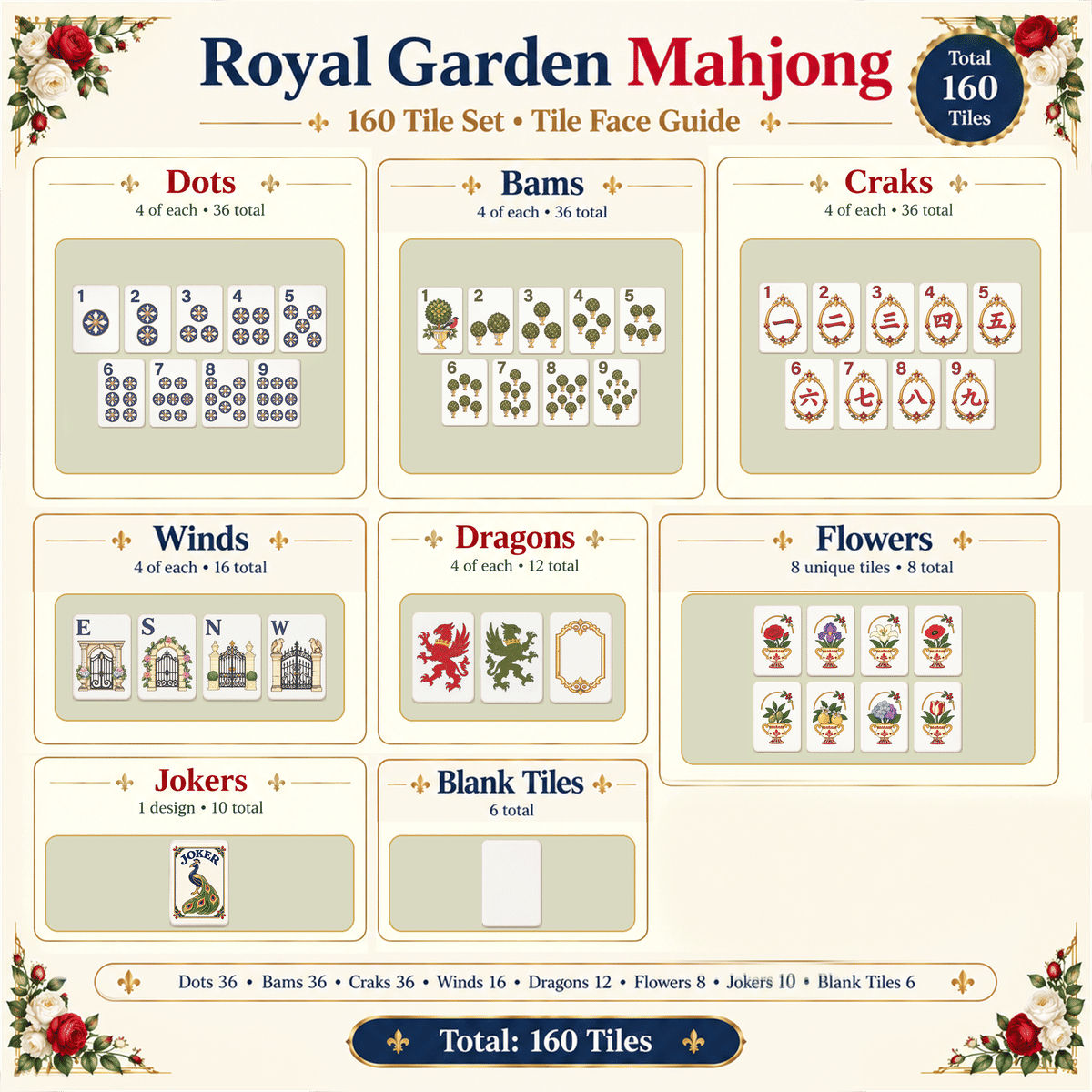
Nine Gates (also called "Nine Tile Hand" or sometimes "Rare Combination" depending on the card year) is an American mahjong hand composed of one full suit (all numbers 1–9 in Bams, Craks, or Dots) plus three honor tiles (winds and/or dragons from a single family). The hand requires 14 tiles total: seven tiles from your suit (one of each number), repeated twice, plus one additional tile to complete the pung or kong. It appears on the current year's National Mah Jongg League card in a specific section. Nine Gates is expensive to build because you need multiple copies of the same number tiles and cannot use jokers to fill the suit numbers—only to replace honors. The hand rarely goes out because other players must avoid discarding the exact tiles you need, and you cannot call sets from opponents if they discard; you draw only. For beginners learning American mahjong, Nine Gates is worth studying because it teaches tile discipline and the value of narrow, focused hands.
Nine Gates is one of the most challenging hands in American mahjong—a hand built entirely from one suit plus honors, creating a dense, high-scoring pattern rarely seen at the table.
What tiles make up a Nine Gates hand?
A Nine Gates hand contains exactly 14 tiles: one complete sequence of a single suit (1, 2, 3, 4, 5, 6, 7, 8, 9 in Bams, Craks, or Dots), then repeats one number from that suit (a duplicate of any 1–9), plus three honor tiles (winds and/or dragons). For example: 1 Bam, 2 Bam, 3 Bam, 4 Bam, 5 Bam, 6 Bam, 7 Bam, 8 Bam, 9 Bam, 3 Bam (repeat), White Dragon, Red Dragon, Wind. The three honors can be any combination from the winds (North, East, West, South) or dragons (Red, Green, White). The hand is named "Nine Gates" because all nine number tiles from one suit are present, locked in place like gates. You cannot call or expose any part of a Nine Gates hand—you must draw and concealed discard until you have all 14 tiles, then declare and score.

Why is Nine Gates so hard to complete?
Nine Gates demands precision: you need four copies of one specific number tile and one copy each of the other eight numbers in your chosen suit. Since you draw only 14 tiles in your hand and the wall contains only 152 tiles total across four players, the odds of collecting the exact combination are extremely low. You cannot use jokers to fill in the nine suit numbers—jokers can only replace honors in this hand. If another player discards a tile you need, you cannot call it (American mahjong rules forbid calling into suit numbers for a closed hand like this). You must wait and hope the wall delivers it. Meanwhile, other players are watching and inferring which suit and which numbers you collect from your discards. If they suspect you're playing Nine Gates, they guard their tiles ruthlessly. Most Nine Gates attempts fail within five rounds.
How does the current mahjong card show Nine Gates?
Each spring, the National Mah Jongg League publishes a new card listing all legal hands for that year. Nine Gates appears in a dedicated section—usually grouped with other rare or pattern-based hands rather than in the standard suit-and-honor sections. The card shows the exact tile breakdown and any joker rules for that year's version. Since hands and their rules change annually, a hand legal one year may be removed, modified, or reworded the next. To find Nine Gates on your current card, scan for sections labeled "Rare Combinations," "Quint Hands," "Special Patterns," or consult your league's reference guide. Online mahjong communities sometimes post hand-by-hand breakdowns of the current card to help players navigate quickly. If you're hosting weekly games, keeping the current year's card visible and updated prevents disputes at the table.
How do you play Nine Gates differently from standard hands?
Standard American mahjong hands allow you to expose pungs, kongs, and longer melds as you form them, then draw and discard openly. Nine Gates is fully concealed: you draw in silence, never expose tiles, and only declare once all 14 tiles are locked in place. This silence is both a strength and a weakness. Strength: opponents cannot read your progress. Weakness: if you're one tile short and the wall runs dry before your draw comes again, you cannot pivoting into a backup hand mid-game—your hand is too narrow. Most players reserve Nine Gates for hands where they catch the first or second tile they need very early; if the opening draw does not hint at Nine Gates, they pivot immediately to a flexible hand. The payoff is high: Nine Gates is typically worth 40 points or more (depending on your region's scoring rules), so even one completion in fifty games makes the strategy worthwhile for patient players.
What's the difference between Nine Gates and other single-suit hands?
American mahjong includes several single-suit hands (all Bams, all Craks, all Dots, etc.), but Nine Gates is unique because it forces you to use every number 1–9 from one suit, plus repeating one number in an exposed or concealed group. Other all-suit hands may ask for "pairs of 1–8" or "all even numbers" or "triplets of alternating numbers"—patterns that offer more flexibility in which tiles appear. Nine Gates is rigid: you need 1, 2, 3, 4, 5, 6, 7, 8, and 9 present, full stop. A standard all-suit hand might complete in ten rounds; Nine Gates often never completes. Compare this to "Like Numbers" hands, which ask for multiple copies of single numbers (e.g., four 5 Bams, three 5 Craks, three 5 Dots)—those are often easier because you're not chasing nine different numbers.
Hand Type | Tiles Required | Joker Flexibility | Difficulty | When to Attempt |
Nine Gates | One suit 1–9 + 1 repeat + 3 honors | Honors only | Very high | Early strong draw |
Like Numbers | Multiple copies of one number across suits | High | Moderate | Mid-hand pivot |
All of One Suit | All 14 from Bams/Craks/Dots + jokers | Medium | Moderate | Solid wall run |
Mixed Honors & Suit | Suit numbers + winds/dragons | High | Low to moderate | Flexible pivot |

What common mistakes do players make with Nine Gates?
Holding too long. New players see two or three tiles toward Nine Gates and commit, then draw twelve more tiles with no new fits. By round four, they're holding a dead hand. Exit early if you miss the third or fourth tile. Telegraphing your intent. If you discard only honors and never suit tiles, opponents infer you're building Nine Gates or another suit-heavy hand and tighten their discards. Instead, discard one suit tile early to confuse the table. Ignoring the current card rules. Nine Gates rules shift yearly—sometimes jokers are allowed in honors, sometimes they're restricted. Study the card before you sit. Not pivoting in time. Nine Gates is a luxury hand; ordinary hands are your anchor. If your Nine Gates fades by round three, switch your focus to a two-pung or three-pung hand using tiles already in your rack. Assuming draws will come. The wall has 152 tiles split four ways; you draw roughly 38 tiles per game. Nine Gates often needs specific tiles that four players share—the odds are steep. Build a backup strategy from your opening hand.
🀄 Shop best-selling mahjong sets →
What you'll need to study and play Nine Gates
To master Nine Gates, you need access to the current National Mah Jongg League card (updated every spring) and a full American mahjong set with 152 playing tiles and 8 jokers. Most players also find a mat with printed reference guides helpful because they can scan nine-gate patterns while the card sits nearby. If you host weekly games and want to minimize disputes, rack organizers with tile pushers help newer players manage their tiles without accidentally exposing concealed melds. Many hosts also keep spare jokers and blank tiles on hand in case of damage during a long season of Nine Gates attempts.
What to check before you play Nine Gates
Confirm Nine Gates is listed on your current-year card; it is not guaranteed every season.
Verify whether jokers are permitted in the honors portion for your card's version.
Agree with your table whether exposing one honor tile (instead of keeping all 14 concealed) is allowed; rules vary by region.
Start with a backup hand in mind before your opening draw; do not commit to Nine Gates until you have at least three tiles.
Time-box your attempt: if you have not completed by round four or five, pivot to a standard hand.
🎁 See our most-loved mahjong sets & accessories →
Why Nine Gates teaches you American mahjong discipline
Nine Gates is rare and difficult, but it's worth learning because it reveals how American mahjong works beneath the surface. The hand teaches tile counting (how many of each number is left in the wall), opponents' strategies (which tiles they guard and why), and the value of speed (committing late to a hand is almost always slower than pivoting early). Players who attempt Nine Gates develop an intuition for when a hand is dead and when it still has a pulse. Over time, this intuition transfers to all other hands: you learn which signals from your opening draw predict success and which predict failure. Most importantly, Nine Gates teaches patience—not every good starting tile becomes a good hand, and knowing when to fold is as crucial as knowing when to push forward.
✨ Find your Mahstead set — free US shipping →

FAQ
Can I use jokers in a Nine Gates hand?
In most recent years, jokers can replace the three honor tiles but not any of the nine suit numbers, making Nine Gates a "closed" or restricted hand. Always check your current card for that year's rules.
What is the score for Nine Gates?
Score depends on your league and card—typically 40 points or higher—but exact values are printed on your current card's hand listing.
If I discard a tile someone else needs, can they call it for Nine Gates?
No. In American mahjong, you cannot call or expose a concealed hand; you can only call (meld and expose) into pungs, kongs, and longer melds of other players. Nine Gates is fully concealed until you declare.
How many players can play Nine Gates at once?
American mahjong is always a four-player game with 152 tiles and 8 jokers, so only one player can pursue Nine Gates per round. Other players focus on standard hands.
Is Nine Gates the same in Chinese or Hong Kong mahjong?
No. Chinese and Hong Kong mahjong use different tile sets (usually 136 tiles), different hand names, and different rules for melds and calling. Nine Gates is specific to American mahjong and the National Mah Jongg League card.


View More
View More
View More
