
How Many Tiles in Hangzhou Mahjong: Variants Explained
Last updated: Nov 23, 2026
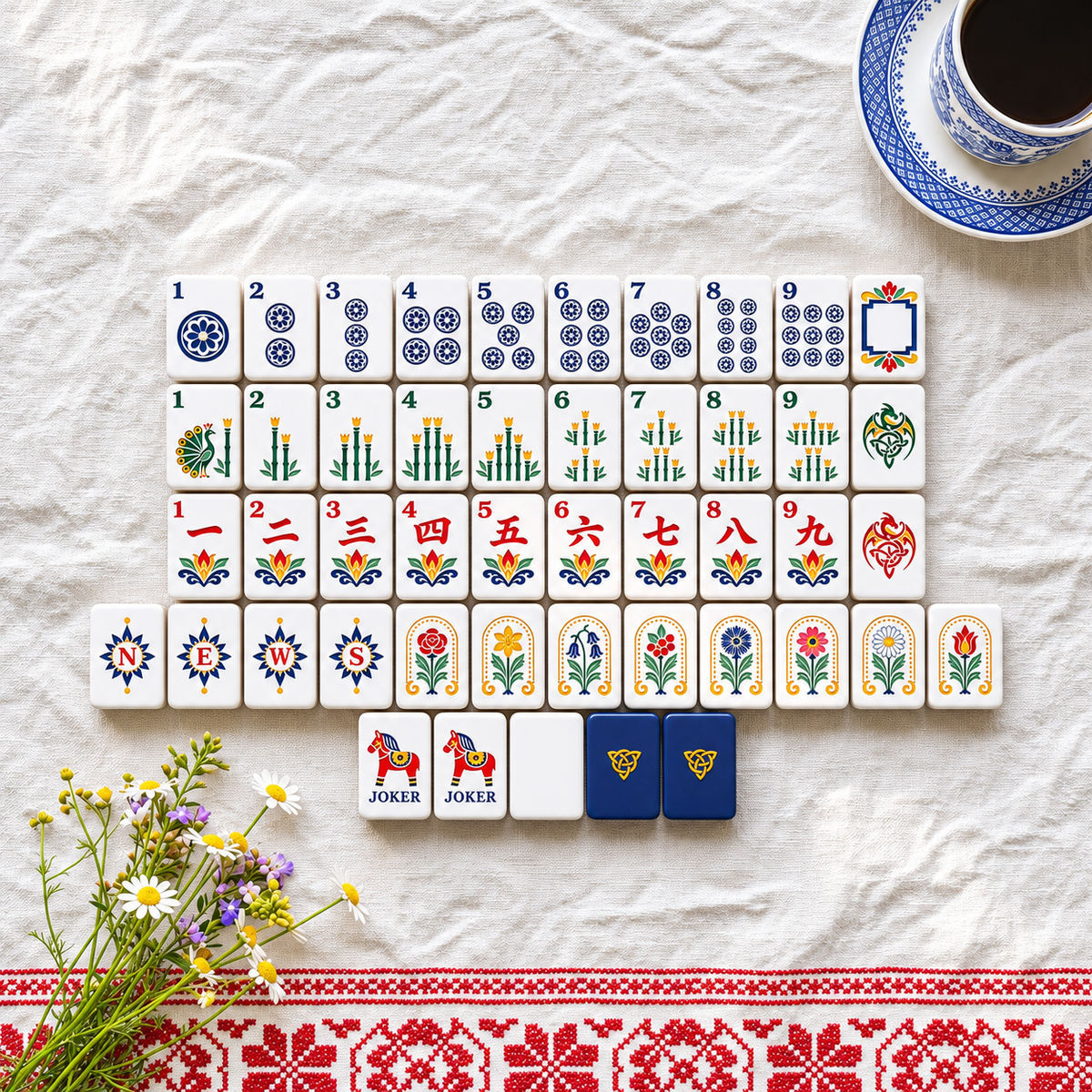
Hangzhou mahjong uses exactly 108 tiles—the smallest standard count in Chinese mahjong variants. The game removes the Flowers and Seasons entirely, stripping the core to three suits (Bams, Craks, Dots numbered 1–9, four copies each = 108 total) plus Winds and Dragons but excludes bonus tiles. This lean design speeds play and reduces hand complexity, making it popular in Zhejiang Province. By contrast, American mahjong uses 152 tiles with Flowers, jokers, and a rigid hand structure from the annual National Mah Jongg League card. If you're hosting Hangzhou players or learning the variant, verify your set tile count before buying; most Western retailers stock American 160-tile sets or standard 144-tile Chinese sets, not the 108-tile Hangzhou version. Mahstead carries best-selling mahjong sets designed for American play, which use a different rule system and tile composition altogether.
Hangzhou mahjong—also spelled Hangchou—originated in China's Zhejiang Province and has carved a devoted regional following. Yet outside that area, it remains rare in Western clubs and online shops. Understanding its tile count helps you choose the right set and avoid confusion with American, Cantonese, or standard Chinese (Wuhan) rules.
What makes Hangzhou mahjong use only 108 tiles?
Hangzhou mahjong strips the game to its structural core by removing Flowers and Seasons—eight tiles that typically appear in 144-tile Chinese variants. With those gone, you're left with 108 tiles: three suits (Bams, Craks, Dots) in numbers 1–9, each copied four times (36 tiles per suit = 108 total), plus Winds (16 tiles: four each of North, East, West, South) and Dragons (12 tiles: four each of Red, Green, White). The removal of bonus tiles speeds the game and tightens decision-making, favoring memory and tactical play over luck.

How does the 108-tile count change gameplay?
Fewer tiles mean a shorter draw cycle and tighter hand options. In Hangzhou, melds (pungs, kongs, chows) feel more constrained because you're missing the wild-card appeal of Flowers. The dealing structure shifts: you begin with fewer tiles in hand and draw faster toward winning. Winning hands emphasize "all honors" (Winds and Dragons only), "all numbers," or mixed patterns, with no Flower bonuses to pad scoring. Every decision carries more weight since you cannot rely on luck bonus tiles to complete a hand. If you've played American mahjong—which uses a completely different 152-tile system and hand-matching card—Hangzhou's stripped approach will feel alien at first.
Why don't Western mahjong shops stock 108-tile Hangzhou sets?
Regional Chinese mahjong variants never gained commercial traction outside Asia because rule standardization came late and club affiliation remained local. American mahjong, by contrast, unified under the National Mah Jongg League card in the 1930s–1950s, creating a portable, teachable standard. Hangzhou players either inherit family sets or order custom tiles from specialist makers in China. Western manufacturers—including Mahstead—focus on the best-selling American 160-tile sets because that's where demand and rule clarity exist. If you need a Hangzhou set in the US, sourcing it direct from a Shanghai or Hangzhou supplier is your only reliable path.
American vs. Hangzhou: tile count and rule comparison
Aspect | American | Hangzhou | Standard Chinese (144) |
Total Tiles | 160 (152 play + spare) | 108 | 144 |
Suits | 3 (Bam, Crak, Dot) | 3 (Bam, Crak, Dot) | 3 (Bam, Crak, Dot) |
Numbers per Suit | 1–9, four copies | 1–9, four copies | 1–9, four copies |
Winds | 16 (4 each: N/E/W/S) | 16 (4 each: N/E/W/S) | 16 (4 each: N/E/W/S) |
Dragons | 12 (Red, Green, White "Soap") | 12 (Red, Green, White) | 12 (Red, Green, White) |
Flowers | None | None | 8 (4 seasons) |
Jokers | 8 | 0 | 0 |
Hand Source | NMJL card (annual) | Regional rules (varies) | Varied by region |
Sequence/Chow Rule | No exposed chows | Exposed chows allowed | Exposed chows allowed |
Pung/Kong | Identical tiles only | Identical tiles only | Identical tiles only |
American mahjong is a fixed, card-driven game with jokers and no chows; Hangzhou and standard Chinese allow chows (1-2-3 sequences) but use no jokers. The philosophical split reflects two rule families: American isolation and standardization vs. Chinese regional evolution.
🀄 Shop best-selling mahjong sets →

How to verify tile count before buying a set
Before ordering, check the product listing for an explicit tile count. Many retailers list "144-tile" or "152-tile" prominently; some deliberately hide the number in fine print. Hangzhou sets are nearly impossible to find in Western stock—if a seller claims "Hangzhou," ask for a photo of the tile lineup (you should see only 108 individual tiles, no Flowers or jokers). Standard Chinese sets (144 tiles) are common; American sets are 160-tile configurations. If you're new to mahjong, engraved American mahjong sets let you customize faces or tile designs while keeping the rule structure consistent and learnable.
🎁 See our most-loved mahjong sets & accessories →
What to check before you buy
Tile count: Confirm 108 (Hangzhou), 144 (standard Chinese), or 160 (American 152-play + spare).
Rule book included: Hangzhou sets from Asia rarely ship English rules; American sets always do.
Suit labels: Verify tiles are marked Bam, Crak, Dot (not pinyin or unmarked).
Joker presence: Hangzhou has zero; American has eight; standard Chinese has zero.
Flower tiles: Hangzhou has none; standard Chinese has eight (4 seasons, 4 flowers).
Return policy: Regional game sets may not be returnable; clarify before purchase.
Language support: American sets include English scoresheets and card guides; Hangzhou sets from China likely do not.
When to choose American mahjong instead of Hangzhou
If you're hosting in the US, teaching friends, or joining a local club, American mahjong is your only practical choice. The NMJL card is published every spring, handed out at clubs, and taught nationwide. Hangzhou remains a family-and-friend game in Zhejiang; no equivalent organized league or card exists. You'll find American mahjong racks with pushers, mats, and bags designed for the 152-tile layout. Hangzhou accessories are custom-made or improvised. Unless you have a specific Hangzhou group waiting, American mahjong is the gateway to an active, learnable, and well-supported game.
✨ Find your Mahstead set — free US shipping →

FAQ
Can I play Hangzhou mahjong with an American 160-tile set?
No. American sets include eight jokers and are structured for card-based hand matching; Hangzhou uses 108 fixed tiles with chow sequences. Using American tiles breaks Hangzhou's rules entirely. You need a purpose-built 108-tile set.
Where can I buy a Hangzhou mahjong set in the US?
Most Western retailers, including Mahstead, stock American 160-tile or standard Chinese 144-tile sets. Hangzhou sets are specialty items; source them directly from suppliers in Shanghai, Hangzhou, or Alibaba-style marketplaces. Shipping may take 4–8 weeks.
Is Hangzhou mahjong harder than American mahjong?
They're different, not harder. Hangzhou requires memory of chow sequences and honor-tile tactics; American requires reading the NMJL card and joker placement. Hangzhou is faster; American is more rigid and club-standardized.
What's the minimum number of players for Hangzhou mahjong?
Hangzhou is strictly a four-player game, like standard Chinese mahjong. Wind positions (East, South, West, North) rotate through rounds. American mahjong is also four-player in its traditional form, though variant rules for two or three players exist.
How much does a Hangzhou mahjong set cost?
Prices vary widely depending on material and shipping. A basic set from a Chinese supplier costs $20–$50 USD before international shipping (often $10–$30 extra). Mahstead's best-selling sets are American 160-tile designs; see current pricing on the product pages.


View More
View More
View More
