
How Many Tiles in Chinese Mahjong? All Variants Explained
Last updated: Nov 23, 2026
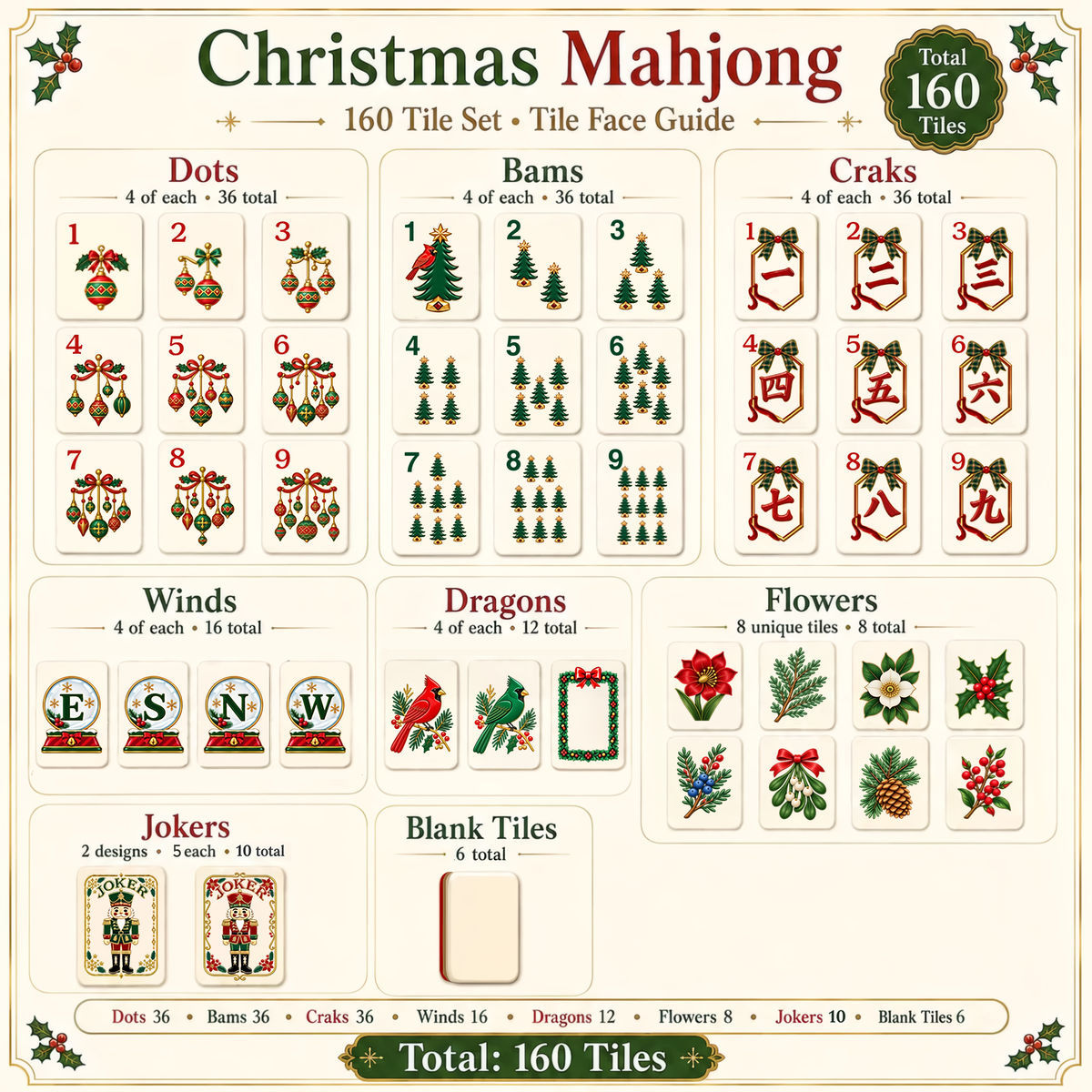
Chinese mahjong's core set contains 108 tiles: three main suits (Bamboo, Character, Dot) with numbers 1–9, four copies each (108 total). Most Chinese games add 8 flower tiles (spring, summer, autumn, winter × 2 each) and 8 season tiles, totaling 144 per full set—but only the 108 main tiles are always in play. Winds (North, East, South, West) and dragons (Red, Green, White) exist as optional bonus tiles in some regional play; honor tiles function differently than in American mahjong. Unlike American mahjong's 152-tile play with fixed hands from the League card, Chinese mahjong allows melds of consecutive numbers (chows), which Americans cannot call. You'll need a set designed for the regional variant you play—standard 108-tile sets work for most Cantonese and Mandarin games, while Taiwan and Hong Kong sometimes use extended sets.
🀄 Shop best-selling mahjong sets →
What is the standard Chinese mahjong tile count?
Standard Chinese mahjong uses 108 tiles as its foundation. Three suits—Bamboo (竹), Character (筒), and Dot (萬)—each contain numbers 1 through 9, repeated four times. That gives you 36 tiles per suit (9 numbers × 4 copies), totaling 108. This is the universal base; no Chinese regional variant removes these 108 tiles. Players draw, discard, and form winning melds using only these numbers; they're the engine of every hand.

How do regional Chinese variants add more tiles?
Most full Chinese sets include 108 base tiles plus 8 flower tiles divided into two categories—four seasons (spring, summer, autumn, winter) and four flowers (plum, orchid, chrysanthemum, bamboo)—and 8 additional bonus tiles (wind and dragon combinations or animal tiles depending on region). This expands the active set to 144 tiles, though not all players draw from the full pool; in many games, flowers are drawn separately as bonus points and returned to the deck, so the playing hand stays smaller. Taiwanese and Hong Kong variants sometimes include a ninth tile per suit (the "0" or blank honor tile), and Riichi mahjong (Japanese) uses a different honor system entirely. Always confirm your region's ruleset before buying—a Cantonese player and a Taiwanese player use different tile inventories.
What's the difference between Chinese and American tile counts?
Aspect | Chinese (Standard) | American |
Total tiles in play | 108 | 152 |
Main suits | 3 (Bamboo, Character, Dot) | 3 (Bam, Crak, Dot) |
Numbers per suit | 1–9 | 1–9 |
Copies of each tile | 4 | 4 |
Winds | 4 tiles | 16 tiles (4 × 4 copies) |
Dragons | 3 tiles | 12 tiles (4 × 3 copies) |
Flowers/Seasons | 8 or 16 (optional bonus) | 8 flowers (part of set) |
Jokers | 0 (not part of hand) | 8 (always in play) |
Melds allowed | Chows (sequences: 1-2-3) + pungs (sets: 3 identical) + kongs (4 identical) | Pungs, kongs, quints, sextets only; no chows or sequences |
Winning hands | Free combinations; melds can be concealed or exposed | Fixed patterns from current-year League card only |
Chinese mahjong's open-meld system means your strategy reveals mid-hand; American mahjong hides your goal until you declare a win. The 152-tile count in American play includes winds and dragons as four full sets each, whereas Chinese uses just the base 108.
🎁 See our most-loved mahjong sets & accessories →
Why do some Chinese games use 144 tiles instead of 108?
Many regional Chinese mahjong tournaments and family games add flower and season tiles as automatic bonus draws, expanding the set to 144 tiles on the table but not increasing the tiles each player draws per round. When you draw a flower or season tile, you keep it as a scoring multiplier and draw a replacement tile, so your hand still contains only numbered and honor tiles. This speeds up play and adds scoring complexity—flowers are worth extra points. Hong Kong and Singapore games often use the full 144-tile pool; Cantonese home games may play with just the 108 base tiles and no flowers, keeping the game faster. Always ask your host or check the rulebook before arriving—showing up with the wrong tile count wastes everyone's time.

How does the American mahjong set differ if you've played Chinese?
American mahjong requires exactly 152 tiles plus 8 jokers—never fewer, never more—because the hand patterns printed on the annual League card depend on that exact inventory. You cannot call sequences (chows) in American mahjong; you expose only pungs (three identical), kongs (four identical), quints (five identical), or sextets (six identical). The hand combinations are drawn from the current year's card only, which changes every spring, so memorizing hands doesn't transfer year to year. Chinese mahjong, by contrast, uses a free-form melding system—you can make any legal combination of chows and pungs, and the game flows until someone wins, without a reference card. If you're switching from Chinese to American, expect to relearn the entire hand structure, honor tile rules, and the Charleston passing ritual. Our guide to American mahjong basics walks you through the transition step by step.
What should you check before buying a Chinese mahjong set?
Before purchasing, confirm these points:
Region of origin or variant: Cantonese, Mandarin, Taiwanese, Hong Kong, or Riichi? Each uses slightly different tile counts and honor rules.
Tile material: Bone and bamboo are traditional; acrylic is durable and easier to read. Resin or plastic sets are budget-friendly but may wear unevenly.
Active tile count: Does the set come with 108 base tiles only, or 144 including flowers and seasons? Are all tiles playable, or are some decorative spares?
Size and weight: Standard Chinese sets are smaller and lighter than American acrylic sets; check dimensions if you're traveling or have limited storage.
Clarity of markings: Chinese tiles use traditional characters and simple symbols; if you're learning, choose a set with clear, bold marking—avoid faded or worn examples.
Racks and case: Most full Chinese sets include wooden racks and a wooden case; if you're buying tiles alone, you may need to source storage separately.
If you're American-trained and considering Chinese mahjong, buying an engraved American set first helps you master the core tile system before tackling Chinese variants.
✨ Find your Mahstead set — free US shipping →
How to choose between Chinese and American mahjong as a beginner
If you're starting fresh, ask yourself: Do you want a social game with visible strategy (Chinese, with exposed melds and chows) or a puzzle-solving game with fixed patterns (American, with a card and seasonal hand updates)? American mahjong has a steep learning curve because you must memorize the current year's hand card—there's no freestyle play. Chinese mahjong is easier to teach and play casually because the rules stay the same; any hand is legal if it follows the meld structure. American players commit to weekly sessions and purchase a new card each spring; Chinese players can play anytime with a stable ruleset. If you like the social rhythm of a group, American mahjong clubs are widespread in North America. If you want to play with family or travel to Asia, Chinese mahjong is the global standard. Once you've picked a variant, buy a set matched to that game—mixing tile counts or honor structures mid-game breaks the hand logic.
What to check before you buy
Confirm your region's exact tile rules (108, 144, or regional add-ons) with your play group or coach before ordering.
Verify the tile material suits your environment: acrylic for casual home play, bone or bamboo for traditional games or tournaments.
Check that the set includes both main tiles and any regional bonus tiles your game requires—don't assume "standard" means what your group plays.
Review the case and rack quality if you'll transport your set—damaged tiles slow the game.
Ask if the markings are readable in your home's lighting—tiles with faded or small characters frustrate new players.

FAQ
Is 144 or 108 tiles the real standard for Chinese mahjong?
108 is the base; 144 adds flowers and seasons that most regional games treat as bonus draws. Both are standard depending on region. Cantonese home games often use 108; Hong Kong tournaments typically use 144. Ask your group which they play.
Can I use an American mahjong set to play Chinese mahjong?
No. American sets have 152 tiles, different honor rules, jokers, and no chows. Chinese mahjong needs 108 or 144 tiles and allows sequences. You need a set built for Chinese rules.
Do all Chinese regional variants use the same tile count?
Almost all use 108 base tiles (Bamboo, Character, Dot 1–9 × 4 copies). Flowers and seasons vary by region. Riichi (Japanese mahjong) is a distinct system with its own tile set and honor structure—don't assume it's interchangeable with Chinese.
What are honor tiles, and how do they differ between Chinese and American mahjong?
Honor tiles include Winds (North, East, South, West) and Dragons (Red, Green, White). In Chinese mahjong, honors form pungs and melds like number tiles. In American mahjong, honors are part of the 152-tile inventory and combine with numbers in hand patterns printed on the League card. The rules for using them differ significantly.
If I learned American mahjong, will Chinese mahjong rules transfer?
No. American mahjong has no chows (you cannot call sequences), fixed hand patterns from the League card, and a formal Charleston passing ritual. Chinese mahjong uses free-form melding, sequences as legal plays, and no reference card. You'll relearn the entire logic—but the tile basics (suits and numbers) are similar.
Where can I find a Chinese mahjong set near me?
Try community centers, libraries, and cultural organizations in your area—many host mahjong clubs and sell or recommend authentic sets. Online specialty retailers serve players who can't find local options. Always verify the regional variant your local group plays before ordering online.


View More
View More
View More
