
How Mahjong AI Plays: Strategy & Machine Learning Explained
Last updated: Nov 23, 2026
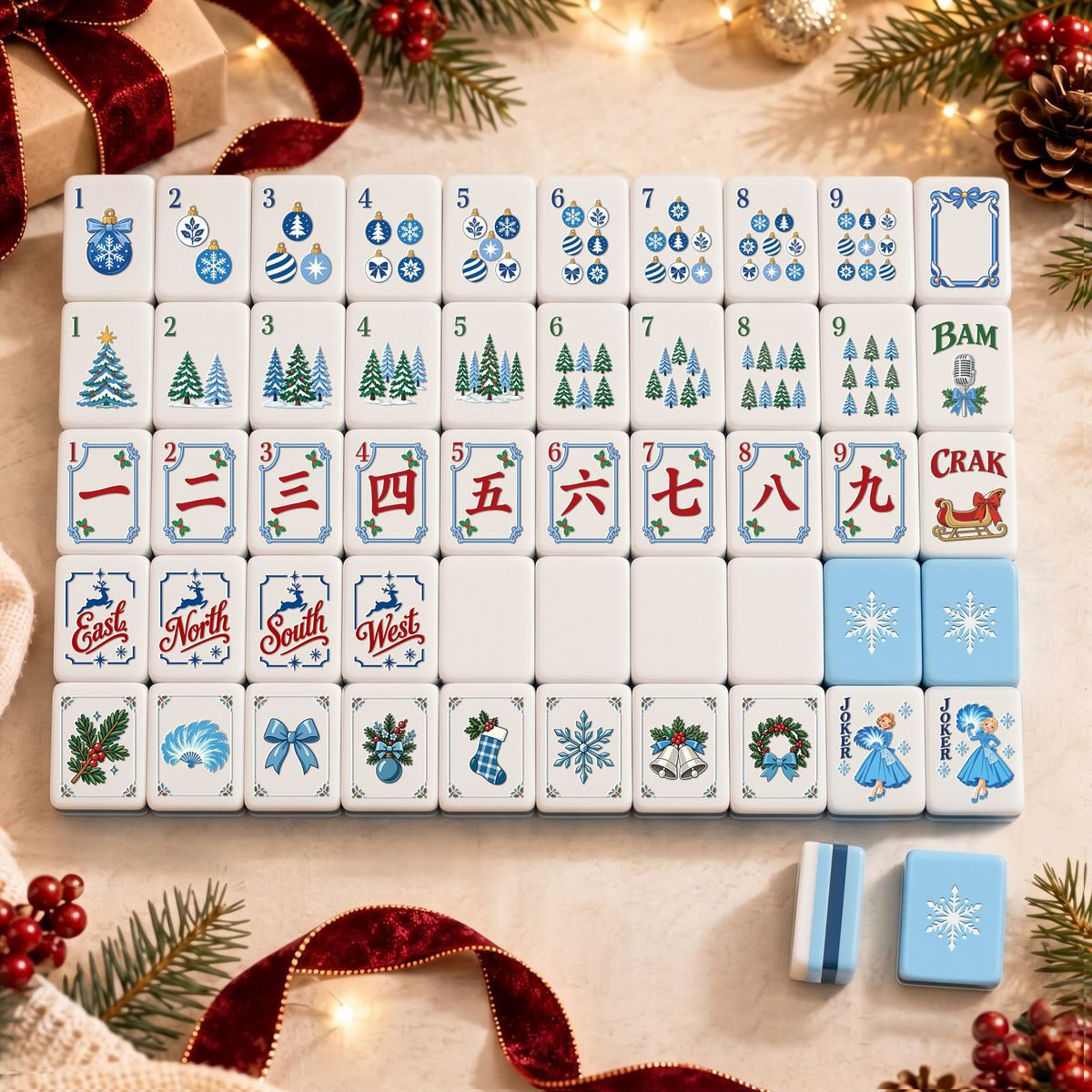
Mahjong AI works by training on millions of game states, learning probability patterns for discards, concealment, and pair prediction—but it struggles with four-player hidden information in ways chess engines never do. Unlike chess, where all pieces are visible, mahjong hides 130 of 152 tiles from any single player, forcing AI to reason under uncertainty. The strongest mahjong engines use Monte Carlo tree search and neural networks trained on professional games; they play Chinese and Japanese variants better than American rules (which have smaller competitive databases). A good AI beats casual players consistently but loses to experienced humans who read opponents' psychology and discard timing—skills machines haven't fully replicated. Mahstead players often ask whether AI can help them learn: the answer is yes for hand recognition and tile probability, less so for table reading, which remains the human advantage.
Mahjong AI has become surprisingly sophisticated, but it faces unique challenges that make it more complex than chess engines. Unlike chess, where all pieces are visible, mahjong hides 130 of 152 tiles from any single player, forcing AI to reason under uncertainty. The strongest mahjong engines use Monte Carlo tree search and neural networks trained on professional games; they play Chinese and Japanese variants better than American rules (which have smaller competitive databases). A good AI beats casual players consistently but loses to experienced humans who read opponents' psychology and discard timing—skills machines haven't fully replicated. Mahstead players often ask whether AI can help them learn: the answer is yes for hand recognition and tile probability, less so for table reading, which remains the human advantage.
Why Is Mahjong Harder for AI Than Chess?
Chess has perfect information: both players see every piece at all times. Mahjong hides 78% of the board. At any moment, you know only your 14 tiles (13 in hand plus 1 drawn), the exposed melds on the table, and the discard pile—but 130 tiles remain unknown. This forces AI to estimate probability distributions instead of calculating exact outcomes. Chess engines solve this with brute-force lookahead; mahjong engines must blend lookahead with Bayesian inference (guessing what other players hold). Additionally, mahjong has four players with conflicting goals, while chess is two-player zero-sum. A discard that hurts one opponent might help another—the AI must weigh these trade-offs under uncertainty every turn. This is why even the strongest mahjong engines sometimes play moves that look irrational: they're balancing hidden-state estimation against multiple adversaries, a problem far messier than checkmate.

How Do Machine Learning Models Learn Mahjong Strategy?
Today's mahjong engines train on two main approaches: supervised learning and self-play reinforcement learning. Supervised learning reads thousands of professional game records (especially from Japan's Riichi mahjong competitions, which have detailed online databases) and learns which tiles strong players discard, when they call tiles, and how they manage risk. The model recognizes patterns—e.g., "discard from the middle of your hand when you have 3-4 tile groups incomplete"—without explicit programming. Self-play reinforcement learning is more powerful: the AI plays itself millions of times, adjusting weights after each loss, and eventually discovers strategies humans never found. AlphaGo used this method for Go; mahjong engines like Mortal and Suphx (developed by Tencent and others) combine both. They also use Monte Carlo tree search, which simulates random future plays from a given position thousands of times, then picks the move that wins most simulations. The challenge: all these methods need massive labeled datasets, which exist for Riichi mahjong but are sparse for American mahjong (fewer competitive records, smaller player base, different ruleset). This is why AI plays Japanese variants far better than it plays the American game that many home players know.
🀄 Shop best-selling mahjong sets →
What Can Mahjong AI Do (and Not Do)?
What AI does well:
Calculates tile probability: after 20 discards, it infers which tiles remain and estimates which are safe to play.
Counts visible groups: it tracks every exposed pung, kong, and the discard pile without error.
Optimizes hand efficiency: it evaluates whether to aim for a complex high-scoring hand or a simple win, based on hand structure and game position.
Detects patterns: given a partial hand, it identifies valid melds and incomplete groups faster than most humans.
What AI does poorly:
Reading psychology: it cannot tell whether an opponent is bluffing with a fast discard or playing a weak hand. Humans spot hesitation, hand positioning, and discard tempo; AI sees only the tile sequence.
Adapting to style: an experienced player adjusts strategy mid-game against different opponents. AI typically plays the same optimal distribution regardless.
Playing American mahjong well: the smaller ruleset community means less training data; AI engines are built for Riichi mahjong and require reworking for American hands (which come only from the yearly National Mah Jongg League card).
Understanding cultural/social context: in home games, players trade information through banter, table position, and informal signals. AI plays by pure game theory and misses these cues entirely.
How Human Players Still Beat Mahjong AI
Experienced players beat AI engines for three reasons. First, psychology: a seasoned player reads an opponent's discard timing. Quick discard = hand is progressing slowly; hesitation = close to a win. AI sees none of this. Second, risk tolerance: humans adjust aggression based on game state and table dynamics. When trailing, they take calculated risks; AI plays conservatively across all scenarios. Third, metagaming: human groups develop house rules, preferred strategies, and cultural play styles that aren't in training data. A veteran American mahjong player using the National Mah Jongg League card every spring knows thousands of valid hands; most AI engines trained on Asian rulesets don't even recognize American hands correctly. Over thousands of games, human judgment—especially about when to draw a dangerous tile vs. pass—wins against machines that haven't learned home-game psychology. This is why AI works best as a training partner, not a replacement for table intuition.

Should You Use AI to Improve Your Game?
AI tools can help you in two practical ways:
Hand recognition and tile probability. Apps that photograph your hand and suggest safe discards are genuinely useful for beginners learning tile theory. They remove decision paralysis on unfamiliar positions. Use them to study, not to cheat during real games.
Replay analysis. Some mahjong engines let you upload recorded games and show which moves cost you points. This is valuable for learning game fundamentals—recognizing when you should have won faster, or which opponent tiles you should have tracked more carefully. Focus on the "why" (probability and logic), not the machine's move, which may not account for the specific table you're playing in.
However, AI cannot replace the judgment of an experienced human player at your table. When learning American mahjong, prioritize playing with people who understand the National Mah Jongg League card and can coach you on real-time decisions—which tiles to hold, which to discard, when to call a tile, and how to read the table. An AI will tell you the mathematically optimal move; a human partner will teach you why that move works in your specific game context.
✨ Find your Mahstead set — free US shipping →
How to Choose Between Mahjong AI and Human Practice
What you want | Best approach | Why it works |
Learn tile theory & probabilities | AI apps + online tutorials | Machines don't lie about odds; useful for solo study. |
Understand American hand patterns | Play with experienced humans using the yearly card | AI engines lack American ruleset training data; humans know real hands. |
Practice fast decision-making | Speed games with friends | Pressure + psychology matter; AI cannot simulate table tension. |
Improve psychological reading | Multi-session games with the same opponents | Habit and familiarity reveal patterns; machines don't build relationships. |
Prepare for tournament play | Mix both: AI practice + live games | Machines teach rules; humans teach table dynamics and meta. |
The honest truth: AI is a teaching tool, not a shortcut. If you want to play well at your Thursday night game, invest in learning the rules, studying how jokers work, understanding the Charleston, and playing live opponents every week. AI will help you understand why you lost a hand; your friends will help you win the next one.
What to Check Before You Buy AI Mahjong Software
Ruleset support. Does it play American mahjong, or only Riichi and Chinese variants? American-specific engines are rare.
Training data age. Older engines may have learned outdated strategies. Check the publication date or last major update.
Difficulty levels. Can you start easy and advance, or does it only play at one skill level?
Transparency. Does it explain why it suggests a move, or just hand you a choice? Explanations are more useful for learning.
Offline capability. Can you run it without internet, or does it need a server? Home players often lack reliable connection.
🎁 See our most-loved mahjong sets & accessories →
If you're building your first home game, your real asset isn't AI—it's a clear set of best-selling mahjong tiles and racks, a legible National Mah Jongg League card, and consistent players. Mahstead's acrylic sets are built for decades of use, so you and your group can log thousands of hands together. That repetition, and the human judgment it builds, beats any algorithm.

FAQ
Can AI beat professional mahjong players?
AI beats casual and intermediate players consistently, especially at Riichi mahjong. Against elite professionals, machines win maybe 40–50% of the time. Human psychology and adapting to opponents remains an advantage AI has not fully closed.
Why do mahjong engines play differently than humans?
AI maximizes mathematically expected value across all possible tile distributions. Humans weight psychology, risk tolerance, and incomplete information more heavily. This makes AI look "textbook" and humans look "creative."
Which mahjong variants does AI play best?
Riichi mahjong (Japanese). Most training data comes from online Riichi platforms and professional tournaments. Chinese and Hong Kong mahjong are second. American mahjong is least supported because competitive records are sparse and the ruleset is regional.
Should I use AI during a real game?
No. It violates the spirit of mahjong and most house rules. Use AI for solo study and replay analysis only. Playing live teaches you more than any machine ever will.
Is AI good for teaching beginners?
Partially. AI is excellent for explaining tile probability and recognizing valid hands. It's poor at teaching table reading, opponent psychology, and the cultural flow of a real game. Pair it with human mentorship for best results.
Can I play against AI online?
Yes, several platforms offer AI opponents, but most are built for Riichi or Chinese mahjong. American mahjong AI opponents are rare. Check the ruleset before downloading.


View More
View More
View More
