
How Do You Keep Score in Mahjong? American Rules
Last updated: Nov 23, 2026
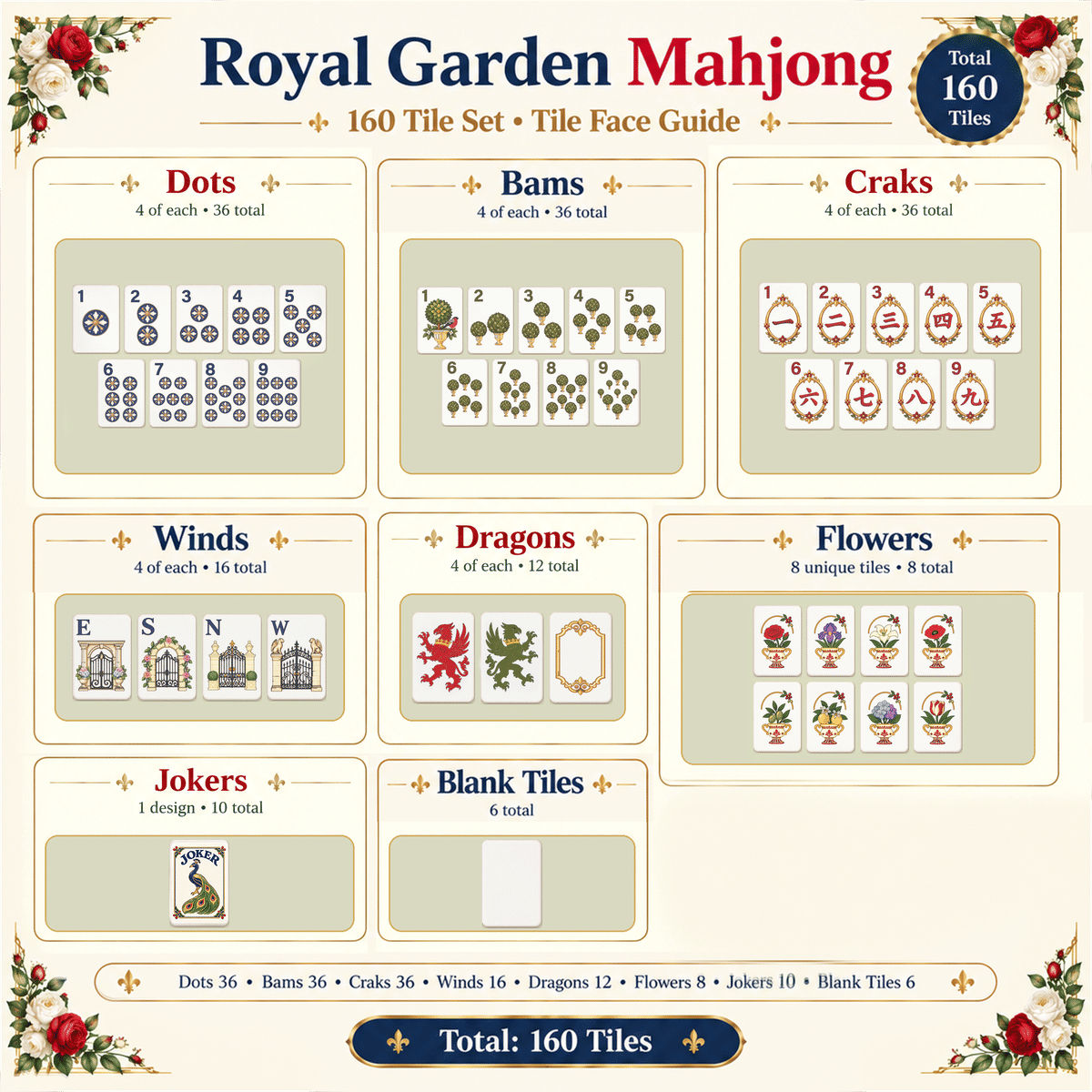
American mahjong scoring is fixed by pattern, not cumulative. Each winning hand from the current National Mah Jongg League card carries a set point value (typically 2–8 points for standard hands). When you win, all three opponents pay you that amount; if you go out on a discard, only the discarder pays double. The game runs 16 rounds (four walls of four rounds each). At the end, players tally total points received and paid, settling in cash or chips per your house rules. Unlike Asian variants that calculate per tile, American mahjong's simplicity—knowing your hand's value instantly from the card—makes scoring fast and eliminates arithmetic disputes. We track scores on paper scorecards or, for regular players, a best-selling mahjong set often comes with built-in score-tracking pads.
Why does American mahjong use fixed scoring instead of point math?
American mahjong adopted the National Mah Jongg League card system in the 1920s to speed play and prevent disputes. Each valid hand's point value is printed directly on the card—you look up your pattern, read the value, and collect. This removes the need for on-the-spot calculation like Chinese variants require. Every player at the table knows exactly what's owed before anyone pays. Fixed scoring also keeps games tight: you can't pad your score by adding extra tiles. The card resets annually (new card every spring), so the game stays dynamic while the scoring rules stay constant.

How do you read the point value from the card?
The current year's National Mah Jongg League card lists each legal hand in rows by point value—usually 2, 3, 4, 5, 6, 7, or 8 points for open hands; some years include higher values for harder patterns. You look up your winning tile combination (three of a kind, mixed suits, specified joker usage, etc.), find your row, and the leftmost column tells you the points. If you went mah jongg (called "won" or "went out"), you simply announce your hand type, another player confirms it on the card, and you collect. No calculator needed. Most players memorize the high-value patterns they chase and glance at the card only for rare or borderline hands. The card is always at the table during play—one player holds it centrally or it sits in the middle so everyone can verify if challenged. Learning to read the mahjong card cuts disputes and speeds settlement.
🀄 Shop best-selling mahjong sets →
How do players pay each other after a hand?
When you win (mah jongg), the payment rules are simple and identical for all hands regardless of pattern—the value on the card is what changes, not the settlement math. If you picked a winning tile from the wall (self-drawn), all three opponents pay you the hand's point value; if someone discarded your winning tile, only the discarder pays you double the hand's value. In a four-player game, if the hand is worth 4 points and you self-drew, you collect 4 points from each of the three losers (12 total). If you went out on a discard, you collect 8 points from the discarder only. At game's end (typically 16 rounds), total what you received minus what you paid, and settle the differences. Many groups play "even money" (players cash out so the winners break even with the losers), while others track cumulative scores across multiple sessions. We recommend keeping a running paper scorecard—one column per player—to avoid end-of-night confusion. For more details on scoring variants and special hands, see American mahjong scoring.
What does "going for mahjong" versus "going for a limit hand" mean?
Some hands on the card are marked as limit hands—the highest point value for that year (often 6 or 8 points). Other hands pay their listed value. "Going for mahjong" simply means you're trying to complete and win any legal hand; "going for a limit" means you're holding a hand you know is marked as top-value and chasing it aggressively. There's no scoring bonus for declaring one or the other—the card value is final. What changes your strategy is which hand you need to win: a 2-point hand is easier to complete (more tile combos available), but a limit hand often requires specific tiles and jokers. We usually track our hand during the game mentally and adjust our play (what we discard, which tiles we're fishing for) based on whether we're chasing an easy win or holding out for points. The card tells you every legal option available that year; your job is to pick one pattern and pursue it intelligently.

How do you track scores across multiple sessions or a league season?
For casual weekly games, pen-and-paper scorecards work fine: write each player's name as a column, mark points won and paid in each round, and total at the end. For regular groups that play weekly or monthly, cumulative tracking prevents one big settlement night. Many players use a simple table in a notebook or spreadsheet: date, player names across columns, round scores, cumulative total. Some clubs use a dedicated score sheet printed or digital, updated after each game. The key is consistency—always record who won, how many points, and who paid. This avoids memory disputes and lets you see long-term patterns (who usually finishes first, which hands you win most). We've seen groups use everything from napkins to phone apps; the best tool is whatever your table will actually use every week. For traveling games or tournaments, the scorekeeper role often rotates so no one dominates the pen. If you host regular games, a printed scorecard pad—sometimes included with quality mahjong set purchases—keeps things professional and durable.
🎁 See our most-loved mahjong sets & accessories →
What are the most common scoring mistakes and how do you avoid them?
Mistake 1: Forgetting who called the tile. If you won on a discard, the discarder pays double—not all three opponents. Write down immediately: "Wall" (self-drawn) or the player's name (discarder). If unclear, check the tile positions or ask before you pay out.
Mistake 2: Mixing up the hand's value. Always verify on the card before announcing. If you misread a 3-point hand as 4, you'll overpay. Have a second player confirm your hand matches the card pattern exactly.
Mistake 3: Paying the wrong player. In some hands, you might not actually win (you might have an illegal hand, or the called tile was already claimed). Confirm the winning announcement with the card holder before anyone pays.
Mistake 4: Losing track of cumulative scores. At the end of 16 rounds, recalculate who paid what. Tally by player (total received minus total paid), then settle. If totals don't balance (total paid should equal total received across all players), recheck your scorecard.
How to avoid: Designate a scorekeeper. Announce your hand type AND point value aloud before payment. Have the card at the center so everyone sees it. Record each payment in writing, not memory. Verify totals match before cash changes hands. If a dispute arises, consult the card and the written record; the card is law.
Mistake | Why It Happens | How to Catch It |
Wrong payout direction | Discarder vs. wall payment confused | Ask aloud: "Who won this?" before settling |
Hand misread from card | Card is far away or poorly lit | One player reads card aloud; a second confirms |
Score not recorded | Someone forgets to mark the points | Scorekeeper writes down EVERY payment in real time |
End-of-game tally doesn't match | Arithmetic error or a forgotten round | Recount all rounds in writing; total received should equal total paid |
Joker usage overused | Joker limits misunderstood (max per pattern) | Check card for joker rules each hand |
Do different mahjong variants score differently?
Yes. Chinese mahjong, Hong Kong mahjong, Riichi (Japanese), and Taiwanese mahjong all use point-per-tile systems, meaning a hand's value depends on the number and type of melds, dragons, winds, and runs. A hand might be worth 20, 40, or 100+ points depending on which tiles and patterns you combined. American mahjong's fixed-value card approach is unique—no meld-by-meld math. If you've played Asian variants and you're new to American rules, the biggest adjustment is this: stop calculating fan/bao/points per tile. Instead, find your exact hand on the card, read the number, and collect. It's faster and more uniform. How to play American mahjong covers the full rule set; scoring is just one piece of that puzzle.
✨ Find your Mahstead set — free US shipping →
What should you check before you buy a scoring mat or scorecard set?
Size and durability. A scorecard pad should fit on or near your table without crowding the tile racks. Paper pads wear fast if you play weekly; laminated or dry-erase versions last longer.
Columns and rows. Check that the card has room for four player names and at least 16 rows (one per round). If you play tournaments or longer sessions, choose pads with more rows or a blank design you can reuse.
Legibility. Numbers should be large enough to read across the table without squinting, especially in dim lighting common to home game nights.
Permanence. Pen ink should dry quickly and not smudge; pencil is erasable but fades. Laminated pads let you use a dry-erase marker and wipe clean.
Card access. Your scorecard is useless if the card itself is hard to read. A mat with a card pocket or a clear card holder at the table's center keeps the season's card visible to all without fumbling.
Many players pair a sturdy scorecard with a durable mat to keep the entire table organized and professional, especially if you host regular games.

FAQ
Can you score a hand without looking at the card?
No. Every legal hand must be on the current year's National Mah Jongg League card. If you can't find it on the card, it's not a valid win—no score, no payout. Always verify with the card before settling.
What if you go out on a discard but then realize your hand is illegal?
You don't collect. The discarder does not pay. The round continues until someone makes a legal mah jongg. Never pay out until the hand is confirmed on the card by at least one other player.
Do you score bonus points for special circumstances (like using all jokers or matching flowers)?
No. American mahjong scores only the hand pattern's fixed value from the card. There are no bonus multipliers for hand difficulty or tile combinations beyond what the card lists. The card is the complete scoring rule.
How do you handle tied scores at the end of 16 rounds?
Tally each player's net (points received minus points paid). If two players tie, they split the difference or play a tiebreaker round depending on your house rules. Most casual groups just call it even and move on; tournaments usually specify tiebreaker protocol in advance.
Can you change the scoring system mid-game?
No. Agree on scoring rules before the game starts—house rules on cash payouts, settlement timing, or joker limits. Changing the rules mid-game causes disputes. If a new player wants different rules, discuss before the next session and all four must agree.
If someone miscalculates and pays the wrong amount, can they take it back?
Only if caught immediately. Once a round is marked paid and the next hand begins, that payout stands. This is why writing down every score in real time is critical. Disputes after the fact are nearly impossible to settle fairly.


View More
View More
View More
