
Chinese Official Mahjong Tips: Rules, Strategy & Tile Play
Last updated: Nov 23, 2026
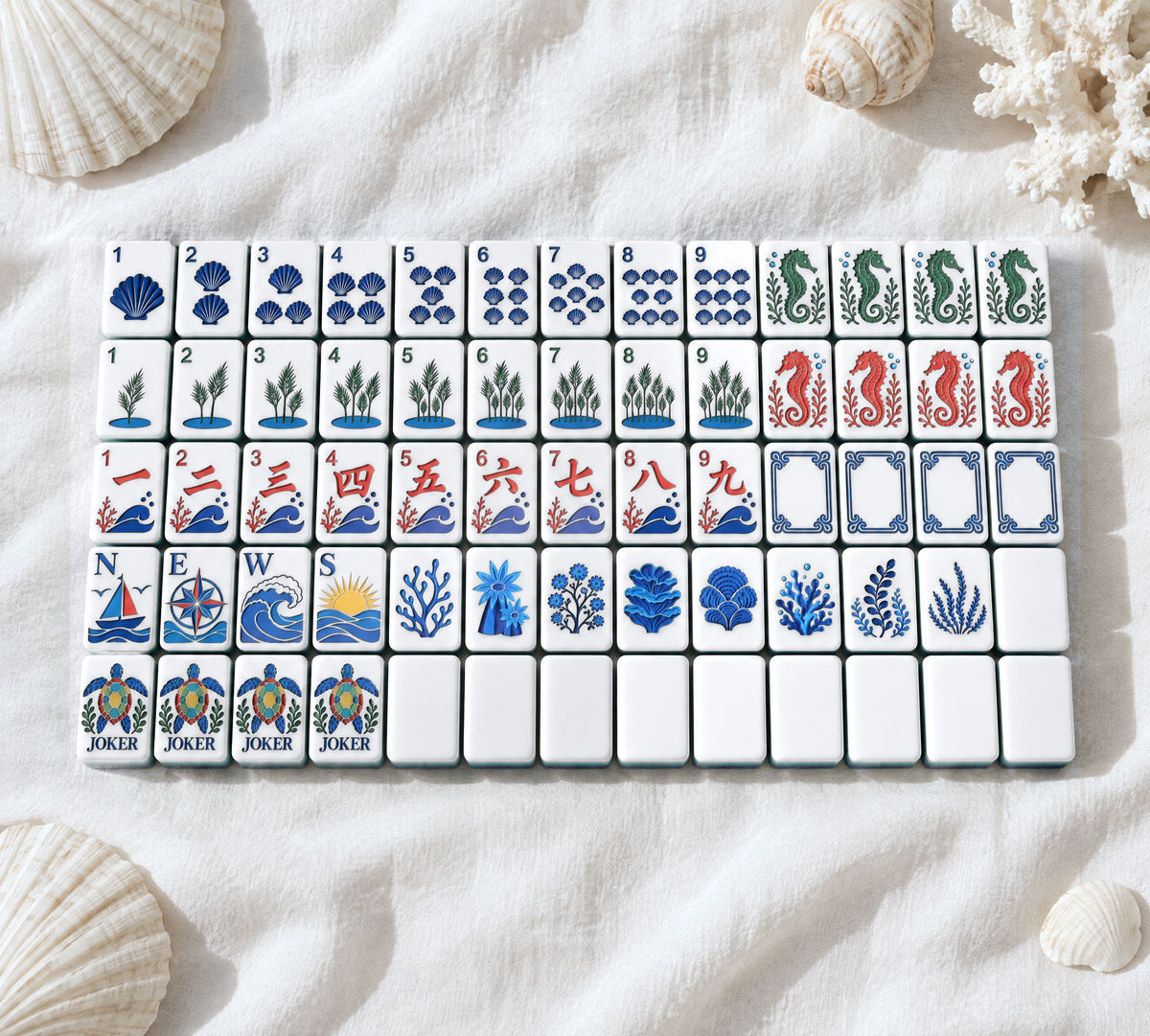
Chinese official mahjong uses 136 tiles (Bams, Craks, Dots 1–9 × 4 each; Winds N/E/W/S × 4 each; Dragons Red/Green/White × 4 each; eight Flowers and eight Seasons). Unlike American mahjong, Chinese hands are built from chows (sequences: 1-2-3, 4-5-6, etc.), pungs (three identical tiles), and kongs (four identical). A hand wins by completing four melds plus a pair (14 tiles total). Jokers don't exist in classical Chinese play; you draw and discard live each turn. Scoring varies by region—Hong Kong uses points-per-meld; Taiwanese uses fu and fan (base points × multiplier). There are no official annual hand cards; combinations are learned and memorized. Play moves faster than American mahjong and penalties for illegal calls are strict. If you're coming from American mahjong rules, expect a fundamentally different tile-passing ritual, hand structure, and endgame.
What tiles and equipment do I need to play Chinese official mahjong?
You need exactly 136 tiles: three suits (Bams, Craks, Dots) numbered 1–9 with four copies each; four Winds; three Dragons with four copies each; and eight Flowers plus eight Seasons. A cloth mat, four racks (one per player), and a wind indicator are standard. Dice determine turn order and break position. Unlike American mahjong, there are no jokers or blank tiles—every tile in the set is in play. Most Chinese sets come in bamboo or bone, though acrylic versions are now common for durability and ease of reading. If you're starting fresh, look for sets labeled "136-tile" and verify all four of each tile number are present.

What's the core difference between Chinese chows and American pungs?
Chinese official mahjong requires chows (sequences like 1 Bam–2 Bam–3 Bam) as part of winning hands—many patterns demand two or three chows plus one or two pungs. American mahjong forbids chows entirely; you build only pungs, kongs, quints, and sextets from the annual National Mah Jongg League card. In Chinese play, a chow must be consecutive and the same suit; you can call ("pung!") a discard to take a chow, or meld it from your hand. This means Chinese play rewards quick pattern recognition and tile-pairing flow, while American play demands memorizing the current year's allowed hands. The strategic depth differs: Chinese rewards adaptability; American rewards precision and prior planning.
How do winning hands work in Chinese official mahjong?
A winning hand has 14 tiles: four melds (each 3 tiles: a chow or pung) plus one pair (2 tiles). Example: 1 Bam–2 Bam–3 Bam (chow), 5 Dot–5 Dot–5 Dot (pung), East–East–East (pung), Red–Red–Red (pung), plus a pair of North Winds. The hand is complete when you draw or claim a discard that completes the final meld or pair. "Winning" is called "going mahjong" or "going out." In American mahjong, by contrast, you consult the annual card to check if your 14-tile pattern is listed—if it isn't, it doesn't win, even if it looks logical. Chinese play has no such card; hands are defined by meld structure alone. Scoring then depends on the variant: Hong Kong style awards points per meld type and honors; Taiwanese style calculates fu (base) and fan (multiplier) for a total score.
What are the main scoring systems in different Chinese variants?
Variant | Melds Scored | Speed | Complexity | Best For |
Hong Kong | Each meld × points; honors bonus | Fast | Medium | Social, quick rounds |
Taiwanese | Fu (base) + fan (multiplier) | Slow | High | Serious study |
Cantonese | Mixed scoring; many local rules | Medium | High | Regional groups |
Hong Kong style scores each meld independently—a concealed pung is worth more than an open pung; a terminal sequence scores higher than a middle-number one. Taiwanese style uses a base calculation (fu) multiplied by a win level (fan); a 2-fan win with 30 fu scores 960 points (or 1920 all-in). Cantonese play blends both and adds many local variations—always confirm scoring rules before play. American mahjong, by comparison, uses a flat point scale tied to the current year's card; there is no concept of fu or fan. If you're learning Chinese play, start with Hong Kong rules; they're more intuitive and widespread in casual clubs.
How do I handle the initial draw and tile-passing ritual?
In Chinese official mahjong, players don't perform a Charleston pass like American players do. Instead, the dealer (usually East) shuffles all tiles face-down and builds a "wall"—two stacks of 17 tiles each, two tiles high per player. Players sit N/E/S/W around the wall. The dealer rolls dice to determine the break point; play begins with the break player drawing the first tile from the wall. Each turn consists of drawing one tile from the wall and discarding one tile face-up into the center. When a player discards, anyone else can claim it to complete a meld—this is called "calling" and ends your turn. If no one claims the discard, the next player draws from the wall. Play continues in turn order (East → South → West → North) until someone melds the 14th tile and wins, or the wall empties (a draw). This live, reactive flow is much faster than American mahjong and demands alert listening and quick decision-making.
How do jokers and wildcards work in Chinese mahjong?
Classical Chinese official mahjong has no jokers or wildcards. Every meld must use actual tiles—no substitution. This is a core rule difference from American mahjong, where jokers are essential and can fill gaps. Some modern casual games in clubs add jokers (typically 1–4 per set) with house rules—usually a joker can represent any tile in a meld—but this is non-standard. If you're playing "official" Chinese mahjong (as codified by regional federations), never expect jokers. If you're in a casual group that uses jokers, establish the rule in advance: Can a joker stand alone in a meld? Can it be part of a pair? Can the player who played the joker reclaim it later? Confusion here causes arguments; always agree before the Charleston equivalent (here, before the first draw from the wall).

What are common mistakes when switching from American to Chinese play?
Mistake | Why It Happens | How to Avoid It |
Looking for the annual card | American players consult yearly card for valid hands | Chinese play has NO card; memorize meld patterns instead |
Expecting jokers as wildcards | American sets include 8 jokers per standard | Classical Chinese sets have zero jokers; use actual tiles only |
Melding non-consecutive numbers as a chow | Misremembering sequence rules | Chows must be three consecutive (1-2-3, not 1-3-5) in the same suit |
Holding onto honor tiles too long | Honors (Winds, Dragons) are less flexible than Bams/Craks/Dots | Honors form fewer chow options; prioritize suit sequences |
Calling a discard too slowly | American players have time to check the card; Chinese play is live | Listen actively; if you miss the discard, it's gone to the next player |
The biggest adjustment is mindset: American mahjong is a pattern-matching game where you hunt for hands listed on a card. Chinese mahjong is a meld-building game where you adapt to the tiles you draw and the discards available. Don't overthink; play faster. Also, American players often treat jokers as problem-solvers; in Chinese play, you solve problems by reading the wall, tracking discards, and predicting what others need.
🀄 Shop best-selling mahjong sets →
What equipment will help me practice or host Chinese mahjong?
A good practice setup includes a 136-tile set, a cloth mat with marked player seats, and four racks with pushers to keep your tiles organized and hidden. If you're hosting weekly games, invest in a durable mat—it protects your table and gives players a smooth surface for sliding tiles. A wind indicator (usually a plastic or wooden token that rotates) saves time tracking who is East and prevents arguments. Dice—two for determining break position—are essential. For casual home play, a standard set and mat are enough. For club-level or tournament prep, add mahjong racks so tiles stay private and organized. An acrylic set with clear markings is easier to read across the table than bone or bamboo, especially under standard indoor lighting.
Where can I find Chinese mahjong groups or learn from experienced players?
Chinese mahjong clubs exist in most cities with significant Chinese communities—check local community centers, libraries, temples, and cultural associations. Meetup boards and Facebook groups often list casual games and lessons. Some clubs have formal membership and tournament schedules; others are drop-in social games. When you first attend, arrive 15 minutes early, introduce yourself, and ask what scoring variant they use and what house rules apply (jokers, limits on kongs, dead-wall draw rules). Don't assume everyone plays the same way—regional variants (Hong Kong, Taiwanese, Cantonese) differ in scoring and tile combinations. Watching one full game before playing is wise. Many groups are patient with beginners; ask to sit out a round and observe. Online tutorials on YouTube can teach the basics, but nothing beats live play and correction from experienced players who can show you real tile combinations and hand-ending decisions in context.
🎁 See our most-loved mahjong sets & accessories →
What should I check before buying a Chinese mahjong set?
Before purchase, verify:
Tile count: 136 tiles total (never fewer).
Completeness: Four copies of each tile 1–9 in three suits, four Winds, three Dragons (each 4 copies), and eight Flowers and eight Seasons.
Material: Bamboo or bone are traditional; acrylic is durable and easy to read.
Marking clarity: Can you read all numbers and suit symbols across a table? Poor print fades quickly.
Rack fit: Do the tiles stack easily into standard four-tile-high racks? Oversized or warped tiles jam.
Case/bag: Does it come with organized storage? Loose tiles get lost or damaged in transit.
Jokers (none expected): Classical sets have zero jokers. If jokers are included, they're spares or non-standard; confirm they're optional with your group before purchase.
No blanks: A 136-tile set is complete as-is; blanks or "wild" tiles indicate a set intended for other games.
Check the product page for material composition and dimensions. Request photos or a size reference if you're unsure. For practice or casual play, an acrylic set is forgiving and affordable; for display or long-term use, bone or bamboo ages beautifully but requires care.
✨ Find your Mahstead set — free US shipping →
How do I transition my American mahjong skills to Chinese play?
Strengths you already have:
Tile recognition and suit/honor understanding.
Hand pattern logic (melds and pairs).
Turn discipline and discarding strategy.
Skills to relearn:
Sequences matter: In American mahjong, you've never built a chow (sequence). Chinese play depends on them. Practice: 1-2-3, 4-5-6, 7-8-9 in each suit. A chow must be consecutive and same-suit.
No annual card: Stop looking for a reference. Play live. After 10–20 games, winning patterns become second nature.
Speed over perfection: American play is methodical. Chinese play is fast. Discard quickly; don't agonize over every tile.
Forget jokers: Jokers don't solve problems in Chinese play. You must use real tiles.
Listen and watch: Tracking discards is 50% of strategy. If someone discards a Dot, they likely don't need Dots. Act on that.
We recommend playing 5–10 games in a beginner-friendly group before playing competitively. Ask the organizer to slow the pace and explain calls. After a dozen games, you'll feel the rhythm.

FAQ
Can I play Chinese mahjong with an American mahjong set?
No. American sets have 152 tiles plus jokers and flowers designed for American game rules. Chinese official mahjong needs exactly 136 tiles—different composition, no jokers. The tile counts and purposes don't align; you'd lack tiles for proper Chinese play.
What's the fastest-growing Chinese mahjong variant among casual players?
Hong Kong-style play is the most common in North America because it scores quickly per meld, games finish in 30–45 minutes, and rules are less rigid than Taiwanese. Taiwanese style is more complex and appeals to serious students; Cantonese play dominates in Southern China and includes many local tweaks.
If I discard a tile and no one claims it, does it stay in play?
No. Once a tile is discarded and passed—meaning the next player has drawn from the wall—the discard is dead. If you miss it, you missed your chance. This is why listening is crucial.
Can I play Chinese mahjong with fewer than four players?
Classical Chinese mahjong is designed for four players. Two or three-player variants exist but require rule modifications (adjusted wall size, hand scoring). Check with your group first.
How long does a typical Chinese mahjong game take?
20–45 minutes per game, depending on skill and luck. Hong Kong style is fastest (30 min average); Taiwanese is slower (45 min+). American mahjong averages 45–60 minutes because of the card-checking pause.
Are there any official Chinese mahjong championships or federations?
Yes. The Asian Mahjong Association, various regional federations in China, Taiwan, and Hong Kong, and several international tournaments exist. Rules are standardized within each federation, but variants still differ by region. Online play platforms are growing but less common than casual club play.


View More
View More
View More
