
Easiest Mahjong Rules for Families: Start Playing Today
Last updated: Nov 23, 2026
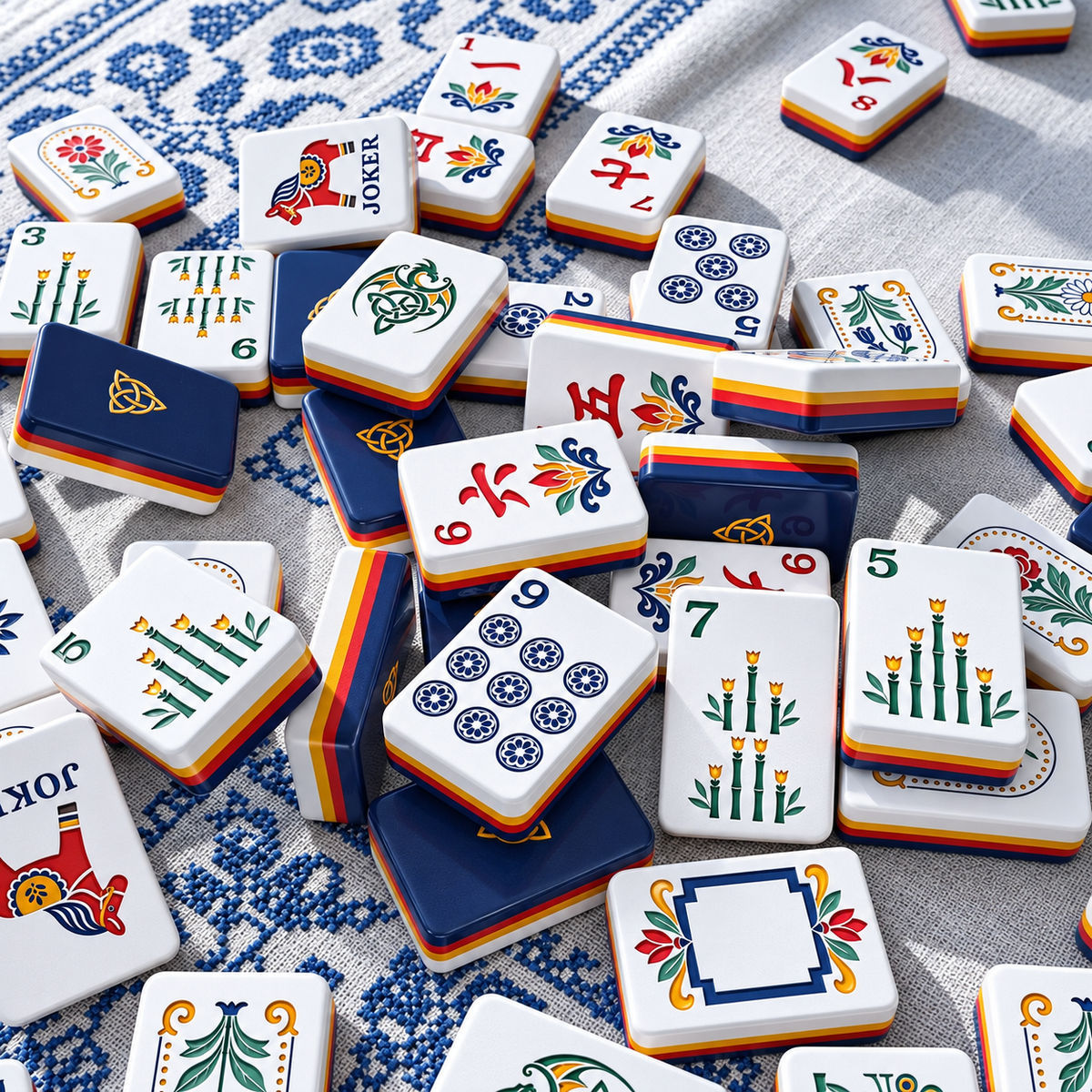
American mahjong for families means learning four rules: (1) draw one tile per turn and discard one; (2) call "pung" when you have three identical tiles, "kong" for four—or keep building in hand; (3) match your tiles to patterns on the current year's National Mah Jongg League card; (4) reach 2–4 winning hands per night depending on what you agree. No one plays Chinese or Riichi variants in typical family settings—American is the standard in home games. Setup takes 5 minutes; a game of four players finishes in 45 minutes to an hour. You'll need a best-selling mahjong set (152 tiles + jokers), the card, and a mat to protect your table. No special skill required: draw, discard, check the card, win. Mahstead acrylic sets ship with tile racks so everyone holds their hand neatly. 🀄 Shop best-selling mahjong sets →
What's the simplest first rule: draw and discard?
Every turn, you draw one tile from the wall and discard one from your hand. That's it. If you draw the tile you need, you've won; if not, pass it to the next player. Most turns last 3–5 seconds. The only exception: if you call a pung (three identical tiles), you take one from the discard and add it to the table—then immediately discard a different tile to keep fourteen tiles in hand.

Can my family play if no one knows the patterns?
Yes. Keep the National Mah Jongg League card face-up at the table so all four players can read it together. When someone thinks they've won, everyone checks the card to confirm the hand matches one listed pattern. For 2026, the card refreshes each spring. No memorization required—the card does the work. Check the pillar guide to mahjong for beginners for how to read it without confusion.
What's a pung versus a kong—and why does it matter?
A pung is three identical tiles (e.g., three 5 Dots). A kong is four identical tiles. When you have either in hand, you can "call" it: expose the tiles on the table and take your discard tile from the discard pile instead of the wall. This speeds up your turn and signals to other players what you're collecting. Jokers can be used as wild tiles in exposed groups but never as a single tile or a pair—that's the key family mistake to avoid.
🎁 See our most-loved mahjong sets & accessories →
How does the Charleston work, and do families really need it?
The Charleston is the tile-passing ritual before the first game starts: each player passes three tiles to the right, then three to the left, then three across. Families often skip it on night one to start faster—it's optional but traditional. Our Charleston guide explains the full dance step-by-step if your group wants to learn it next time.
Which family mahjong set setup stops arguments over tiles?
A set with acrylic tiles and wooden racks with pushers prevents tile-reading disputes because everyone's hand stays upright and easy to count. Some families use a mahjong mat to define the wall and scoring zones; others play on the dining table. The mat also protects your furniture—a practical choice if you're playing weekly.
Family-Friendly Rules Setup Checklist
✓ Get a full 152-tile set with jokers (Mahstead ships acrylic sets with built-in racks)
✓ Print or buy the current-year National Mah Jongg League card
✓ Agree on scoring: most families play first to 2 or 4 wins per night
✓ Teach the Charleston after the first two games (don't overload beginners)
✓ Assign one player as "card keeper" to read patterns aloud
✓ Use jokers only in exposed groups, never as a single tile or pair
✓ Let players practice calling "pung" and "kong" without penalty in the first round

How Long Until We're Actually Playing?
Setup step | Time | Who does it |
Unpack set and arrange tiles | 2 min | One person |
Explain draw-and-discard rule | 3 min | One experienced player |
Run one practice hand (cards visible) | 10 min | All four players |
Play first real game | 45–60 min | All four players |
Total from zero to first win | 60 min | Team effort |
Most families get comfortable by game three. By week two, you'll play two full games in an evening and laugh at your early mistakes—that's when it becomes addictive.
Five Common Family Mistakes and How to Avoid Them
1. Forgetting jokers can't be a single tile or a pair Jokers are wild—they substitute for any tile in an exposed pung, kong, or larger group. But they can't stand alone or form a pair, ever. If someone draws a joker on their winning turn, they've lost because jokers don't count as a final tile. Teach this once and make a rule: "No joker as your last tile."
2. Calling pungs too early Calling a pung before your hand is strategic. If you expose three 5 Dots, other players know what you want and won't discard it. Wait until you're close to winning, then call to grab that fourth tile fast. Beginners often call too eagerly and tip their hand.
3. Losing track of the wall The 152 tiles are arranged in a wall; players draw from it in order. If someone draws from the middle or forgets where it was, the game breaks. Use a mat to mark the wall's edge, or lay out tiles in a clear rectangle on the table.
4. Reading the card wrong The National Mah Jongg League card lists winning patterns, but beginners misread the notation. Pungs (three identical), quints (five in a row of the same suit), and pairs have different symbols. Take 10 minutes to decode the card before you play. The card keeper role prevents one person from deciding winners by mistake.
5. Playing with a borrowed set that's missing jokers American mahjong uses 8 jokers—no exceptions. If your borrowed set has only 4, you can't play the game correctly. A full Mahstead set comes with the right count built in, and spare jokers mean replacements if one ever goes missing.
What You'll Need
Family game night works best with:
A complete 160-tile acrylic set (152 playing tiles + spares)
The 2026 National Mah Jongg League card (updated each spring; order online or buy at a local game store)
Tile racks for each player (keeps hands organized and prevents dropped tiles)
A mat or tablecloth (protects your table and defines the play zone)
Dice or a smartphone timer (for random wall pick and turn speed)
✨ Find your Mahstead set — free US shipping →
What to Check Before You Buy
Set completeness: Confirm the set has 152 playing tiles + jokers. American mahjong won't work with fewer.
Tile size and weight: Acrylic tiles (about 1.25 inches) are easier for families to read than bamboo; lighter sets tire hands less during long sessions.
Rack style: Some sets come with racks; others don't. If you buy a set without racks, order them separately—they're worth it.
Card compatibility: The card refreshes yearly; your set works with any year's card, so buying a set is a long-term investment.
Shipping and damage: Acrylic tiles can crack if dropped, so confirm the set arrives intact before opening. Most Mahstead orders arrive within the continental US with free shipping.
Why American Mahjong Suits Family Games
American mahjong has no luck barrier like Chess, no memory demand like Bridge, and no sitting-out like Poker—everyone plays every hand. Families pick it up because the card does the thinking (you match patterns, not invent them), and each game lasts one predictable hour. Grandparents, teenagers, and newcomers all compete fairly. You can play weekly for years and still discover new strategies, yet no one needs to study rulebooks—just the card. That balance is rare in games and is why American mahjong works for families.

FAQ
Do I need to memorize the National Mah Jongg League card to play?
No. Keep the card face-up at the table and read patterns from it as you play. The card keeper role (rotated each game) ensures everyone trusts the call. Most families play this way forever.
How is American mahjong different from Chinese mahjong?
American mahjong uses a patterns card (you match exact layouts), has 152 tiles with 8 jokers, and lets you call pungs and kongs but not chows (sequences). Chinese mahjong uses sequences heavily and plays off melds. They're separate games; families starting out should stick to American.
Can three people play, or is it always four?
Four is standard, but three-player variants exist with rule tweaks (you use 144 tiles and skip one wind). See our 2 and 3 player rules guide if your group is often short a player.
What happens if someone accidentally picks the wrong tile or discards out of turn?
House rules vary, but most families restart that turn (no penalty on turn one) or have the guilty player skip their next turn. Agree on it before you start. For casual play, rewind and continue—winning at mahjong is less important than the rhythm of play.
Is mahjong expensive to start?
A full American mahjong set costs less than most board games. Mahstead offers best-selling acrylic sets designed for families, with free US shipping. A mat and racks are optional but add durability and comfort for weekly play.


View More
View More
View More
