
What Does the 8 Bam Tile Look Like in Mahjong?
Last updated: Nov 23, 2026
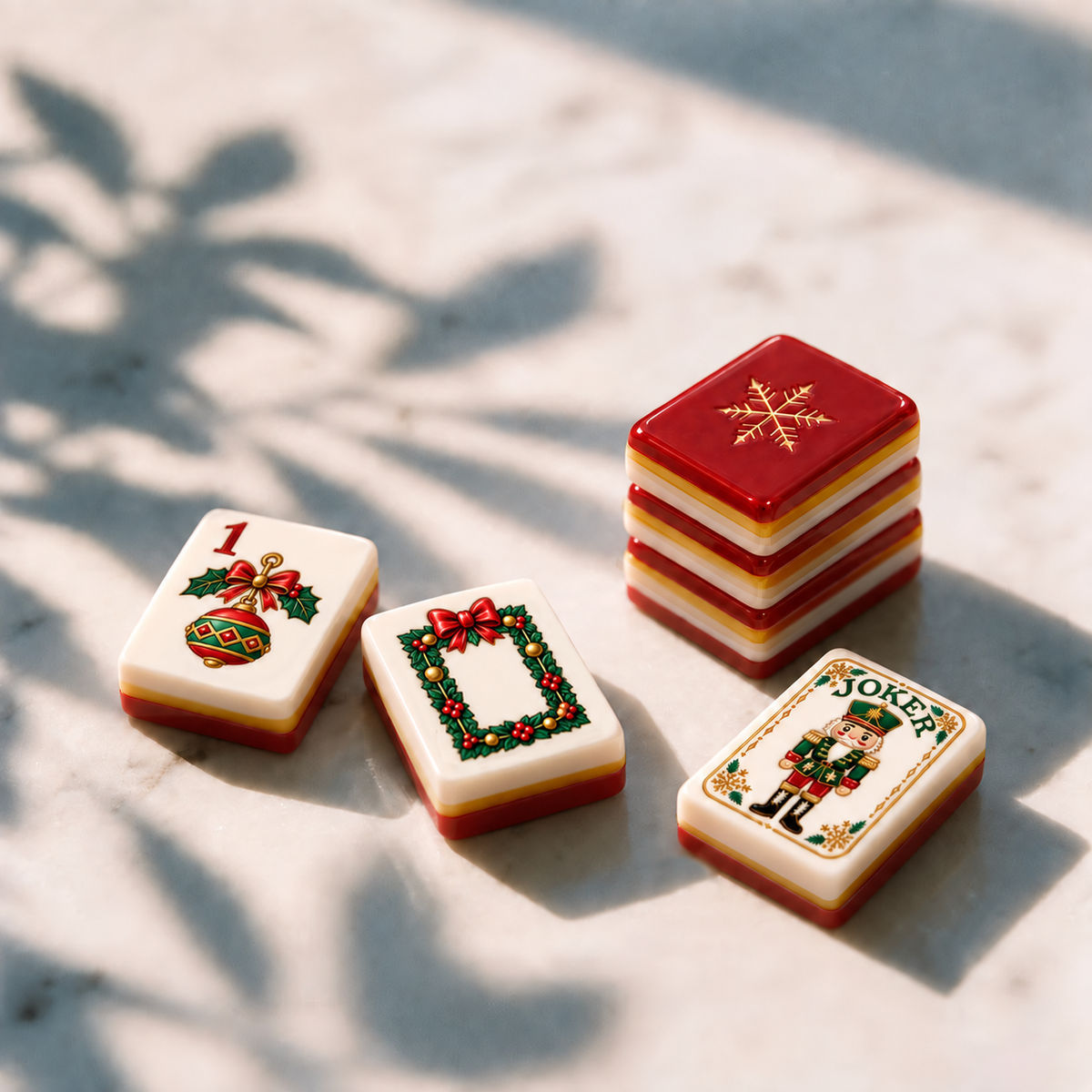
The 8 Bam tile shows eight identical small circles arranged in a standard pattern on an acrylic or bone face. In American mahjong, this tile belongs to the Bam suit (the other two number suits are Craks and Dots). The 8 Bam is one of 108 number tiles in the standard 152-tile set used in every American game. You'll encounter four copies of the 8 Bam in play—one for each player. Visually, it sits between the 7 Bam and 9 Bam in sequence. On Mahstead's engraved sets, the tile face is clearly marked so players can read it from any angle, even mid-game. The specific arrangement and depth of the circles varies by set design; higher-quality sets use deeper etching or embossing to prevent glare and make the tile instantly recognizable under table lights.
The 8 Bam shows eight identical circles arranged on a single tile face. In American mahjong, this tile belongs to the Bam suit (the other two number suits are Craks and Dots). The 8 Bam is one of 108 number tiles in the standard 152-tile set used in every American game. You'll encounter four copies of the 8 Bam in play—one for each player. Visually, it sits between the 7 Bam and 9 Bam in sequence. On quality acrylic sets, the tile face is clearly marked so players can read it from any angle, even mid-game. The specific arrangement and depth of the circles varies by set design; higher-quality sets use deeper etching or embossing to prevent glare and make the tile instantly recognizable under table lights.
How Are Bam Tiles Different From Craks and Dots?
All three number suits (Bam, Crak, Dot) count from 1 to 9, with four identical copies of each number in every 152-tile set. Bam tiles show small circles; Crak tiles show character symbols (often looking like sticks or stylized marks); Dot tiles show solid filled circles. The 8 Bam is distinguished only by its eight circles—not by color or special markings. Many newer players mix up which circles belong to which suit, so learning the shapes early saves time. The key: Bams are small open circles arranged in neat rows, while Dots are solid and slightly larger. Once you've handled a full set during a real game, the difference becomes automatic.

Why Is Reading the 8 Bam Quickly Important in American Mahjong?
In American mahjong, speed matters. Players expose pungs, kongs, and quints during play, and everyone must verify matches instantly. A pung requires three identical tiles—three 8 Bams, for example. If the circles are poorly engraved, faded, or glare under overhead lighting, you'll hesitate or misread the tile, slowing the table. Since the 8 Bam appears frequently in hands (it's a mid-range number with no special restrictions), being able to spot it in a rack of 13 tiles without lifting your racks speeds up your play and keeps the game moving. Mahstead's engraved sets are designed with game-speed readability in mind—deeper etching and anti-glare finishes mean you see the 8 Bam clearly from three feet away, even when tile racks are stacked.
What Should You Look for When Choosing a Set That Shows Tiles Clearly?
When selecting a mahjong set, prioritize contrast and depth. Acrylic sets with engraved designs are easier to read than sets with painted or printed tiles because the engravings don't fade with handling. The tile face should have sufficient depth—shallow engravings blur under glare or from 4–6 feet away. Color also matters: ivory or cream backgrounds with black engravings provide the highest contrast. Check the tile size: standard American tiles measure roughly 1.25 inches wide; smaller tiles force you to lean in or squint. Finally, examine samples under various lighting—fluorescent, natural, and lamplight. A quality set designed for serious play remains readable at any angle and lighting condition. Our best-selling mahjong sets are tested in live game settings and engineered for readability and durability.
🀄 Shop best-selling mahjong sets →

How Do You Organize Bams, Craks, and Dots in Your Rack?
Most players organize their 13-tile racks by suit and number to spot winning combinations faster. All Bams go together (1–9 in order), then all Craks, then all Dots, with winds and dragons grouped separately. When you're holding an 8 Bam (or searching for one), this organization means you know exactly where to look—the middle of the Bam section. This habit prevents you from calling "pung" when you actually have only two 8 Bams and a misread joker. During the Charleston (the tile-passing ritual before each hand starts), you're moving tiles rapidly, so neat organization prevents accidents. After you draw the first tile of the hand, your racks stay visible only to you—keep the 8 Bams grouped and upright. When exposing a pung of 8 Bams, place all three in a row so everyone can verify the match instantly. This clarity reduces disputes and keeps the game flowing.
What Makes a Set Easy to Learn On If You're New to Mahjong?
New players often confuse number tiles because they haven't built visual memory yet. The 8 Bam, being a mid-range number with no special meaning, is easier to learn than honor tiles (winds and dragons), but harder than the 1 Bam (which often includes a bird image for recognition). Choosing a set with bold, deeply engraved designs accelerates learning. High contrast between the tile face and background also helps—you can focus on counting circles instead of squinting to see them. Avoid sets with small print, decorative borders, or ornamental fonts on the number tiles; these distract from the core shape recognition. If you're buying for a mahjong group that includes beginners, mahjong sets with engraved titles allow you to customize your set with group names or dates, adding an extra memory anchor. Consider pairing a clear set with a durable mat that includes a guide to tile suits and values—this speeds up learning without slowing the game.
🎁 See our most-loved mahjong sets & accessories →
Comparison: Set Features That Help Tile Recognition
Feature | Impact on Reading | Best For |
Deep engraving | High contrast; readable from distance | Competitive play, large groups |
Acrylic material | Durable, no paint fade; consistent over time | Long-term investment |
Cream or ivory base | Maximum contrast with black marks | Fast, accurate recognition |
Standard tile size (1.25") | Comfortable handling and visibility | All play levels |
Anti-glare finish | No reflection under overhead lights | Game rooms, bright venues |
High-quality acrylic | Resists cracking; tiles stay flat | Regular weekly games |
What to Check Before You Buy
Before ordering, ask yourself: Do I play weekly or casually? Weekly players benefit from durable acrylic racks with pushers and protective bags, since tiles wear faster with frequent use. Do I play in bright or dim rooms? Bright rooms require anti-glare or matte finishes; dim rooms can use glossy finishes. Am I buying for myself or as a gift? If it's a gift for someone new to mahjong, include a beginner's guide or recommend they learn how to read the mahjong card first—this context makes the 8 Bam tile meaningful. Do I need portability? If you travel to games, mahjong bags and cases protect tiles from humidity and warping. If your set will sit unused for months, acrylic is more stable than bone or bamboo. Finally, confirm that your set includes exactly 152 playing tiles plus the 8 jokers that complete a legal American game.
✨ Find your Mahstead set — free US shipping →

FAQ
Is the 8 Bam always shown as eight circles, or are there variations?
In American mahjong, the 8 Bam is always eight small circles arranged in a standard pattern—no variations. Chinese sets may use different styles or arrangements, but American tiles follow one consistent design to ensure all sets are playable together at any table.
Can I use the 8 Bam in a joker position or as a wild tile?
No. In American mahjong, the 8 Bam is a fixed number tile and never serves as a joker or wild. Jokers are separate tiles used to substitute missing tiles in exposed melds. The 8 Bam must always be an identical match to count toward a pung, kong, or quint.
Why do some sets make the 8 Bam look blurry or hard to read?
Shallow engravings, poor contrast between tile and background, gloss finishes reflecting light, or paint that fades with use can all blur the 8 Bam's appearance. High-quality acrylic sets with deep engravings and matte finishes maintain readability indefinitely, even under bright table lights.
How many 8 Bam tiles are in a complete 152-tile American mahjong set?
There are exactly four 8 Bam tiles in every 152-tile American set—one for each of the four players. This holds true for all number tiles in American mahjong: each suit (Bam, Crak, Dot) has numbers 1 through 9, each numbered four times.
If I'm learning mahjong, should I practice recognizing the 8 Bam before I play my first game?
Yes. Before your first game, spend 10 minutes reviewing the three number suits (Bam, Crak, Dot) with a real set. Memorize that Bams are small open circles, Craks are character marks, and Dots are solid circles. The 8 Bam, being mid-range, will feel natural after one or two practice hands, making your first real game less overwhelming.


View More
View More
View More
