
Difference Between American and Sichuan Mahjong: Rules & Gameplay
Last updated: Nov 23, 2026
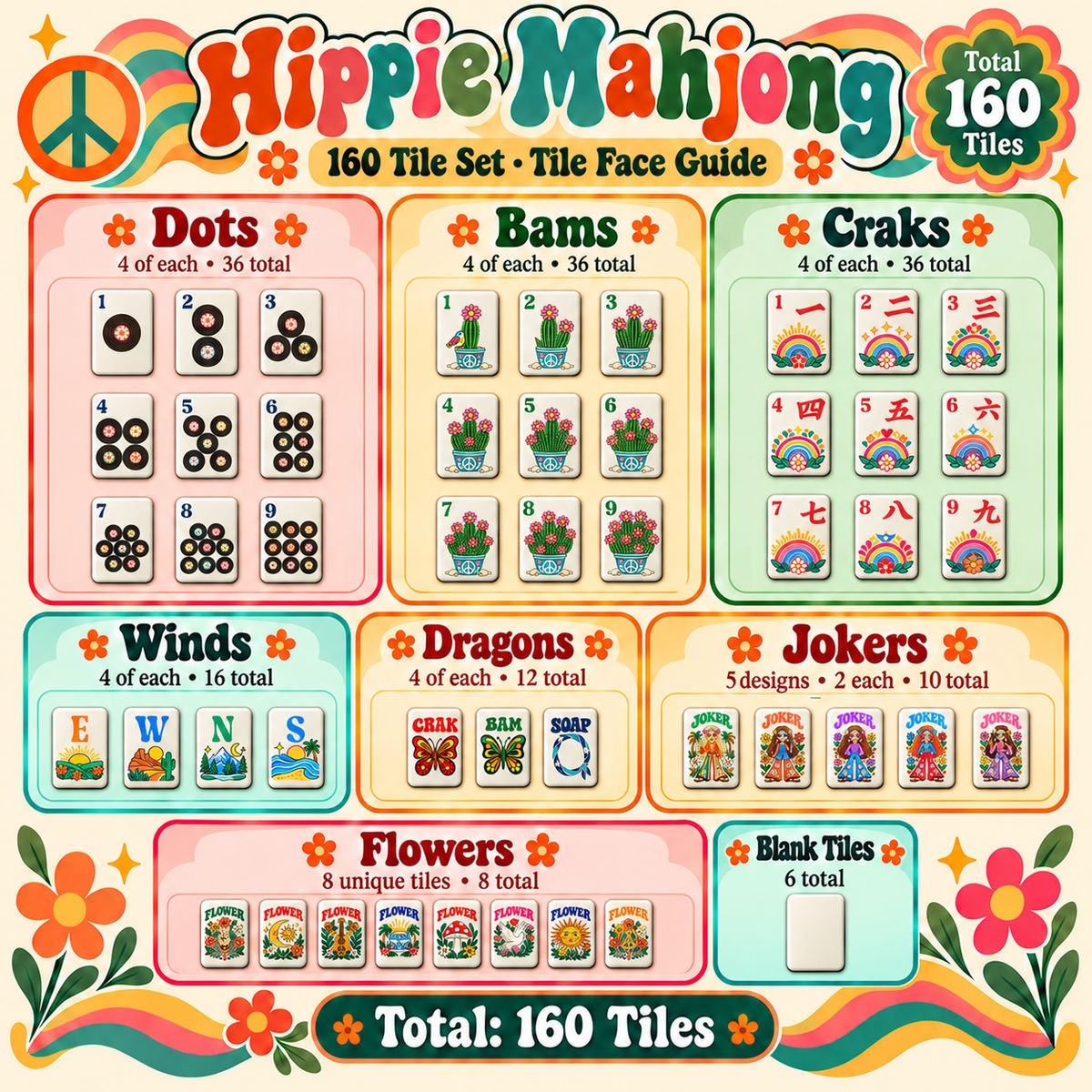
American mahjong uses 152 tiles (36 per suit: Bams, Craks, Dots; plus winds, dragons, flowers, jokers) and draws exclusively from the current-year National Mah Jongg League card, meaning hands are fixed patterns. Sichuan mahjong uses 108 tiles (just numbered suits 1–9, four of each per suit, plus winds and dragons—no flowers or jokers) and play is entirely freestyle: you form sequences (chows: 1-2-3), pungs (three identical), and kongs (four identical) with no reference card. American has no sequences, only identical sets; melding (exposing sets) is restricted; and jokers substitute inside sets but never stand alone. Sichuan play runs faster, relies on memory and strategy rather than hand recognition, and scoring varies by region. Both are 4-player games with a discard pile, but American requires the Charleston (tile-passing ritual), while Sichuan does not. A game of American takes 1.5–2 hours; Sichuan rounds are typically quicker. Choose American if you want structure and a printed card; choose Sichuan if you prefer freestyle building and speed.
🀄 Shop best-selling mahjong sets →
Why does American mahjong require a printed card and Sichuan doesn't?
American mahjong invented the reference card in the 20th century to lock down which 14-tile hands are legal each season. The card displays thousands of valid patterns—arranged by suit, honors, pairs, and special combinations—and all four players use the same card, all season long. This creates consistency: two games in the same living room follow identical rules. Sichuan mahjong predates this system; players memorize hand types (flush sequences, all simples, all terminals, dragons, etc.) and infer legality from traditional rankings. Because Sichuan is older and rooted in folk play, regional variation is normal—some areas score high pairs differently, or allow melds you can't expose in others. American mahjong's card removes ambiguity and regionalisms, making it portable and teachable to newcomers.

What tiles are in each game, and why the difference?
Game | Tiles | Suits | Honors | Flowers | Jokers | Handsize |
American | 152 | Bams, Craks, Dots (1–9×4 each) | 16 winds, 12 dragons | 8 | 8 | 14 |
Sichuan | 108 | Bams, Craks, Dots (1–9×4 each) | 16 winds, 12 dragons | 0 | 0 | 14 |
American mahjong adds flowers (spring, summer, autumn, winter, plus four bonuses) and eight jokers, raising the deck from 108 to 152. Flowers and jokers serve different roles: flowers are drawn but don't contribute to your hand—you replace them immediately—while jokers act as wildcards inside sets (e.g., three 5 Craks where one is a joker). Sichuan keeps it simple: only numbered suits and honors, no substitutes, no bonus tiles. This is why Sichuan feels harder to new players—every tile in your hand must be real; there's no joker safety net. American's extra tiles and wildcards make learning easier and give casual players more flexibility.
Can you form sequences in both games?
No. American mahjong has no sequences. You build only pungs (three identical tiles—e.g., three 5 Dots) and kongs (four identical). The Charleston and the card enforce this: no 1-2-3 or 7-8-9 arrangements are ever valid on the American card. Sichuan mahjong requires sequences (called "chows" or runs). A hand must include at least one sequence; often, the entire hand is sequences plus one pair. Sichuan scoring rewards specific sequence types: all simples (2–8 in each suit), all terminals and honors (1, 9, winds, dragons), or sequences in a single suit. This is perhaps the biggest gameplay difference. In American, you're matching numbers in sets of three or four identical tiles. In Sichuan, you're weaving numbers across runs, like rummy, and sequences are the backbone of your hand.
How do jokers and wildcards work differently?
In American mahjong, jokers are wildcards—they can stand in for any tile inside a pung or kong. If you have two 7 Bams and need a third, a joker fills that slot; your pung becomes 7 Bam, 7 Bam, Joker. However, jokers can never be used as a single tile or as a pair. If you need a joker in your pair, you're out of luck; you must use two real jokers (which counts as a pair of jokers). Many players misunderstand this: jokers are powerful inside groups but useless as standalone tiles. Sichuan has no jokers at all. Every tile is real; players must complete their hand with tiles already in play or drawn from the wall. This raises the difficulty: you can't substitute—if you're one 6 Bam short, you have to draw it or win it from a discard. We've written a full guide to how jokers work in American play.
🎁 See our most-loved mahjong sets & accessories →

What's the pre-game ritual, and does it differ?
American mahjong begins with the Charleston: each player passes three tiles to the right, then three to the left, then one tile to the right again (or variations). This ritual redistributes tiles before the hand is drawn and ensures no player has an unfair edge before the wall is broken. It's a charming, social moment and a core part of American mahjong identity. Sichuan mahjong has no Charleston. Play begins immediately after tiles are shuffled and walls built. The Charleston adds 10–15 minutes to an American game; Sichuan play starts faster. If you're teaching American mahjong to newcomers, the Charleston often feels confusing at first—we recommend practicing it separately, outside a live game, so players understand the rhythm before the pressure of a real hand.
How does game length and scoring differ?
A single game of American mahjong (often called a "round," though it technically runs four rotations of dealer position) takes roughly 1.5 to 2 hours, with an average hand lasting 10–20 minutes. Scoring is fixed per the current year's card: each hand lists its point value (from a few points to 80+ for harder patterns). Players keep cumulative scores, and the winner of each hand collects from the other three based on that hand's value. Sichuan rounds tend to be faster—hands often end in 5–10 minutes because melds happen faster (no reference card needed, no Charleston setup) and players can play more hands before stopping. Sichuan scoring is regional and traditional, often tabulated differently per area; some regions score by base points and multipliers, others by a flat scale. If speed is a priority, Sichuan suits fast-moving groups; American suits players who want depth and a long, steady session.
✨ Find your Mahstead set — free US shipping →
Which game should your table learn?
Choose American if:
You enjoy structure and printed reference materials.
Your group wants a consistent, year-round ruleset that doesn't vary by region.
You value slower, strategic play with time to think between turns.
You like jokers and bonus tiles (fewer tiles are discarded dead).
You want a strong beginner-friendly onboarding (the card teaches you what's legal).
Choose Sichuan if:
Your group has players who know classical mahjong (Sichuan is closer to Hong Kong, Chinese, and Riichi variants).
You prefer freestyle building—no reference card, pure memory and intuition.
You want faster-moving rounds and quicker decisions.
You like the challenge of forming sequences and reading opponents' discards.
You're comfortable with regional variation and house rules.
Most Western players begin with American, then branch into Sichuan later if they want a fresh challenge. Both are excellent 4-player games; neither is objectively better. The best choice depends on your group's patience level, learning style, and appetite for structure versus improvisation.
What to check before you buy
If you're building an American mahjong library, ensure your best-selling mahjong sets include the current-year card (check the seller's website—the card updates every spring). A complete American set contains exactly 152 tiles plus 8 jokers. If you want durable, long-lasting tiles for weekly play, choose acrylic or bone-and-bamboo sets; they resists cracking and fading. For Sichuan, you'll need only 108 tiles (though many sets sold in North America are American 152-tile sets, which work fine—you just ignore the extra tiles). Consider a mahjong mat if you're hosting; it protects your table and organizes tile placement. If you travel between games, mahjong bags and cases keep tiles safe and organized. Always confirm the tile set includes the current year's American League card if you're playing American; for Sichuan, any numbered-suit set works, since you're not constrained to a card.
Comparison Table: What to Expect
Factor | American | Sichuan |
Tile count | 152 | 108 |
Sequences allowed | No | Yes, required |
Reference card | Yes (current year) | No |
Jokers/wildcards | 8 jokers (in sets only) | None |
Flowers | 8 (drawn, replaced) | None |
Pre-game ritual | Charleston (3-3-1 pass) | None |
Avg. hand length | 10–20 min | 5–10 min |
Learning curve | Moderate (card reference) | Steep (memory-based) |
Regional variation | Minimal (card-enforced) | High (house rules common) |
Best for | Casual, structured play | Speed, strategy, variant players |

FAQ
Can I play American mahjong with a Sichuan set?
Not really. A Sichuan set lacks flowers and jokers, so you can't play American correctly—several card hands call for flowers or jokers. You'd miss valid hands. Buy a best-selling mahjong set with the full 152 tiles and current-year card for American play.
Why do sequences not exist in American mahjong?
American mahjong was deliberately redesigned in the 1920s-30s to simplify and standardize play for Western tables. Removing sequences made the game easier to teach to newcomers and reduced disputes. The printed card codified this rule, and it stuck.
Is Sichuan mahjong harder than American?
Yes, for most Western beginners. Sichuan requires memorizing hand types, reading tile frequency without a card, and predicting opponent moves. American gives you a printed card showing every valid hand, making it more forgiving. However, experienced players may find Sichuan's freestyle aspect more rewarding.
Can I play American mahjong without the card?
Technically, yes, but don't. The card is the rulebook. Without it, your group will argue over which hands are legal, and different tables will play by different rules. Always use the current year's National Mah Jongg League card.
Do I need different sets for American and Sichuan, or can I use one set for both?
You need different sets. American requires 152 tiles (including flowers and jokers); Sichuan uses 108 (no flowers or jokers). Mixing them causes confusion during play. Buy a dedicated set for whichever game you're learning first.
Can I play American or Sichuan with fewer than four players?
American has official 2- and 3-player variants with modified rules. Sichuan traditionally demands four; 2- or 3-player versions exist in some regions but lack standardized rules. For American, we've got a full guide on 2 and 3 player mahjong rules.


View More
View More
View More
