
Easiest Mahjong Rules for Busy Professionals
Last updated: Nov 23, 2026
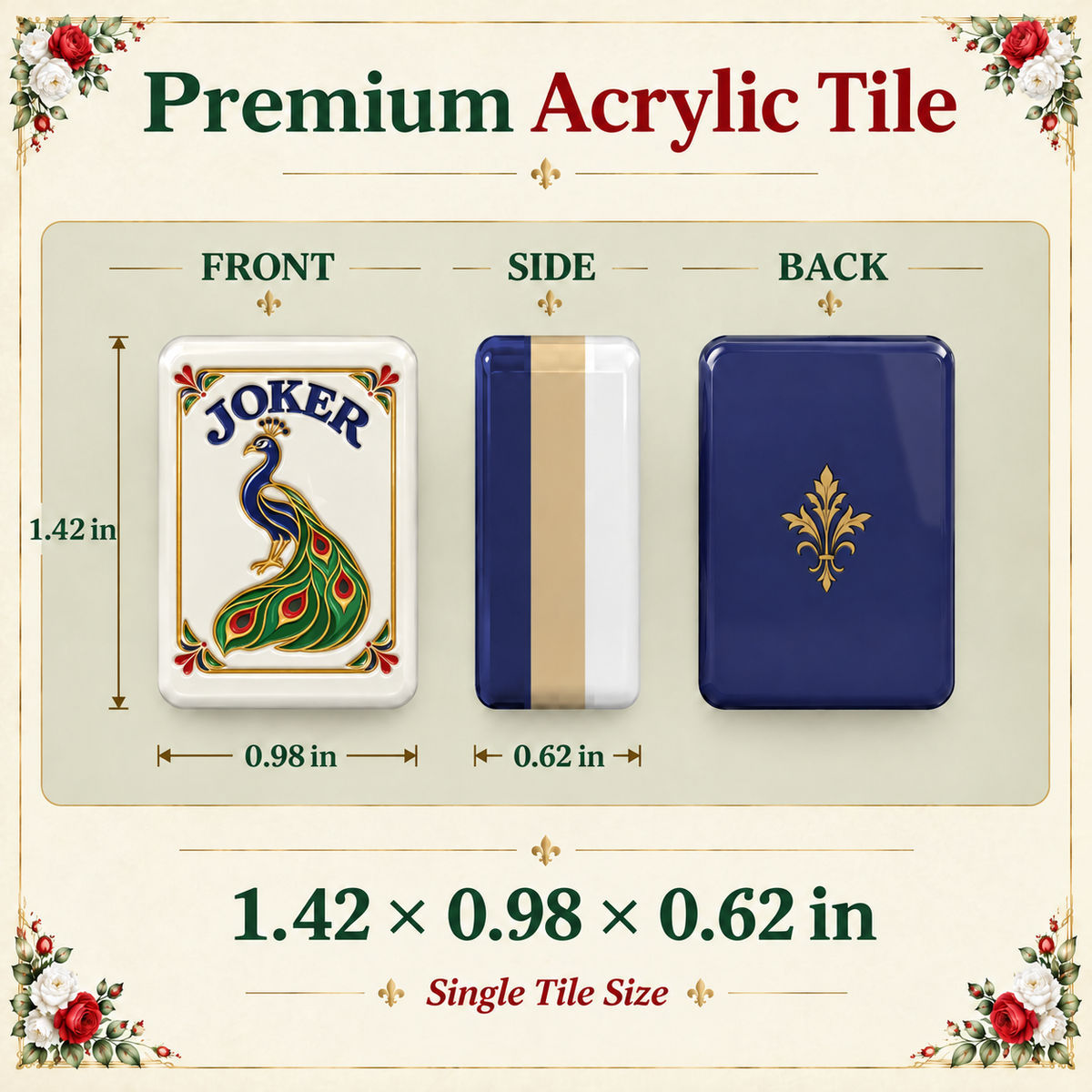
American mahjong plays with 152 tiles (8 jokers + 144 core tiles: Bams, Craks, Dots 1–9 in four copies each, 16 winds, 12 dragons, and eight flowers). A hand is a set of 14 tiles arranged into four groups of three (called melds: pungs, kongs, or pairs of identical tiles) plus one pair, all matching patterns on the current year's National Mah Jongg League card. You draw and discard one tile per turn; whoever completes a valid hand first wins and scores points. The core rule: match the card, build identical groups, draw-discard-win—that's the entire game. Most professionals learn it in 30 minutes; a first game takes 45 minutes. Mahstead's best-selling sets ship with instruction cards that compress this into four pages, making it practical to teach at your desk.
🀄 Shop best-selling mahjong sets →
Can I really learn mahjong in under an hour?
Yes. American mahjong is a draw-discard-win pattern game, not a complex strategy engine. The rulebook exists because scoring is granular, but gameplay is straightforward: match tiles to card patterns, build groups of three identical tiles (called a pung), and form 14 tiles into four groups plus a pair. The National Mah Jongg League card—issued each spring—is your cheat sheet. A newcomer who knows the card, the four tile types, and the discard rule can play a full game with one patient table in 40 minutes. The second game is 25 minutes. By game five, most professionals stop checking the rules.

What are the four absolute rules I need to know?
Rule 1: Identical tiles form groups; different numbers don't. In American mahjong, a "pung" must be three of the exact same tile—three 5 Dots, not 3-4-5. This differs from Hong Kong mahjong, which allows sequences (chows) like 3-4-5; American mahjong does not. A "kong" is four identical tiles. The pair (your 14th tile) is also two identical tiles. Jokers can substitute for any tile except in a pair or a single-tile placeholder.
Rule 2: All 14 tiles must match a single hand on the current year's card. The National Mah Jongg League card shows roughly 150 valid hand patterns per year, organized by sections (2024, 2025, 2026 hands). You cannot win a hand unless all 14 of your tiles match one complete pattern on that year's card. This is why the card sits in the center of the table.
Rule 3: You draw one tile and discard one tile per turn. After drawing, your hand has 15 tiles. You must discard exactly one, leaving 14. If your 14 remaining tiles match a card pattern and it is your turn to discard, you "go mahjong" (win). If another player discards a tile you need, you may call it for an exposed meld (pung, kong, or quint); your hand is then partially visible to the table.
Rule 4: Jokers substitute freely, but never count as a tile or pair by themselves. If a hand calls for three 1 Bams and you hold two 1 Bams plus one joker, the joker stands in for the third. Jokers make hands faster and are the only tiles that move between melds—they can never sit as a single tile, a pair, or a blank placeholder. A hand cannot win on the joker alone.
🎁 See our most-loved mahjong sets & accessories →
Why is the 160-tile set better for office groups than the standard 152?
A standard American game uses exactly 152 tiles. A 160-tile set includes spare tiles (extra jokers and backup tiles) so that if one is dropped, cracked, or misplaced—common after dozens of games—you still have a complete 152 to play with. For a casual group meeting weekly at the office, this is essential insurance. A 152-tile set has no spares; if a tile breaks, you cannot finish that game. Professionals who host games once or twice a year rarely notice; groups that play 20+ times a year will eventually see a chipped or lost tile. The spare jokers also help if your group prefers to use an extra joker per hand (some variants do). The 160-tile set costs slightly more than the 152, but the trade-off—zero game disruption for a broken tile—is worth the peace of mind. Explore our curated best-selling mahjong sets, all of which ship with spares.
How do I know which patterns are on the card for this year?
The National Mah Jongg League card is the binding reference. It's printed annually (typically released in March or April) and divides into sections by hand complexity. Each section shows a pattern: for example, "2024" hands at the top of the card, "2025" hands below. Within each section, you'll see symbols like "P" (pung), "K" (kong), "Q" (quint), "S" (sextet), and "2 Like" (two identical tiles). A hand might read "P P P 2 Like" at the 2024 level—meaning you need four groups of three identical tiles (four pungs) plus one pair.
The easiest way for busy professionals: ask your host to email the card or print copies before the first game. Many clubs and synagogues also have card PDFs online. The card is small enough to fit on a phone and reference during play. After two or three games, most players stop checking; the mind learns patterns visually. Consult our guide to reading the mahjong card for deeper breakdowns of how sections and symbols work.

What's the fastest way to teach newcomers before our first game?
Spend 10 minutes on tile names, 5 minutes on the card format, and 10 minutes on one practice hand. Here's the checklist:
Minute 1–5: Show the four tile types (Bams, Craks, Dots, Honors). Point out: Bams have a bird on the 1, Craks look like Chinese coins, Dots are solid circles. Winds are N/E/W/S. Dragons are Red, Green, White. Flowers are bonus tiles (not used in most hands; hold them aside). Jokers are wild.
Minute 6–10: Open this year's National Mah Jongg League card. Pick a simple pattern (e.g., "4 Like P, Pair 1" = four groups of the same tile, one pair). Show where it lives on the card. Explain: to win, all 14 tiles must match one pattern exactly.
Minute 11–25: Deal four players 13 tiles each. Ask each player to see if they can spot any groups (three identical tiles). Walk through a mock discard: "I have two 3 Dots and a joker, so that's a pung of 3 Dots. I need one more group and a pair to go mahjong." Simulate two turns. Restart the real game.
Most groups spend less than 15 minutes total before play begins. The second game is when people truly absorb the flow.
Learning Phase | Time | Focus | Outcome |
Tile names & symbols | 5 min | Bams, Craks, Dots, Honors, Jokers | Can identify each tile |
Card format & sections | 5 min | Where hands live on card | Can spot a pattern on paper |
One practice hand | 10 min | Draw, discard, recognize groups | Can play one full turn |
First real game | 40 min | Apply rules, adjust pace, learn card flow | Ready to host again |
✨ Find your Mahstead set — free US shipping →
What mistakes wreck the first game and how do I avoid them?
Mistake 1: Mixing up pung (three identical) with a sequence (1-2-3). American mahjong does not allow sequences. A pung is always three or four of the same tile. If a player says "I have 1 Dot, 2 Dot, 3 Dot," that is not a group in American mahjong. Common fix: before the first hand, show the card and point out that it only lists "P" (pung), "K" (kong), "Q" (quint), "S" (sextet), "Pair"—no "Chow" or sequence symbol. If someone is used to Hong Kong or Riichi mahjong, remind them: American rules, American card only.
Mistake 2: Losing track of the discard pile. In American mahjong, discards stay visible in the center. A player can call a discard to expose a pung (or kong, or quint) on their rack; the exposed meld then belongs to that player, and the discard pile is reset. If players throw tiles carelessly or stack discards in a messy pile, no one knows which tile was discarded when. Fix: use a mat with a clear discard zone or ask players to line discards neatly left-to-right. Choose a mahjong mat with a dedicated discard zone—it removes confusion in seconds.
Mistake 3: Jokers used where they shouldn't be. Jokers cannot form a pair and cannot sit alone. If a player says "I'll use a joker as my pair," that's invalid. Jokers also cannot "blank out" a tile; they must replace a specific tile in a meld. Fix: print a house rule card that says "Jokers substitute for one tile in a meld only; jokers cannot be a pair or single tile." Post it on the mat.
Mistake 4: Playing an outdated card. Every spring, the National Mah Jongg League releases a new card. Hands from 2025 cannot be used to win in a game using the 2026 card. A group that forgets to update the card will reject winning hands and stall games. Fix: each autumn, ask your host to confirm the current year's card and print new copies (or update the digital link).
Mistake 5: Calling a win on an incomplete hand. A player must hold exactly 14 tiles in a valid pattern from the current card and call "mahjong" on their own turn. If a player wins with 13 tiles or a pattern that doesn't match the card, the win is void and play continues. Fix: before play, ask one experienced player to spot-check the first winner's tiles on the card. After the first game, most groups self-regulate.
What equipment actually saves time at the table?
Three items cut confusion and speed up games:
A mat with zones. A dedicated discard zone prevents tile chaos. A rack-holding edge lets players avoid dropping tiles. Compare mats and table covers to find the right fit for your space.
Racks with pushers. Tiles stay upright and organized; racks let you see your entire hand without fumbling. Pushers let you advance tiles cleanly from your hand to the discard zone. A newcomer with a rack makes half as many "wait, where did that tile go?" mistakes as someone holding tiles in their lap.
A printed or digital card at the table. The physical card (or a PDF on a phone/tablet) is the tie-breaker for disputes and the reference for learning. One card per table is a house minimum.
Beyond these three, a mahjong bag or case is valuable only if your group travels or stores the set between games. For a permanent office table, it's optional.
What to check before you buy
Tile clarity: Acrylic tiles (the standard) are easier to read than bamboo or wood, especially under office fluorescent lighting. Engraved symbols (not printed) last longer through dozens of games.
Spare tile count: A 160-tile set includes spares; a 152-tile set does not. For a weekly game, 160 is safer.
Mat size: Measure your table. A mat that hangs over the edge or leaves no room for the card is a source of tension. A 33"–36" mat fits most dining tables; check your table depth before ordering.
Set completeness: Confirm the set includes eight jokers and all four flowers. Some sets ship with fewer jokers.
Instructions: A compact rulebook or QR code link to rules saves you from explaining the card format manually each week.

FAQ
Do I have to memorize the mahjong card?
No. The card sits on the table for reference. After three to five games, your eye learns patterns; by game ten, most players skim the card once per turn instead of staring at it. Memorization is not a requirement—pattern recognition comes naturally.
Can I play with fewer than four people?
Yes, but the rules change. Two-player and three-player mahjong use modified tile sets and different point structures. The standard American game assumes four players (one at each compass point: North, East, South, West). If your group has three people, consult the specific rules for three-player mahjong before starting.
What if someone wins but we're not sure the hand is valid?
Check the card. If all 14 tiles match a pattern on the current year's card, the hand is valid. If it doesn't match any pattern on the card, the win is void. Dispute resolved. This is why having a physical or digital card on the table is non-negotiable.
How long does a typical game take?
A first game with four players new to the rules takes 45–60 minutes. A second game with the same group takes 30–40 minutes. After five games, experienced groups play 20–30 minutes per hand. Speed depends on how quickly the table draws, discards, and decides whether to call tiles.
Can I use an older year's card or mix cards from different years?
No. Hands are valid only against the current year's card. If you use the 2025 card, you cannot win a hand using a 2026 pattern. Always use one card per game, issued in the current year.
What's the difference between a pung and a quint?
A pung is exactly three identical tiles. A quint is exactly five identical tiles. Both are valid melds on the card (marked "P" and "Q"). A kong is four identical tiles. They are separate and not interchangeable; if the card calls for a pung, a quint is not a substitute.


View More
View More
View More
