
Dora in Riichi Mahjong Explained: What It Is and How It Works
Last updated: Nov 23, 2026
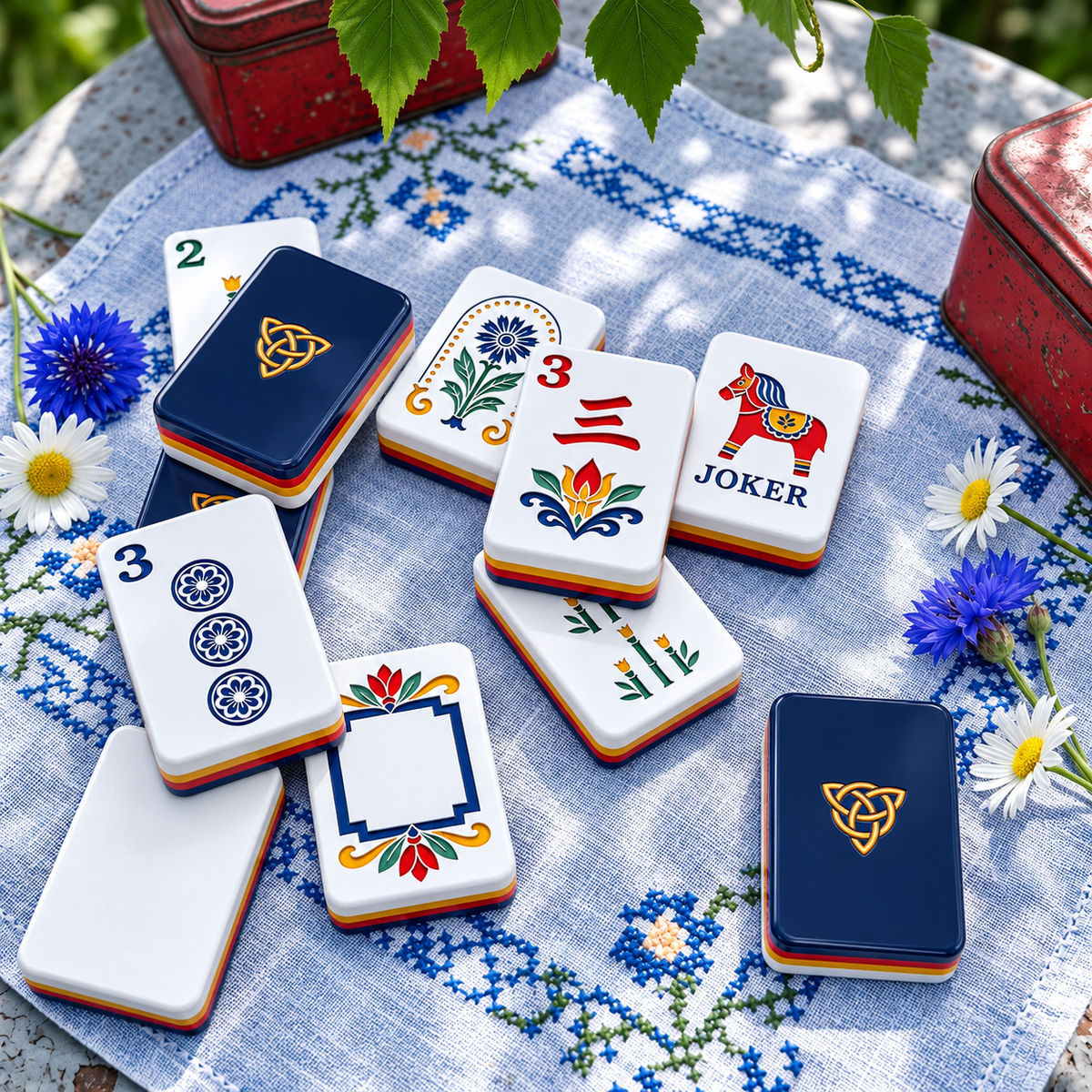
In Riichi mahjong, dora are specific bonus tiles that multiply your hand's point value. After the wall is broken, the dealer's team flips an indicator tile face-up; the tile that comes immediately after it in sequence (cyclically through winds, dragons, and suit numbers) is the dora. If you're holding that tile when you win, each copy adds bonus points—typically 1 dora = +1 fu (minipoint). Hidden dora may also be revealed after a Riichi declaration. Dora exist nowhere in American mahjong, which uses a fixed yearly hand card and jokers instead. In Riichi, dora create volatility: a hand with three or four dora tiles can suddenly be worth double or triple points. Learning to track dora during play is essential for competitive Riichi; casual players often learn it through repeated games rather than memorization.
What exactly is an indicator tile, and how do I find the dora?
The indicator tile is revealed by the dealer's team after the wall is broken. Count one tile forward in the sequence—winds go East → South → West → North → East (cyclical), dragons are Red → Green → White → Red, and numbered tiles go 1 → 2 → 3 → 4 → 5 → 6 → 7 → 8 → 9 → 1. The tile you land on is the dora. For example, if the indicator is the 5 of Bamboo, the dora is the 6 of Bamboo. If it's the White Dragon, the dora is the East Wind. This applies to every copy of that tile in your hand—three 6 Bamboo tiles = three dora.

Why does dora scoring matter more in competitive play?
Dora directly affect hand value without requiring melds or special patterns. In Riichi, a single dora can mean the difference between 2,000 and 4,000 points; four dora might push a hand from winning to earning a dealer bonus or special hand classification. Casual games may skip dora tracking entirely, but tournament play (including online platforms) mandates strict dora counting. Players who spot hidden dora (revealed after Riichi) after declaring win extra points—this mechanical twist rewards both luck and attention, separating casual from serious players.
How do hidden dora work after a Riichi call?
When you declare Riichi, the dealer's team flips another indicator tile, revealing additional hidden dora. Typically one to three hidden dora tiles are exposed, depending on house rules. These hidden dora apply the same sequence rule: count forward from each new indicator. If you win after Riichi, you collect points for both original and hidden dora. This mechanic creates high-stakes moments—players sometimes win massively on hidden dora they didn't even know were active, or lose an advantage if the hidden indicator works against their hand.
How does dora scoring compare to American mahjong hand values?
Aspect | American Mahjong | Riichi Mahjong |
Bonus tiles | Jokers (wild, never in pairs/singles) | Dora (specific tiles, stack multiplicatively) |
How scoring works | Fixed hand patterns from yearly card | Pattern + fu + dora + round bonuses |
Scoring ceiling | ~400–800 points per hand | 1,000–12,000+ points (dora can triple value) |
Variability | Low—hand card controls outcomes | High—dora + luck + player skill interact |
Learning curve | Moderate; memorize the hand card | Steep; track dora + fu + timing + hidden dora |
American mahjong hands are predetermined each year; your score depends on which hand you complete. In Riichi, the base hand structure matters less than fu (minipoints), dora count, and round position—the same pattern can be worth vastly different scores depending on dora luck and who won it.
What mistakes do new Riichi players make with dora?
Forgetting to count all copies: If you're holding three 5 Craks and the dora is the 5 Crak, you get three dora, not one. New players often count only the hand's primary tile.
Miscounting the sequence: The wind cycle and the numerical cycle both wrap; practice cycling through all 13 types (East to West, 1 to 9, Red to White) until it's automatic.
Ignoring hidden dora: Some casual players flip the hidden indicator but forget to apply it. In competitive play, missing hidden dora costs real points.
Not tracking dora during discard: Watching which dora tiles other players throw tells you if dora copies are still in the wall. This influences your hand-building strategy.
Assuming dora always helps: Sometimes the indicator lands on a tile no one wants; dora in a dead suit won't increase anyone's hand value that round.

How do you practice tracking dora if you're switching from American mahjong?
Start by playing casual Riichi games where dora are tracked but scoring penalties for miscounts are forgiving. Use a pencil and paper to record the indicator and the resulting dora at the start of each hand. After five to ten hands, most players internalize the sequence cycle. Online Riichi platforms (available free or paid) automate dora detection—playing there builds muscle memory without table pressure. When returning to in-person games, announce the dora aloud after each hand reveal so others can confirm you counted correctly.
🀄 Shop best-selling mahjong sets →
Riichi vs. American mahjong: which should I learn first?
If you live in a region where American mahjong clubs are active (common in Dallas, California, and the Midwest), starting there is practical—more players, easier-to-find weekly games, and no dora learning curve. American mahjong uses a fixed hand card each year, so new players don't need to memorize tile sequences or fu calculations. However, if you have access to a Riichi community or play online, Riichi offers more complex strategy and faster gameplay. Many serious players eventually learn both; dora knowledge doesn't hurt American players, and vice versa. The question isn't which is "better"—it's which community you can actually sit down with weekly.
Setting up for Riichi vs. American play: what equipment differs?
Riichi mahjong traditionally uses bamboo tiles with a slightly different visual hierarchy (bamboo suit symbols are clearer). American mahjong sets use acrylic tiles and always include a current-year hand card. If you're playing Riichi casually at home, you can use any standard 160-tile set with acrylic or bone tiles—the tile count and composition are nearly identical. The real difference is not the set itself, but the scoring pad, the rule reference (Japanese vs. National Mah Jongg League), and whether you track dora visually. For hosting either variant, a sturdy mahjong mat is essential; it protects tiles and keeps the wall organized so indicator and hidden dora can be flipped cleanly.
🎁 See our most-loved mahjong sets & accessories →
What to check before you buy a set for Riichi play
Tile durability: Riichi games move faster than American games; tiles get shuffled and drawn more frequently. Look for reinforced acrylic or bone tiles that won't crack.
Indicator clarity: Make sure the indicator tile can be seen from all seats. A mat with a clear wall zone helps.
Spare tiles: Riichi play doesn't add extra jokers or blanks like American does, but having spares prevents delays if a tile cracks mid-game.
Tile size: Standard Riichi tiles (roughly 1.3 × 1 inch) fit Western hands comfortably; confirm dimensions match your reach and table space.
Language on tiles: Riichi sets show Japanese characters; American sets use English-language suits and numbers. If you're switching between variants, a bilingual or unmarked set (with symbols only) works for both.
Most best-selling acrylic sets sold in the US work fine for casual Riichi play, though tournament players prefer bone or ceramic tiles for weight and tradition.
✨ Find your Mahstead set — free US shipping →
Dora as a teaching moment: why Riichi appeals to strategy lovers
Dora introduce controlled randomness—the indicator is public, visible to all players, yet individual luck still decides who holds the dora tiles. This is why competitive Riichi attracts players who enjoy probability and hand management. In American mahjong, the hand card is fixed and public, so strategy revolves around tile timing and discard reading. In Riichi, you must balance pursuing a basic winning hand against the hope of drawing dora copies—a psychological game within the tile game. Understanding dora mechanics teaches you to embrace uncertainty as part of skill. New Riichi players often feel frustrated by dora variance; experienced players learn to calculate expected value and play accordingly.

FAQ
Can I play Riichi mahjong on an American mahjong mat?
Yes. Mahjong mats are universal—they protect tiles and provide a wall zone for any variant. The mat doesn't enforce rules; players do. Make sure the wall area is clear enough to flip the indicator tile visibly.
If the indicator tile is a 9, is the dora a 1 (wrapping around)?
Yes. Numbered tiles wrap: 9 → 1. Winds wrap: North → East. Dragons wrap: White → Red. Always count forward one step cyclically through each suit or honor grouping.
Do I count dora in my hand only, or do other players' dora count too?
Only your hand counts. If another player wins with dora you were holding, their dora doesn't affect your score—you simply lose. Dora is personal to the winning hand.
What if I'm holding the indicator tile itself—is that a dora?
No. The indicator tile is never the dora. Count forward one step from the indicator. The indicator stays face-up on the wall table; it doesn't move into your hand.
Can I use the same 160-tile set for both American and Riichi mahjong?
Yes, functionally. American play uses exactly 152 tiles plus 8 jokers; Riichi uses the same count but no dedicated jokers (wild tiles). The tile counts match. However, American sets have English suits; Riichi sets have Japanese characters. A standard acrylic set labeled in English works for Riichi if you know which tiles represent which suits.
How many dora can I possibly have in one hand?
Typically up to four—one indicator tile per round. In some house rules or special conditions, multiple indicators may exist, but standard play offers one dora and up to three hidden dora, totaling four maximum. A hand with four dora of the same tile (impossible) would win with four copies, multiplying points dramatically.
Does the dora system exist in Hong Kong or Chinese mahjong?
No. Hong Kong and Chinese mahjong use different winning hands, melds, and scoring entirely. Dora is specific to Japanese Riichi mahjong. American mahjong has no dora equivalent. Each variant is mechanically distinct.


View More
View More
View More
