
Daisangen in Riichi Mahjong Explained
Last updated: Nov 23, 2026
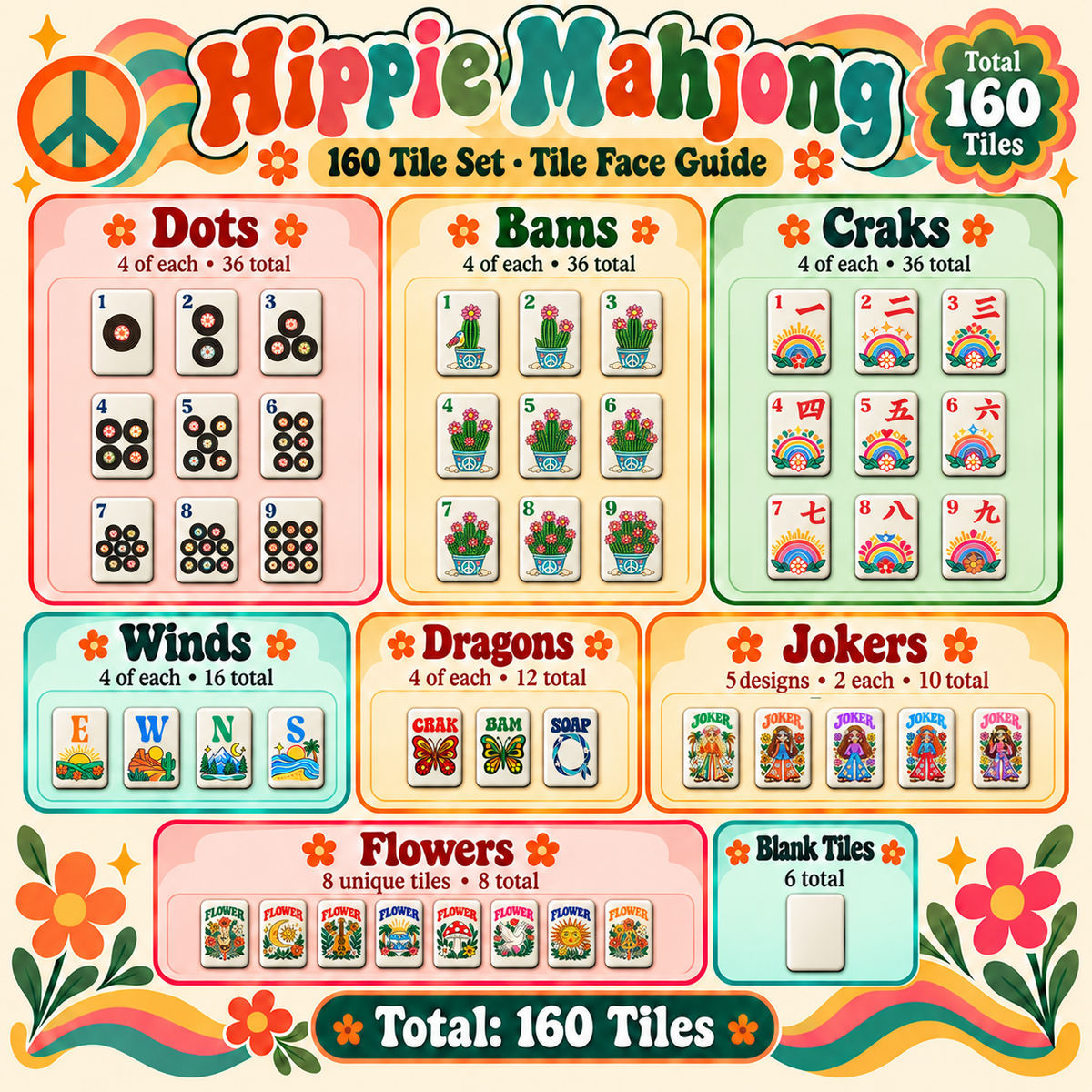
Daisangen (大三元, "big three dragons") is a scoring hand in riichi mahjong featuring all three dragon tiles (Red, Green, White). It ranks high in points and is a yakuman hand when completed—meaning it wins immediately with maximum points, typically 8,000 points for the dealer or 4,000–8,000 for non-dealers depending on ruleset and winning tile source. It differs fundamentally from American mahjong: riichi uses a 136-tile set (34 tiles × 4), allows chows (sequences like 1–2–3), and plays from a constantly drawn single tile, not a pre-made card of hands. Daisangen appears only in certain rulesets (Tokyo, Osaka, Shogi Association rules) and is worth learning if you play Japanese riichi or mixed-variant groups.
What exactly is daisangen and how do you build it?
Daisangen requires three separate melds (exposed groups): one pung or kong of Red Dragons, one of Green Dragons, and one of White Dragons. Each pung is three identical tiles; a kong is four. You may also complete daisangen in your hand (closed hand) without exposing any melds, which earns a bonus multiplier called a "dora" effect. For example: you might call Red Dragon (pung) from an opponent's discard, then later receive Green Dragon (pung) from another discard, then draw the final White Dragon (kong) yourself. The moment all three melds are complete and you win the hand (by drawing or calling a tile that completes your winning set), daisangen scores immediately—you do not need to wait for other players or count further points.

How does daisangen score compared to other yakuman?
In most riichi rulesets, daisangen is a single yakuman, worth 8,000 points if you are the dealer (east wind) or 4,000 points from each of the three other players if you are non-dealer (west, north, or south). One yakuman = one baseline; some hands like kokushi (terminal and honor tiles only) or suuankou (four hidden pungs) are also single yakuman and score identically. If you combine daisangen with another yakuman (for example, by winning daisangen while also meeting the conditions for "tanyao," an all-simples hand), the score doubles or triples depending on ruleset—this is called "yakuman stacking" or "renrakuyakuman." In contrast, American mahjong has no yakuman; the highest hand on the annual National Mah Jongg League card typically scores 70 or 80 points, and American tiles come from how to read the mahjong card, not from constant draw play.
Why is daisangen risky to pursue?
Because daisangen requires three separate melds and dragon tiles are relatively rare in a 136-tile riichi set, you often signal your intent to other players by calling (or claiming from the discard pile) your first or second dragon. Skilled opponents will then avoid discarding the third dragon, blocking your win. You may spend many rounds setting up daisangen only to have your strategy disrupted. Additionally, if your hand is incomplete and no yakuman path opens, you fall back to scoring ordinary hands (often low-value ones like "tanyao" or "pinfu," worth 2,000–4,000 points). The opportunity cost is high: abandoning a safe 2,000-point hand to chase daisangen that never materializes leaves you with 1,000 points or nothing. Veteran riichi players weigh the board state (which dragons have been discarded already, how many rounds remain, dealer status) before committing to daisangen.
How does daisangen differ across regional riichi rulesets?
Riichi mahjong has several ruleset families: Tokyo rules (the most widespread), Osaka rules (faster gameplay, fewer yakuman), Shogi Association rules (tournament standard), and others. Daisangen is recognized as a yakuman in Tokyo and Shogi Association rules; in some Osaka variants, it may score as a lower-value hand or be absent entirely. Online platforms like Tenhou and Mahjong Soul (which use Tokyo rules) include daisangen as standard. When joining a riichi game, always confirm the ruleset before play—ask "Which scoring do we use?" If the group plays American mahjong (using our best-selling mahjong sets and the current year's National Mah Jongg League card), daisangen does not apply; American mahjong has no dragons in the traditional sense and uses entirely different tile distributions and hand categories.

What's the best strategy for daisangen in mixed or practice games?
In casual riichi play, daisangen is a teaching hand: learning to recognize it builds tile awareness and hand-reading skills. To pursue daisangen safely: (1) note which dragons have been discarded early—if two dragon types are already gone, abandon the pursuit; (2) keep at least one fallback hand path open (e.g., a half-built tanyao or simples hand) so you score if daisangen fails; (3) only call dragons if the hand is already halfway built or if you are dealer and the board favors aggression; (4) in the last two rounds, fold into a defensive posture unless daisangen is nearly complete. When hosting riichi games, clarify the ruleset aloud at the start—many players mixing American mahjong and riichi get confused about tile counts, melds, and yakuman. If your group is learning, use a printed ruleset guide or reference app to avoid disputes.
Factor | Daisangen | Other Yakuman (e.g., Kokushi) | Low-value Riichi Hand |
Tiles needed | 3 dragon pungs/kongs | 13 terminal/honor tiles, one pair | Variable; e.g., 3 pungs + pair |
Base score (dealer) | 8,000 | 8,000 | 1,000–4,000 |
Vulnerability | High (opponents block dragon discards) | Medium (harder to read intent) | Low (safe, quick) |
Setup time | 3–6 rounds | 4–8 rounds | 1–4 rounds |
Best board state | Early/mid-game, not dealer | Any | Any |
🀄 Shop best-selling mahjong sets →
What materials do riichi players need, and how do they differ from American sets?
Riichi mahjong uses 136 tiles (not 152 or 160 like American sets), including two extra flower sets in some versions. Tiles are traditionally bamboo, bone, or plastic; red and green tiles are typically marked with symbols (not numbers) in traditional packs. Many riichi players prefer sets with small-print tile numbers for fast reading during rapid play. If you're hosting riichi games and want engraved American mahjong sets to sit alongside riichi tiles for flexibility, label them clearly—the tile counts and hand structures are incompatible. A quality mahjong mat designed for four players works for both American and riichi play; what differs is the tile set itself.
🎁 See our most-loved mahjong sets & accessories →
What to check before you buy or play riichi sets with daisangen rules
Before ordering or joining a riichi group, verify:
Ruleset: Ask "Do we play Tokyo, Osaka, or Shogi Association rules?" Daisangen is standard in Tokyo and Shogi Association but may be absent in Osaka.
Tile count: Confirm the set has 136 tiles (riichi standard), not 144 or 152 (which are non-standard or American).
Printed reference: Have a yakuman list or rulebook visible during your first game—daisangen rankings and scoring vary subtly.
Player experience: In beginner groups, daisangen may be house-ruled differently; clarify scoring before the hand begins.
Language: If using a non-English ruleset, confirm translations with the group leader.
✨ Find your Mahstead set — free US shipping →

FAQ
Is daisangen the same in all riichi mahjong rulesets?
No. Daisangen is a yakuman in Tokyo rules (most common) and Shogi Association rules, but some Osaka variants omit it or score it lower. Always confirm your group's ruleset before play.
Can I build daisangen closed (unexposed) for bonus points?
Yes. A fully closed daisangen (tsumo—self-drawn win) earns an additional "dora" or multiplier, typically doubling or tripling the 8,000-point base. Check your ruleset for exact bonuses.
How do I avoid losing to daisangen if another player is pursuing it?
Keep track of which dragons have been discarded. Once two dragon types are in the discard pile, stop discarding the third type. On offense, avoid signaling your dragon pursuit—claim dragons only when confident in the hand.
What's the difference between daisangen and the dragon tiles in American mahjong?
American mahjong uses 12 dragon tiles total (4 Red, 4 Green, 4 White/"Soap") in a 152-tile set, but dragons are just one tile type in a hand—there is no "daisangen" hand category. Riichi mahjong's daisangen requires three separate melds of all three dragons and is scored as a yakuman. The games are fundamentally different.
How long does it usually take to complete daisangen?
Typically 3–8 rounds, depending on how many dragons are discarded early. If both other dragon types hit the discard pile, you abandon daisangen and pivot to a backup hand. In tournament play, daisangen is rare—most hands score as lower yakuman or ordinary patterns.
Can I play riichi mahjong on a mat designed for American mahjong?
Yes, but you'll need a 136-tile riichi set, not an American 152-tile set. The mahjong mats and racks with pushers work for both games—what differs is the tile set. Riichi tile distribution and hand categories are incompatible with American tile counts.
Does daisangen count as "big three" if some melds are in my hand (closed)?
Yes. A fully or partially closed daisangen still counts as daisangen; the closed melds often earn a bonus multiplier. Only the final winning tile must be called or self-drawn; the preceding dragon melds can be hidden.


View More
View More
View More
