
Common Mistakes in Cantonese Mahjong — and How to Fix Them
Last updated: Nov 23, 2026
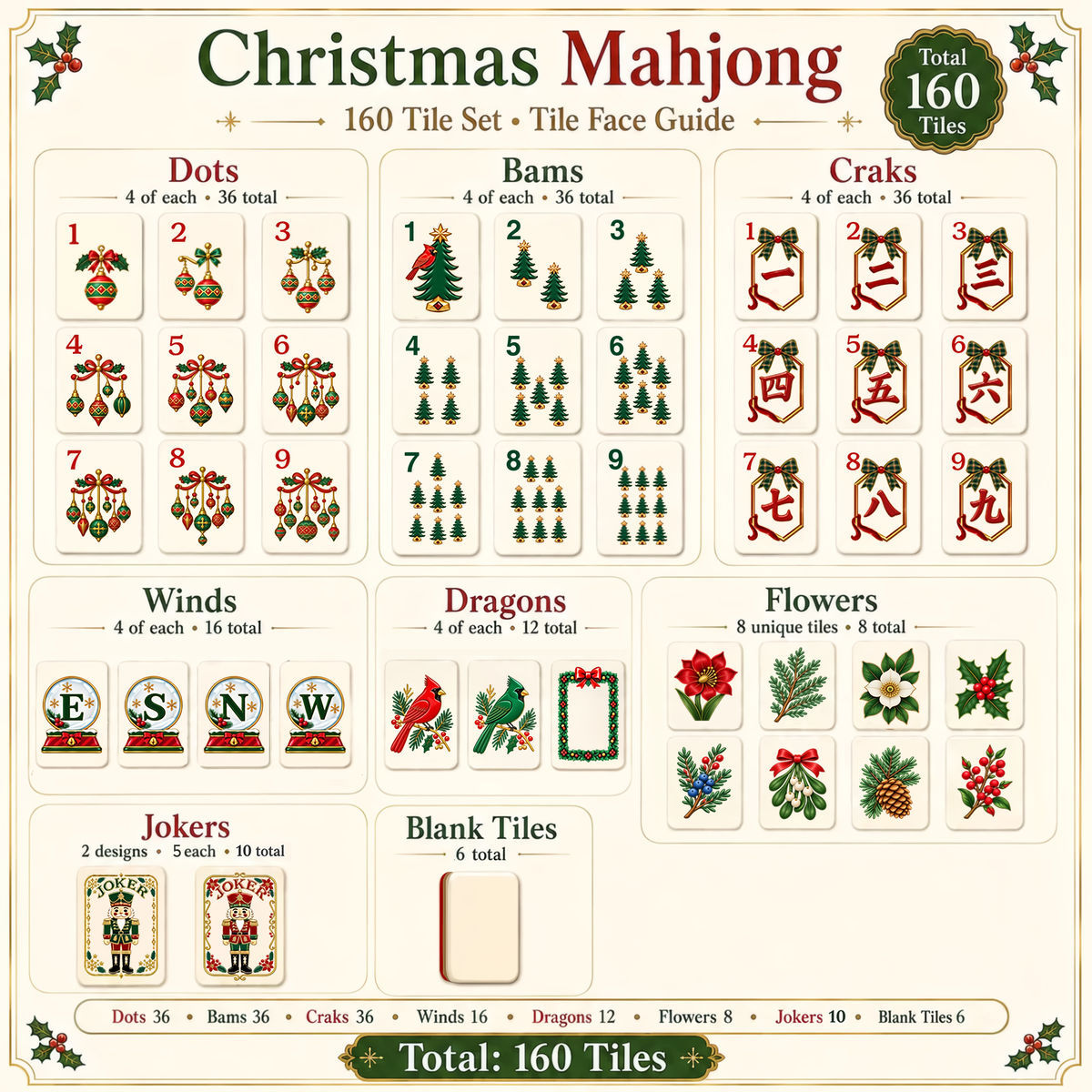
Cantonese mahjong (also called Hong Kong mahjong) lets you form chows (1–2–3 sequences) and expose them mid-game, play melds flexibly, and score by fan (multiplier tiers), not fixed hands from a card. It uses 144 tiles (no American flowers or jokers), plays with four players, and rewards fast adaptation over rigid hand-matching. The biggest mistakes: calling a winning tile too early and leaving the table open, exposing chows when they trap you, misreading fan calculations, and not tracking discards. Cantonese players often switch to American expecting the same speed and exposure freedom, then botch the American rule that chows don't exist and only specific hands on the current year's card can win. If you play both variants, our best-selling collection includes sets designed by players who host both games and need tile clarity under pressure.
Why do players expose melds too early in Cantonese?
In Cantonese play, exposing a pung, kong, or chow signals your intent but doesn't lock your hand. Many players expose greedily because Cantonese rewards visible pressure—drawing from the wall stays open longer. The mistake: once you expose, other players see your strategy and discard away from your likely win pattern. Exposing a chow of 3–4–5 Bams early broadcasts "I'm building a suit," and everyone starts withholding middle-rank tiles. Hold exposures until the final stages or use them tactically to block an opponent, not to build early. Only expose when you're genuinely close to winning or when the exposure stops a dangerous hand.

What's the biggest scoring error in Cantonese mahjong?
Fan calculations trip up Western players most. A hand's score multiplies by fan tier: 1 fan = base points, 2 fan = double, 3 fan = triple, and so on. Many players confuse "having a pung" with "having a fan"—a pung is just three identical tiles, not a scoring element on its own. In Cantonese, fan comes from specific combinations: all one suit (1 fan), pung of 5s or 6s (1 fan per pung), or terminal/honor tiles in your melds (1 fan each). American players accustomed to matching hands line-by-line on a card often forget to tally the entire hand's fan structure, not just count visible melds. Write down each fan source before agreeing to the total; disputes evaporate.
How does calling winning on another player's discard differ from self-drawn?
In Cantonese, calling on a discard (ronning) pays less than drawing your winning tile from the wall (tsumo). Many players forget this and pay/collect at the same rate, creating scorekeeping chaos. Typically, self-drawn pays double or more because the wall is "public" luck while a discard is personal fault. When someone discards carelessly into your hand, they pay higher. When you draw lucky, everyone chips in equally. Beginners often call "mahjong" on a discard, collect the discard player's full payment, and then argue—always clarify before the discard is touched whether it's a legal win and which pay tier applies. House rules vary; agree at the start of the session.
Why can't new players adapt from Cantonese to American mahjong?
The shift breaks because American has no chows and no flexible melds. In Cantonese, a 2–3–4 sequence melts into your hand and can pair with your other tiles. In American, chows don't exist at all—every meld must be a pung (3 identical), kong (4 identical), quint (5 identical), or sextet (6 identical). This forces American players to think in rigid blocks, not fluid runs. New Cantonese players see an American mahjong set and immediately hunt for sequences, then feel lost when none fit the card. American hands are pre-drawn each spring by the National Mah Jongg League; you match exactly, not build your own. Learning how to read the card solves this in one session—the card is your rulebook, not your suggestion.
How does discard tracking prevent costly mistakes in Cantonese?
Every tile that hits the table tells a story. If three 7 Dots have been discarded and you hold a 7 Dot, the fourth is in someone's hand—they won't discard it. Most Cantonese players keep mental track, but in American, jokers and blanks hide tiles, so tracking becomes even harder. New players forget that a discarded 1 Bam (the bird) is gone forever; they keep waiting for it and waste turns. Write discards in a line or grid so the table sees what's floating—this cuts arguments and keeps the game honest. A pen and paper near the mat costs nothing and saves minutes.
Quick Decision Table: Cantonese vs. American Mistake Patterns
Mistake | Cantonese Games | American Games | How to Prevent |
Exposing too soon | Blocks your own path | Not applicable (exposure rules differ) | Hold exposures until final two rounds |
Miscalculating fan | Loses money instantly | Doesn't apply; scores are fixed per card | Tally fan aloud before payout |
Calling on discard vs. self-drawn | Wrong payout tier | Not applicable; fewer win routes | Clarify pay rules before session starts |
Forgetting chows don't exist (American) | Doesn't apply | Builds wrong hand patterns | Spend 10 min. reading the card before play |
Losing track of tiles | Reduces odds, wastes draws | Allows opponents to predict your next move | Keep a discard grid visible to all |

What to Check Before You Play
Confirm the ruleset — Cantonese, Hong Kong, or American? Rules differ sharply; don't assume.
Review fan tiers or card sections — spend two minutes aloud so everyone agrees.
Agree on exposure timing — does your table expose pungs immediately, or hold until close?
Set payout tiers — discard win vs. self-drawn, and how much each multiplier increases the pot.
Assign a scorekeeper — rotates each hand; one person writes all points.
Set a discard grid — pen and paper visible to the table; track every tile played.
Test tile visibility — if your set feels slick or tiles are hard to read, switch sets mid-session; clarity prevents accidents.
🀄 Shop best-selling mahjong sets →
Playing Both Cantonese and American in One Week
Many of us rotate between variants—Cantonese Friday night, American Sunday brunch. The cognitive shift is real. Your brain retrains in one play session, but muscle memory lingers. Here's what helps: set the variant name aloud before tiles are drawn. Use different mats or set covers for each (Cantonese games often use simpler graphics, while American sets benefit from clear tile markings and larger pips for quick card-reading). Keep a laminated card rule summary near the mat—one page for Cantonese fan, one for American hand structure. Experienced players call out "chows aren't valid here" when a newcomer fumbles an American sequence; normalize the teaching. After ten rounds in one variant, switching becomes automatic again.
🎁 See our most-loved mahjong sets & accessories →
Why Tile Clarity Matters More in Cantonese
Cantonese play rewards speed. You draw, you see a tile, you meld or discard within seconds. If your tiles blur or the suit symbols (Bams, Craks, Dots) aren't crisp, you make mistakes under pressure. Misreading a 3 Bam as a 3 Crak costs points and burns time while everyone recalculates. Engraved sets with large, deeply etched pips and clear suit colors eliminate this friction. We've replaced sets mid-game more than once because tiles were too slick or symbols too faint; swapping to a readable set saved the afternoon. American games are slower and more deliberate, so players tolerate softer markings longer—but if you play both, invest in a set that works fast for Cantonese and clear for American. A good mat with a pushable rack also keeps tiles organized when play accelerates.
The Exposure Tightrope
In Cantonese, exposing shows strength and risk simultaneously. A exposed chow says "I'm moving toward this suit," but every opponent adjusts. Inexperienced players expose because it feels like progress; experienced ones expose to bait discards. If you expose 2–3–4 Bams, opponents stop discarding 1s and 5s Bams (safety), but they also assume you're not collecting Craks (you become a discard target for Crak-builders). Younger Cantonese players often over-expose early and run out of hidden options by mid-game. The fix: expose only pung-heavy hands early, and chows only when you're within one or two tiles of winning. This keeps opponents guessing and leaves your real strategy hidden. Scoring and timing matter equally in Cantonese; raw speed loses to smart pacing.
American Rule Traps When You Know Cantonese Too Well
No jokers in pairs or single tiles. In Cantonese, jokers are interchangeable wild cards. American jokers are not—they can only substitute within a pung, kong, quint, or sextet, never form a pair or stand alone. A pair of jokers is an instant dead hand. No chows ever. You cannot call or expose 1–2–3 anything. If your Cantonese brain screams "that's a chow!", stop—it doesn't win. Hands come from the card only. You don't build a hand; you match one on the current year's card. The card is law. Exposures lock the hand. Once you expose in American, that meld is final; no rearranging later. In Cantonese, you rearrange constantly. Spend time on the American card before your first game; one player teaching three new ones often causes confusion that ruins the afternoon.
✨ Find your Mahstead set — free US shipping →

FAQ
Can I play American chows if I expose them early?
No. American mahjong has no chows—not exposed, not hidden, not at any stage. Every meld is a pung, kong, quint, or sextet of identical tiles. Chows are exclusive to Cantonese, Hong Kong, and Chinese variants.
What happens if I call "mahjong" on a discard but the tile doesn't complete my hand?
In most Cantonese games, you pay a penalty (often double the hand value) and your hand is dead. In American, you're simply not mahjong; the tile passes to the next player. Always verify your hand before calling.
Why is tracking discards harder in American than Cantonese?
American uses jokers and blanks as wild substitutes, so a discarded tile doesn't guarantee its fourth copy is still in play. Cantonese has no jokers, making discard tracking more reliable and faster.
Can I rearrange my melds after exposing them in American?
No. Once exposed in American, a meld is final. In Cantonese, you rearrange melds freely. This is one of the hardest mental shifts between variants.
Do fan calculations exist in American mahjong?
No. American uses fixed hand patterns from the yearly card; each hand has a set score, not a multiplier tier. Cantonese scores by fan (multipliers). The scoring systems are completely different.
If I misread a tile symbol, whose fault is it?
Typically, yours—if you play it and it's wrong, the game resets and you're penalized. Prevent this by using a set with clear, large pips and reading tiles aloud before you discard or meld.
How do I know which variant my local group plays?
Ask directly before showing up. Community centers, libraries, synagogues, and country clubs often host one variant exclusively; mixing causes chaos. Many groups post house rules online or on meetup boards.
Can I use the same mahjong set for Cantonese and American games?
Yes, if the tiles are readable. Cantonese rewards speed, so clarity matters more. American is slower, so even softer markings work—but a high-clarity set serves both beautifully.


View More
View More
View More
