
Classical Chinese Mahjong: Rules, Tiles & How It Differs from American
Last updated: Nov 23, 2026
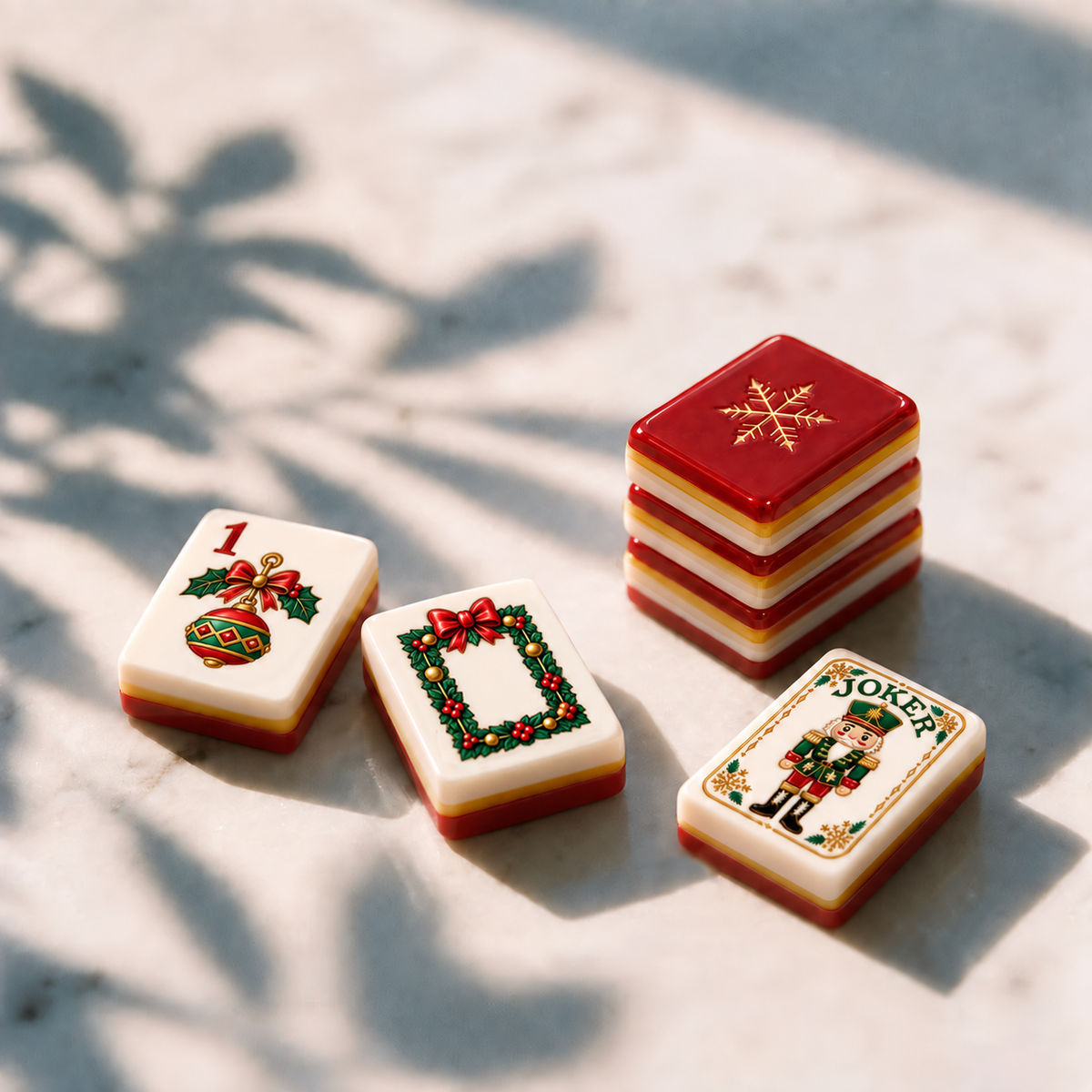
Classical Chinese mahjong uses 144 tiles: three suits (Bams, Craks, Dots) numbered 1–9 in four copies each, plus 16 winds, 12 dragons (typically honor tiles), and 8 flowers. Play centers on forming three-tile sequences (chows) alongside pungs (triplets) and a pair—no jokers or American card-based hands. A game typically lasts 4–8 rounds and plays with exactly 144 tiles, no spares. The goal is "going out" (declaring mahjong) with a complete 14-tile hand; the mechanics are strategy-driven rather than card-dependent. While American mahjong adopted the tile set and passing ritual (Charleston), classical Chinese mahjong retains sequences, honor-tile scoring systems, and a more fluid game structure unbound by yearly hand cards. Sets vary widely in material and artwork; our best-selling mahjong sets include variants suited to both traditions.
What tiles does classical Chinese mahjong actually use?
Classical Chinese mahjong begins with the same 144-tile foundation: 36 tiles in each of three main suits (Bams, Craks, Dots), numbered 1 through 9, with exactly four copies of each number. Beyond the suits, you get 16 wind tiles (four each: North, East, West, South), 12 dragon tiles (four Red, four Green, four White), and 8 flower tiles (sometimes substituted with seasons). No jokers exist in classical Chinese play—every hand is built from these 144 tiles alone. The 1 Bam displays a bird; the White dragon is often called the blank or "Soap" tile. This tile count and composition differs sharply from American mahjong, which adds jokers and uses a yearly card to dictate legal hands. When you're learning classical Chinese mahjong, the first mistake is assuming jokers matter—they don't in classical play.

How does going out work in classical Chinese mahjong?
In classical Chinese mahjong, "going out" (declaring mahjong) means assembling a complete 14-tile hand: four melds (each three or four tiles) plus one pair. Melds come in two forms: a pung (three identical tiles) or a kong (four identical tiles) from the same suit or honors, and a chow (three consecutive tiles from one suit only—for example, 3–4–5 Bams). You cannot make a chow from wind tiles, dragons, or flowers; those honor tiles form pungs and kongs only. You draw one tile per turn and discard one, keeping exactly 13 tiles in hand until you draw the 14th tile that completes your mahjong. The hand does not come from a pre-printed card like American mahjong; instead, you declare any valid combination. Many hands include scoring bonuses for all-honor melds, all-pung hands, or mixed-suit patterns—scoring varies by regional rule set (Hong Kong, Taiwanese, Singaporean, Cantonese, etc.).
What's the key difference: chows in classical vs. American mahjong?
Classical Chinese mahjong allows chows (sequences)—they are the backbone of hand-building. American mahjong does not allow chows at all; you can only declare exposed pungs, kongs, quints (5-tile runs), and sextets (6-tile runs), and those are built from identical tiles only, never sequences. In classical play, a chow like 4–5–6 Craks is as valid as a pung of 4–4–4 Craks; both count toward your final hand. This single rule creates a vastly different strategic landscape: classical play emphasizes rapid tile combinations and reading the discard pile for opponents' patterns, while American mahjong rewards card memorization and tile-pairing logic. If you transition from American to classical, the hardest habit to break is resisting the urge to treat three consecutive tiles as anything meaningful—in American play, they mean almost nothing.
Do classical Chinese variants play differently from each other?
Yes. The three most widespread classical variants—Hong Kong, Taiwanese (also called Shanghai), and Cantonese—each have distinct scoring systems, bonus rules, and winning hand structures. Hong Kong mahjong typically emphasizes specific hand patterns (called "melds") and includes "limit" hands that pay maximum points; Taiwanese mahjong adds more complex scoring with multipliers and rarely allows scoring bonus combinations in the same hand; Cantonese (Guangzhou) mahjong is faster-paced, allows more winning patterns, and often permits declaring mahjong on a draw or a discard from any player. Singaporean, Vietnamese, and Japanese Riichi variants add further rules—Riichi, for instance, introduces a "ready" declaration and a betting system. None of these variants use jokers or a yearly hand card. If you're buying a classical set, check whether the seller specifies regional play rules; they're essential for teaching newcomers the right way.
Variant | Signature Feature | Scoring System | Chows Allowed? | Typical Game Length |
Hong Kong | Fixed winning patterns, limit hands | Points + limit multipliers | Yes | 4–8 rounds |
Taiwanese | Complex multiplier chains | Multiples of base score | Yes | 4–8 rounds |
Cantonese | Fast, loose patterns | Simple per-hand points | Yes | 2–4 rounds |
Riichi (Japan) | "Ready" declaration, betting | Meld-based points + riichi fee | Yes | 1–4 rounds |
American | No chows, yearly card required | Strictly by card hand only | No | 1 round (4 players) |
Choosing a variant depends on your group's learning curve and available teaching resources; Hong Kong and Taiwanese are easiest for Western learners because English rulebooks are widely available online.
How does the turn structure differ from American mahjong?
Classical Chinese mahjong play unfolds turn by turn: one player draws from the wall, declares any melds (exposed on the table for points or strategy), discards one tile face-up, and passes play to the next player. Any player can "win" off another player's discard if it completes their hand—this is called "robbing the kong" in some variants (claiming a tile meant to replace a kong draw). In American mahjong, you draw from a rack of 13 tiles and must wait for your turn to discard; only after the Charleston is complete and the wall is built do you begin drawing from the wall. American play also has strict calling rules: you can only declare an exposed pung, kong, quint, or sextet on your turn or when another player discards directly into your hand. Classical play is more permissive; multiple players can claim a single discard if they can use it for a chow or pung, though only one gets it (priority rules vary by region). This fluidity makes classical mahjong feel faster and more reactive than American.

What scoring and bonuses appear in classical Chinese mahjong?
Scoring in classical mahjong depends on the regional variant, but common bonuses include: all-pung hands (no chows), all-honor hands (only winds and dragons), self-drawn tiles (you drew the winning tile yourself), all-simples (only numbered tiles 1–9, no honors or terminals), and "flowers" or seasonal bonuses. Each hand also has a base value—often 1 point or 2 points—multiplied by the number of "faan" (doubles or multipliers) it earns. A hand with three doubles is worth four times the base; a hand with five or more doubles is a "limit" hand worth a fixed maximum payout (this rule is prominent in Hong Kong play). Winning on your own draw typically pays all three opponents full value; winning on an opponent's discard means that player pays you double and the others pay single. In American mahjong, scoring is only from the yearly card and involves point values assigned to each hand type. These differences mean a classical player cannot use American scoring logic, and vice versa—always clarify which system your table uses before the game begins.
What mistakes do beginners make when learning classical Chinese mahjong?
The most common beginner errors: (1) forgetting that honor tiles (winds, dragons, flowers) cannot form chows—they only make pungs or kongs; (2) discarding high-value tiles too early because they don't recognize opponents' winning patterns; (3) holding onto terminals (1s and 9s) as "safe" discards when experienced players use them to build legitimate hands; (4) failing to count how many of each tile have been discarded, making it impossible to calculate hand probability; (5) declaring a hand too early when one more turn would yield a bonus hand worth far more points; (6) misunderstanding regional bonus rules—for example, assuming a hand works in Hong Kong mahjong when it's only valid in Taiwanese. To avoid these, spend your first 5–10 games as an observer, writing down every hand declared and noting which tiles were discarded in what order. Learn the scoring system of your chosen variant inside-out before joining live play. Study one variant deeply before switching; mixing Hong Kong and Taiwanese rules mid-session will derail your entire table.
🀄 Shop best-selling mahjong sets →
What do you need to host a classical Chinese mahjong game?
You need one best-selling mahjong set—classical Chinese mahjong requires exactly 144 tiles, so sets marketed for classical play will specify that count. You'll also want a sturdy mahjong mat to protect tiles during shuffling and to clearly mark the wall and player positions; a good mat prevents tiles from sliding and improves accuracy during the draw phase. Racks with pushers keep your hand organized and hidden from opponents, and pushers let you manage tiles without touching the wall—essential for fair play. A mahjong bag or case protects your set during storage and transport, especially if you host games at different locations. Paper scorecards and a pencil are mandatory—classical mahjong scoring compounds quickly, and mental math errors breed disputes. Some groups use a dice tower or bamboo dice to determine the starting wall; if your set doesn't include dice, you can purchase them separately. If you're playing Riichi or another variant with betting, you'll want chips or a dedicated currency; your rulebook will specify amounts.
How do you teach classical mahjong to beginners without confusion?
Start by teaching tile recognition: walk through the 144 tiles once, grouping them by suit and honor type. Spend 20 minutes on chow rules—the fact that only numbered tiles form sequences is non-negotiable. Then explain pung/kong rules (identical tiles only), the winning hand structure (four melds + one pair), and drawing/discarding mechanics. Next, teach one basic winning hand—all-pung, self-drawn—and play 1–2 practice rounds without scoring. Only after beginners can call a winning hand confidently should you introduce scoring and bonuses. Use a cheat sheet for your chosen regional variant; Hong Kong rules are simplest to start with. Play slowly; allow questions mid-turn. Avoid switching variants until everyone has played 10+ hands of the first one. If a beginner asks "Can I make this hand?", answer by reference to the written rules, not intuition. Disagreements resolve by rulebook—not by vote. This approach prevents the chaos of half-remembered rules spreading across the table.
🎁 See our most-loved mahjong sets & accessories →
What to check before you buy a classical Chinese mahjong set
Before purchasing, confirm the set contains exactly 144 tiles—many Western retailers mix up counts. Verify that the set includes wind tiles, dragon tiles, and flower tiles; some simplified sets omit flowers or use season tiles instead, which changes gameplay. Look for sets where tiles are clearly marked: Bam tiles should display dots (the bamboo suit), Crak tiles show characters (the suited symbol), and Dots are literally circles—unclear markings cause misidentification and slow play. Check whether the set specifies which regional variant it supports; a set sold for "classical Chinese mahjong" may include rulebooks for Hong Kong or Taiwanese play but not Riichi or Singaporean rules. If you're new to classical play, choose a set with thick, durable tiles that won't chip during shuffling—acrylic or high-quality bone sets last far longer than thin plastic. Inspect the bag or case; does it fit all 144 tiles plus mat, racks, and dice? A well-designed bag prevents tiles from tumbling loose during transport. Finally, ensure any included rulebook is in your language and specifies the regional variant; an English rulebook for Hong Kong mahjong won't teach you Taiwanese play.
✨ Find your Mahstead set — free US shipping →

FAQ
Can I use an American mahjong set to play classical Chinese mahjong?
No. American sets include jokers and extra tiles beyond 144, and jokers are forbidden in classical play. The tile count and composition must match exactly—144 tiles, no jokers. Buy a classical-specific set.
Which classical Chinese variant is easiest for American mahjong players to learn?
Hong Kong mahjong is most approachable because the hand patterns are relatively fixed and well-documented in English. Taiwanese mahjong involves more complex multiplier chains. Start with Hong Kong, then explore others.
Do I have to use the Charleston in classical Chinese mahjong?
No. The Charleston (passing tiles before play begins) is an American mahjong innovation. Classical Chinese mahjong builds the wall and begins drawing immediately. The Charleston is optional in casual classical games but not traditional.
What happens if two players declare mahjong on the same discard in classical play?
Priority is determined by regional rule and seating position. In Hong Kong mahjong, the player closest to the discarder (in turn order) wins; in Taiwanese play, the player one seat away has priority. Your chosen rulebook specifies priority exactly.
How long does a typical classical Chinese mahjong game take?
One round (one complete game cycle) typically takes 30–60 minutes for four players, depending on skill level and variant. Beginners may take 90 minutes. A full session is usually 4–8 rounds, lasting 2–6 hours.
Can I play classical Chinese mahjong with three players or two players?
Yes, but the rules change significantly. Three-player games omit one suit and adjust hand structures. Two-player games are uncommon and require substantial rule modifications. Always check your rulebook's variant for your player count; American mahjong has dedicated 2–3 player rules, but classical variants differ widely.
Is scoring the same in every classical Chinese mahjong region?
No. Hong Kong, Taiwanese, Cantonese, Singaporean, and Riichi variants each have distinct scoring systems, bonus rules, and payout structures. Choose one variant and master its scoring before switching to another—mixing them causes confusion and disputes.


View More
View More
View More
