
Easiest Mahjong Rules for Teens: American Game Setup & Play
Last updated: Nov 23, 2026
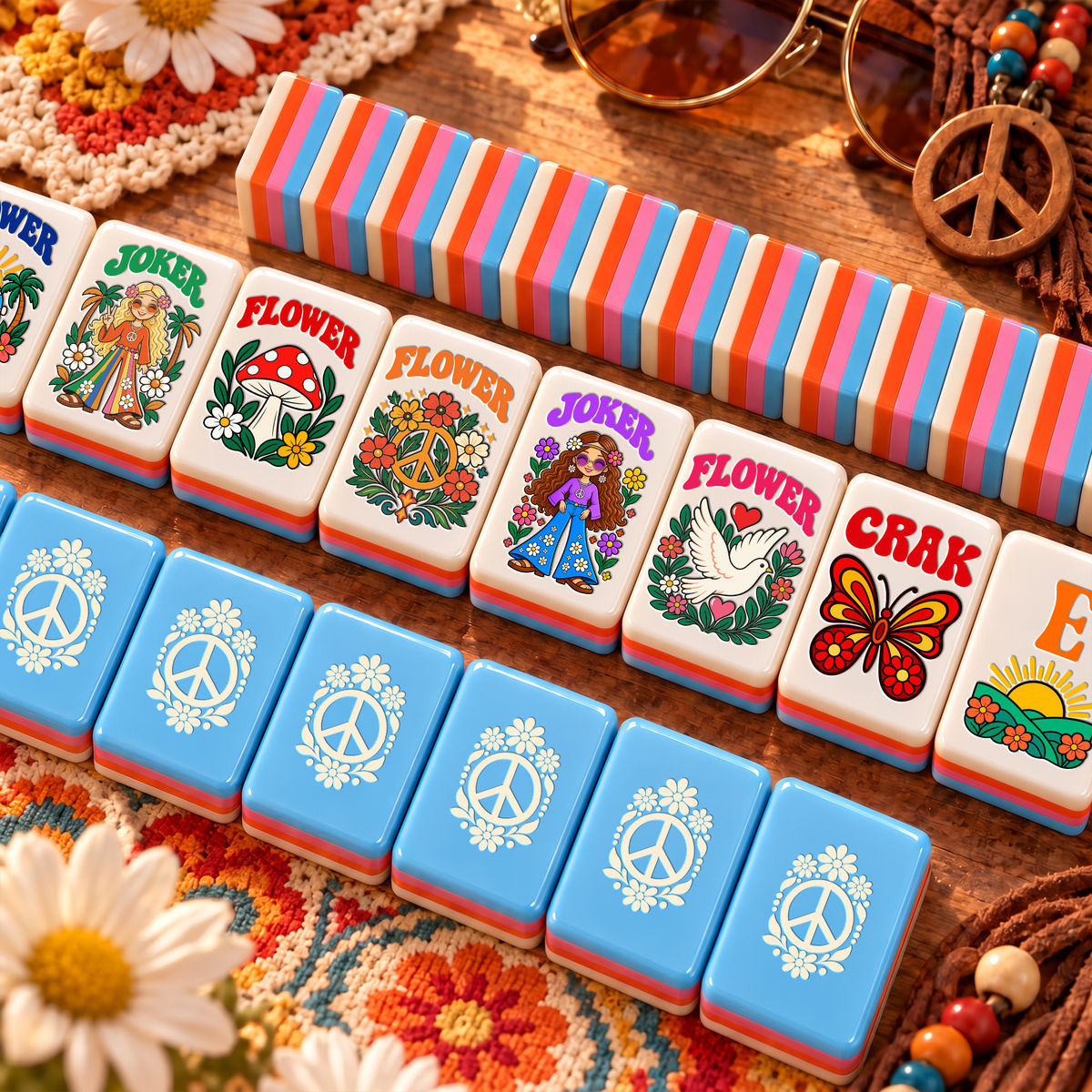
American mahjong uses 152 playing tiles (plus 8 jokers) and is designed around a card published every spring by the National Mah Jongg League—you only ever play hands listed on that card, which removes most guesswork. A four-player game lasts 10–20 minutes per hand; setup and Charleston (the tile-passing ritual) take about five minutes once you've played once. Unlike Chinese mahjong, American has no chows (sequences that "run")—you build only pungs (3 identical tiles), kongs (4 identical), or longer runs of the same tile number, plus one pair. Teens find this intuitive because the card does the thinking; you memorize your hand patterns, not abstract rules. Our best-selling sets come with clear tiles, racks, and pushers designed so tiles don't slide mid-game. The main barrier is learning to read the card fast—we'll show you how below.
What tiles are in a standard American mahjong set?
American mahjong has three number suits (Bams, Craks, Dots, numbered 1–9), winds (North, East, West, South), dragons (Red, Green, White), flowers, and jokers. Each numbered tile exists in four copies; you need all of them to play legally. The White dragon is special—it's called Soap and counts as zero. The 1 Bam usually shows a bird instead of a dot. A full playable game is always exactly 152 tiles plus 8 jokers; never add or remove tiles mid-game.

How does the Charleston work, and why?
The Charleston is the three-round tile-passing ritual before play starts—it's mandatory and prevents anyone from steering the game by sitting out. Round one: each player passes three tiles to their right neighbor. Round two: three tiles go to the left. Round three: three tiles go across the table. After that, each player draws one tile from the wall (the pile of unplayed tiles stacked in the center), and the game begins. The point is to randomize your hand and let every player rejoin the shuffled pool fairly.
What does the annual National Mah Jongg League card show?
The card (released each spring) lists every legal winning hand for that year—roughly 70–80 hands across four sections, each labeled by pattern and point value. Each hand is a specific combination: for example, "3 Bams, 4 Bams, 5 Bams + 3 Dots, 4 Dots, 5 Dots + Pung of Red Dragons + pair of East Winds." Because American mahjong allows jokers as wild tiles (except in pairs and single tiles), many hands can be made multiple ways. Teens quickly learn three or four hands in their "rotation" (the section of the card their position is playing that hand), so they don't need to read the whole card every time.
How do you actually read and play a hand from the card?
Pick a hand from your section. Let's say it reads: "3 Bam, 4 Bam, 5 Bam / 3 Crak, 4 Crak, 5 Crak / 2 Dot, 2 Dot, 2 Dot / pair Green Dragon." You need three tiles of each description. The "/" marks separate groups; each group is called a set (a pung, kong, or sequence). You can replace any tile in a set with a joker—except the pair cannot contain a joker, and you cannot use a joker as a single tile. Once you have all eight tiles touching your rack (or in your hand, if you prefer), you call "Mahjong!" and lay your tiles on the mat. Everyone scores based on the card's point value; highest score wins the hand. Jokers make hands easier—a teen often wins by using three jokers in the first hand they play.
What are the most common teen beginner mistakes?
Using a joker in the pair: The pair must be two identical tiles; jokers don't count. Confusing Bam, Crak, Dot symbols: The 1 Bam is a bird (not a dot); Craks are wheel/spiral shapes; Dots are circles. Spend two minutes on a physical set before you start. Passing the same tile back to the person who passed it to you during the Charleston: You're allowed to pass any tile; watch your neighbors' reactions and pass tiles they haven't been passing back. Drawing a replacement tile before announcing exposure: If you expose a pung or kong during play, someone else draws from the wall before you do. Not knowing which "rotation" position you hold: The card changes slightly based on whether you are player 1, 2, 3, or 4 (East, South, West, North). Ask the dealer (player 1) at the start.
Quick reference: hand-building checklist for your first five games
Do this | Why | What goes wrong |
Read the card section for your position before the Charleston starts | You'll recognize a hand when tiles land in your rack | You miss a win because you didn't know it was possible |
Count your tiles after the Charleston (you should have 13; dealer has 14) | An uneven hand means someone miscounted or passed wrong | Game proceeds with a hidden error; someone accuses another at the end |
Spot a pung or kong in your rack and tell the table immediately | Once exposed, you lock that set; opponents know what you have | You hide a pung, forget it, and try to use the same tiles later |
Keep joker tiles separate (face-up, to the side of your rack) | Everyone should see exactly how many jokers you have | Disputes over whether you "already used" a joker |
Call "Mahjong!" loud and clear, then lay tiles down | No ambiguity; the hand is witnessed and scored | Someone claims you miscounted or weren't actually done |
🀄 Shop best-selling mahjong sets →

What equipment makes it easier for teens to learn?
A set with large, clear tiles (acrylic or clay) beats plastic dice-sized ones—teens squint less and spot patterns faster. Racks with pushers are worth the small investment; they keep tiles from sliding sideways during the Charleston, which frustrates new players. A padded mat protects tiles and gives you a flat workspace so nothing rolls off the table. Printed cards (or laminated ones) are easier than phone apps—a teen can glance at the physical card while holding tiles. Our best-selling sets include racks and pushers; buying them separately often costs more.
Should a teen learn American, Chinese, or Riichi mahjong?
American mahjong (the focus here) is fastest to teach and hardest to screw up—the card is the rule book. One game takes 15 minutes. Chinese mahjong is faster to learn (fewer rules on paper) but requires memorizing 40+ hand patterns and winds; harder for beginners. Games last 30+ minutes. Riichi mahjong (Japanese) is the most complex and competitive—played in tournaments; suited for teens who want depth after mastery. We recommend American for a first game because the card removes ambiguity and kids feel like winners quickly.
Why do teens like mahjong more than poker or card games?
Mahjong has no bluffing—only pattern recognition and tile luck. Teens don't need to read opponents' faces or manage a poker face. Hands rotate; everyone gets the same number of turns and chances. A new player can win on their second hand. Games are loud and social; tiles clack, people call and laugh. The Charleston is funny and chaotic. No screens required (though scoreboards help). And unlike card games, you can't "fold early" and waste time; everyone stays in every hand.
✨ Find your Mahstead set — free US shipping →
How long until a teen can teach someone else?
After three or four hands, a teen can teach a beginner the basics: "Here's a pung, it's three of the same. Here's the pair—no jokers. Your section of the card is right there; find a pattern you have." Teens are often better teachers than adults because they didn't overthink it. The learning curve flattens fast. By game two, they're asking strategy questions (e.g., "Should I expose this pung now or wait?"). By game five, they're advising which tiles to pass during the Charleston.
What to check before you buy a set for your teen
Tile size: acrylic or clay tiles ≥0.75 inches wide (no tiny dice-sized plastic).
Racks included: essential for keeping the Charleston organized.
Pushers included: worth checking; some sets omit them, and buying separately is pricey.
Carrying bag or case: if your teen is bringing it to a friend's house or school, a padded travel bag or case prevents cracked tiles.
Joker count: all sets have 8 jokers; some include spares. Not critical, but nice.
Card included: always make sure a yearly National Mah Jongg League card is packed with the set. You can also buy cards separately.
For a deeper dive on the rules and hand patterns, see our complete American mahjong guide.
🎁 See our most-loved mahjong sets & accessories →

FAQ
Do jokers have to be used if they're in my hand?
No. Jokers are optional wild tiles. If a joker helps you complete a hand, use it; if not, pass it. You're never forced to expose or play a joker. Many new players hoard jokers early—that's fine, but remember jokers can't be in the pair or a single tile.
Can a teen win on their first hand of the game?
Rarely, but yes. If they're extremely lucky and draw the right tiles after the Charleston, and no one exposes sets in their hand (which locks them), they could draw one more tile and win. It happens maybe once every 20 games for a beginner, which makes it memorable and exciting.
What's the difference between exposed and hidden tiles?
If you call out that you have a pung or kong (three or four identical tiles), you turn those tiles face-up on the mat in front of you and everyone can see them—that's "exposed." Any tile still in your rack or hand is "hidden." Exposed sets are locked and can't be rearranged. Hidden tiles can be juggled until you call Mahjong.
How do I explain the card sections to a new teen player?
Tell them: "Your position on the card (1, 2, 3, or 4) has one section. In your section are about 15–20 hands you can make this year. You win by completing one of those hands. The card only shows hands for your position—you don't have to memorize the others."
Is it okay if someone at the table has played before and others haven't?
Absolutely. The returning player should be the dealer (player 1) and lead the Charleston so the pace stays even. One experienced player at a table of three teens actually speeds up the first two hands a lot—they catch missed jokers and remind people of the Charleston order.
What's the best way to store a mahjong set between games?
Keep tiles in the set case or a padded travel bag; don't leave them loose in a shoebox. Store in a cool, dry place—extreme heat can warp acrylic or clay slightly. Keep the yearly card in a sleeve or laminate it so it doesn't wear out.


View More
View More
View More
