
Chinese Mahjong How to Count Points: Scoring Rules
Last updated: Nov 23, 2026
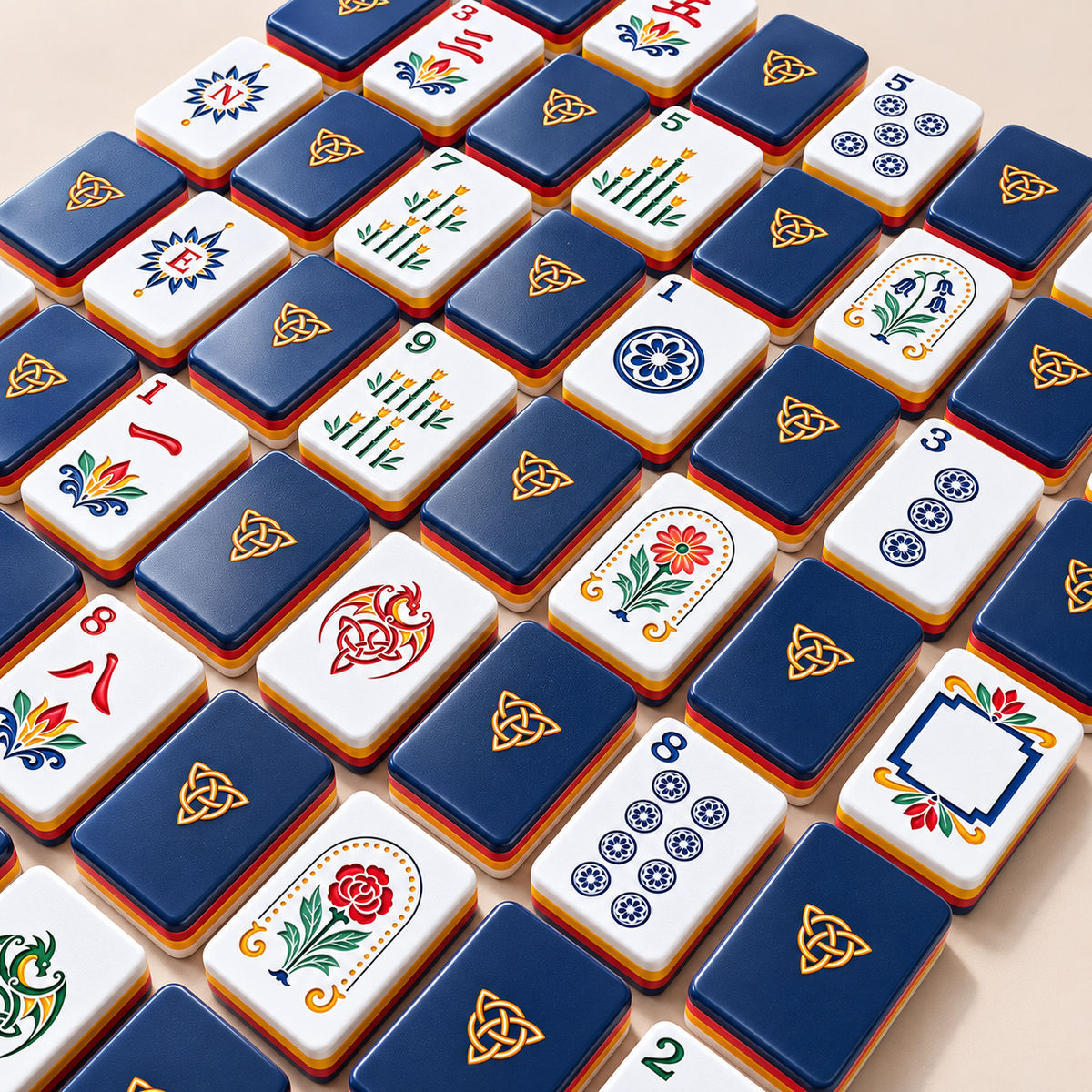
Chinese mahjong scoring awards points to the winner from all three opponents based on the hand's base value and scoring multipliers. A completed hand—four melds plus one pair—earns points starting at 1 base unit, multiplied by factors such as the number of simples (1–7) versus terminals and honors, winning conditions (draw, self-drawn, declared win), and limit hands with maximum payouts. Payments flow from the discarder (who discards the winning tile) at a higher rate; self-drawn victories split payment evenly among opponents. Unlike American mahjong's fixed hand list, Chinese scoring builds from pattern recognition—each pung of dragons, each absence of simples, each terminal sequence—layering multipliers to build the final payout. The game uses a tile set and score sheet; weekly clubs typically teach simplified rules, though regional Hong Kong, Taiwanese, and Riichi variants add their own twists.
How is the base point value calculated?
Base points start at 1 and scale upward based on the hand pattern. Each pung of dragons, each pung of seat wind or prevalent wind, and other scoring features adds 1 base point. The simplest complete hand (mixed simples only, no bonus melds) earns 1 base; hands with multiple pungs of winds and dragons climb to 2, 3, or higher. Once base points are set, they're multiplied by 2 for each multiplier that applies—see the multipliers section below. Most hands in casual play score between 1 and 3 base points before multipliers.

What are the four main scoring multipliers?
Multipliers double the base points each time they apply: 1. All Pungs (no sequences; four melds are all pungs or kongs), 2. All Honors and Terminals (no simple tiles 2–6 in any meld), 3. Prevalent Wind or Seat Wind bonus (a pung of the round or your seat wind), 4. Dragons (a pung of the round's dragon tile). Other multipliers include self-drawn winning and all-simple hands. Each multiplier you hit doubles the base again: 1 base × 2 × 2 × 2 = 8 points if you've earned three multipliers. Regional variants add "one-suit" and "honor-only" multipliers that cap scoring at a limit hand.
What's a limit hand and how much does it pay?
A limit hand is the maximum payout in a round, often equivalent to 5–8 doublings of base points. Examples include "All Honors" (only winds and dragons), "Concealed Hand" (all four melds hidden; no discarded tile used for the winning meld), "All Green" (only green tiles: 2 Bam, 3 Bam, 4 Bam, 6 Bam, 8 Bam, and Green Dragon), or "All Terminals" (only 1s and 9s plus honors). Reaching a limit hand ends multiplier stacking—you pay or receive the fixed limit amount instead of adding more doublings. Limit hands occur rarely in casual play but reward skilled pattern-building.
How does the payment flow work—who pays whom?
When a player wins by declaring "Mahjong," the discarder (who played the winning tile) pays the winner alone, at the full calculated rate. When a player wins by drawing from the wall (self-drawn), all three opponents pay the winner equally, each at half the declared-win rate (since payment splits three ways). If no one wins and the wall empties, the hand is a draw and no one pays. Most regional rules allow "robbing the kong" (taking a tile just added to a kong) or "dead wall" conditions that trigger payment even on a draw. Keep a running score card so no one loses track of who owes what across the session.

Which hand patterns are illegal or void?
A hand is void if it contains an error that violates the win condition: 1. Wrong number of tiles (must hold exactly 14 when declaring, or have drawn exactly one from the wall), 2. Incomplete sets (a pung missing a tile, a sequence with a gap), 3. No pair (must have exactly one pair of identical tiles), 4. Pair used in a meld (the pair cannot also be part of a pung, kong, or sequence), 5. Dead hand (the player already used a tile that matches the only remaining way to win). In casual games, you announce "Mahjong" only when all four melds and the pair are valid; if invalid, the hand is dead and play passes to the next player. Always double-check before declaring—a false win ends your turn immediately.
Comparison: Chinese vs. American mahjong scoring
Aspect | Chinese | American |
Hand source | Any valid pattern on table | Only hands on official NMJL card |
Winner gets points from | All three opponents (discarder pays more) | Bonus points tracked from initial bet |
Multipliers | Pattern-based (pungs, honors, winds, dragons) | Fixed by card pattern (e.g., "Like Numbers") |
Limit cap | Usually 5–8 doublings | Single hand value, no doubling |
Sequences allowed | Yes, in melds (chows) | No sequences; only pungs/kongs |
Jokers | Vary by region; often few or none | 8 jokers mandatory; wild in melds |
Game progression | 4 winds × 4 rounds = 16 hands typical | Varies by rule set (often 8 or 12 hands) |
The key difference: American mahjong is a fixed-hand lookup game where you match the current year's card; Chinese mahjong is a pattern-recognition and calculation game where any valid combo scores if you complete it first.
What common scoring mistakes should we avoid?
Mistake 1: Forgetting the seat wind bonus. Each player has a seat (East, South, West, North) and a prevalent wind for the round. A pung of either wind adds one multiplier—easy to miss if you're new. Check before you announce.
Mistake 2: Counting a pair as a meld. The pair is not a meld; it's separate. If you have four melds and a pair, that's 14 tiles and a win. If your "pair" is actually part of a pung (three 5 Dots), you have only three melds, not four—no win.
Mistake 3: Double-paying or underpaying on self-drawn. When you draw from the wall, all three opponents each pay you half the discard-win rate, not the full rate. Divide first, then collect. This is the biggest math error at the table.
Mistake 4: Ignoring the discarder penalty. The player who discarded the winning tile always pays more than the others (or pays alone in some variants). If you set the base points and multipliers but forget to assess the discarder separately, you'll short-change the winner.
Mistake 5: Calling a win with an incomplete hand. You must verify all four melds and the pair before saying "Mahjong." A false win means your hand is dead and you cannot win again that round. Take three seconds—it's worth it.
What to check before you buy a Chinese mahjong set
If you're hosting weekly games and scoring by hand, a quality tile set and a printed score sheet are essential. Choose sets with clear numbering and suit marks (Bams, Craks, Dots, plus winds, dragons, flowers) so you can read tiles from across the table. Many players use a dedicated mahjong mat to define the wall and melds clearly, reducing confusion over which tiles are claimed and which are still available. A scoring pad or laminated reference card listing all multipliers and limit hands keeps novices on track and speeds up gameplay. If you play frequently, invest in a set where tiles are durable—bone or acrylic tiles hold their engravings longer than cheaper alternatives, and you'll replace them less often.
🀄 Shop best-selling mahjong sets →
Can you walk through a worked scoring example?
Setup: East round, Player A (East, your seat). You draw from the wall.
Your hand: Pung of 1 Craks (terminal), Pung of Red Dragons, Sequence 2–3–4 Bams (simples), Pung of East Wind (your seat wind), Pair of 5 Dots.
Step 1 – Base points:
Pung of Red Dragons: +1
Pung of East Wind (seat wind): +1
Total base: 2
Step 2 – Multipliers:
All Pungs (no sequences): ×2
You drew from wall (self-drawn): ×2
Total multiplier: 4× (two doublings applied)
Step 3 – Calculation:
2 base × 4 = 8 points from each opponent
Step 4 – Payment:
Each of the three opponents pays you 8 points.
Total you receive: 24 points.
Why this isn't a limit hand: You have two pungs of honors/terminals, but your Sequence 2–3–4 Bams includes simples, so you don't qualify for "All Terminals" or "All Honors." The hand stops at 8 points per opponent.
If you had instead held four pungs and a pair with no sequences, you'd have an additional multiplier (All Pungs again, or a second dragon pung), pushing the score higher or toward a limit.
🎁 See our most-loved mahjong sets & accessories →
What's the difference between Hong Kong and simplified Chinese scoring?
Hong Kong mahjong (traditional) uses a more complex multiplier system with named hand types—for example, "Pung of Terminals," "Blessing of Man," "Blessing of Heaven"—each with its own multiplier value. Payouts are often higher and limit hands trigger sooner. Simplified Chinese scoring (taught in most weekly clubs) uses the four core multipliers: All Pungs, All Honors/Terminals, Wind bonus, and Dragon bonus, plus a few others. Most beginners learn the simplified version because it's faster and the math is more transparent. If you're playing with experienced Hong Kong players, ask for their local variant in advance—Hong Kong rules can double payouts and shift strategy significantly.
✨ Find your Mahstead set — free US shipping →

FAQ
Is Chinese mahjong scoring the same as Japanese (Riichi) mahjong?
No. Riichi uses a different hand structure (five melds total), a point system based on "fu" (tile combos worth 10 points each) and "han" (hand value layers), and a payment formula tied to dealer/non-dealer roles. The two systems are incompatible—learn which one your group plays before the game starts.
What happens if two players complete a hand on the same tile?
In most Chinese mahjong rules, the player whose turn it is (closest to the discarder in turn order) wins and receives payment. If a player declares "Mahjong" after drawing from the wall, that draw order takes priority over a discard. Clarify your house rules before the first hand.
Can you win on a tile you just discarded yourself?
No. You cannot win on your own discard. If you discard a tile and immediately realize it completes your own hand, you cannot claim it—the turn passes to the next player. This rule prevents accidental "false wins" and keeps play flowing.
How many rounds does a typical Chinese mahjong session last?
A full match is 16 hands (four winds × four rounds), but casual weekly games often play 8, 12, or even one-off hands for fun. Decide before you sit down how many hands you'll play and track the running score across the entire session.
What if the wall runs out of tiles and no one has won?
The hand is a draw (called "the wall is empty" or "no one wins"). No points are awarded; the tiles are shuffled and the next hand begins. Some regional rules allow a "dead wall draw" where the discarder or a specific player pays a small penalty even if no one won.
Do you need jokers in Chinese mahjong like you do in American?
No. Traditional Chinese mahjong uses 144 tiles (no jokers). Some casual regional games add one or two jokers, but they're optional. American mahjong requires 8 jokers as wild tiles—it's a core difference between the two games.


View More
View More
View More
