
American Mahjong Tracking Flowers: Rules and Record-Keeping
Last updated: Nov 23, 2026
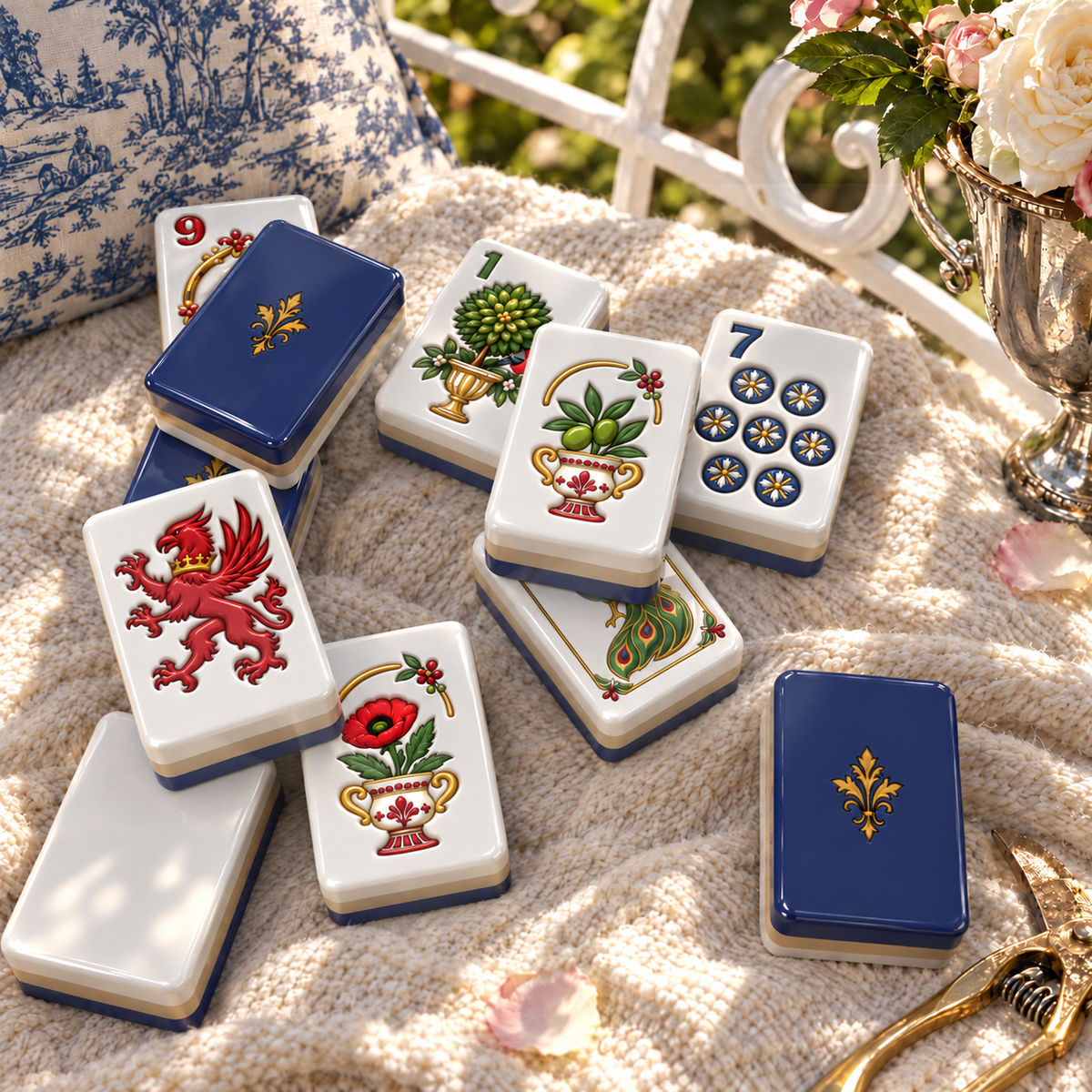
In American mahjong, flowers are eight bonus tiles (four sets of Spring, Summer, Autumn, Winter) that are drawn but not played—they go directly to your point pile and are never part of your hand. Each flower scores 1 point. When you draw a flower during the game, you immediately set it aside face-up and draw a replacement tile from the back of the wall. The National Mah Jongg League card (issued every spring) shows flower requirements in certain patterns: look for notation like "F1" or "F2" (representing which flowers count in a specific hand). Track flowers on a scoresheet or use a best-selling mahjong set with clear, readable tile markings so you and your tablemates instantly see what's been set aside. At game end, each player's flower count is added to their hand score before winner determination. Confusion usually happens when players forget to announce a flower or mix up which tiles count as flowers—always call them aloud when drawn.
Where do flowers sit on the NMJL card?
The National Mah Jongg League card organizes hands by category (Consecutive Like Numbers, Consecutive Different Suits, etc.). Flower patterns appear in their own dedicated section of the card, often near the end. Each pattern is labeled with a code (e.g., "1 Flower," "2 Flowers," or "Flowers Like" patterns) and shows exactly which flowers you must collect—for example, "All Four Flowers" or "Spring and Summer only." Check your current year's card in the Flowers section: the left margin lists how many jokers are allowed and what tile combinations work. If a hand does not mention flowers in its description, then no flowers count toward that hand's score, even if you drew them during play.

How do you announce and claim a flower?
When you draw a flower from the wall, you announce it immediately: "Flower—Spring" or "Flower—Summer" so all players hear and note it. Flip the flower face-up on your rack or in front of you (never hide it; all players must see it). Draw a replacement tile from the wall tile immediately to keep your hand at fourteen tiles (or thirteen if you just won). Write the flower down on your scoresheet or scratch pad right away. Do not add a flower to your hand tiles; it has already been claimed and scored. If you forget to announce a flower and another player notices before the next player draws, stop, announce it, and continue. If no one notices until after the hand is complete, the flower is usually forfeited—house rule may vary, so clarify before the game starts.
What's the fastest way to track flowers during the hand?
Create a simple tracking line on your scoresheet for each player:
Player | Hand Score | Flowers Drawn | Flower Points | Total |
Alice | 30 | 2 (Summer, Autumn) | 2 | 32 |
Bob | 25 | 0 | 0 | 25 |
Carol | 40 | 1 (Spring) | 1 | 41 |
Dana | — | 3 (Spring, Summer, Winter) | 3 | — |
As each flower is drawn, the drawing player calls it aloud and the scorekeeper (usually the player keeping the official score) makes a small mark or writes the flower name on that player's row. After the hand ends, count each player's flowers, add 1 point per flower to their hand score, and enter the total. This method takes fifteen seconds and eliminates disputes. If you're playing informally at home, use a pen and paper—no special equipment needed—but write legibly so no one has to ask "Wait, did you say three or two flowers?"
How do flowers differ from jokers and regular tiles?
Flowers, jokers, and regular number/honor tiles each serve a completely different role. A regular tile (e.g., 5 Dot, North Wind) is played into your hand and must match a pattern on the card to win; jokers are wild tiles that can substitute for any tile in an exposed pung, kong, quint, or sextet but can never be used as a single tile or pair. Flowers are pure bonus points: they cannot be used to form any hand pattern and are never exposed on the table. Jokers sit in your hand until you expose a group containing them; flowers are removed from play entirely. A single flower is always worth 1 point, no matter which flower it is—there is no special bonus for collecting all four. How jokers work in American mahjong is different, so review that rule separately if you're building your first hand.

What happens if you draw a flower when you've already exposed all your tiles?
If you have already exposed your entire hand (meaning you've called Mahjong with a winning pattern), you do not draw from the wall—the hand is over, and flower tracking is complete. However, if you have exposed some groups (pungs, kongs, quints, sextets) but your hand is not yet complete, you continue drawing normally. Any flower drawn goes directly to your point pile and does not affect your hand. The only time a flower could cause confusion is if you draw it at the exact moment you would have drawn a winning tile: call the flower, announce it, draw a replacement from the wall, and continue trying to win. Flowers do not interrupt play; they are smoothly removed and replaced.
How are flower points scored in the final settlement?
American mahjong scoring adds flowers as a flat 1-point bonus per flower. If Alice's winning hand is worth 30 points and she drew 2 flowers during the hand, her total score is 32 points. In a four-player settlement, the winner is paid by all three losers: if the payment is 32 points per loser, Alice receives 96 points total (32 × 3). Flower points never multiply, double, or scale—they are simply 1 + 1 + 1 for each flower drawn. Some house rules reward first-place finishers with bonus flower points or allow players to keep running totals across multiple hands; check your group's house rules before the session starts. The standard National Mah Jongg League rule is that flowers are scored in the hand where they are drawn, and the points are settled immediately when the winner is determined.
🎁 See our most-loved mahjong sets & accessories →
What to check before you buy a set to practice flower tracking
When you choose an American mahjong set for learning or regular play, confirm that the tiles are clearly marked and easy to read at arm's length—flowers should be instantly recognizable so no one has to squint or ask "Is that a flower?" Look for sets with large, legible characters and contrasting colors (engraved sets often print flowers in a distinct color or pattern). If you're keeping a scoresheet, use paper or a scorepad with enough space for each player's name, hand score, flower count, and total. A mahjong mat with a built-in score area can help you organize flowers and scores in one glance. If you play online or track scores digitally, add a "Flowers" column to your spreadsheet so the running total updates automatically. Test your tracking method with one full hand before playing for real stakes—catch any confusion early.
✨ Find your Mahstead set — free US shipping →

FAQ
Can a flower be used as a joker or wild tile?
No. Flowers are bonus points only and are immediately removed from play when drawn. They cannot substitute for any tile in a pattern and do not sit in your hand.
What happens if I forget to announce a flower until after the hand is over?
House rules vary. Most groups allow the flower to count if all players agree it was drawn; some groups forfeit it. Clarify your group's rule before play starts to avoid disputes.
Do all four flowers have the same point value?
Yes. Spring, Summer, Autumn, and Winter each score 1 point. There is no bonus for collecting a full set of four—count each one separately.
How do I know if flowers are required in a specific hand?
Check the current year's National Mah Jongg League card in the Flowers section. Hands that require flowers will show "F1," "F2," or a written description like "All Four Flowers" or "Spring and Autumn."
If I draw a flower on my turn, do I still get to draw my regular tile?
Yes. When you draw a flower, you immediately set it aside, announce it, and draw a replacement tile from the wall to keep your hand at fourteen tiles. The flower does not count as your one draw for that turn.
Can flower points be paid differently than regular hand points?
No. Flower points are added to your hand score and paid at the same rate as the rest of your hand. If your hand is worth 30 points and you have 2 flowers (2 points), your total is 32 points, paid once per loser.
Are flowers used in Hong Kong or Chinese mahjong the same way?
No. Chinese and Hong Kong mahjong use flowers (or "Flowers/Seasons") as playable tiles that form melds, not as automatic bonus points. American mahjong flowers are unique—they are removed from play and never form patterns. How to play American mahjong is completely different from these variants.


View More
View More
View More
