
American Mah Jongg Scoring: How Points Work & When You Win
Last updated: Nov 23, 2026
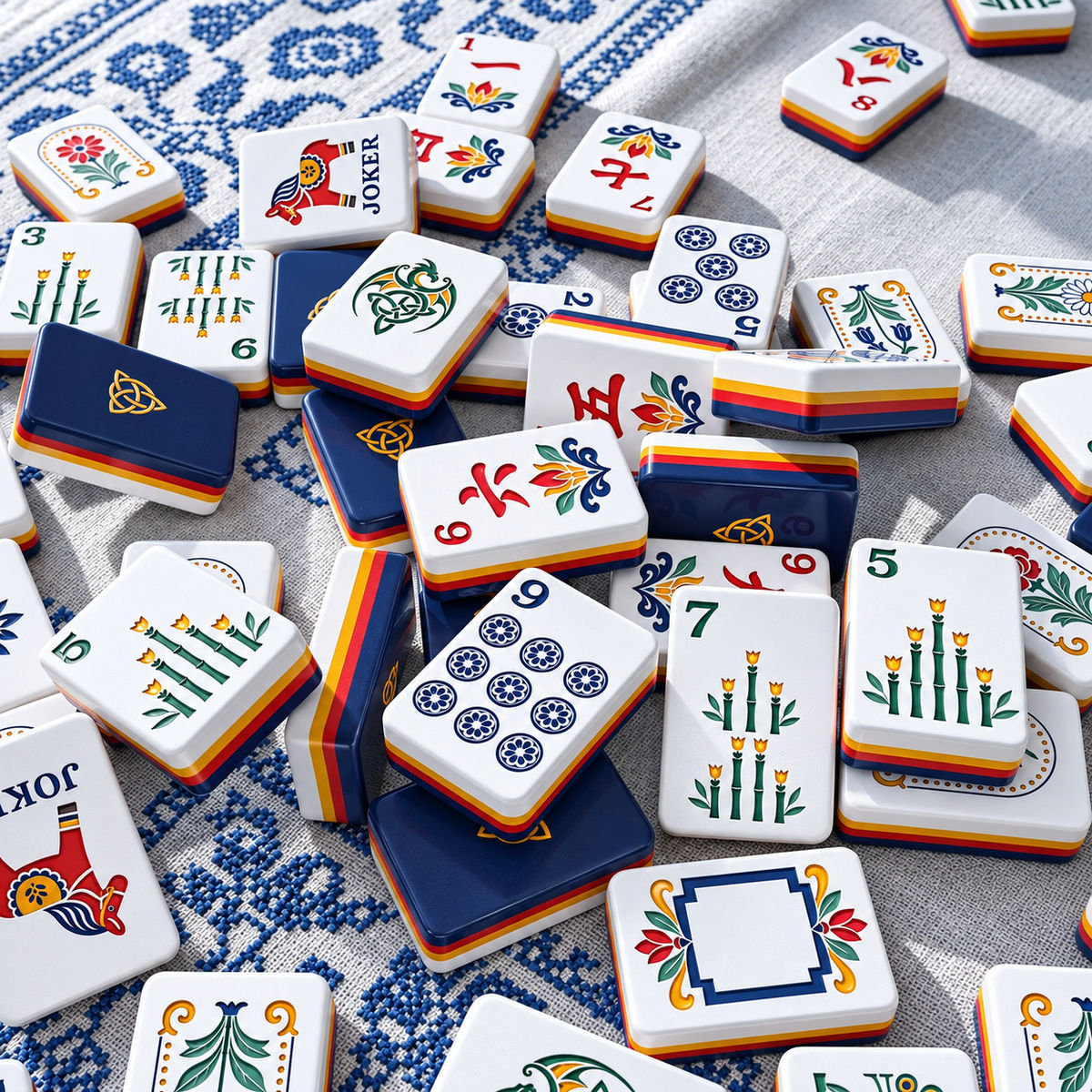
American mahjong scoring is tied directly to the current year's National Mah Jongg League card. Every legal hand on the card has a fixed point value (ranging from 2 to 8 points per hand type). When you win (declare mahjong), you collect payment from all three opponents: each pays you based on your hand's points and whether they dealt. If you won off the discard, only the player who discarded pays double. If you drew from the wall, all three pay single. Non-winning players never score. Payment is settled per-hand; there's no cumulative score across a round—only the winner collects in that hand. Most groups play with chips or pennies per point, establishing stakes before the game begins. The card, updated yearly, is your only reference for valid hands and their values.
What does the point value on the mahjong card actually mean?
The National Mah Jongg League card lists hundreds of winning hand patterns, each labeled with a number: 2, 3, 4, 5, 6, 7, or 8. That number is the hand's point value—essentially a multiplier for payment. A 2-point hand is the simplest; an 8-point hand is the most complex or restrictive (harder to form). The card changes every spring, so hand values can shift year to year. Players study the card to memorize high-point hands worth pursuing. Your hand's point value is fixed the moment you declare mahjong; the card section (like "Like Numbers," "Consecutive Pairs," or "Flowers & Seasons") just tells you where on the card to find that pattern. Once you verify your hand matches a listed pattern and its point value, payment is calculated instantly. The card is the single source of truth—no house rules override it in serious play.

How much does each opponent pay you when you win?
Payment depends on two factors: your hand's point value and how you won (off a discard or from the wall). If you called a discard (won off another player's discarded tile), only that player pays you double the hand's points. The other two players pay nothing. If you drew from the wall (won by picking a tile yourself), all three opponents each pay you single the hand's points. Example: you win with a 4-point hand off a discard. The player who discarded pays you 8 chips (4 × 2); the other two pay nothing. Same 4-point hand, but you drew it yourself: each opponent pays 4 chips, so you collect 12 total (3 × 4). Ties and disputes are rare if everyone has studied the card beforehand. Most groups agree on stakes before dealing—often pennies, chips, or points that tally across multiple hands for a final settlement at the end of the session.
What's the difference between winning off the wall and winning off a discard?
Winning off the wall (self-drawn) rewards all three opponents paying equally, because you found your own tile without help. Winning off a discard (called mahjong) charges the discarder double, since they gave you the winning tile. This asymmetry encourages defensive play—discarding safely becomes critical in the endgame. Many players track which opponents hold power hands and become more cautious. A self-drawn 5-point hand nets 15 chips (5 × 3); called off a discard, only the discarder pays 10 (5 × 2). This structure makes drawn wins slightly riskier but more rewarding if the hand is high-value. Most losses come from discarding carelessly late in the hand when others are close to mahjong. Learning to read the board and anticipate what tiles others need is as crucial as understanding scoring.
Do non-winning players ever score or keep running totals?
No. In American mahjong, only the winner of a hand scores. The three players who did not win that hand collect nothing and pay. There is no cumulative score that carries across hands within a session. Each hand is settled independently—winner takes payment, losers pay, and the game resets. At the end of a multi-hand session (often 4 rounds of 4 hands each, so 16 hands total), players may tally up all payments to see who ended ahead or behind overall. Some groups play "zero-sum"—total chips paid equals total chips collected, so stakes are balanced. Others may set a buy-in and play for a fixed number of hands, then cash out. Keeping a running tally per hand is optional and social, not part of the official rules. The National Mah Jongg League card is your reference; it lists hands and points only—no tournament scoring mechanics.
What if two players think they've both won—who gets the points?
If two or more players declare mahjong simultaneously, the player who won off a discard takes priority. That player collects from all three others (double from the discarder, single from the other two non-winners). If both won off the wall (self-drawn), the player closest to the dealer in turn order (East, then South, then West, then North) takes the win. The other player(s) who thought they won actually had a false win—their hand was not on the current year's card or they miscounted tiles. This is rare but worth clarifying before play. Most groups avoid this by agreeing that only the first clear declaration stands. If you announce mahjong and immediately realize your hand is wrong, you cannot take it back—you've bust (failed to win) and pay a penalty to all three opponents (usually 1 chip each, per house rules). Studying the card carefully before declaring saves embarrassment and money. Always double-check your hand against the card section before calling out loud.

How do payment tiers work for 2-point vs. 8-point hands?
A 2-point hand is the easiest to form—perhaps a simple pung of flowers plus tile runs. An 8-point hand is far more restrictive: maybe quints, specific number sequences, or rare combinations. The card ranks hands by difficulty; higher points reflect rarer patterns. Example tiers (based on typical card structure): 2-point hands are common, quick wins; 3–4-point hands are standard and balanced; 5–6-point hands require planning and sacrifice; 7–8-point hands are rare, high-risk, high-reward. If you win a 2-point hand off a discard, the discarder pays 4 chips; you collect 4 total. A 8-point off the wall nets you 24 chips (8 × 3). Many players hunt 5+ point hands because payoff scales quickly, but they're harder to complete. Beginners often win 2–3 point hands early, then target higher values as familiarity grows. The current year's card is essential; you cannot score correctly without it.
🀄 Shop best-selling mahjong sets →
How do you calculate final settlement after a full session?
A typical session is one round (4 hands) or two rounds (8 hands), sometimes more. After each hand, winner collects, losers pay immediately or tally mentally. At the session's end, add up each player's total wins and losses. Example: Alice won three hands (5 points, 4 points, 3 points), collecting 24 chips total. Bob won two hands (2 and 3 points), collecting 10. Carol and Dave never won, but Carol lost less overall. The three non-winners settle: whoever is highest up pays that amount to whoever is lowest, until all balances are zero. Most casual groups keep it simple—tally each player's net win or loss, then highest-scoring player takes the pot or chips are cashed out per-point rate (penny per point, nickel per point, etc.). Formal tournament play uses different systems, but home games rarely do. The key is transparency: settle each hand visibly, announce totals clearly, and agree on payment before dealing the first hand. Learn how to read the card so disputes rarely occur.
🎁 See our most-loved mahjong sets & accessories →
Comparison: 2-point vs. 5-point vs. 8-point hand payoff scenarios
Hand Type | Points | Won off Discard | Discarder Pays | Won from Wall | Each of 3 Pays | Why Choose It |
Simple | 2 | Risky; low reward | 4 chips | Quick | 2 chips each | Fast, reliable win early |
Medium | 5 | Balanced risk | 10 chips | Solid | 5 chips each | Sweet spot for learning |
Complex | 8 | High risk; big reward | 16 chips | Rare | 8 chips each | Chase for session boost |
A 2-point hand from the wall yields 6 chips total; an 8-point from the wall yields 24. The trade-off is complexity and time—higher-point hands take longer to form, and you may lose before completing them.
✨ Find your Mahstead set — free US shipping →
What to check before you buy mahjong tiles for scoring practice
Set includes 8 jokers? American mahjong uses 8 jokers (extras are spares); confirm your complete mahjong set has them.
Current-year card in box? Many sets don't; order the card separately if needed or verify before purchase.
Tile clarity? Worn or unclear tiles lead to misreads and scoring disputes; look for crisp, legible engravings.
Rack height & angle? A good rack with pusher prevents accidental reveals and speeds sorting during the Charleston.
Bag for transport? If hosting rotating games, a padded travel case protects tiles and keeps scoring chips organized.

FAQ
Can you score a hand that's not on the National Mah Jongg League card?
No. Only hands listed on the current year's card are valid and scoreable. Any hand off the card is a bust—you pay 1 chip to each opponent (per house rules). Studying the card before play prevents costly mistakes and disputes over what counts.
If I win but discarded the same tile I drew, can I win both ways?
No. You win one way only: off a discard or from the wall. If you complete your hand by drawing a tile, that's a wall win, and all three opponents pay single. You cannot also call someone else's discard in the same hand.
What happens if nobody wins a hand—does someone pay a penalty?
No penalty in standard American mahjong. If all 152 tiles are drawn and no one has declared mahjong, the hand is a dead draw. No one scores; the game continues with the next hand, and the deal passes to the next player (typically East → South → West → North).
Do jokers count toward your hand's point value?
Jokers are wildcards that substitute for any single tile in a pung, kong, quint, or sextet—they don't add points by themselves. Your hand's point value comes only from its pattern (listed on the card), not from how many jokers you used.
Can a 3-player or 2-player game use the same scoring system?
No. The standard American mahjong scoring system assumes four players. In reduced-player games, payment rules differ—fewer opponents mean different multipliers and payout structures. Consult house rules or a 2/3-player variant card before starting.
Is there a maximum score or a winning threshold, like 100 points?
No. American mahjong has no cumulative winning score or point cap. Sessions end after a set number of hands (often 4 or 8), and whoever has the highest net win at the end wins the session. Each hand is independent; only that hand's winner scores.
What if I think my opponent's winning hand is fake or not on the card?
Ask to see the card and verify the hand together before payment. If the hand is not found on the current card, it's a bust—your opponent pays 1 chip to each player. Disputes are rare if everyone has studied the card beforehand and plays honestly.


View More
View More
View More
