
4 Dot Mahjong Tile Symbol Explained
Last updated: Nov 23, 2026
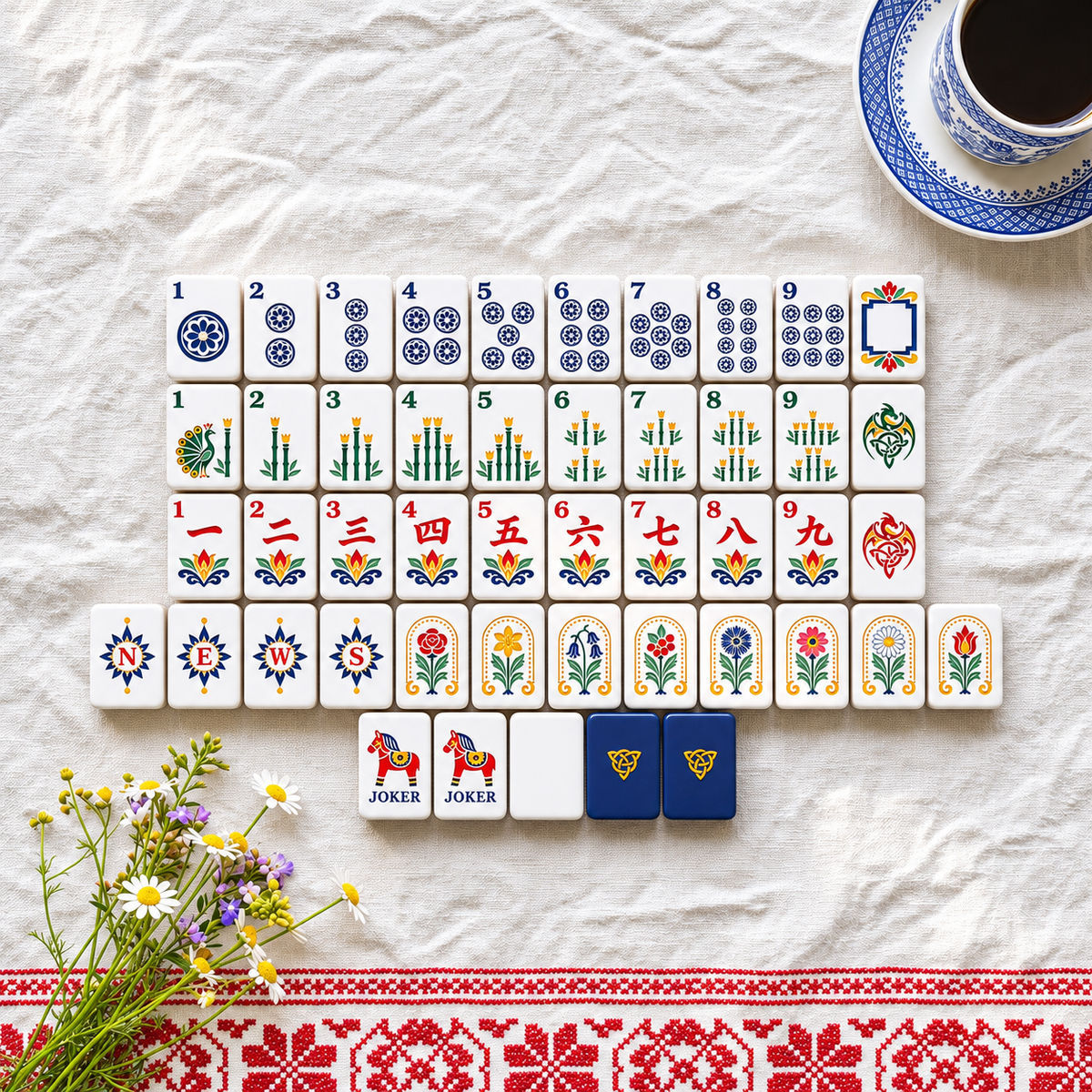
The 4 Dot (also called "4 Dotsies") is a single tile from the Dot suit—one of three core suits in American mahjong. It bears the numeral 4 and four circular symbols (dots) arranged on its face. In a standard 152-tile set, you'll find exactly four copies of the 4 Dot tile. Its numeric value (4) ranks it firmly in the middle of the 1–9 Dot sequence, making it neither a terminal nor a honor. The 4 Dot typically appears in hand patterns that call for mid-range numeral tiles, especially sequences of consecutive Dots or matching pungs (groups of three identical tiles). Because American mahjong has no chows (sequences you call during play), the 4 Dot's power comes from being part of a pung, kong (four copies), or mixed sets like quints and sextets that you expose or hold concealed until your winning call. Clarity matters: choose a set with legible numerals and dot patterns so you never miscount at the table.
The 4 Dot tile is one of the 36 Dot suit tiles in American mahjong. It bears the numeral 4 and four circular symbols arranged on its face. In a standard 152-tile set, you'll find exactly four copies of the 4 Dot tile. Its numeric value (4) ranks it firmly in the middle of the 1–9 Dot sequence, making it neither a terminal nor a honor. The 4 Dot typically appears in hand patterns that call for mid-range numeral tiles, especially groups of three or more identical copies. Because American mahjong has no chows (sequences you call during play), the 4 Dot's power comes from being part of a pung, kong, or mixed sets like quints and sextets that you expose or hold concealed until your winning call. Clarity matters: choose a set with legible numerals and dot patterns so you never miscount at the table.
🀄 Shop best-selling mahjong sets →
Why does 4 Dot appear in so many hand patterns?
The 4 Dot sits in the numerical sweet spot (neither low like 1–3 nor high like 7–9), so it bridges gaps between terminal and honor tiles. American mahjong hands on the annual National Mah Jongg League card include 4 Dot in patterns that reward flexibility: you might need a 4 Dot as part of a 2–4–6 Dot sequence (in a pung), or as one tile in a large quint or sextet of identical Dots. Its mid-rank position means you're less likely to dead-tile it early. The 4 Dot appears in enough hand patterns each year to keep it in circulation throughout most games, so holding or drawing a 4 Dot rarely feels like a wasted turn.

How do you tell 4 Dot apart from 5 Dot at a glance?
At the table, speed matters. A 4 Dot tile shows exactly four dots; a 5 Dot shows five. The dot arrangement on a mahjong tile typically forms a pattern—often a corner dot plus a center dot for odd numbers. Count the dots, not the edges. If a tile has a numeral printed directly on the face (as most modern American mahjong tiles do), read the number first. Most quality acrylic sets use contrasting ink and clean dot patterns so players can distinguish numerals instantly, even from a distance. When tiles are worn or printed with unclear ink, confusion happens: always verify your hand before declaring it.
What's the difference between a 4 Dot pung and a 4 Dot that's part of a mixed set?
A pung is three identical tiles (e.g., three 4 Dots); a kong is four identical tiles (four 4 Dots). Both must be exposed on the table when you claim them during play, and you can then draw a replacement tile from the dead wall. A mixed set (like a quint or sextet) combines tiles of different ranks but the same suit or mixed suits, and may be held concealed or exposed depending on the hand pattern you're playing. A pung of 4 Dots is always just three 4 Dots—nothing else. A quint might be "2, 3, 4, 5, 6 Dots" or "1, 1, 4, 4, 7 Dots" (with jokers substituting). The 4 Dot's role changes based on the hand you've declared: if your hand calls for a pure pung, the 4 Dot must be part of three or four identical tiles; if it calls for a sequence or mixed group, the 4 Dot fills one slot in that larger pattern.
🎁 See our most-loved mahjong sets & accessories →
How does the 4 Dot rank compared to other numerals in strategy?
Tile | Rank | Strategy Role | Risk |
1 Dot (terminal) | Low | Hard to match; often discarded early | Quick dead-tile |
4 Dot (mid-range) | Medium | Flexible; fits many patterns | Depends on declared hand |
7 Dot (mid-high) | Medium-high | Useful; balances sequences | Stays in play longer |
9 Dot (terminal) | High | Specific patterns only; risky | Dead-tiles if pattern shifts |
The 4 Dot is neither a high-value terminal (1 or 9 Dot) nor a middle-heavy tile like 5 Dot. Strategically, it's useful but not dominant. In early turns, hold it unless your declared hand explicitly forbids it. Watch what others discard: if no one is claiming Dots in the mid-range, a 4 Dot has lower danger. If players are calling Dots aggressively, the 4 Dot becomes more valuable and higher-risk to hold. Learn how to read the mahjong card so you know which patterns use 4 Dots in your current game year.

What tile characteristics make 4 Dot easy to identify in poor lighting?
When you're playing in dimmed light, outdoors, or at a crowded table, poor visibility turns a clear 4 Dot into a guessing game. Quality matters. Choose a set where the numeral and dots are printed in high-contrast ink—white or bright numerals on a dark tile background, or dark numerals on a light background. The dot pattern should be raised, embossed, or deeply printed so shadows emphasize each dot's outline. Acrylic tiles with engraved or hand-painted numerals hold clarity better than flat printed tiles. Avoid tiles with tiny fonts or pale ink; they fade and blur within a few seasons. Our best-selling mahjong sets use legible, durable marking standards so a 4 Dot remains unmistakable even after heavy rotation. If you host weekly games, a mat with a reading light or positioning your rack under a lamp helps prevent misreads entirely.
When should you hold vs. discard a 4 Dot early in the hand?
Hold a 4 Dot in opening turns if:
Your declared hand requires mid-range Dots (check the card or your notes before the game starts).
No one has claimed Dots in your hand's range yet (safer to hold longer).
You have two 4 Dots already (building toward a pung or using jokers to complete one).
Discard a 4 Dot early if:
Your declared hand has no Dots, or specifies only 1, 9, or Dragons in Dot patterns.
Another player just discarded a 4 Dot (indicates lower demand that turn).
You have only one 4 Dot and no matching tiles visible in the first three turns.
Never hold a 4 Dot "just in case"—American mahjong rewards committing to a declared hand. Confusion and slow play result from ambiguous holdings. Before the game, use the how to play American mahjong guide to review hand composition, so you know your 4 Dots' exact role from turn one.
✨ Find your Mahstead set — free US shipping →
What to check before you buy a mahjong set to ensure 4 Dots are clear
Before purchasing, verify:
Dot pattern visibility: Can you count four distinct dots on a sample tile without squinting?
Numeral printing: Is the "4" printed large and in high-contrast ink?
Tile material: Acrylic and resin tiles hold marking clarity longer than plastic; check the product description.
Finish: Does the tile have a matte or slightly textured surface (reduces glare and makes dots pop)?
Set reviews: Look for buyer feedback mentioning legibility in various light conditions.
Our engraved American mahjong sets and new mahjong arrivals all feature hand-engraved or precision-printed numerals so every tile—including 4 Dot—remains readable after hundreds of games. Compare the product photos side-by-side to see dot clarity; if the photo shows vague markings, the actual tile will disappoint.

FAQ
Is a 4 Dot the same in Chinese, Hong Kong, and Riichi mahjong as in American mahjong?
No. Chinese, Hong Kong, and Riichi mahjong use 1–9 numerals in multiple suits, but hand patterns, suit names, scoring, and tile counts differ from American mahjong. In American mahjong, a 4 Dot is always from the Dot suit (36 total Dots, four copies of 4 Dot). Other variants have different rules. Stick to one variant per game.
Can a joker replace a 4 Dot, and does it count the same in scoring?
In American mahjong, jokers can substitute for any exposed tile in a pung, kong, quint, or sextet, including a 4 Dot. However, jokers cannot be used in a single tile or in a pair—only in groups of three or more. Jokers do not earn bonus points; they are wild substitutes only. Check the hand pattern you've declared to confirm joker use.
What happens if I miscalculate and claim I have a 4 Dot when I don't?
If you declare a winning hand and cannot show the claimed tiles, you lose that hand and pay penalties to all three opponents. Always count and verify every tile before declaring "Mahjong!" On-table verification prevents disputes: lay your hand open so all players confirm the tiles match your declared pattern.
Does the 4 Dot tile have special meaning or superstition in mahjong culture?
In some Chinese traditions, the number 4 carries unlucky associations (the word for "four" sounds similar to the word for "death"). However, American mahjong is a strategic card-based game, not a cultural practice steeped in numerology. The 4 Dot is simply a mid-range numeral tile. Play it as strategy dictates, not superstition.
How do I know if my set has all four copies of the 4 Dot tile?
Count before your first game. Lay out all tiles by suit and rank, and verify four copies of each numeral (1–9) in each suit: Bam, Crak, Dot. If you're short one 4 Dot, contact the seller. A complete American mahjong set contains exactly 152 playing tiles (36 Dots, 36 Bams, 36 Craks, 16 winds, 12 dragons, 8 flowers, 8 jokers). If a tile is missing or chipped, replace it before play begins.


View More
View More
View More
